Key Takeaways
Why Cross-State Sales Create Title Headaches
Selling a car to someone in your own state is already paperwork-heavy. Add a state line to the equation and you now have two DMVs with different forms, different deadlines, and different ideas about what a properly signed title looks like. Neither agency talks to the other automatically — it falls on the two parties to bridge the gap.
The core tension is this: you, as the seller, are bound by your state's rules for releasing a title. The buyer is bound by their state's rules for registering it. Those two sets of rules do not always speak the same language, and it's surprisingly easy to hand over a title that looks complete to you but arrives at the buyer's DMV with a missing form, an unstamped odometer disclosure, or a lien release the buyer never received.
This article walks you through the process from the seller's side — what you need to prepare before the sale, how to sign and release the title correctly, what disclosure documents travel with the car, and how to protect yourself legally once money changes hands.
For a broader look at how state-specific rules affect the buyer's side of an out-of-state purchase, see State-Specific Rules That Affect Online Car Purchases. And if you want a detailed reference on fees and deadlines in all 50 states, State-by-State Title Transfer Requirements is a useful companion to this guide.
What You Need Before the Sale Closes
Getting your paperwork in order before you accept payment prevents the most common cross-state delays. Here's what to gather and verify early.
What you will need
Start with the title itself. Pull it out and examine it closely. Check that your name on the title matches your current legal name exactly — a discrepancy as small as a middle initial can cause a rejection at another state's DMV. If your state issued the title in a previous owner's name with a reassignment section, make sure those fields are fully completed and not just initialed.
If there is an active lien on the vehicle, your lender holds the title. You cannot legally transfer it until the lien is released. Contact your lender early — payoff processing and lien release paperwork can take 1–3 weeks, and some lenders mail the physical title to you while others send it directly to the DMV. Know which process applies to your loan. For a detailed walkthrough of how fees and lien situations interact with the transfer process, see Title Transfer Fees: What Sellers Pay, What Buyers Pay.
Vehicle Title (Original)
The primary legal document proving ownership; must be signed and transferred to complete the sale.
Lien Release Letter
Required if a lender was previously listed on the title; proves the loan has been paid and ownership is unencumbered.
Bill of Sale
Documents the agreed purchase price, vehicle details, and date of transfer for both parties' records and for the buyer's DMV.
Federal Odometer Disclosure Form
Required by federal law for most vehicles under 10 years old; may be printed on the title or require a separate NHTSA form.
As-Is Disclosure Statement
Protects the seller by confirming the buyer accepted the vehicle in its current condition without warranty.
Emissions or Safety Certificate
Required by some states before a private sale can legally be completed; must be issued by an authorized station in the seller's state.
Notary Service
Required by certain states (Maryland, Louisiana, Montana, and others) to authenticate title signatures or bill of sale.
Trackable Overnight Mailer
Used to securely transmit title documents when the buyer is remote and documents cannot be exchanged in person.
If the vehicle is co-owned, gather the other owner early. Some states require both signatures to release a title; others require only one, depending on whether the title reads "and" or "or" between the names. Don't assume — check your state's DMV website. The Joint Ownership and Car Sales guide covers this in full detail.
Step-by-Step: Releasing the Title Across State Lines
Follow these steps in order. Skipping ahead — particularly on disclosures and notarization — is the primary reason cross-state transfers get kicked back by the buyer's DMV.
Confirm Your Title Is Clear and in Your Possession
Before anything else, verify that you physically hold a clean, lien-free title. If a lender is listed as the lienholder, call them to initiate the payoff and lien release process. Ask specifically: Will the lien release be sent to me or directly to my DMV? If it goes to your DMV, you'll need to request a duplicate title after the lien is released — and that takes additional time. Do not agree to a sale date until you know exactly when the title will be in your hands.
Look Up Your State's Title Signing Requirements
Go to your state's DMV website and search for "title transfer seller instructions" or "how to sign a title." You need to confirm: whether a notary is required, whether a separate odometer disclosure form is needed, whether a bill of sale must accompany the title, and whether there are any seller-side fees due at transfer. Write these requirements down — don't rely on memory when you're in the middle of a transaction.
Research the Buyer's State Requirements
Go to the buyer's state DMV website and look up what a buyer needs to register an out-of-state vehicle. You're looking for: whether they'll accept your state's title as-is, what bill of sale format they prefer, and whether they require any additional seller documentation (such as a notarized title or a specific odometer disclosure form). Some states have a designated "out-of-state title" registration checklist — find it and share it with the buyer so they know what to expect.
Obtain Any Required Inspection or Emissions Certificate
If your state requires a smog check or safety inspection before a private sale, schedule it now — don't wait until the buyer is ready to pick up the car. Certificates typically have an expiration date, so time it so the certificate is still valid at the time of sale. If the certificate is required for registration in your state, the buyer cannot register elsewhere without it. Attach the original certificate to the title packet.
Complete the Title Accurately and Completely
Fill in every required field on the title — buyer's full legal name, buyer's address, sale price, sale date, and odometer reading. Sign exactly as your name appears on the title. If two owners are listed, both must sign unless your state's titling convention ("and" vs. "or") permits a single signature. Do not use correction fluid, do not scratch out errors — if you make a mistake on a title, most states will require you to apply for a duplicate. A correction on a title is grounds for rejection at any DMV.
Assemble and Deliver the Complete Document Packet
Hand the buyer a complete packet that includes: the signed title, federal odometer disclosure (if not on the title), a bill of sale, the as-is disclosure, any emissions or safety certificate, and the lien release document if applicable. If notarization is required by either state, get it done before this handover. Give the buyer two copies of the bill of sale — one for their records and one for the DMV. Photograph the entire packet before handing it over.
File Your Release of Liability with Your State DMV
Immediately after the transaction, go online to your state's DMV portal and file a notice of sale, release of liability, or transfer of ownership notification — whatever your state calls it. Enter the buyer's name, the sale date, and the odometer reading. Save or print the confirmation. This single step determines your legal separation from the vehicle and any incidents that occur after the sale date.
Once you've completed all steps, notify your state's DMV that you've sold the vehicle. Most states have an online release-of-liability form. Filing it protects you from parking tickets, toll violations, and liability claims that occur after the sale date. Do this the same day you hand over the title — not a week later.
Never Mail an Unsigned Title
If the buyer is remote and you're mailing the title, sign it before sending — but only after payment has cleared or you have verified funds in hand. Mailing an unsigned title to a buyer before payment is received creates serious fraud risk. Use an escrow service or require a wire transfer that has fully settled before you release any documents.
Out-of-State Buyers Face a Registration Deadline
Most states give buyers 10–30 days to register a newly purchased vehicle before penalties apply. If your paperwork is incomplete or takes too long to deliver, the buyer may incur late fees they'll hold you responsible for. Agree on a firm handover date for all documents at the time of sale.
For a full breakdown of what happens next on the buyer's side — including their registration timeline and what taxes they'll owe — refer to Out-of-State Car Purchases: Tax and Registration Traps. Understanding the buyer's obligations helps you anticipate their questions and avoid last-minute friction.
Disclosures That Must Travel With the Car
The title is only one piece of the paperwork stack. Several disclosure documents are federally or state-mandated and must accompany the vehicle — not be sent separately later.
Federal Odometer Disclosure
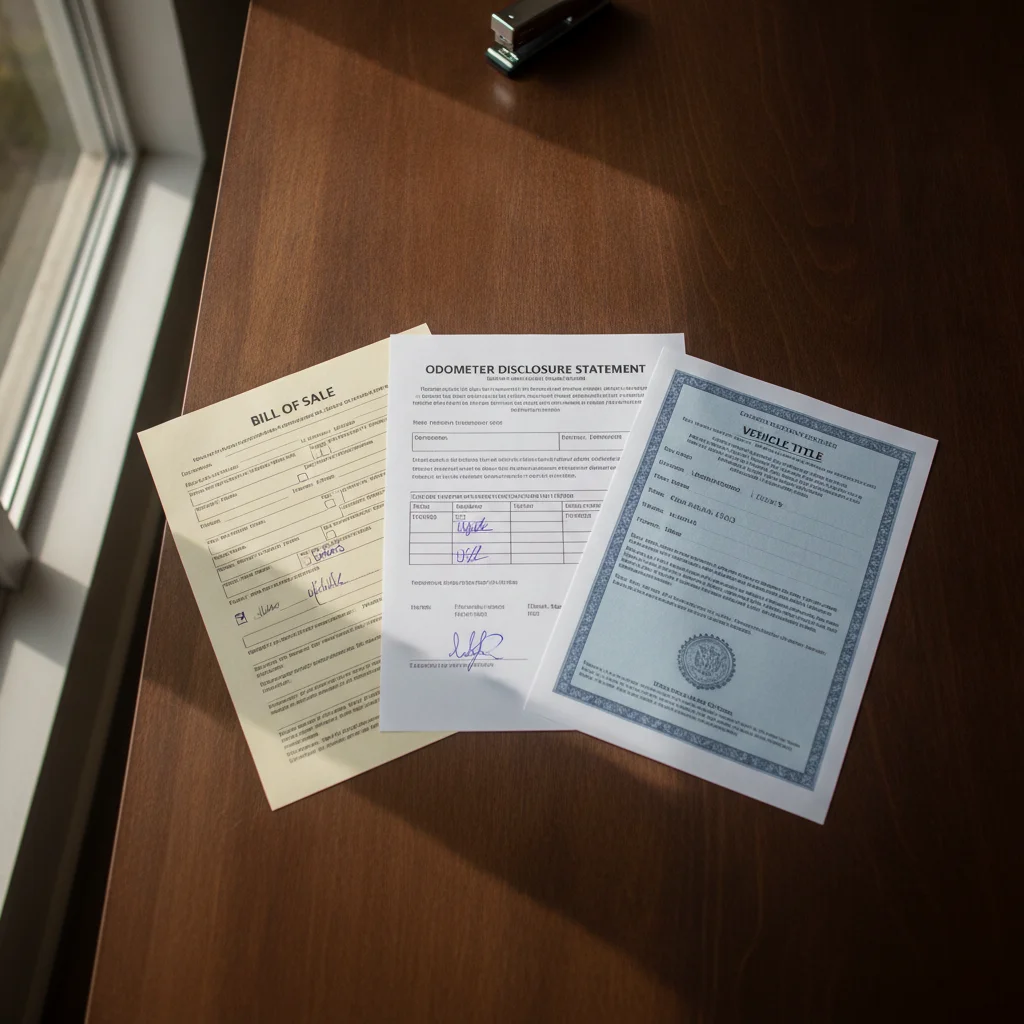
Under the Federal Truth in Mileage Act, any vehicle under 16,000 pounds that is less than 10 years old requires a written odometer disclosure at the time of sale. On many newer titles, this disclosure is printed directly on the title document itself. On older titles or when a separate form is used, it must be signed and dated by both seller and buyer at the time of transfer. Do not leave the odometer field blank and do not estimate — use the exact reading at the time of sale.
Bill of Sale
Not all states require a bill of sale for private sales, but most buyer states will ask for one at registration. Create one regardless. It should include: the full legal names and addresses of both parties, the vehicle's year, make, model, and VIN, the sale price, the odometer reading, and the date of transfer. Some states have official bill of sale forms — use the buyer's state form if one exists, since their DMV will be more comfortable with it. The Private Sale Paperwork: A State-by-State Overview article has a useful reference table for what each state expects.
Emissions and Safety Certificates
This is where cross-state sales get genuinely tricky. Some states — California and many Northeast states — require a smog certificate dated within a specific window (often 90 days) before the sale. The certificate is issued by an authorized station in the vehicle's current state, not the buyer's state. If your state requires one, get it before the buyer arrives to take the car. If your state does not require one but the buyer's state does, they will generally handle that requirement themselves after taking possession — but confirm this with the buyer's state DMV before assuming.
Use the Buyer's State DMV Form When Possible
If the buyer's state has an official bill of sale or odometer disclosure form, use it instead of a generic version. Their DMV staff will be familiar with it and less likely to flag it for review. Most state DMV forms are available as free PDF downloads. Ask the buyer to send you the form link before the meeting.
Send Documents by Tracked Mail, Not Email
Original titles must be physical documents — scanned copies are not accepted by any state DMV for a title transfer. If you're mailing the title, use USPS Priority Mail with signature confirmation or FedEx overnight. Track the shipment and keep the receipt. Never fold the title — some DMVs reject creased or damaged titles.
Keep Your Sale Records for Three Years Minimum
Disputes over odometer readings, undisclosed damage, or title defects can surface long after the sale. Store photograph copies of all signed documents — title front and back, bill of sale, odometer disclosure, and lien release — for at least three years. Cloud storage with a clear folder label is fine; just make sure you can access it quickly if needed.
As-Is Disclosure and Lemon Law Exemptions
Private sales are generally exempt from lemon law protections, but you should still provide a written as-is disclosure for your protection. Some states have a standard form; others accept a handwritten or typed statement signed by both parties. Include it in the paperwork packet even if it isn't legally mandated in your state — a buyer's state DMV may flag the absence of one if their state's rules call for it.
Common Complications and How to Handle Them
Even well-prepared sellers run into snags. Here are the most frequent issues and how to resolve them before they become deal-killers.
The Title Is in a State the Buyer's DMV Doesn't Recognize
This is rare but possible with older titles from states that have redesigned their title format. If your title looks unusual — for example, it's a paper bond title or was issued by a state with a non-standard format — call the buyer's state DMV and describe the document before the sale. They'll tell you whether they'll accept it directly or require you to get a replacement title from your own state's DMV first.
The Buyer Needs a Title Quickly for Financing
If the buyer is financing through a bank or credit union, that lender typically needs the title within a set window — sometimes as short as 10 days after funding. This is almost impossible if your state still has a lien recorded and you haven't started the payoff process. Get your lender's lien release timeline in writing before you agree to a sale date.
Notarization Requirements Don't Match
Some states — Maryland, Louisiana, Montana, and a handful of others — require a notarized title or a notarized bill of sale. If your state doesn't require notarization but the buyer's state does, you'll need to get the document notarized before you hand it over, since the buyer won't be able to notarize a document signed by you after the fact. A UPS Store or bank branch can typically notarize in under 30 minutes.
Never Leave Any Title Field Blank
A title with blank fields — even optional-looking ones like buyer's address or county — is one of the leading causes of DMV rejection in out-of-state transfers. The buyer's state DMV will see a blank field and flag the title for review, adding weeks to the process. Fill in every field completely, and verify with the buyer that their legal name is spelled exactly as it appears on their ID. One transposed letter can force a full restart of the transfer process.
A Release of Liability Protects You Legally
Until the buyer registers the vehicle in their state, your name may remain on DMV records as the last known owner. Without a filed release of liability, you can be contacted about parking violations, red-light camera tickets, and in rare cases insurance claims tied to that vehicle. File the release the same day as the sale — not after you confirm the buyer has registered it.
The Car Is Being Shipped, Not Driven
When a buyer is having the vehicle transported rather than driving it home, the paperwork exchange must happen separately from the physical handoff. Use a secure method — trackable overnight mail with signature confirmation — to send title documents. Never hand the title to a transport driver. Complete the paperwork exchange directly with the buyer before or after transport, not through an intermediary.
For a broader view of how title transfer mistakes create registration delays, see Transferring a Used Car Title: State Rules, Common Delays, and What to Bring. Understanding the buyer's experience at their DMV will help you anticipate what documents they'll be asked for and make sure your packet is complete.
Protecting Yourself After the Sale
Your liability as a seller doesn't end the moment payment clears. A few final steps protect you from issues that can surface weeks or months after the transaction.
File Your Release of Liability Immediately
As mentioned in the steps above, most states let you file a notice of sale or release of liability online the same day. This document records the exact date and time ownership transferred and shields you from any tickets, tolls, accidents, or emissions violations that occur after that moment. Without it, your name stays attached to the vehicle's record until the buyer registers it — which can take weeks in some states.
Cancel or Transfer Your Insurance
Contact your insurer the day of the sale. Don't wait until the buyer has registered the car in their state — that process can take 30–90 days depending on the state. You don't want to be paying premiums on a car you no longer own, and you don't want any ambiguity about coverage if the buyer is involved in an incident before they register it. Most insurers will prorate a refund for unused premium.
Keep Copies of Everything
Photograph every document before you hand it over: the front and back of the signed title, the odometer disclosure, the bill of sale, the as-is statement, and any lien release paperwork. Store these copies for at least three years. If a dispute arises — a buyer claiming you misrepresented the odometer, a DMV claiming the title was improperly signed — your copies are your evidence.
Use the Buyer's State DMV Form When Possible
If the buyer's state has an official bill of sale or odometer disclosure form, use it instead of a generic version. Their DMV staff will be familiar with it and less likely to flag it for review. Most state DMV forms are available as free PDF downloads. Ask the buyer to send you the form link before the meeting.
Send Documents by Tracked Mail, Not Email
Original titles must be physical documents — scanned copies are not accepted by any state DMV for a title transfer. If you're mailing the title, use USPS Priority Mail with signature confirmation or FedEx overnight. Track the shipment and keep the receipt. Never fold the title — some DMVs reject creased or damaged titles.
Keep Your Sale Records for Three Years Minimum
Disputes over odometer readings, undisclosed damage, or title defects can surface long after the sale. Store photograph copies of all signed documents — title front and back, bill of sale, odometer disclosure, and lien release — for at least three years. Cloud storage with a clear folder label is fine; just make sure you can access it quickly if needed.
Selling a car privately — especially across state lines — involves more moving parts than most sellers expect. The Private Party Sales hub has additional resources on listing, negotiating, and closing a private transaction safely. And if you need to understand what registration fees and taxes the buyer will face on their end, the Registration and Taxes hub breaks down state-by-state obligations in plain language.
Never Leave Any Title Field Blank
A title with blank fields — even optional-looking ones like buyer's address or county — is one of the leading causes of DMV rejection in out-of-state transfers. The buyer's state DMV will see a blank field and flag the title for review, adding weeks to the process. Fill in every field completely, and verify with the buyer that their legal name is spelled exactly as it appears on their ID. One transposed letter can force a full restart of the transfer process.
A Release of Liability Protects You Legally
Until the buyer registers the vehicle in their state, your name may remain on DMV records as the last known owner. Without a filed release of liability, you can be contacted about parking violations, red-light camera tickets, and in rare cases insurance claims tied to that vehicle. File the release the same day as the sale — not after you confirm the buyer has registered it.

All claims are backed by peer-reviewed research. Sources on request.