
Key Takeaways
Joint Vehicle Ownership
Joint vehicle ownership means two or more people are listed on the car's title as legal owners. Both parties have a recognized ownership interest in the vehicle, which directly affects who must sign off when the car is sold. The specific word connecting the names on the title — 'and' or 'or' — determines exactly how much cooperation is required to complete a sale.
In most states, a title using 'and' between owner names requires all listed owners' signatures on the assignment section, while 'or' (or 'and/or') allows either owner to sign alone. This distinction is a matter of property law, not DMV preference.
Why the Title Is the Starting Point for Everything
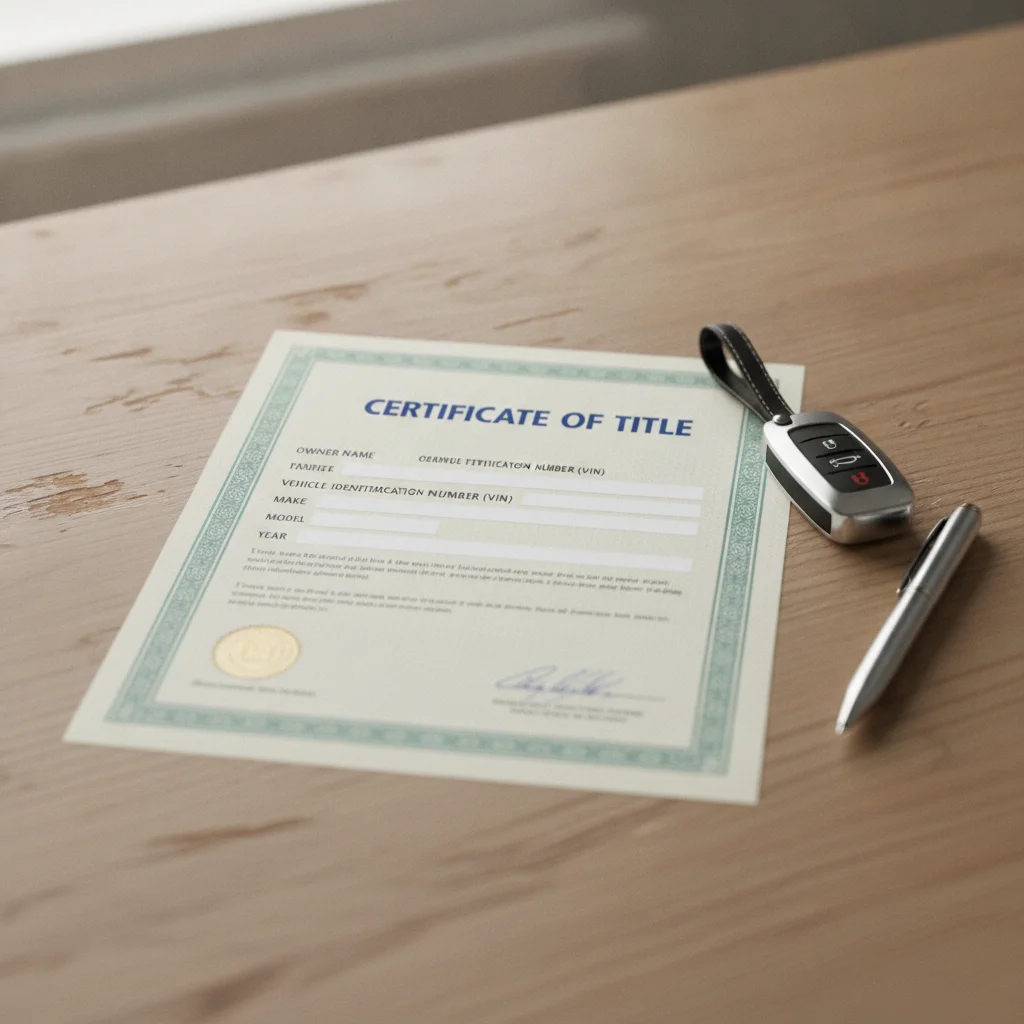
Before you post a listing, negotiate a price, or accept a deposit, the car's title tells you exactly what you're allowed to do — and what you're not. The title is the legal document that proves ownership, and when two names appear on it, both of those people have a legally recognized stake in the vehicle.
If you haven't looked at your title recently, now is the time. Pull it out and look at the line where the owners are listed. The critical detail isn't just whose names appear — it's the conjunction between them. That single word, 'and' or 'or,' is the hinge point of the entire transaction.
Understanding what a vehicle title contains and why it governs every legal sale is essential before diving into the specifics of co-ownership. Without a clear title — signed correctly by every required party — no buyer can register the vehicle, and no sale is legally complete.

'And' vs. 'Or': The Word That Changes Everything
This distinction is the single most important thing to understand about selling a co-owned vehicle, and it's one that trips up even experienced sellers.
When 'And' Connects the Names
If your title reads Jane Smith AND Robert Smith, both owners must sign the title assignment section before the car can be legally transferred. There are no workarounds under standard state titling law. You cannot sell the vehicle without the other person's active cooperation and signature — period.
This structure is common on vehicles purchased together by married couples, business partners, or parents and adult children who shared financing. It offers strong joint protection but creates a hard requirement when it's time to sell.
When 'Or' (or 'And/Or') Connects the Names
If your title reads Jane Smith OR Robert Smith — or in some states, Jane Smith AND/OR Robert Smith — either owner can sign the title and complete the sale independently. The other co-owner does not need to be involved or even informed at the time of the transaction, though splitting proceeds is still a separate financial obligation between the two parties.
This structure is often used intentionally when one co-owner wants flexibility — for example, a parent who wants their college-aged child to be able to sell or trade the car without coordinating schedules.
State Variations on the 'And/Or' Rule
A small number of states treat 'and/or' differently than a simple 'or.' In those jurisdictions, 'and/or' may still require both signatures to complete a title transfer. Always confirm the interpretation directly with your specific state's DMV before assuming one signature is sufficient. A five-minute phone call or DMV website check can save weeks of paperwork delays.
Power of Attorney as a Substitute Signature
If a co-owner is unavailable or unwilling to appear in person, some states allow a properly executed power of attorney (POA) document to authorize another person to sign the title on their behalf. The POA must typically be notarized and specific to the vehicle transaction. Not all states accept this approach for title transfers, so verify with your DMV before drafting any documents.
State Variations on the 'And/Or' Rule
A small number of states treat 'and/or' differently than a simple 'or.' In those jurisdictions, 'and/or' may still require both signatures. Always confirm the interpretation with your specific state's DMV before assuming one signature is sufficient. A five-minute phone call can save weeks of paperwork delays.
~60%
of vehicle titles involve co-ownership
Industry estimates suggest the majority of consumer auto loans involve multiple signers, most of whom also share title — creating frequent co-ownership transfer challenges.
43 states
require notarized title signatures in some transfer scenarios
According to AAMVA (American Association of Motor Vehicle Administrators) guidelines, notarization requirements vary widely but affect sellers in most U.S. states under certain conditions.
Up to 30 days
delay when title errors occur
DMV processing delays caused by incorrectly completed titles or missing co-owner signatures can hold up a buyer's registration for weeks, according to state motor vehicle agency advisories.
Checking for Liens Before You Even Think About Selling
A co-ownership situation and an outstanding loan often go hand in hand — many co-titled vehicles were co-financed. Before any sale can proceed, any active lien on the title must be addressed.
A lien means a lender has a legal interest in the vehicle as collateral for a loan. The lender's name may appear on the title itself, or the title may be held directly by the lender until the loan is paid off. Either way, you cannot transfer clean ownership to a buyer until the lien is released.
Steps to Address an Active Lien
- Contact the lender to get the exact payoff amount. This figure may differ from your current balance due to accrued interest and early payoff fees.
- Determine whether the sale price covers the payoff. If the car is worth more than what you owe, the difference goes to the co-owners after the loan is settled. If you owe more than the car's value (negative equity), you'll need to bring cash to close.
- Coordinate the payoff at closing. In private sales, buyers often pay the lender directly (for the loan amount) and the sellers (for any equity above that). Dealerships typically handle this process in-house when buying your car.
Once the lender receives full payoff, they release the lien and either send a clean title or authorize the DMV to issue one. That clean title, signed by all required co-owners, is what you hand to the buyer.
Get the Payoff Amount in Writing
Lender payoff amounts are time-sensitive — they often expire within 10 to 30 days and may change daily as interest accrues. Always request a written payoff statement with an exact expiration date, and factor this into your sale timeline. If your sale closes after the payoff quote expires, request a new figure before proceeding.
Document All Disclosures in Writing
Verbal disclosures offer almost no legal protection in a dispute. Write down every known defect, prior accident, or mechanical issue and have both co-sellers sign the disclosure before the buyer signs anything. Keep a copy for your own records after the sale closes. This simple step is your best defense if a buyer later claims misrepresentation.
When Co-Owners Don't Agree: Your Legal Options
The hardest scenario in a joint ownership sale isn't paperwork — it's people. Divorces, dissolving partnerships, estranged family members, or simply disagreements over price can leave one co-owner ready to sell and the other unwilling to cooperate.
If you're in this situation, here's a realistic look at your options:
- Negotiate directly
- The fastest and cheapest resolution is often a direct conversation. If the disagreement is about price, present comparable market values using tools like Kelley Blue Book or recent local listings. Sometimes a reluctant co-owner simply needs to feel the process is fair.
- Offer a buyout
- One co-owner can offer to purchase the other's share of the vehicle's equity. Once that transaction is complete, the buying co-owner becomes the sole owner and can sell freely. This requires a title transfer between the co-owners first.
- Pursue a partition action
- If cooperation is impossible, a court can compel the sale of jointly owned property through a civil partition action. A judge can order the vehicle sold and the proceeds divided. This is slow, costly, and should be a last resort — but it is a legal remedy that exists precisely for this situation.
- Consult a family law or civil attorney
- If the co-ownership dispute is tied to a divorce or estate, an attorney can often negotiate a resolution faster than going through the courts independently. Many offer free initial consultations.

Selling a car you inherited introduces a related set of complications — when a co-owner has died, probate law governs what happens to their ownership share before you can sell.
How to Execute the Sale: A Step-by-Step Walkthrough
Once both co-owners are aligned and any lien is resolved, executing the actual sale is straightforward — provided you follow each step carefully.
Step 1: Gather All Required Signatures in Advance
If the 'and' connector is on your title, coordinate with the co-owner before you have a buyer in hand. Have them sign the seller's assignment section of the title while the buyer name and sale price fields are still blank (check your state's rules — some states prohibit pre-signing; others allow it). Alternatively, arrange a time when both of you can be present for the closing.
Step 2: Complete the Title Assignment Correctly
The title's assignment section must be filled out without errors. Any cross-outs, corrections, or missing fields can render the title void. A field-by-field guide to completing a title correctly walks through exactly what to write in each line, including odometer readings, sale price, and buyer information — mistakes here are surprisingly common and can delay the buyer's registration for weeks.
Step 3: Verify Notarization Requirements
Some states require that seller signatures on a title be notarized. If your state is one of them, both co-owners (if 'and' applies) will need to sign in front of a notary. Banks, UPS stores, and many public libraries offer notary services, often at low or no cost.
Step 4: Complete a Bill of Sale
A bill of sale documents the transaction details — sale price, vehicle description, odometer reading, and the names of all parties. Some states require it; all sellers benefit from having one. Both co-owners should be listed as sellers on the bill of sale.
Step 5: Handle the Title Transfer at the DMV (if required)
In some states, sellers submit paperwork to the DMV to officially release their ownership. In others, the buyer handles registration and title transfer entirely. Know which model your state uses. Transferring a car title correctly in a private sale covers this process end to end, including how to notify the DMV that you're no longer responsible for the vehicle.
“Title errors are the leading cause of delayed or failed private party sales. Most of them are completely avoidable with a 15-minute review of the document before you ever list the car.”
— Anne Tyson, Former DMV Title Examiner and Consumer Vehicle Advocate
Disclosure Requirements: What Both Sellers Must Reveal
When you sell a car — jointly owned or not — you have legal obligations to disclose known material defects. These requirements don't evaporate just because two people are on the title. In fact, joint sellers face double exposure: if either co-owner knew about a problem and it wasn't disclosed, both can potentially be held liable depending on how the sale was structured.
What You Must Typically Disclose
- Accurate odometer reading — federal law (the Truth in Mileage Act) requires a written odometer disclosure for most vehicles under ten years old.
- Salvage or rebuilt title status — if the vehicle was declared a total loss at any point, many states require explicit disclosure even if the title has been reissued as rebuilt.
- Known mechanical defects — issues you're aware of that affect safety or function should be documented in writing. Selling 'as is' limits but does not eliminate liability.
- Prior flood or fire damage — some states mandate specific flood and fire damage disclosure forms.
State-by-State Variation
Disclosure laws vary significantly. California, for example, has some of the most stringent seller disclosure requirements in the country, including a mandatory disclosure statement for private party sales. Florida and Texas have different thresholds. If you're navigating an out-of-state sale, the rules get even more layered — selling across state lines brings its own set of title and disclosure complications worth understanding before you finalize anything.
The safest approach: document everything you know about the vehicle's condition in writing, have both co-owners sign the disclosure, and provide it to the buyer before money changes hands.
Get the Payoff Amount in Writing
Lender payoff amounts are time-sensitive — they often expire within 10 to 30 days and may change daily as interest accrues. Always request a written payoff statement with an exact expiration date, and factor this into your sale timeline. If your sale closes after the payoff quote expires, request a new figure before proceeding.
Document All Disclosures in Writing
Verbal disclosures offer almost no legal protection in a dispute. Write down every known defect, prior accident, or mechanical issue and have both co-sellers sign the disclosure before the buyer signs anything. Keep a copy for your own records after the sale closes. This simple step is your best defense if a buyer later claims misrepresentation.
Splitting Proceeds and Closing Out the Transaction
Once the sale closes, both co-owners need to agree on how the money is divided. This sounds simple, but disputes over proceeds are a common source of post-sale conflict, especially when one owner contributed more to the purchase price, made more loan payments, or paid for major repairs.
Best practices for a clean financial close:
- Agree on the split in writing before the sale closes. A simple signed letter or text message thread documenting the agreed percentage is better than nothing. A formal written agreement is better still.
- Factor in outstanding costs. If one co-owner paid for recent repairs that benefited the sale price, that contribution should be factored into the split.
- Use a shared escrow or simultaneous payment. For large sale amounts, consider having the buyer pay into an escrow account that disburses to each co-owner according to the agreed split. This eliminates the awkward middleman dynamic of one co-owner receiving the check and then paying the other.
If proceeds are going toward a payoff first, the lender gets paid, and only the remaining equity is divided between co-owners. Make sure both parties understand this sequence before the closing — surprises at the table create last-minute friction that can derail transactions.
Once everything is signed and funds are distributed, file any required seller release of liability forms with your state DMV. This officially removes your name from responsibility for the vehicle — important if the buyer delays registration or the car is later involved in an incident.
For a broader look at how private party sales work from listing to closing, the private party sales hub covers negotiation tactics, listing strategies, and everything else you need to sell directly to a buyer with confidence.

All claims are backed by peer-reviewed research. Sources on request.