Key Takeaways
Higher baseline premiums make discounts more valuable
Because EVs already carry elevated insurance costs, a 15–25% telematics discount translates into more absolute dollar savings than the same discount applied to a lower gas-car premium.
EV data sensors provide cleaner, more accurate inputs
Factory-installed sensors in EVs generate higher-quality telematics data than aftermarket OBD-II dongles or smartphone apps, which can mean fairer and more consistent scoring.
Regenerative braking naturally produces favorable scores
One-pedal driving and coasting to a stop — common EV habits — reduce hard braking events, one of the primary behaviors insurers penalize in telematics scoring.
Low-mileage EV use cases align with pay-per-mile savings
Many EV owners use their vehicle for local commuting only, making pay-per-mile UBI programs especially advantageous compared to flat-rate policies priced for average annual mileage.
Real-time feedback can reinforce efficient driving habits
Telematics apps that show scores after each trip can make drivers more conscious of braking and acceleration, which often improves both safety and EV energy efficiency simultaneously.
Native integrations like Tesla Insurance show what's possible
Manufacturer-linked telematics programs remove third-party data intermediaries and can offer more precise, vehicle-specific scoring that rewards actual EV driving behavior rather than proxy metrics.
EV instant torque can inflate acceleration penalty scores
Electric motors deliver peak torque immediately, meaning even moderate throttle inputs can register as aggressive acceleration in algorithms calibrated for gasoline engine power curves.
Late-night charging errands may be penalized
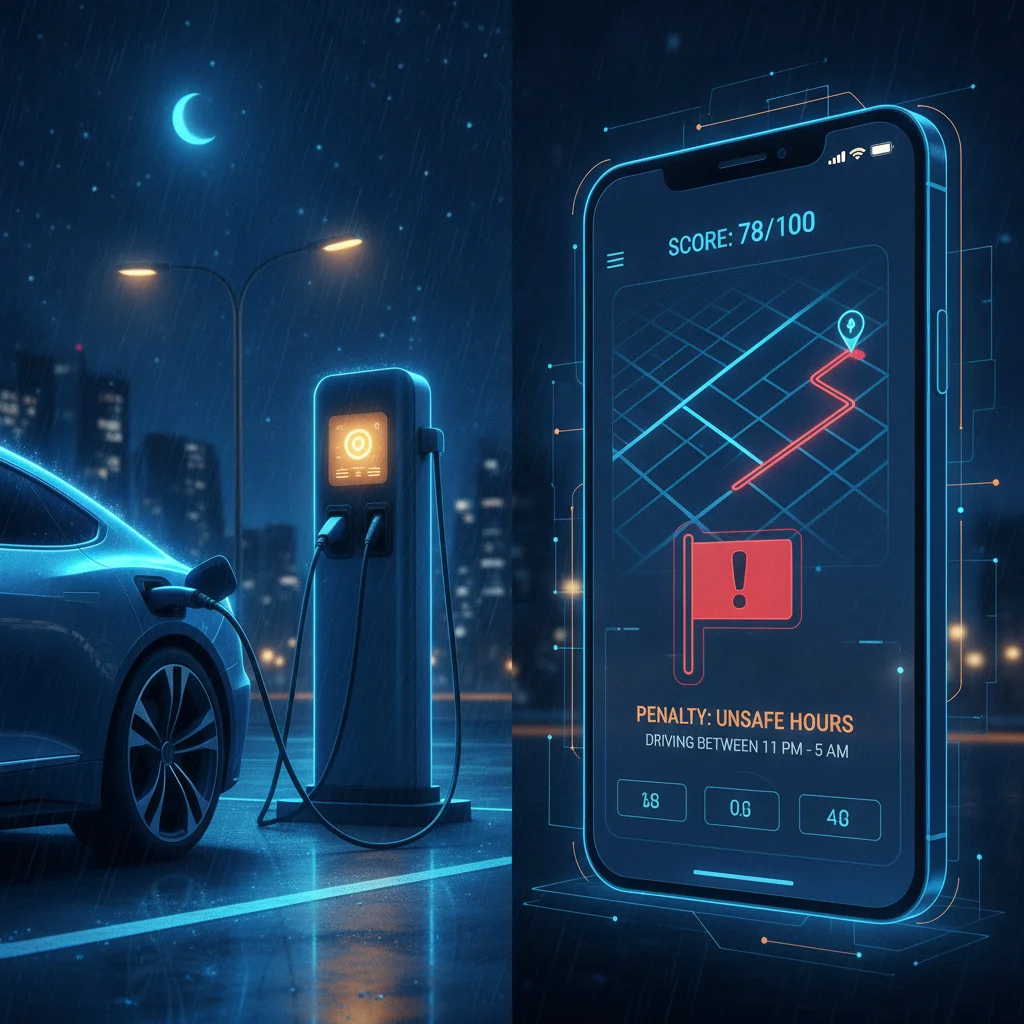
UBI programs frequently flag nighttime driving as higher risk, but many EV owners run off-peak errands or use public chargers during those hours to reduce electricity costs.
Significant privacy trade-offs with granular location data
Telematics programs collect precise GPS location, speed, and behavioral data that many insurers are permitted to share with affiliates or sell — compounding the data already captured by the EV manufacturer.
Programs aren't calibrated for regenerative braking nuances
Some telematics algorithms may misinterpret the deceleration signature of regenerative braking, treating it inconsistently across different EV models and configurations.
High-mileage EV drivers may see rates increase
Pay-per-mile programs that benefit low-mileage drivers can become more expensive than standard policies for drivers who log 15,000 or more miles annually on their EV.
Limited insurer experience pricing EV telematics accurately
Most UBI programs were designed around combustion-vehicle driving patterns, and few insurers have accumulated enough EV-specific telematics data to price risk precisely for electric drivers.
Rate increases are possible if scores underperform
Opting into a UBI program is not a guaranteed savings mechanism — drivers whose scored behaviors fall outside the insurer's preferred range may see their premiums rise at renewal.
Our Verdict
Usage-based insurance is a stronger fit for EV owners than for the average gas-car driver, largely because EVs already capture the data these programs need and because EV premiums tend to run higher, making discounts more valuable. That said, the privacy implications are significant, and drivers who regularly use fast chargers, drive at night, or log highway miles may not benefit as much as they expect. Telematics rewards a very specific driver profile — low-mileage, smooth-braking, daylight commuters — so the math works best when your habits genuinely match that model.
Best for EV owners who drive fewer than 10,000 miles annually, avoid aggressive acceleration and hard braking, and are comfortable sharing detailed driving data with their insurer.
Why the EV–Telematics Overlap Is More Than Coincidence
Every modern electric vehicle is, at its core, a networked computer. Battery management systems, regenerative braking sensors, GPS modules, and cellular modems all generate continuous streams of data that the manufacturer — and increasingly the driver — can access through a companion app. This architecture is fundamentally different from a gasoline car, where an OBD-II dongle or a third-party plug-in device is typically required to collect equivalent information for a telematics insurer.
That distinction matters when evaluating usage-based insurance (UBI). Traditional UBI programs ask drivers to either install a device in the OBD-II port or download a smartphone app that uses the phone's accelerometer and GPS as a proxy for driving behavior. Both methods introduce friction and measurement imprecision. An EV, by contrast, already has factory-installed sensors capturing acceleration rates, braking force, speed, location, and mileage with high fidelity.
The result is a natural compatibility between EVs and telematics programs. Insurers that have native integrations with EV manufacturers — or that use app-based scoring tied to the vehicle's own data — can get cleaner, more accurate inputs than they'd receive from a plug-in dongle in a gas car. For EV owners weighing whether to opt into a UBI program, that data quality is worth understanding before signing up.
See our overview of how UBI programs work before deciding whether to participate, since the mechanics of scoring vary significantly by insurer.
The EV Premium Problem That Telematics Can Help Solve
Insurance costs are one of the less-discussed friction points of EV ownership. Electric vehicles generally carry higher comprehensive and collision premiums than comparable gas models — a gap driven by elevated repair costs, specialized parts, high-voltage battery replacement exposure, and a shortage of trained EV technicians at body shops.
15–25%
Average EV insurance premium premium over gas cars
Multiple independent analyses and insurer pricing studies indicate EV owners typically pay 15% to 25% more for equivalent coverage compared to gas-powered vehicle owners.
Up to 30%
Maximum UBI discount offered by major carriers
Insurers including Progressive, Allstate, and State Farm advertise maximum telematics discounts of up to 30% for highly-rated drivers in their respective programs.
~47%
U.S. drivers open to sharing data for lower premiums
A 2023 J.D. Power survey found that roughly 47% of auto insurance customers expressed willingness to share driving data in exchange for potential premium reductions.
10,000 miles
Approximate UBI mileage threshold for net savings
Industry observers and independent consumer analyses generally suggest drivers logging under 10,000 miles annually are most likely to see net savings from pay-per-mile UBI programs.
~40%
Tesla drivers enrolled in Tesla Insurance (eligible states)
Tesla has reported significant adoption of its in-house insurance product in states where it is available, reflecting strong interest in native telematics integration among EV owners.
For context, industry data from several independent analyses has pegged the average EV insurance premium anywhere from 15% to 25% higher than an equivalent internal-combustion vehicle, with luxury EVs like the Rivian R1T or Mercedes EQS sitting at the wider end of that range. A telematics discount of 10% to 30% — the range commonly advertised by major carriers — could meaningfully offset that surcharge for qualifying drivers.
That makes the UBI value proposition stronger for EV owners than it might be for a gas-car driver whose baseline premium is already modest. If you're paying $2,400 annually on an EV policy and a telematics program yields a 20% discount, that's $480 back per year. The same percentage discount applied to a $1,200 gas-car policy returns only $240. The starting point matters.
This is also why EV-specific insurers and programs deserve particular attention. Comparing EV insurance policies the right way means looking beyond the quoted premium to evaluate telematics eligibility, EV-specific coverage riders, and whether the insurer has experience pricing electric vehicles accurately.
Pros of Usage-Based Insurance for EV Drivers
The advantages of pairing a UBI program with an electric vehicle are meaningful, particularly for drivers whose daily habits align with what insurers reward.
Higher baseline premiums make discounts more valuable
Because EVs already carry elevated insurance costs, a 15–25% telematics discount translates into more absolute dollar savings than the same discount applied to a lower gas-car premium.
EV data sensors provide cleaner, more accurate inputs
Factory-installed sensors in EVs generate higher-quality telematics data than aftermarket OBD-II dongles or smartphone apps, which can mean fairer and more consistent scoring.
Regenerative braking naturally produces favorable scores
One-pedal driving and coasting to a stop — common EV habits — reduce hard braking events, one of the primary behaviors insurers penalize in telematics scoring.
Low-mileage EV use cases align with pay-per-mile savings
Many EV owners use their vehicle for local commuting only, making pay-per-mile UBI programs especially advantageous compared to flat-rate policies priced for average annual mileage.
Real-time feedback can reinforce efficient driving habits
Telematics apps that show scores after each trip can make drivers more conscious of braking and acceleration, which often improves both safety and EV energy efficiency simultaneously.
Native integrations like Tesla Insurance show what's possible
Manufacturer-linked telematics programs remove third-party data intermediaries and can offer more precise, vehicle-specific scoring that rewards actual EV driving behavior rather than proxy metrics.
One nuance worth highlighting: many EV drivers are, by habit, already smoother drivers. Regenerative braking encourages coasting rather than late, hard stops. One-pedal driving promotes gradual deceleration. These are exactly the behaviors telematics algorithms score favorably. EV drivers who've adapted to their vehicle's driving dynamic may find they're naturally well-positioned to earn top-tier discounts without consciously modifying their behavior.
Low annual mileage is another common EV ownership pattern that aligns well with pay-per-mile programs. Many EV owners use their electric vehicle primarily for local commuting while relying on a gas vehicle or rental for longer trips. If your EV logs 7,000 miles per year rather than 15,000, a mileage-based UBI program could produce significant savings. See our guide to EV charging costs and savings for the full picture of where EV ownership economics can work in your favor.
Cons and Hidden Risks for EV Drivers in Telematics Programs
The advantages are real, but so are the risks — and some are specific to EV driving patterns that standard telematics algorithms weren't designed to accommodate.
EV instant torque can inflate acceleration penalty scores
Electric motors deliver peak torque immediately, meaning even moderate throttle inputs can register as aggressive acceleration in algorithms calibrated for gasoline engine power curves.
Late-night charging errands may be penalized
UBI programs frequently flag nighttime driving as higher risk, but many EV owners run off-peak errands or use public chargers during those hours to reduce electricity costs.
Significant privacy trade-offs with granular location data
Telematics programs collect precise GPS location, speed, and behavioral data that many insurers are permitted to share with affiliates or sell — compounding the data already captured by the EV manufacturer.
Programs aren't calibrated for regenerative braking nuances
Some telematics algorithms may misinterpret the deceleration signature of regenerative braking, treating it inconsistently across different EV models and configurations.
High-mileage EV drivers may see rates increase
Pay-per-mile programs that benefit low-mileage drivers can become more expensive than standard policies for drivers who log 15,000 or more miles annually on their EV.
Limited insurer experience pricing EV telematics accurately
Most UBI programs were designed around combustion-vehicle driving patterns, and few insurers have accumulated enough EV-specific telematics data to price risk precisely for electric drivers.
Rate increases are possible if scores underperform
Opting into a UBI program is not a guaranteed savings mechanism — drivers whose scored behaviors fall outside the insurer's preferred range may see their premiums rise at renewal.
The behavioral scoring problem deserves elaboration. Many UBI programs penalize late-night driving, interpreting it as a risk factor correlated with impaired drivers and reduced visibility. But EV owners frequently charge at home overnight and may run errands or travel during off-peak hours to take advantage of lower time-of-use electricity rates. Similarly, algorithms that flag high-speed acceleration may not distinguish between a driver flooring a gas pedal aggressively and an EV driver using normal throttle input — electric motors deliver instant torque, and even gentle acceleration in an EV can register differently than a gas car's equivalent power delivery.
Before opting in, it's worth reading the scoring methodology carefully. Some insurers publish what behaviors they track and how they're weighted; others are opaque. Our article on participating in telematics programs wisely covers how to audit your own driving patterns against an insurer's scoring criteria before committing.
Tesla's Safety Score: The Closest Thing to Native EV Telematics
No discussion of EVs and telematics insurance would be complete without examining Tesla Insurance, which is currently available in a growing number of U.S. states. Unlike traditional UBI programs that use third-party apps or plug-in devices, Tesla Insurance draws directly from the vehicle's own sensor suite — cameras, radar (on older models), and the onboard computer — to generate a real-time Safety Score.
Tesla Safety Score: How It Actually Works
Tesla's Safety Score is calculated continuously using five inputs captured by the vehicle itself: forward collision warnings per 1,000 miles, hard braking instances, aggressive turning, unsafe following distance, and forced Autopilot disengagements. Scores range from 0 to 100, with higher scores yielding lower monthly premiums. Unlike traditional UBI programs that recalculate at policy renewal, Tesla adjusts premiums monthly based on the previous month's rolling score — creating a tighter, more dynamic feedback loop than most third-party programs offer.
Your EV Already Shares Data — With the Manufacturer
Before enrolling in a telematics insurance program, it's worth recognizing that your EV is likely already transmitting driving and location data to the automaker. Tesla, Ford, GM, and most other EV manufacturers collect telemetry by default, governed by their own privacy policies. Adding a UBI insurer to the mix creates a second data relationship with its own retention and sharing terms. Reading both policies — the automaker's and the insurer's — before opting in gives you a clearer picture of the full data exposure.
UBI Is Not Automatically a Discount
Usage-based insurance programs are sometimes marketed as savings programs, but they are more accurately described as performance-based pricing programs. Drivers whose behaviors score well relative to the insurer's model receive discounts; drivers who score poorly may see no change or, in some programs, a rate increase. Insurers in states that permit rate increases via telematics data are required to disclose this possibility, but many consumers overlook it. Always confirm whether an insurer can raise your rate based on telematics scores before enrolling.
Tesla's Safety Score is calculated from five factors: forward collision warnings per 1,000 miles, hard braking events, aggressive turning, unsafe following distance, and forced Autopilot disengagements. Monthly premiums are recalculated based on the rolling Safety Score, which updates daily. A driver consistently scoring above 90 can see premiums that are meaningfully lower than market rates; a driver scoring below 80 may pay more than a comparable third-party policy.
The model is compelling for disciplined Tesla drivers who are willing to accept that level of monitoring. It also illustrates what native telematics integration can look like when the insurer and the manufacturer are the same entity — data quality is higher, latency is lower, and the feedback loop is tighter. Whether that's reassuring or concerning depends on your comfort with the surveillance model.
For those evaluating whether Tesla's approach or a third-party policy makes more financial sense, see our comparison of Tesla Insurance versus traditional policies.
Privacy, Data Ownership, and the Fine Print
Telematics programs collect granular data — precise GPS coordinates, timestamps, speed profiles, and behavioral events — that goes well beyond what's needed to set a premium. Understanding what insurers do with that data after the policy period ends is essential reading before opting in.
Most major UBI programs are governed by privacy policies that permit data sharing with affiliates, use in aggregate research, and in some cases sale to third parties. A small number of insurers have committed to not selling individual driving data, but this is not the industry norm. Drivers should also understand that telematics data collected by an insurer could theoretically be subpoenaed in an accident investigation — meaning your precise location and speed in the moments before a collision might become part of a legal record.
Tesla Safety Score: How It Actually Works
Tesla's Safety Score is calculated continuously using five inputs captured by the vehicle itself: forward collision warnings per 1,000 miles, hard braking instances, aggressive turning, unsafe following distance, and forced Autopilot disengagements. Scores range from 0 to 100, with higher scores yielding lower monthly premiums. Unlike traditional UBI programs that recalculate at policy renewal, Tesla adjusts premiums monthly based on the previous month's rolling score — creating a tighter, more dynamic feedback loop than most third-party programs offer.
Your EV Already Shares Data — With the Manufacturer
Before enrolling in a telematics insurance program, it's worth recognizing that your EV is likely already transmitting driving and location data to the automaker. Tesla, Ford, GM, and most other EV manufacturers collect telemetry by default, governed by their own privacy policies. Adding a UBI insurer to the mix creates a second data relationship with its own retention and sharing terms. Reading both policies — the automaker's and the insurer's — before opting in gives you a clearer picture of the full data exposure.
UBI Is Not Automatically a Discount
Usage-based insurance programs are sometimes marketed as savings programs, but they are more accurately described as performance-based pricing programs. Drivers whose behaviors score well relative to the insurer's model receive discounts; drivers who score poorly may see no change or, in some programs, a rate increase. Insurers in states that permit rate increases via telematics data are required to disclose this possibility, but many consumers overlook it. Always confirm whether an insurer can raise your rate based on telematics scores before enrolling.
EV owners face a compounded version of this concern because their vehicles already transmit data to the manufacturer. Depending on your vehicle brand and privacy settings, the automaker may retain location history, charging behavior, and energy consumption data independently of any insurer program. Opting into a UBI program adds a second data collector to that picture.
This isn't a reason to categorically avoid telematics — the potential savings are real — but it is a reason to read both your insurer's and your vehicle manufacturer's data policies before enrolling. Our comparison of EV vs. gas car insurance considerations covers the data dimension as part of a broader look at how EV policies differ structurally from standard auto coverage.
How to Evaluate Whether UBI Makes Sense for Your EV
The decision to enroll in a telematics program should be based on an honest assessment of your driving profile, not on the discount advertised in the marketing materials. Here's a practical framework.
- Audit your annual mileage. Pull your odometer reading or check your EV's app for lifetime mileage. If you're logging fewer than 10,000 miles per year, pay-per-mile programs are worth strong consideration. Above 15,000 miles, the per-mile cost can exceed what you'd pay on a standard policy.
- Review your charging habits. Do you charge primarily at home overnight? Frequent DC fast charging at public stations, especially late at night, may be flagged by some algorithms. Understanding when and how you charge affects the risk profile you present.
- Check the insurer's scoring methodology. Ask specifically how the program handles EV acceleration characteristics and whether hard braking events are calibrated for regenerative braking deceleration. Some programs have begun to adapt; many haven't.
- Calculate the upside ceiling. If the maximum discount a program offers is 10% and your current premium is already competitive, the privacy trade-off may not be worth it. If you're paying an elevated EV premium and the program offers up to 30%, the math shifts meaningfully.
- Consider a trial period. Several insurers offer a monitoring period before locking in a rate adjustment. Use that window to see your actual score before any financial consequence applies.
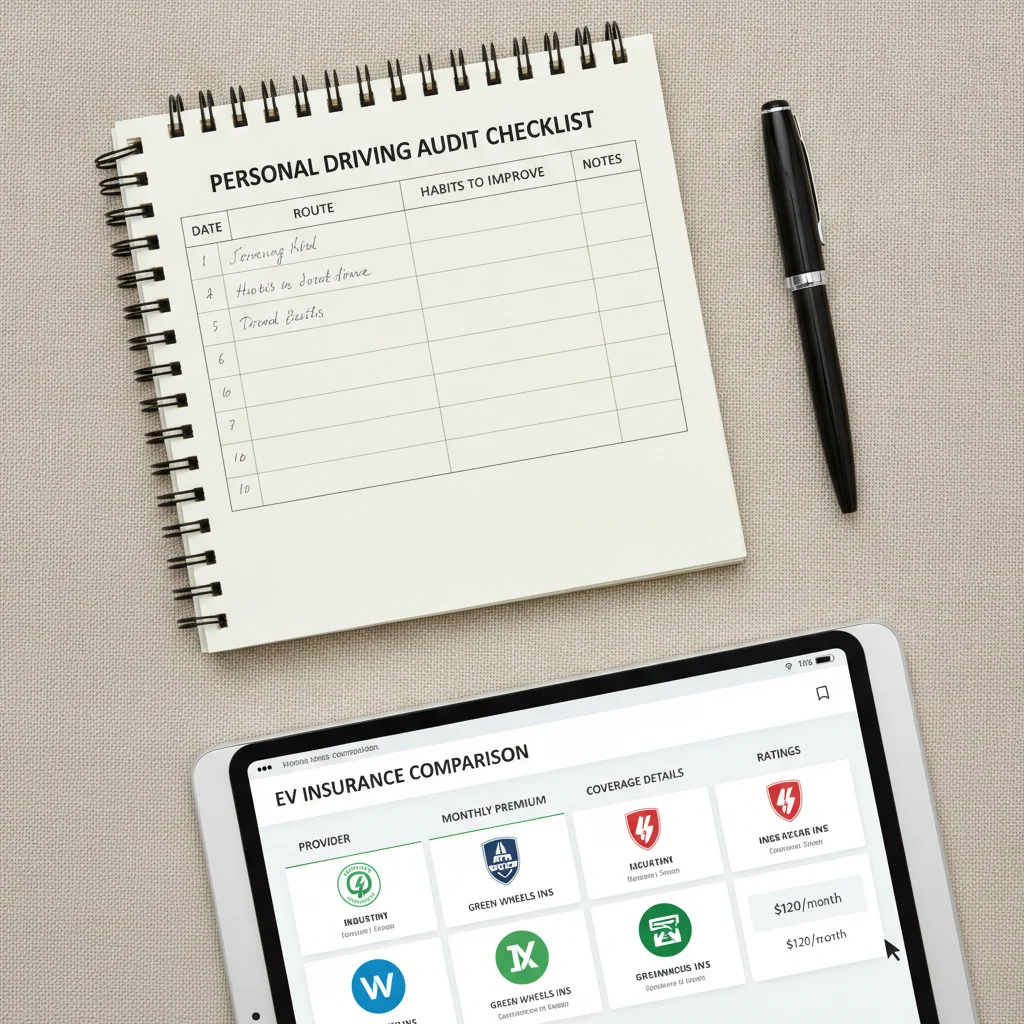
Also factor in whether your EV qualifies for other premium-reducing mechanisms — some states and insurers offer green vehicle discounts, and federal tax credit eligibility can affect total ownership cost calculations. The EV tax credits hub is a useful starting point for understanding the broader financial picture.
All claims are backed by peer-reviewed research. Sources on request.