Key Takeaways
Option A
Agreed Value
The locked-in, negotiated coverage amount.
Best for: EV owners who want guaranteed payout certainty and own vehicles that may depreciate unpredictably.
Option B
Actual Cash Value (ACV)
The market-based, depreciation-adjusted standard.
Best for: Owners of mainstream EVs seeking lower premiums who accept market-rate depreciation settlements.
If you own a high-value or limited-production EV
Agreed Value
Niche or luxury EVs can be difficult to price accurately at the time of a claim. Locking in a value upfront removes the risk of a lowball ACV settlement when comparable sales data is thin.
If you're carrying a large auto loan on a new EV
Agreed Value
Rapid early depreciation in some EV segments means an ACV payout could fall short of your loan balance. An agreed value policy, or ACV paired with gap coverage, protects you from being underwater.
If you drive a mainstream EV and want to minimize premium costs
Actual Cash Value (ACV)
Popular models like the Tesla Model 3 or Chevrolet Equinox EV have robust sales data that supports fair ACV settlements, and the premium savings over agreed value can be substantial.
If your EV is several years old and mostly paid off
Actual Cash Value (ACV)
Once a vehicle is paid off and its value has stabilized, the premium cost of agreed value coverage is harder to justify, and ACV settlements align reasonably well with real-world market prices.
If you own a collector or low-volume EV that rarely sells on the open market
Agreed Value
Without comparable sales data, insurers calculating ACV can undervalue rare EVs significantly. Agreed value is the only reliable way to ensure a fair settlement for one-of-a-kind or limited-run vehicles.
Why Valuation Methodology Matters More for EVs
When a gas-powered car is totaled, insurers have decades of depreciation data, robust used-car markets, and well-established pricing guides to determine what that vehicle was worth at the moment of the crash. The process isn't perfect, but it's predictable. Electric vehicles operate in a fundamentally different environment — one where battery health, software versions, federal tax credit eligibility, and rapid model-year updates all create valuation complexity that standard ACV formulas weren't designed to handle.
That complexity makes the choice between agreed value and actual cash value (ACV) insurance coverage far more consequential for EV owners than for their gas-car counterparts. Choose the wrong valuation method and a total-loss claim — from a collision, flood, fire, or theft — could leave you with a settlement check that's thousands of dollars below what you need to replace your vehicle.
Understanding how each approach works, and where each breaks down in the context of electric vehicles, is essential reading before you sign your next insurance policy. For a broader look at how insurers price EVs differently across all coverage types, see how EVs affect auto insurance rates.

How Each Valuation Method Works
Actual Cash Value is the standard valuation method used in most personal auto insurance policies in the United States. When you file a total-loss claim under an ACV policy, the insurer calculates what your vehicle was worth immediately before the loss — factoring in age, mileage, condition, and comparable sales in your local market. Depreciation is baked in. If your EV has lost 30% of its value since purchase, your settlement reflects that loss.
ACV is calculated using a combination of pricing databases (such as JD Power, Kelley Blue Book, and Manheim auction data), local market comparables, and insurer-proprietary algorithms. The result is a number that, in theory, reflects what you could have sold the vehicle for on the open market the day before it was destroyed. In practice, disputes are common — especially when market data is thin or rapidly shifting.
Agreed Value, sometimes called stated value with no ACV clause, works differently. Before the policy is issued, you and the insurer negotiate and formally agree on the vehicle's worth. That figure is documented in the policy declarations. If a covered total loss occurs at any point during the policy term, the insurer pays exactly that agreed amount — no depreciation calculation, no market comparison, no negotiation after the fact.
Agreed value policies are more commonly found in the collector car and classic car market, but a growing number of specialty insurers and some mainstream carriers offer them for newer EVs, particularly high-value or limited-production models. The trade-off is straightforward: agreed value premiums are higher, but the certainty of the payout is absolute.
| Criterion | Agreed Value | Actual Cash Value (ACV) |
|---|---|---|
| How payout is determined | Negotiated upfront, fixed in policy | Calculated at time of loss using market data |
| Depreciation impact | None — agreed amount is guaranteed | Full depreciation deducted from settlement |
| Premium cost | Higher than standard ACV policies | Lower; the default for most auto policies |
| Payout certainty | Complete — amount is contractually fixed | Variable — subject to market fluctuations and insurer calculation |
| Availability | Specialty insurers; some mainstream carriers | Universal — standard in nearly all policies |
| Battery degradation impact | None if agreed value already set | May reduce settlement if battery health is assessed |
| Best for loan/lease situations | Strong protection against being underwater | Requires gap insurance to cover loan shortfalls |
| Dispute risk after total loss | Minimal — figure is already agreed upon | Moderate to high — especially for rare or volatile EV models |
| Policy management over time | Requires annual review and renegotiation | Self-adjusting; no action needed by policyholder |
Stated Value Is Not the Same as Agreed Value
Many insurers use the terms interchangeably in marketing materials, but they function differently in claim scenarios. A stated value policy typically caps the payout at the stated amount but still allows the insurer to pay actual cash value if that figure is lower. True agreed value policies contractually guarantee the full negotiated amount with no ACV fallback. Always request the policy declarations page language in writing and specifically ask whether an ACV clause is present before assuming you have agreed value coverage.
The EV Depreciation Problem — and Why It Complicates ACV
Depreciation is the central variable in any ACV calculation, and EVs present an unusually complicated depreciation picture. Some models hold value exceptionally well; others shed it rapidly. The same model year can behave differently depending on which trim, battery option, or software generation it represents.
Several EV-specific factors conspire to make ACV settlements unpredictable:
- Battery degradation: A used EV with measurable range loss is worth less than an identical vehicle with a healthy pack — but most ACV formulas don't precisely account for battery state of health unless the insurer orders a diagnostic test.
- Software and over-the-air (OTA) updates: Features added or removed via software updates can affect perceived value, yet standard depreciation tables don't capture them.
- Federal tax credit ineligibility: Once a used EV has changed hands, the $4,000 used EV tax credit has income and price caps. This can compress the secondary market price for higher-priced models, affecting ACV.
- Rapid model-year obsolescence: Some manufacturers release significant range, performance, or efficiency upgrades annually, quickly making previous-year models feel outdated and reducing comparable sales prices.
- Market volatility: EV used-car prices have swung dramatically since 2020 — surging during the chip shortage and falling sharply in 2023 as new inventory recovered. An ACV calculated in a down market may significantly undervalue what you paid.
For a deeper analysis of how these forces interact, EV depreciation follows a different set of rules than traditional vehicles — and understanding those dynamics is foundational to choosing the right insurance valuation approach.
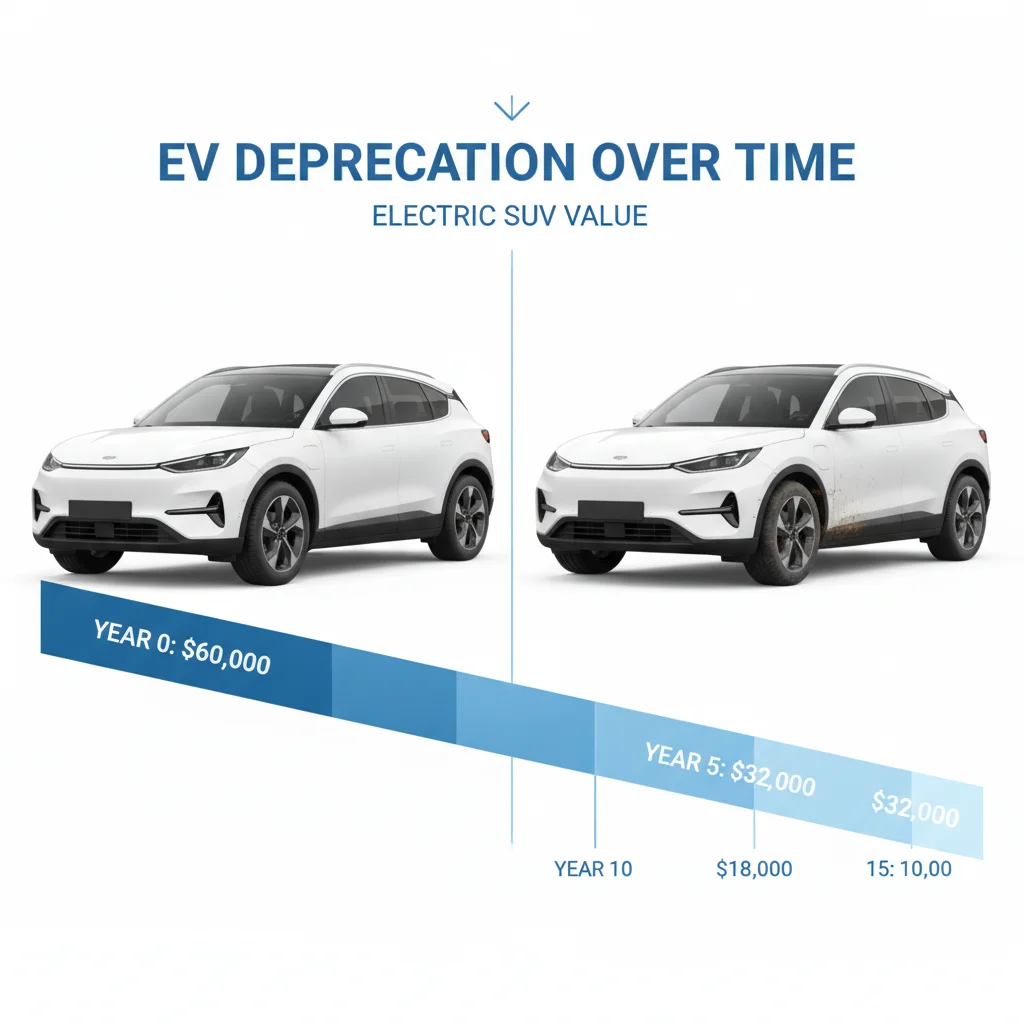
49.1%
Average EV value drop in first year (some models)
iSeeCars analysis of 2023 used-car market data found certain EV models depreciated nearly 50% within 12 months of original purchase.
~$7,000
Typical ACV–loan gap at total loss
Consumer financial analysts estimate the average gap between ACV settlement and outstanding loan balance for underwater EV owners ranges from $5,000 to $10,000 in early loan years.
3x
EV repair cost premium vs. gas vehicles
Mitchell International's 2023 industry report found EV collision repairs cost roughly three times more on average than equivalent gas-vehicle repairs, increasing total-loss frequency.
~20%
Higher comprehensive premiums for EVs
Insurance.com analysis found EV owners pay approximately 20–25% more for full-coverage policies than owners of equivalent gas vehicles, partly reflecting higher replacement values.
Head-to-Head: Agreed Value vs. ACV for EV Owners
The comparison below captures the key practical differences between the two valuation methods as they apply specifically to electric vehicle ownership. Neither approach is universally superior — the right answer depends on your EV model, your financial exposure, and your risk tolerance.
| Criterion | Agreed Value | Actual Cash Value (ACV) |
|---|---|---|
| How payout is determined | Negotiated upfront, fixed in policy | Calculated at time of loss using market data |
| Depreciation impact | None — agreed amount is guaranteed | Full depreciation deducted from settlement |
| Premium cost | Higher than standard ACV policies | Lower; the default for most auto policies |
| Payout certainty | Complete — amount is contractually fixed | Variable — subject to market fluctuations and insurer calculation |
| Availability | Specialty insurers; some mainstream carriers | Universal — standard in nearly all policies |
| Battery degradation impact | None if agreed value already set | May reduce settlement if battery health is assessed |
| Best for loan/lease situations | Strong protection against being underwater | Requires gap insurance to cover loan shortfalls |
| Dispute risk after total loss | Minimal — figure is already agreed upon | Moderate to high — especially for rare or volatile EV models |
| Policy management over time | Requires annual review and renegotiation | Self-adjusting; no action needed by policyholder |
One nuance worth highlighting: many policies marketed as "stated value" are not the same as true agreed value. A stated value policy typically uses the stated amount as a ceiling on the payout, not a guaranteed floor — the insurer still retains the right to pay ACV if that figure is lower. Always read the declarations page carefully and ask your insurer to confirm in writing whether the policy contains an ACV clause. True agreed value policies explicitly waive that clause.
For a direct comparison of how ACV and replacement cost settlements differ in collision and comprehensive claims more broadly, ACV vs. replacement cost in collision and comprehensive claims provides useful context that applies equally to EV and gas vehicle owners.
When ACV Falls Short — and How Gap Insurance Fills the Gap
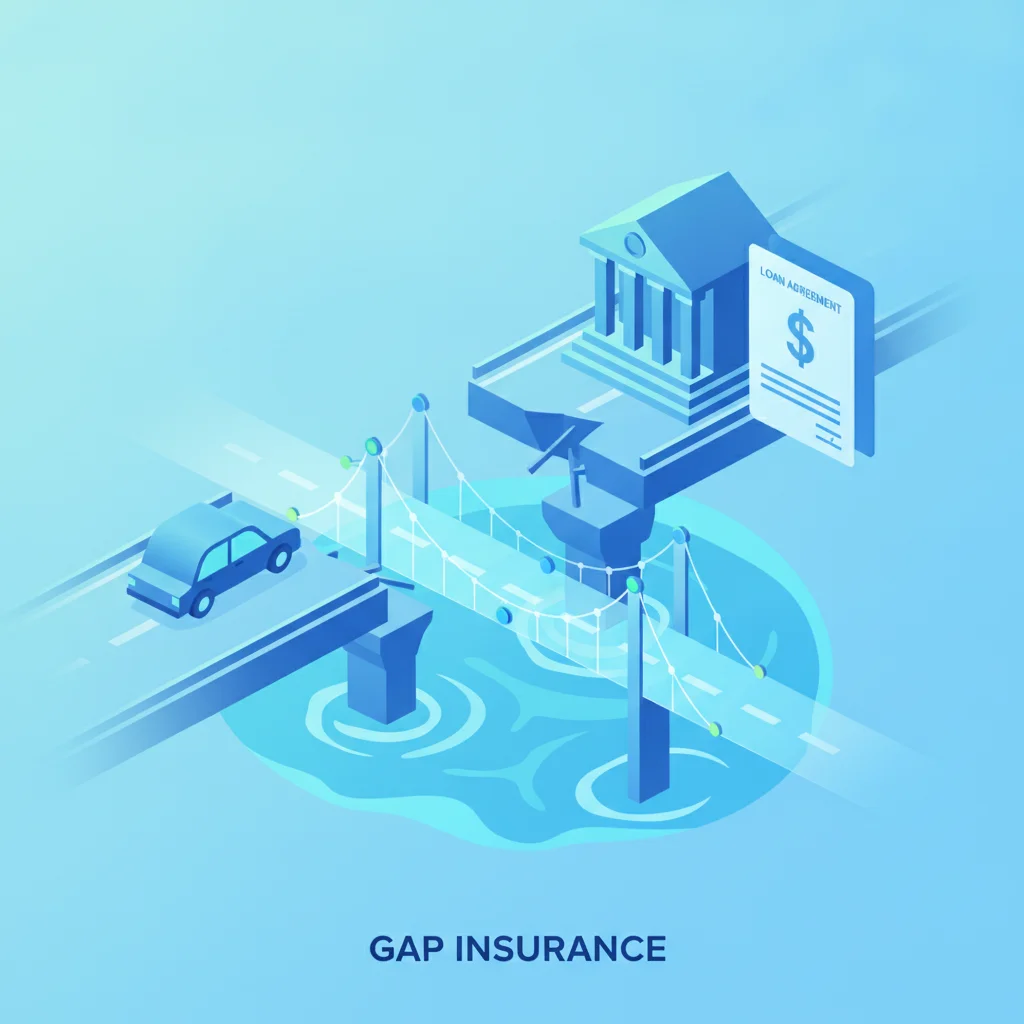
The most financially dangerous scenario for an ACV policyholder is a total loss that occurs when the vehicle's depreciated market value is less than the outstanding loan balance. This situation — being "underwater" or "upside down" — is more common with EVs than gas vehicles for two reasons: aggressive EV depreciation in some segments, and the tendency of EV buyers to finance larger amounts over longer loan terms to manage high sticker prices.
Consider a hypothetical: you purchase a mid-range EV for $52,000, finance $48,000, and 18 months later it's totaled. ACV might peg the vehicle's market value at $36,000 after rapid early depreciation. Your lender is owed $43,000. The ACV settlement pays the lender $36,000, and you owe the remaining $7,000 out of pocket — with no car.
Gap insurance — guaranteed asset protection — covers exactly that $7,000 shortfall. It's the financial bridge between what ACV pays and what you still owe. For EV owners specifically, gap insurance is especially critical for electric vehicles given the steeper early depreciation curves some models experience.
Agreed value policies largely eliminate the need for gap coverage, because a properly negotiated agreed value should match or exceed your loan balance at inception. But gap insurance is typically far cheaper than the premium difference between ACV and agreed value policies — making it a practical middle-ground solution for mainstream EV owners who want ACV's lower premiums without full financial exposure to depreciation.
Practical Steps for EV Owners Choosing a Policy
Selecting the right valuation approach requires a few concrete steps that go beyond simply comparing premium quotes.
- Research your EV's depreciation history. Use tools like Kelley Blue Book, Edmunds, and CarGurus to track how your specific model and trim have held value over one, two, and three years. Valuation tools like KBB and Edmunds can provide a current market baseline to compare against your loan balance.
- Calculate your financial exposure. Subtract your current loan payoff amount from the vehicle's current market value. If you're underwater — or close to it — gap coverage or agreed value deserves serious consideration.
- Ask your insurer the right questions. Specifically: Is this a true agreed value policy with no ACV clause? How will you determine ACV at the time of a loss? Will you account for battery state of health? Will you consider local and national comparable sales?
- Consider your vehicle's replaceability. If your EV is a limited-production model, a recent discontinuation, or simply hard to find in used-car markets, ACV becomes riskier because there may be few or no true comparables to anchor the settlement. Agreed value removes that uncertainty.
- Revisit annually. EV market values shift quickly. An agreed value negotiated in 2022 may be significantly higher than current market value — a situation that could make the policy economically inefficient. ACV policies self-adjust; agreed value policies require active management.
Used EV owners face additional complexity worth examining separately. A vehicle with an aging battery pack, an expired manufacturer warranty, or uncertain charging history introduces insurance variables that don't exist for new EV buyers. Insuring a used EV involves a distinct set of risks and potential savings that deserve their own analysis before you commit to any valuation method.

The bottom line: for EV owners, insurance valuation methodology isn't a technical footnote — it's a financial decision with real stakes. The standard ACV approach works adequately for mainstream models with strong resale data and conservative financing. But the EV market's volatility, battery-specific depreciation, and the growing diversity of vehicle types make agreed value a genuinely superior option for a meaningful subset of owners. Know which category you're in before you sign.
For a fuller picture of how your settlement amount compares to actual replacement cost — regardless of whether your policy uses ACV or agreed value — what ACV vs. replacement cost settlements actually cover lays out the real-world dollar differences clearly.
All claims are backed by peer-reviewed research. Sources on request.