
Key Takeaways
Option A
Actual Cash Value (ACV)
The standard, depreciation-adjusted settlement method.
Best for: Drivers with older vehicles where the cost-to-premium tradeoff of upgraded coverage doesn't make financial sense.
Option B
Replacement Cost Value (RCV)
The fuller-payout option that ignores depreciation.
Best for: Owners of newer or high-value vehicles who want a settlement that can actually replace what they lost.
If your car is three or more years old with significant mileage
Actual Cash Value (ACV)
The premium savings on a depreciated vehicle usually outweigh the added cost of replacement cost coverage. ACV is the practical baseline here.
If you financed or leased a new vehicle in the past two years
Replacement Cost Value (RCV)
New cars shed value quickly, often leaving a gap between ACV and what you still owe. Replacement cost coverage — or gap insurance — closes that shortfall.
If you own a high-value, collectible, or specialty vehicle
Replacement Cost Value (RCV)
Standard ACV calculations may significantly undervalue unique vehicles. Agreed value or replacement cost policies better protect your actual investment.
If budget is your primary concern and you drive an older paid-off car
Actual Cash Value (ACV)
Paying extra for replacement cost on a vehicle worth $5,000 or less rarely pencils out. Keep the savings and self-insure the gap.
If you want the simplest path to replacing a totaled car with something comparable
Replacement Cost Value (RCV)
RCV removes the frustrating math of depreciation and gives you a settlement grounded in today's market replacement cost, not yesterday's value.
What These Two Terms Actually Mean
When your car is totaled or a covered item is damaged beyond repair, your insurer doesn't just hand you whatever number feels right. They use a defined valuation method written into your policy. The two most common methods are Actual Cash Value (ACV) and Replacement Cost Value (RCV) — and confusing one for the other is one of the most common reasons drivers feel blindsided after a claim.
Here's the plain-language version of each:
- Actual Cash Value
- ACV is your vehicle's market value at the time of the loss — meaning what a willing buyer would pay for it in its pre-loss condition. Depreciation is already baked into that number. If your three-year-old SUV has accumulated 45,000 miles and normal wear, the ACV will reflect all of that aging. The insurer isn't being punitive; this is simply how the market values used vehicles.
- Replacement Cost Value
- RCV answers a different question: what would it cost to replace the damaged item with a new equivalent today? For auto policies, this typically means a new vehicle of the same make, model, and trim — at current market prices, without a depreciation haircut. It's a higher number by design, which is why it costs more to carry.
The practical gap between these two methods can be significant. A vehicle you paid $38,000 for two years ago might have an ACV of $27,000 today — but a replacement cost of $40,000 if prices have risen. That's a $13,000 difference that comes out of your pocket under a standard ACV policy.
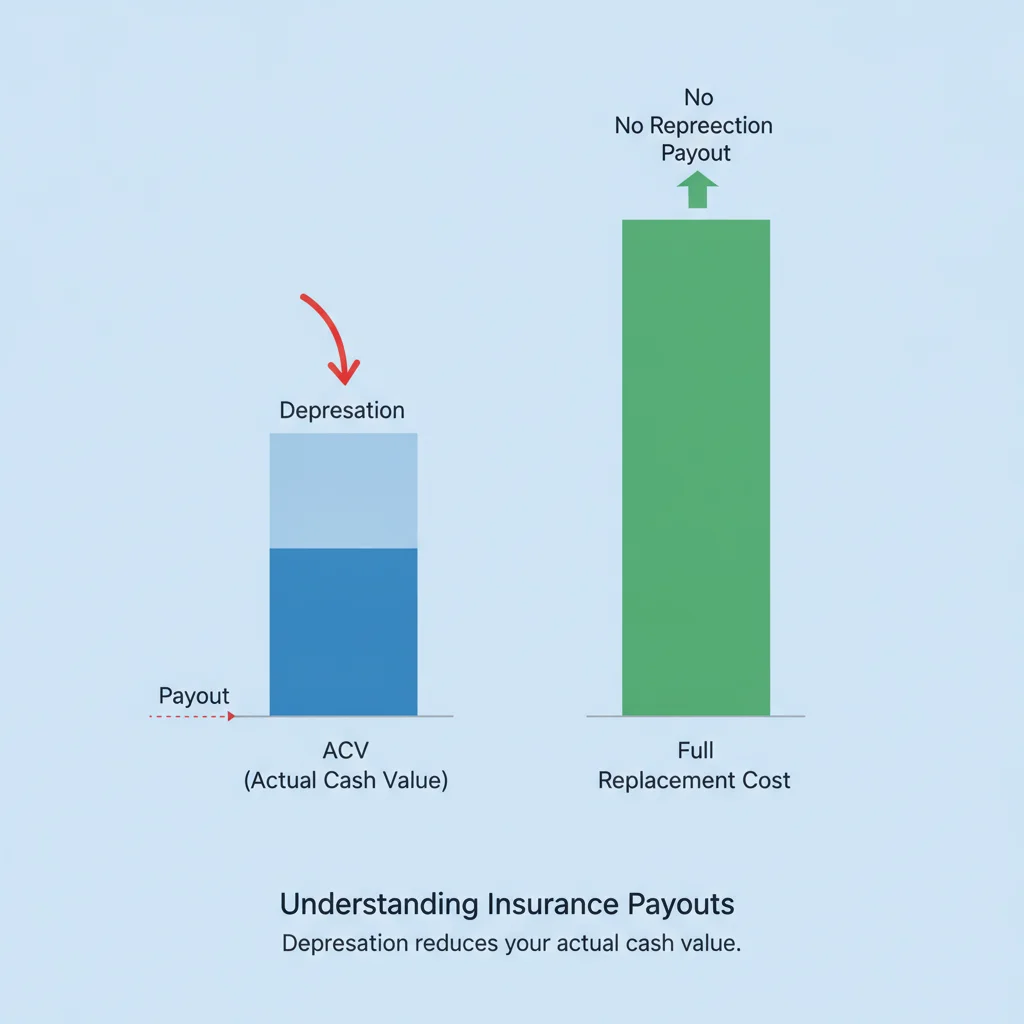
It's also worth knowing that most standard auto insurance policies default to ACV. Replacement cost coverage for vehicles isn't universally available from all insurers, and where it is available, it's almost always an endorsement or a separate policy type — not the baseline. Check your declarations page if you're unsure which method your policy uses.
How Depreciation Changes the Math
Depreciation is the engine running the gap between ACV and RCV, so it's worth spending a moment here. A new car loses roughly 15–20% of its value in the first year alone, and continues depreciating — though more slowly — from there. By year five, many vehicles are worth 40–60% of their original purchase price.
20%
Average first-year vehicle depreciation
According to Carfax, most new vehicles lose approximately 15–20% of their value within the first year of ownership.
~40–60%
Value retained after five years
Edmunds data consistently shows that many vehicles retain only 40–60% of their original purchase price after five years, varying by brand and segment.
$6,054
Average gap between ACV and loan balance
An analysis by Experian found that many financed vehicle owners are "underwater" on their loans, creating a meaningful gap at total-loss claim time.
1 in 5
Drivers unaware of their valuation method
Industry surveys suggest a significant share of policyholders don't know whether their policy pays ACV or replacement cost until after a claim is filed.
When an insurer calculates ACV, they typically use a combination of sources: market data platforms like Kelley Blue Book and Edmunds, regional sales data, and their own proprietary tools. The result is what the car was worth on the open market just before the loss occurred. You can use valuation tools like KBB and Edmunds yourself to get a ballpark before you file — knowing the number going in reduces surprises.
Depreciation affects different vehicles very differently. Trucks and SUVs from domestic brands often hold value better than compact sedans. Luxury vehicles can depreciate sharply. Electric vehicles present their own wrinkle — battery technology changes fast, and older EV models can depreciate faster than their gas equivalents. If you own an EV, it's worth reading about how ACV applies to EV insurance, since the valuation dynamics are meaningfully different.
| Criterion | Actual Cash Value (ACV) | Replacement Cost Value (RCV) |
|---|---|---|
| How value is calculated | Market value minus depreciation | Cost to replace with new equivalent |
| Depreciation applied | Yes — reduces payout | No — not a factor |
| Typical policy default | Yes — standard baseline | No — add-on or endorsement |
| Premium cost | Lower | Higher |
| Payout on new vehicle total loss | Significantly below purchase price | Close to current replacement cost |
| Best vehicle age fit | Older, paid-off vehicles | New or nearly-new vehicles |
| Loan gap risk | High — payout may not clear loan | Low — payout closer to loan balance |
| Parts replacement (partial damage) | Depreciated part value applied | New part cost covered |
| Availability | Universal | Insurer and vehicle-age dependent |
One more thing worth noting: depreciation doesn't stop at the vehicle itself. On collision and comprehensive claims involving partial damage, ACV also governs the value of individual components. A five-year-old headlight assembly isn't replaced at new-part cost under an ACV policy — the insurer applies a depreciation factor to parts as well. That's a detail that catches a lot of people off guard. For a deeper look at how this plays out in real collision and comprehensive claims, see ACV vs. replacement cost in collision and comprehensive claims.
What Each Settlement Type Looks Like in Practice
Abstract definitions are useful, but seeing the numbers side by side makes the difference concrete. Walk through this example:
Scenario: You purchased a midsize sedan two years ago for $34,000. It's now totaled in a covered accident. You have a $1,000 deductible.
- Current market ACV: $24,500 (reflecting two years of depreciation and normal wear)
- Current replacement cost: $36,000 (same make, model, trim at today's prices, slightly higher due to market conditions)
Under an ACV policy, your settlement is $24,500 minus your $1,000 deductible = $23,500. If you still owe $26,000 on your auto loan, you're now $2,500 short — responsible for that difference out of pocket.
Under a replacement cost policy, your settlement is $36,000 minus your $1,000 deductible = $35,000. You clear your loan, and you have a realistic budget to purchase a comparable replacement vehicle.

That loan shortfall in the ACV example is exactly the scenario gap insurance is designed to address. If you financed a newer vehicle and carry only ACV coverage, a gap policy bridges the difference between your settlement and your outstanding loan balance. It's an inexpensive add-on relative to the protection it provides — and something worth layering on top of either coverage type if you're underwater on a loan.
The reasons your payout might fall short go beyond just which valuation method your policy uses. Deductibles, policy limits, comparative fault rules, and insurer-applied condition adjustments all chip away at your final number. For a full breakdown of what else could reduce your settlement, see why claim payouts often come in lower than expected.
When Replacement Cost Coverage Is Worth the Extra Premium
Replacement cost coverage costs more — sometimes meaningfully more — so it's a legitimate question whether the added premium is worth it. The honest answer: it depends on your vehicle's age, your financial cushion, and how much of a gap you can absorb without stress.
New Car Replacement vs. Standard RCV
Some insurers offer a specific endorsement called "new car replacement" that is distinct from a general replacement cost policy. New car replacement typically applies only within the first one to two model years and pays for a brand-new vehicle of the same make and model — not just the equivalent cash value. After that window closes, the policy usually reverts to ACV. Read the fine print on exactly when and how long new car replacement applies before assuming you're covered long-term.
Your State's Total Loss Threshold Matters Too
States set their own rules for when a vehicle is legally declared a total loss — typically when repair costs exceed a percentage of the vehicle's ACV (ranging from 50% to 100% depending on the state). This threshold affects whether a damaged car gets repaired or totaled, which in turn affects which settlement calculation kicks in. Knowing your state's threshold helps you anticipate how your insurer will handle a borderline damage scenario.
Keep Records That Support Your Vehicle's Condition
Detailed service records, receipts for recent repairs, and photos of your vehicle's interior and exterior before a loss all serve as evidence if you need to dispute a low settlement offer. Insurers apply condition adjustments based on what they can document — your own documentation can counter unfair negative adjustments and support a higher ACV calculation. Keep digital copies in a cloud folder or email them to yourself periodically.
Here are the situations where replacement cost coverage earns its keep:
- You own a new or nearly-new vehicle. The depreciation curve is steepest in years one through three. An ACV payout on a one-year-old car can leave you thousands short of buying an equivalent replacement. Replacement cost coverage is at its most valuable here.
- You're carrying an auto loan. If your loan balance exceeds your vehicle's ACV — which happens frequently in the first few years — replacement cost coverage prevents a total loss from also becoming a debt problem. New car replacement coverage is a specific form of this designed for brand-new vehicles, and it's worth understanding how it differs from standard RCV endorsements.
- You can't easily absorb a five-figure surprise. If a $10,000 shortfall between your ACV payout and replacement vehicle cost would seriously disrupt your finances, the extra premium for replacement cost coverage is essentially insurance against that scenario — which is exactly what insurance is for.
- You drive a specialty or high-value vehicle. Standard ACV calculations may not accurately capture what certain vehicles are worth on the collector or enthusiast market. Agreed value policies — which lock in a payout amount at policy inception — are often a better fit here than either ACV or standard RCV. Comparing agreed value vs. ACV can help you decide which approach protects you better.
Conversely, if you drive a paid-off vehicle with significant mileage and age, the math usually tips toward ACV. The premium savings over several years may well exceed any realistic depreciation gap at claim time. Run the numbers for your specific vehicle before assuming one approach is always superior.
How to Find Out Which Coverage You Already Have
One of the simplest things you can do right now — before any claim occurs — is confirm which valuation method your policy uses. Here's how:
- Check your declarations page. This is the summary document your insurer provides at the start of each policy term. Look for language like "actual cash value," "replacement cost," or "agreed value" under your collision and comprehensive coverages.
- Read the definitions section of your policy. Most policies define these terms explicitly. If you see "market value at time of loss" or similar language, that's ACV. If you see "cost to replace with new," that's RCV.
- Call your agent or insurer directly. Ask them point-blank: "If my car is totaled, how will you calculate my settlement?" A clear answer should take less than two minutes. If the answer is vague, push for specifics.
- Ask about available endorsements. If you have ACV and want RCV, ask whether your insurer offers a replacement cost or new car replacement endorsement, what it costs, and whether your vehicle qualifies (many insurers restrict RCV endorsements to vehicles under a certain age).

Being proactive here isn't paranoia — it's just good financial hygiene. The time to understand your coverage is not when you're standing next to a totaled car waiting for a call from an adjuster. A 10-minute review of your policy today can save you from a very stressful discovery at the worst possible moment.
Negotiating and Disputing Your Settlement
Regardless of which valuation method your policy uses, you have the right to question a settlement offer that seems off. Insurers make mistakes, use stale data, or apply condition adjustments that don't accurately reflect your specific vehicle. A calm, documented response is usually far more effective than an emotional one.
If your ACV settlement feels low, here's a reasonable approach:
- Pull your own comparable listings. Search your local market for vehicles matching your car's year, make, model, trim, mileage, and condition. Screenshots of actual listings on sites like Autotrader, CarGurus, or dealer websites are concrete evidence. Multiple comparables carrying the same price range strengthen your case.
- Use the same tools the insurer uses. Pull your vehicle's value from KBB, Edmunds, and similar valuation tools. If those numbers are meaningfully higher than your settlement offer, document the discrepancy in writing.
- Challenge condition adjustments specifically. Adjusters sometimes apply negative condition modifiers for items like interior wear or minor body damage. If those adjustments don't match your vehicle's actual condition, dispute them with photos and service records.
- Request a supervisor review or appraisal. Most states require insurers to offer an appraisal process when there's a valuation dispute. This brings in an independent appraiser — often resulting in a fairer number without the cost or time of litigation.
New Car Replacement vs. Standard RCV
Some insurers offer a specific endorsement called "new car replacement" that is distinct from a general replacement cost policy. New car replacement typically applies only within the first one to two model years and pays for a brand-new vehicle of the same make and model — not just the equivalent cash value. After that window closes, the policy usually reverts to ACV. Read the fine print on exactly when and how long new car replacement applies before assuming you're covered long-term.
Your State's Total Loss Threshold Matters Too
States set their own rules for when a vehicle is legally declared a total loss — typically when repair costs exceed a percentage of the vehicle's ACV (ranging from 50% to 100% depending on the state). This threshold affects whether a damaged car gets repaired or totaled, which in turn affects which settlement calculation kicks in. Knowing your state's threshold helps you anticipate how your insurer will handle a borderline damage scenario.
Keep Records That Support Your Vehicle's Condition
Detailed service records, receipts for recent repairs, and photos of your vehicle's interior and exterior before a loss all serve as evidence if you need to dispute a low settlement offer. Insurers apply condition adjustments based on what they can document — your own documentation can counter unfair negative adjustments and support a higher ACV calculation. Keep digital copies in a cloud folder or email them to yourself periodically.
One important note: accepting a settlement check doesn't always waive your right to dispute. But the rules vary by state and by the specific language on the check or release form. If you're unsure whether cashing a check closes the matter, ask your insurer in writing before depositing it — or consult a licensed public adjuster if the amount at stake justifies it.
The goal isn't to squeeze every last dollar out of a claim — it's to make sure the settlement you receive fairly reflects the coverage you paid for. That's a reasonable expectation, and most insurers will work with a well-documented, professionally presented counteroffer.

All claims are backed by peer-reviewed research. Sources on request.