Key Takeaways
Onboard Charger (OBC)
An onboard charger is a piece of hardware built into your electric vehicle that converts alternating current (AC) from a wall outlet or Level 2 charging station into the direct current (DC) that your battery pack actually stores. Every EV has one, and its maximum power rating — measured in kilowatts (kW) — sets a hard ceiling on how fast the car can charge from any AC source. If your EVSE (charging station) can deliver 11 kW but your OBC is rated for 7.2 kW, the car will only pull 7.2 kW.
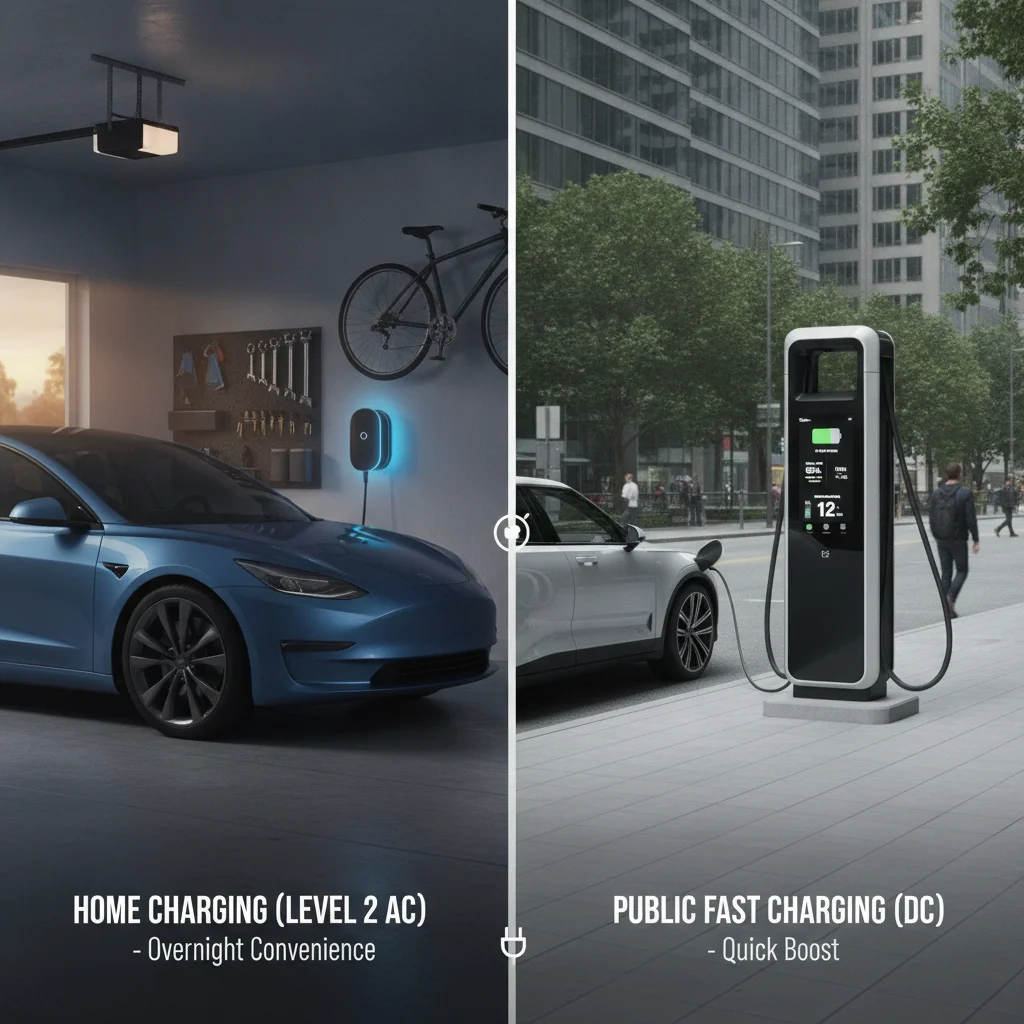
The OBC is distinct from a DC fast charger (DCFC), which bypasses the onboard charger entirely by delivering already-converted DC power directly to the battery through a dedicated port such as CCS, CHAdeMO, or NACS.
The Gap Between the Outlet and the Battery
When you plug your EV into a Level 2 station and see a slower-than-expected charging speed, the most common culprit isn't the station itself — it's the component inside your car that nobody talks about at the dealership: the onboard charger.
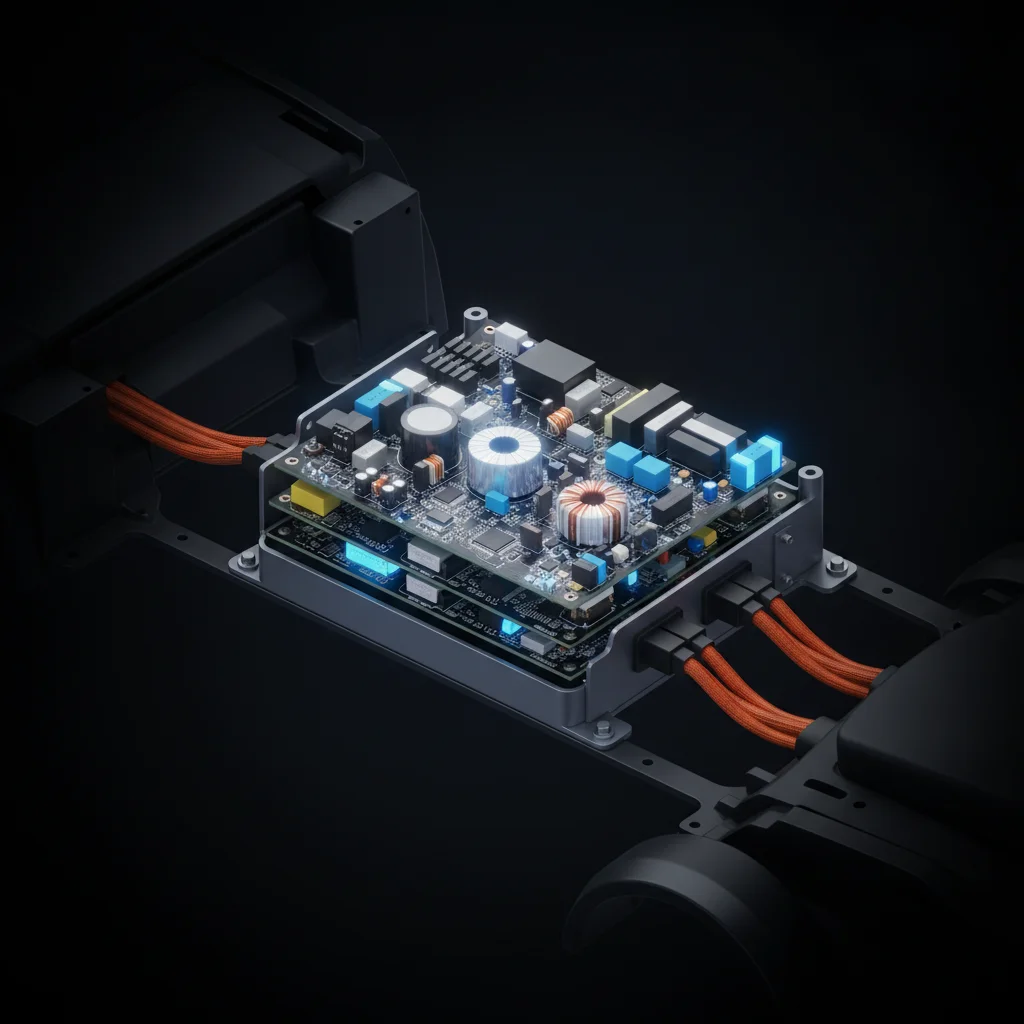
Your home electrical grid, public Level 2 stations, and standard wall outlets all deliver alternating current (AC). Your lithium-ion battery pack stores energy only as direct current (DC). Something has to bridge that gap, and that something is the onboard charger (OBC). It's a power electronics module typically located in the engine bay or under the floor, and it handles rectification — the process of converting AC waveforms into the stable DC voltage the battery management system needs.
Understanding this one component answers a lot of questions that frustrate new EV owners: Why is my car charging slower than the station is rated for? Why did the salesperson's range-per-hour estimate turn out to be optimistic? Why does upgrading to a 48-amp home charger not speed things up on my particular vehicle?
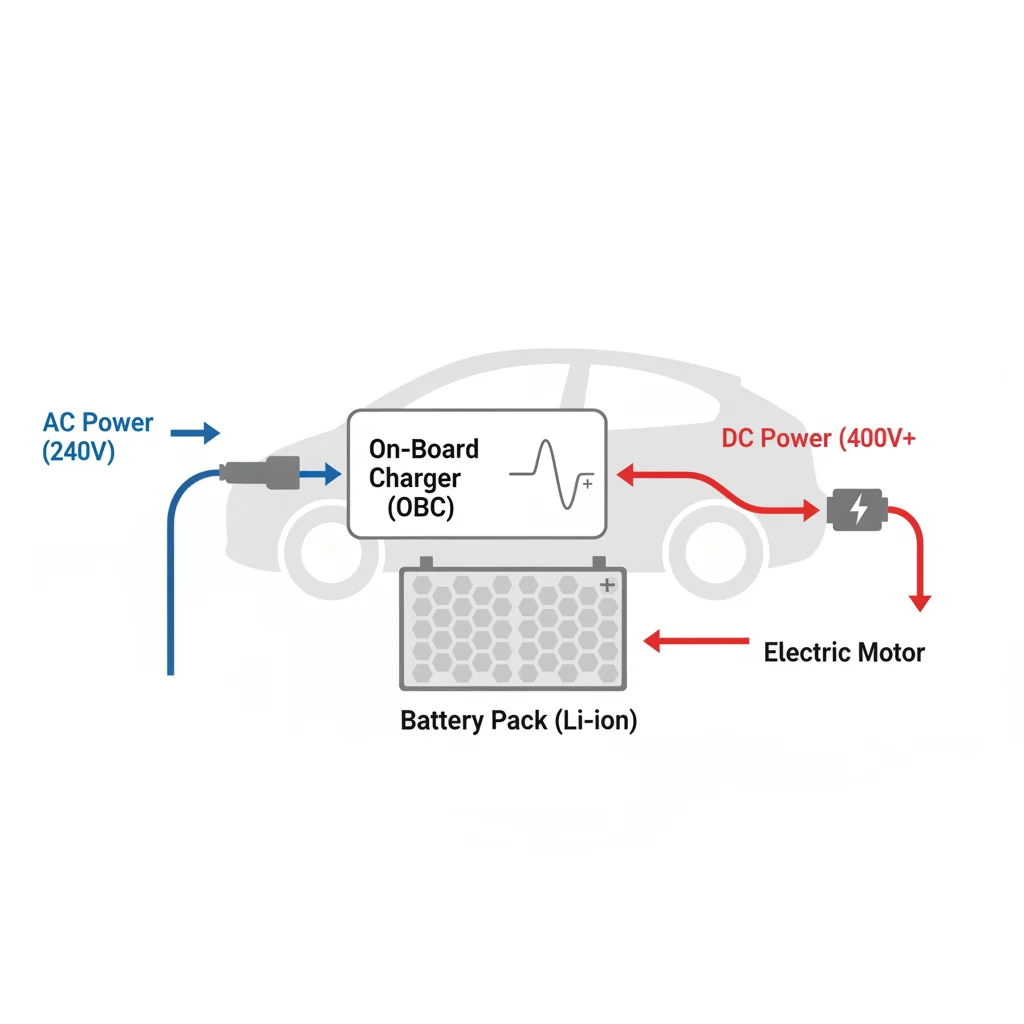
The short answer to all of them: the OBC's kilowatt rating is the ceiling. Everything else is irrelevant above that number.
How the Onboard Charger Actually Works
AC power from the grid arrives at your charging port in a sinusoidal wave — voltage oscillating between positive and negative many times per second (60 Hz in the US). The battery pack cannot accept this waveform directly. It needs a stable, unidirectional DC voltage appropriate to its chemistry and current state of charge.
The OBC performs this conversion in several stages:
- Power factor correction (PFC): The front end of the OBC draws current from the AC source in a way that minimizes reactive power loss and keeps the power factor close to 1.0. This makes the charging process more efficient and avoids overloading circuit breakers.
- DC-DC conversion: The corrected signal is then converted to the specific DC voltage needed by the battery — typically somewhere between 200V and 800V depending on the vehicle architecture. High-voltage 800V platforms (like the Hyundai Ioniq 6 or Porsche Taycan) move more energy per unit of time, which is part of why they support faster charging.
- Communication with the BMS: The OBC doesn't just dump power into the battery blindly. It's in constant communication with the battery management system (BMS), which reports current state of charge, cell temperatures, and target charge rate. The OBC adjusts its output accordingly — slowing near 100% to protect cell longevity.
The power throughput limit of all this circuitry is what we call the OBC's kilowatt rating. A 7.2 kW OBC running at full capacity draws roughly 240V × 30A from the line — a standard 40-amp circuit breaker handles this comfortably. An 11.5 kW unit needs closer to 48 amps continuous draw.
“The onboard charger is the most overlooked specification in EV purchasing decisions. Buyers obsess over DC fast-charge peaks but forget that most of their charging happens overnight at Level 2, where the OBC rating is the only number that matters.”
— Britta Gross, Director of Transportation Electrification, Rocky Mountain Institute
For a deeper look at what's happening on the DC fast-charging side — where the OBC is bypassed entirely — see our AC vs. DC charging explainer.
Why the Kilowatt Rating Changes Everything at Level 2
Here's where it gets practical. Most public Level 2 stations are rated between 7.2 kW and 19.2 kW. Home EVSEs range from around 3.8 kW (16-amp unit) to 11.5 kW (48-amp unit). But none of those numbers matter if your OBC can't match them.
7.2 kW
Most common OBC rating in US EVs
A majority of entry and mid-range EVs sold in the US as of 2024 ship with 7.2 kW onboard chargers, according to manufacturer specification data across major nameplates.
~25 mi/hr
Range added per hour at 7.2 kW Level 2
Based on EPA efficiency ratings for a mid-size EV at roughly 3.5 miles per kWh; actual results vary by vehicle and conditions.
19.2 kW
Highest common OBC in US market (F-150 Lightning)
Ford's F-150 Lightning Pro and XLT trims offer a 19.2 kW onboard charger, requiring an 80-amp dedicated circuit for full utilization.
0 kW
OBC power used during DC fast charging
DC fast chargers bypass the onboard charger entirely, delivering pre-converted DC directly to the battery — the OBC plays no role in this charging mode.
22 kW
Maximum OBC rating on some European EVs
Certain European EVs, including some Renault and BMW models, support 22 kW three-phase AC charging — a rating that exceeds what most US residential infrastructure can deliver.
Consider two popular EVs side by side. A 2024 Chevrolet Equinox EV ships with a 11.5 kW OBC. Plug it into a 48-amp Level 2 station and you're looking at roughly 37–40 miles of range restored per hour. A base-trim 2024 Nissan Leaf ships with a 6.6 kW OBC. On that same station, the Leaf pulls 6.6 kW regardless — about 22 miles of range per hour. The station is irrelevant; the car sets the rate.
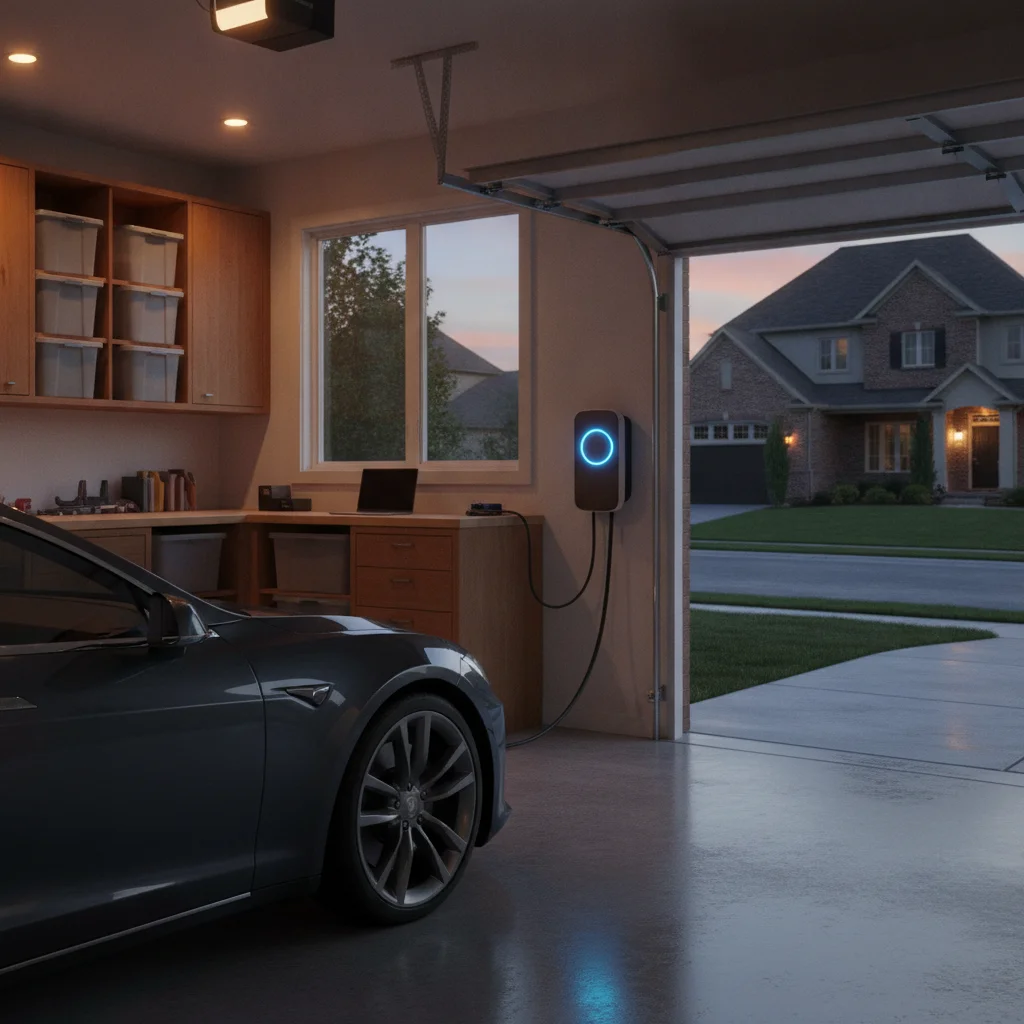
This matters enormously for home charging decisions. If you're buying a vehicle with a 7.2 kW OBC, installing a 48-amp, 11.5 kW home charger gives you no speed advantage over a 32-amp, 7.7 kW unit — and the higher-amperage unit costs more and may require a panel upgrade. You'd be paying for capacity your car can't use.
Match Your Home EVSE to Your OBC Rating
Before buying a home charging station, look up your EV's onboard charger kilowatt rating in the owner's manual or the manufacturer's spec page. Then select a Level 2 EVSE whose continuous output closely matches that rating — not exceeds it significantly. You'll save money on equipment and potentially avoid a panel upgrade, with zero loss in charging speed.
Ask About OBC at the Dealership
Make the OBC kilowatt rating a specific question before you sign. Ask: 'What is the onboard charger rating for this exact trim?' Some dealers will not know off the top of their heads — push them to look it up in the vehicle configuration spec sheet. This single number will affect your daily charging experience for years.
Conversely, if you're purchasing an EV with an 11.5 kW OBC and you install a 32-amp unit, you're leaving speed on the table every night. Matching the home EVSE to the OBC is the optimal move — our amperage selection guide walks through exactly how to do that math.
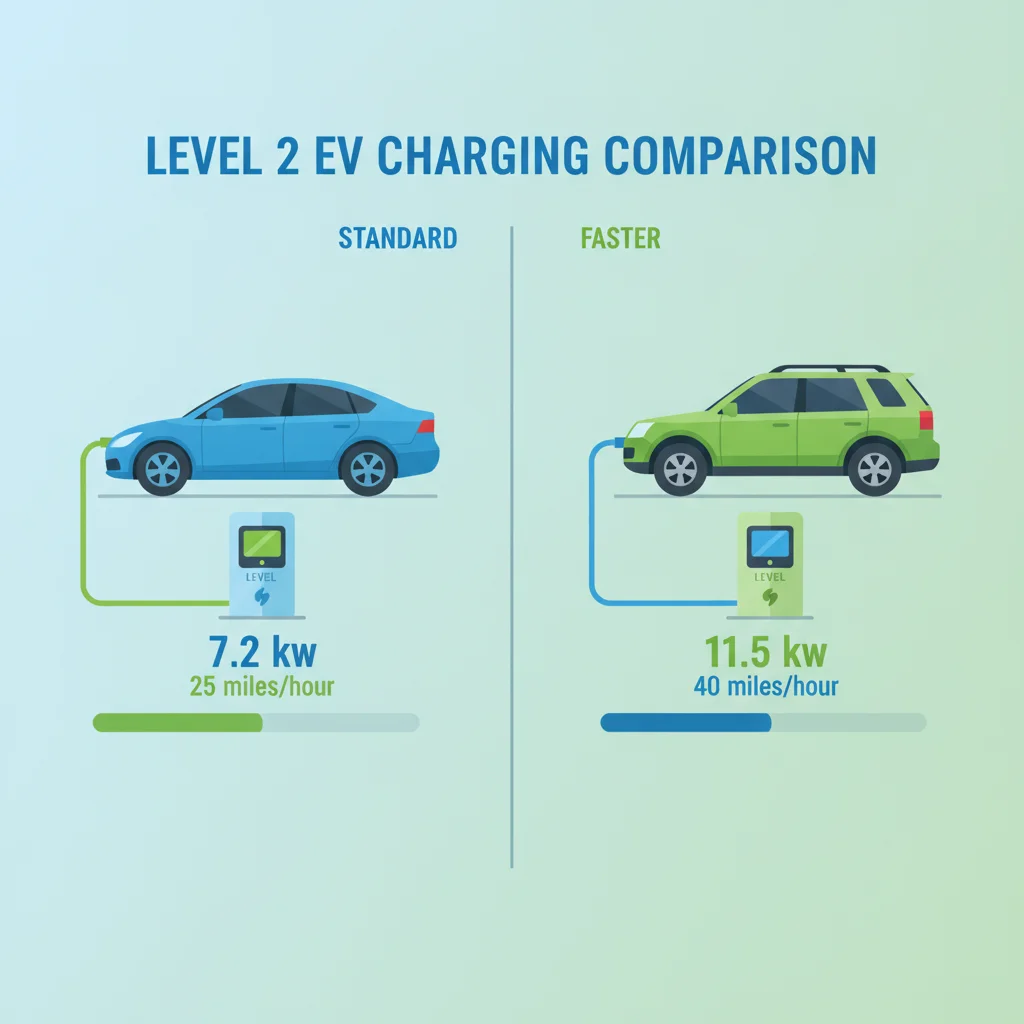
One nuance worth noting: OBC ratings can vary by trim level within the same model. Automakers sometimes offer higher-kilowatt onboard chargers as options or reserve them for upper trims. Always verify the specific configuration you're buying — don't assume trim-level parity.
OBC Ratings Can Differ Within a Model Family
Automakers sometimes tier OBC capacity by drivetrain or trim. For example, a standard-range rear-wheel-drive model may ship with a 7.2 kW OBC while the long-range all-wheel-drive version offers 11.5 kW. Always check the spec sheet for the specific configuration — model-level marketing materials may only highlight the top-tier rating.
Three-Phase Power and the US Grid
Some EVs — particularly those designed for European markets — have OBCs rated at 11 kW or 22 kW for three-phase AC. In the United States, residential power is single-phase, which means these vehicles effectively top out at their single-phase limit (typically 7.2 kW or 11.5 kW) on US home chargers. The higher rating only becomes relevant if you access three-phase commercial charging infrastructure.
Efficiency Losses Are Normal
Even a perfectly matched OBC and EVSE combination will show some efficiency loss during charging — typically 10–15% of the energy drawn from the wall. Heat dissipation within the OBC accounts for most of this. It means your electricity bill will reflect slightly more kWh consumed than what ends up stored in the battery. This is normal and accounted for in most EV range estimators.
OBC vs. DC Fast Charging: Understanding the Bypass
This is the concept that unlocks everything else about EV charging speed. DC fast chargers — whether Tesla Superchargers (V3/V4), Electrify America, EVgo, or ChargePoint DC units — do not send AC power to your vehicle. They convert AC to DC internally, then push that DC directly to the battery pack through a separate high-voltage port (CCS1, NACS, or CHAdeMO depending on the vehicle).
The onboard charger is not involved at all. It's bypassed completely. This is why a vehicle with a modest 7.2 kW OBC can still accept 50 kW, 100 kW, or even 250 kW at a DC fast charger — the ceiling the OBC imposes simply doesn't apply to that power pathway. The DC fast-charge ceiling is set by entirely different hardware: the battery's own thermal and chemical limits, and the vehicle's DC charge controller.
This architectural reality also explains one of the most common misunderstandings new EV owners have. They see their car accepting 150 kW at a Supercharger and assume their 7.2 kW OBC is somehow irrelevant. For DC fast charging, that's true. But plug that same car into a Level 2 station at a hotel overnight, and the OBC is once again the bottleneck — 7.2 kW, no more.
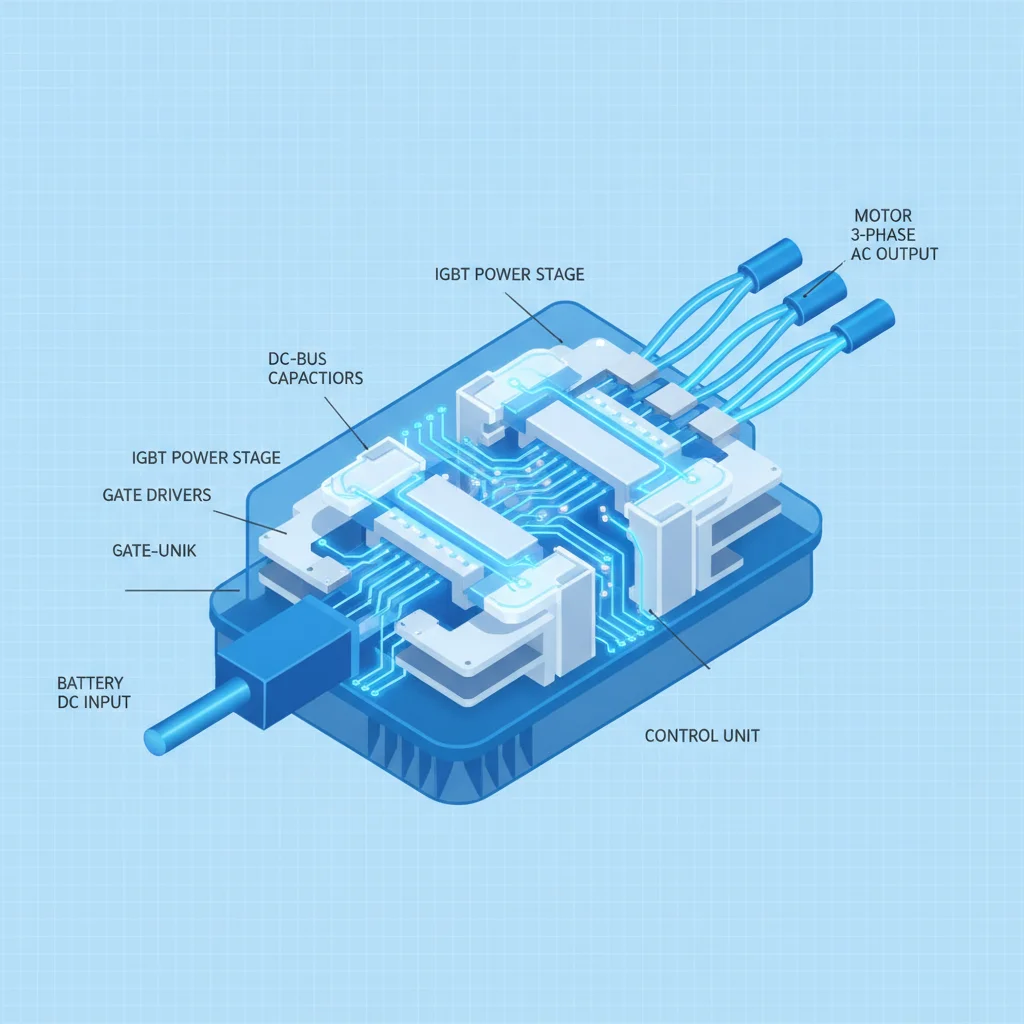
The inverter plays a complementary role on the discharge side — converting DC from the battery back into AC for the motor. It's worth understanding both conversion devices together if you want a complete picture of EV power electronics.
OBC Ratings Across Popular US Electric Vehicles
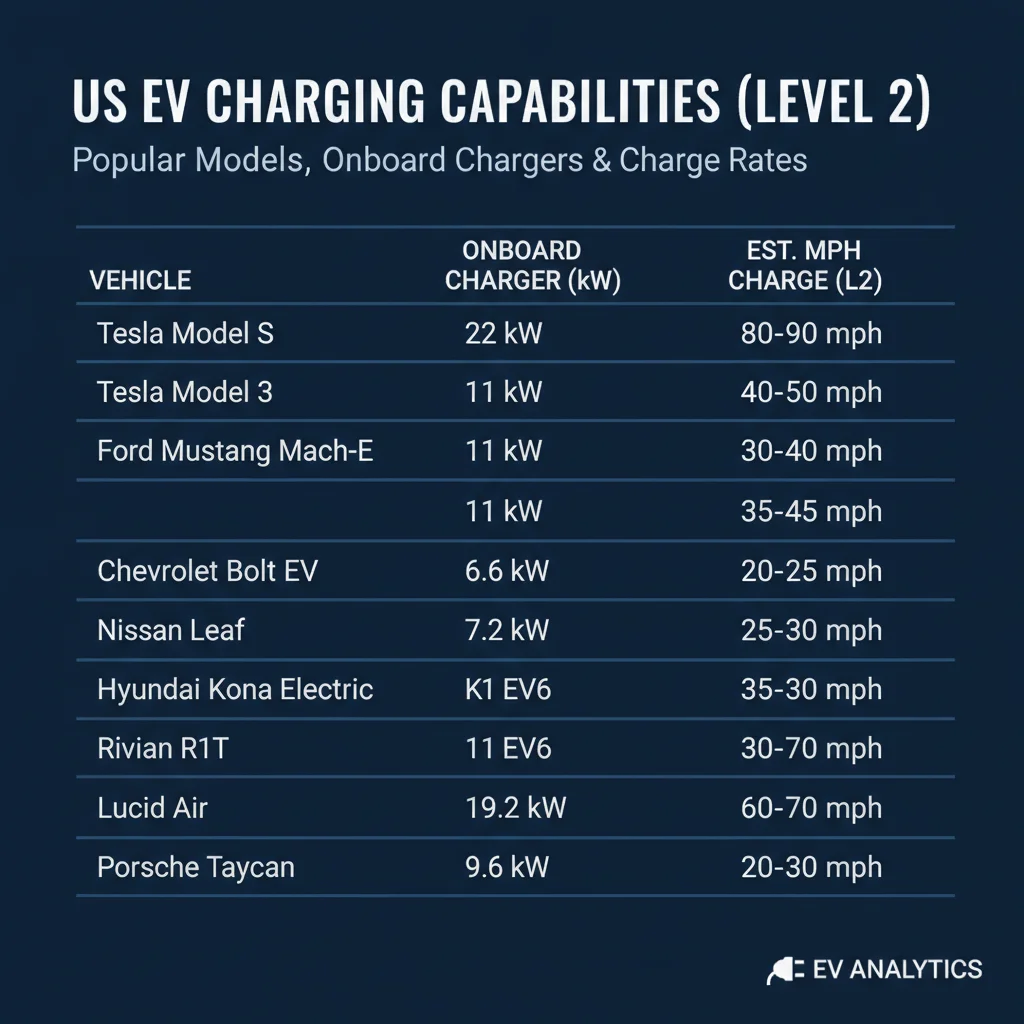
OBC ratings in the US market span a meaningful range. Here's a practical reference for vehicles commonly shopped:
| Vehicle | OBC Rating | Est. Miles/Hour at Level 2 |
|---|---|---|
| Tesla Model 3 (RWD) | 11.5 kW | ~37 miles/hr |
| Tesla Model Y (Long Range) | 11.5 kW | ~37 miles/hr |
| Chevrolet Equinox EV | 11.5 kW | ~37 miles/hr |
| Ford Mustang Mach-E | 10.5 kW | ~34 miles/hr |
| Hyundai Ioniq 6 (SE) | 11 kW | ~36 miles/hr |
| Nissan Leaf (40 kWh) | 6.6 kW | ~22 miles/hr |
| Ford F-150 Lightning (Pro) | 19.2 kW | ~54 miles/hr |
| Rivian R1T | 11.5 kW | ~37 miles/hr |
Estimates based on EPA efficiency ratings and assume a dedicated 48-amp circuit where applicable. Actual results vary with temperature, state of charge, and battery age.
Notice the F-150 Lightning Pro's 19.2 kW rating — this is only useful if you have a 80-amp circuit feeding a compatible EVSE. Most residential panels require an upgrade to support that load. It's a great example of a case where the OBC, the home charger, and the electrical panel all need to be evaluated together. See our home charging setup hub for guidance on that full assessment.
For decoding the numbers on EVSE spec sheets — kW output, continuous amperage, circuit requirements — this charger spec sheet guide is the right next read.
What This Means When You're Shopping for an EV
The OBC rating should be on your shopping checklist alongside range, DC fast-charge speed, and cargo capacity. It has direct, predictable effects on day-to-day ownership — especially if you rely on Level 2 stations at work, hotels, or public garages rather than fast-charging exclusively.
Here's how to put it to work in your evaluation:
- Calculate overnight recovery. If your daily commute is 50 miles and you charge 8 hours overnight, a 7.2 kW OBC returns roughly 176 miles — more than enough for most people. A 48-mile daily driver doesn't need an 11.5 kW OBC to make Level 2 work. Match the math to your actual usage.
- Factor in road trip stops. Level 2 destination chargers at hotels and restaurants become your fallback when DC fast chargers are busy or unavailable. A higher OBC rating squeezes more range out of a 2-hour dinner stop. That's a real quality-of-life difference on longer trips.
- Check trim-level specs explicitly. Don't rely on the marketing brochure's headline number. Look at the window sticker or the manufacturer's build-and-price configurator for the exact trim you're buying. Some automakers only unlock the higher OBC on all-wheel-drive or long-range variants.
- Plan your home charging investment accordingly. There's no reason to install a 48-amp EVSE if your OBC tops out at 7.2 kW. A 32-amp unit will max out your charging speed and cost less to install — potentially saving $300–$600 in equipment and electrician fees. Level 1 charging even deserves a look for drivers with modest daily mileage who can tolerate a slower refill rate.
If you want to dig into what kilowatts and kilowatt-hours actually mean in terms of real-world charging time, our charging speed ratings explainer connects all those units to outcomes you can actually feel at the charger.
Match Your Home EVSE to Your OBC Rating
Before buying a home charging station, look up your EV's onboard charger kilowatt rating in the owner's manual or the manufacturer's spec page. Then select a Level 2 EVSE whose continuous output closely matches that rating — not exceeds it significantly. You'll save money on equipment and potentially avoid a panel upgrade, with zero loss in charging speed.
Ask About OBC at the Dealership
Make the OBC kilowatt rating a specific question before you sign. Ask: 'What is the onboard charger rating for this exact trim?' Some dealers will not know off the top of their heads — push them to look it up in the vehicle configuration spec sheet. This single number will affect your daily charging experience for years.
The Bottom Line
The onboard charger is an unsexy but genuinely important piece of hardware. It's not something you'll ever see, and most dealership salespeople won't mention it unprompted. But it directly determines how useful every Level 1 and Level 2 charging interaction will be for the life of your vehicle.
The key things to carry forward:
- AC charging (Level 1 and Level 2) always runs through the OBC. Its kilowatt rating is your hard ceiling.
- DC fast charging bypasses the OBC. The limits there come from different hardware entirely.
- Higher OBC ratings are worth paying for if you regularly use Level 2 stations and want faster recovery per hour.
- Your home EVSE purchase should match — not exceed — your OBC's rated capacity.
- Always verify the OBC rating for the specific trim you're buying, not just the model family.
Getting this right before you sign the purchase agreement is the kind of detail that separates an EV owner who's happy with their charging setup from one who's frustrated by it. Now you have the context to ask the right questions at the dealership.
OBC Ratings Can Differ Within a Model Family
Automakers sometimes tier OBC capacity by drivetrain or trim. For example, a standard-range rear-wheel-drive model may ship with a 7.2 kW OBC while the long-range all-wheel-drive version offers 11.5 kW. Always check the spec sheet for the specific configuration — model-level marketing materials may only highlight the top-tier rating.
Three-Phase Power and the US Grid
Some EVs — particularly those designed for European markets — have OBCs rated at 11 kW or 22 kW for three-phase AC. In the United States, residential power is single-phase, which means these vehicles effectively top out at their single-phase limit (typically 7.2 kW or 11.5 kW) on US home chargers. The higher rating only becomes relevant if you access three-phase commercial charging infrastructure.
Efficiency Losses Are Normal
Even a perfectly matched OBC and EVSE combination will show some efficiency loss during charging — typically 10–15% of the energy drawn from the wall. Heat dissipation within the OBC accounts for most of this. It means your electricity bill will reflect slightly more kWh consumed than what ends up stored in the battery. This is normal and accounted for in most EV range estimators.

All claims are backed by peer-reviewed research. Sources on request.