Key Takeaways
Zero additional hardware or installation cost
The charging cable ships with most EVs and plugs into any standard 120V outlet. There's no EVSE to buy, no electrician to hire, and no permit process — the total cost of entry is $0.
Works in virtually any parking situation
Standard outlets are everywhere: garages, driveways, apartment parking lots with exterior outlets, workplaces. Level 1 requires no dedicated infrastructure, making it viable in rental housing or temporary living situations.
Covers average daily driving for most U.S. commuters
At 3–5 miles of range per hour, a 10-hour overnight session recovers 30–50 miles — enough to cover the U.S. average daily mileage of roughly 37 miles for most drivers.
Gentler on battery chemistry over time
Slow AC charging generates less heat than faster charging methods, reducing thermal stress on battery cells. While the research is still developing, slower charging rates are generally considered favorable for long-term cell health.
Ideal for evaluating real-world charging needs
Spending 30–60 days on Level 1 gives you actual data on whether you need faster home charging — preventing premature investment in a Level 2 setup you may not need.
Compatible with time-of-use electricity rates
Because Level 1 naturally stretches charging over many hours, it pairs well with overnight off-peak rate windows, keeping electricity costs low without any scheduling complexity.
Slow recovery — high-mileage days create deficits
Drivers who regularly cover 50+ miles in a day may not fully recover overnight on Level 1. Deficits compound over busy stretches, leaving drivers starting mornings with less range than expected.
No buffer for schedule disruptions
Late nights, short parking windows, and forgotten plug-ins can all cut into the charging window significantly. Level 1 offers almost no margin for error when daily mileage is already at the edge of recovery.
Poorly suited to multi-EV households
Two EVs competing for one Level 1 outlet means at least one car consistently charges less than a full overnight session, creating range anxiety across the whole household.
Cold weather reduces effective recovery range
Cold temperatures reduce battery range and trigger preconditioning, which draws power during charging. A 10-hour Level 1 session in winter may only recover 25–35 miles rather than 40–50.
Limits EV's role as a sole household vehicle
Households relying on a single EV for all trips — including frequent long days or weekend travel — may find Level 1's slow recovery rate a recurring constraint rather than an occasional inconvenience.
Can increase reliance on public DC fast charging
Drivers who frequently run short on home-recovered range may compensate with public DC fast charging, which costs more per kWh and, with heavy use, is less ideal for long-term battery health than regular slow home charging.
Our Verdict
Level 1 charging is genuinely adequate for a large slice of EV owners — not just a temporary inconvenience to endure until you install a Level 2 unit. If your daily drive is modest, you have reliable overnight parking, and you're not juggling multiple EVs, the free outlet you already own may be all the charger you need. The upgrade to Level 2 makes clear sense when daily mileage climbs, schedules tighten, or you need flexibility — but it should be a deliberate, data-driven decision, not an anxiety-driven default.
Best for new EV owners, low-mileage commuters (under 40 miles/day), renters or those in temporary housing, and anyone who wants to evaluate real charging behavior before committing to an installation.
Why Level 1 Gets Dismissed Too Fast
Walk into any EV forum or ask a dealership salesperson about Level 1 charging and the reaction is almost universally the same: that's fine for now, but you'll want to upgrade soon. It's delivered the way a doctor tells you that ibuprofen is a stopgap — implying you need the real solution. The reality is more nuanced, and that reflexive dismissal costs some owners money they don't need to spend.
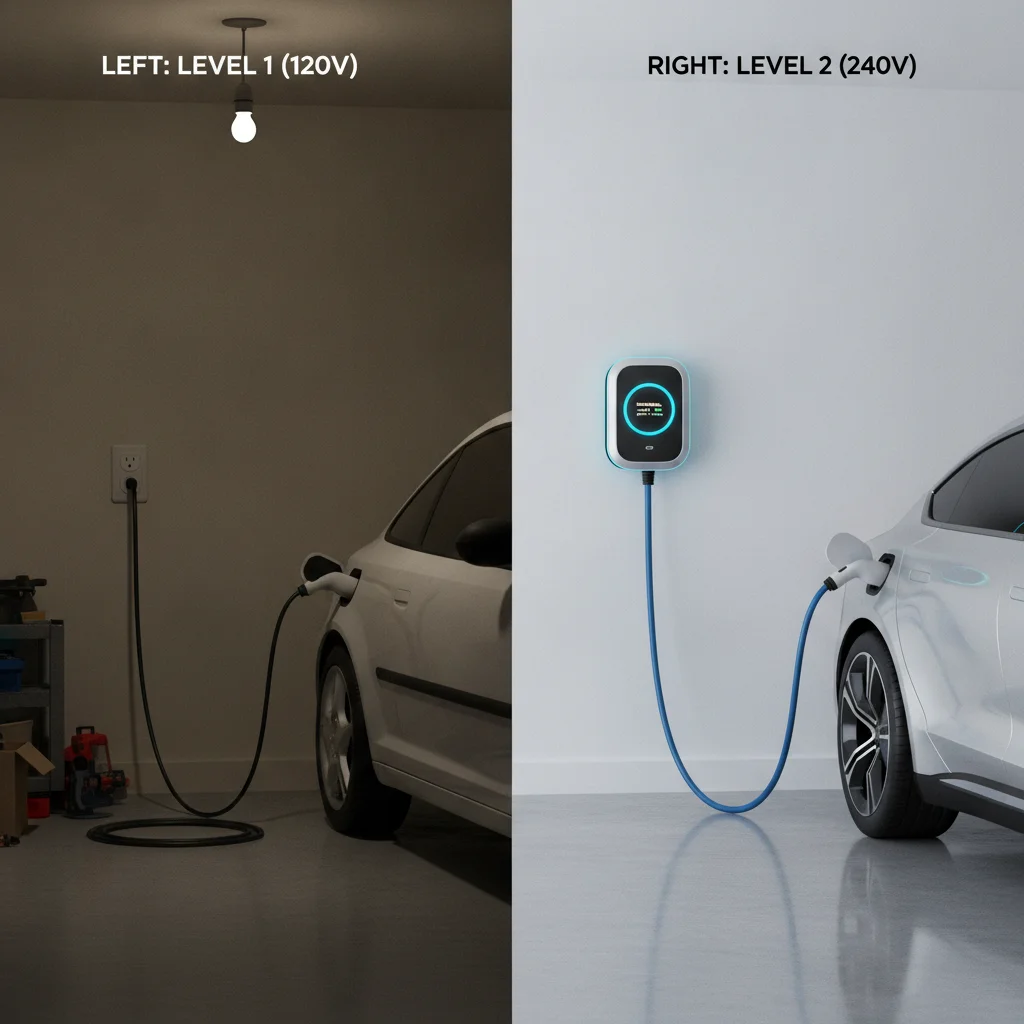
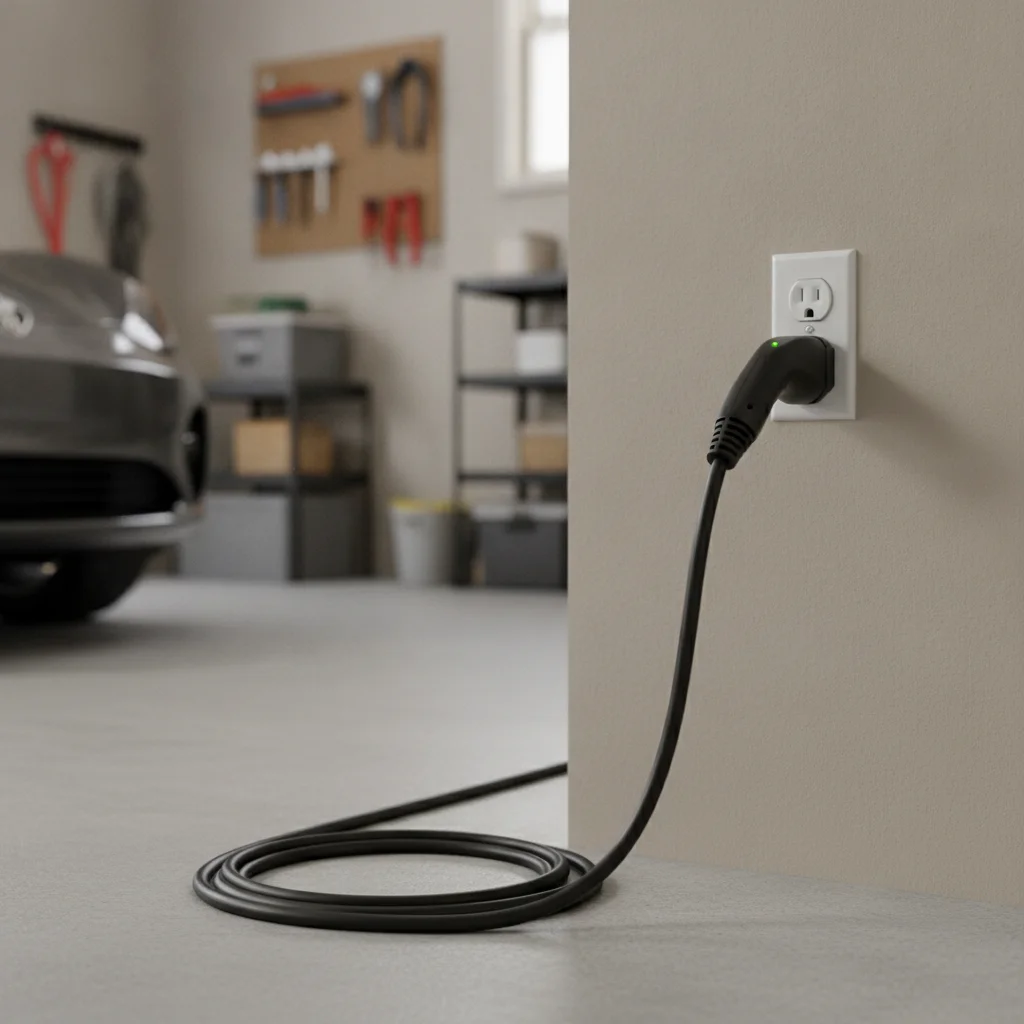
Level 1 means plugging your EV's included charging cable into a standard 120-volt household outlet — the same outlet powering your microwave or floor lamp. No electrician required, no permit, no equipment purchase. The cord typically ships in the box with the car. The charge rate is slow by design: most EVs gain roughly 3 to 5 miles of range per hour on Level 1, depending on the vehicle's onboard charger and the circuit's amperage.
That sounds anemic until you do the math on how most Americans actually drive. The Federal Highway Administration consistently puts average daily vehicle miles traveled in the U.S. at around 37 miles per day. At 4 miles per hour of charging, a 10-hour overnight session recovers 40 miles. For the average driver, that's a full reset every night — no fast charger, no EVSE installation, no additional cost.
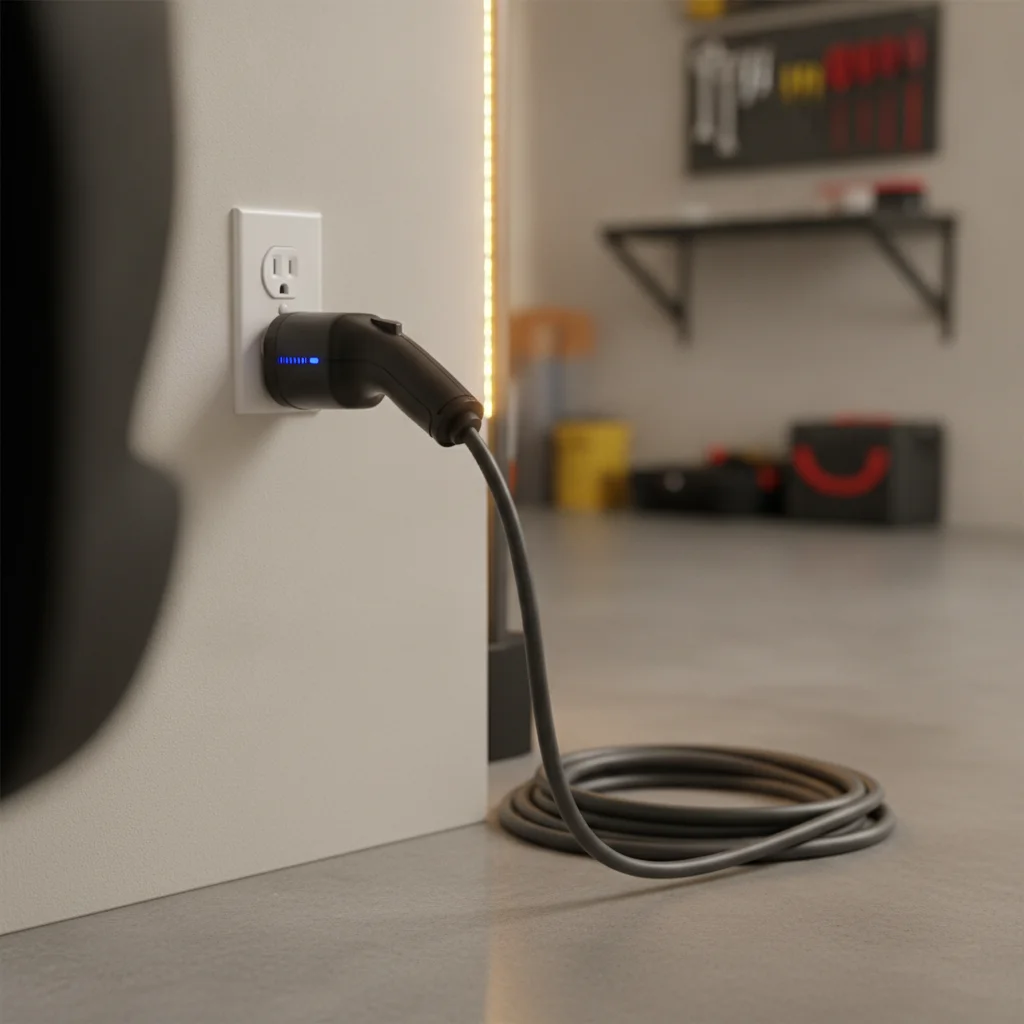
The industry tends to market toward the anxious driver planning a 300-mile road trip, not the suburban commuter who drives 22 miles to work and back. If you're in the latter camp, this article is for you. And if you're not sure which camp you're in yet, that uncertainty itself is a reason to wait before spending $800–$1,500 on a Level 2 setup. See our beginner's guide to home charging options for a full breakdown of the choices from day one.
The Real Numbers: What Level 1 Can and Can't Recover
Before landing on any charging decision, it helps to anchor the math to your specific situation. Level 1 performance varies slightly by vehicle — some EVs accept up to 12 amps on a 120V circuit (about 1.4 kW), while others top out at 8 amps (about 0.96 kW). In practical terms, that translates to 3–5 miles of range per hour as a reliable rule of thumb.
37 mi
Average U.S. daily vehicle miles traveled
According to the Federal Highway Administration's most recent National Household Travel Survey, Americans average roughly 37 miles of driving per day.
3–5 mi
Range added per hour on Level 1
Most EVs recover approximately 3 to 5 miles of range per hour when plugged into a standard 120V household outlet, depending on onboard charger capacity.
$600–$1,500
Typical Level 2 home installation cost
Hardware plus professional electrical installation for a home Level 2 EVSE typically totals $600–$1,500, varying by panel proximity, conduit needs, and regional labor rates.
~80%
EV owners who primarily charge at home
The U.S. Department of Energy has consistently found that the large majority of EV charging sessions take place at home, reinforcing the importance of right-sizing your home setup.
Here's a simple decision framework based on daily mileage:
| Daily Miles Driven | Hours Needed to Recover (at 4 mi/hr) | Level 1 Verdict |
|---|---|---|
| Under 20 miles | ~5 hours | Easily adequate |
| 20–40 miles | 5–10 hours | Generally adequate overnight |
| 40–60 miles | 10–15 hours | Borderline — depends on parking time |
| 60–80 miles | 15–20 hours | Likely insufficient alone |
| Over 80 miles | 20+ hours | Level 2 or public charging needed |
This table assumes the EV parks for the night and charging begins promptly. If you have an irregular schedule — returning home late, leaving early, or driving in two separate shifts — the calculus shifts. Likewise, drivers in cold climates should note that battery preconditioning and reduced range in winter effectively shrink the Level 1 buffer further. For a deeper look at how the speed difference shakes out in daily practice, the Level 1 vs Level 2 comparison covers that territory directly.
Advantages of Staying on Level 1
These aren't consolation prizes — they're real, substantive reasons that favor Level 1 for many owners, especially early in EV ownership.
Zero additional hardware or installation cost
The charging cable ships with most EVs and plugs into any standard 120V outlet. There's no EVSE to buy, no electrician to hire, and no permit process — the total cost of entry is $0.
Works in virtually any parking situation
Standard outlets are everywhere: garages, driveways, apartment parking lots with exterior outlets, workplaces. Level 1 requires no dedicated infrastructure, making it viable in rental housing or temporary living situations.
Covers average daily driving for most U.S. commuters
At 3–5 miles of range per hour, a 10-hour overnight session recovers 30–50 miles — enough to cover the U.S. average daily mileage of roughly 37 miles for most drivers.
Gentler on battery chemistry over time
Slow AC charging generates less heat than faster charging methods, reducing thermal stress on battery cells. While the research is still developing, slower charging rates are generally considered favorable for long-term cell health.
Ideal for evaluating real-world charging needs
Spending 30–60 days on Level 1 gives you actual data on whether you need faster home charging — preventing premature investment in a Level 2 setup you may not need.
Compatible with time-of-use electricity rates
Because Level 1 naturally stretches charging over many hours, it pairs well with overnight off-peak rate windows, keeping electricity costs low without any scheduling complexity.
The cost argument alone is compelling. A Level 2 home EVSE (the hardware unit) typically runs $300–$700, and electrician installation adds another $300–$800 depending on panel proximity, conduit requirements, and local labor rates. Permits in some jurisdictions add time and cost. That's a realistic total outlay of $600–$1,500 or more — money that makes sense if you need the speed, but represents zero ROI if Level 1 already covers your daily mileage.
The battery angle is also worth taking seriously. Most EV manufacturers recommend keeping charge levels between 20% and 80% for daily use, and charging slowly and steadily aligns with that naturally. AC vs. DC charging fundamentals explains why AC Level 1 and Level 2 charging is gentler on battery chemistry than DC fast charging — and while the difference between Level 1 and Level 2 AC is less dramatic, the principle of lower thermal stress still applies.
What 'Level 1' Actually Means Technically
Level 1 refers to charging via a standard 120-volt AC outlet, typically at 12 amps or less, delivering roughly 1.0–1.4 kilowatts of power. The current flows as AC and is converted to DC inside the vehicle by the onboard charger. For a full explanation of how that conversion works and why it matters for charging speed, see our <a href="/electric-vehicles/ev-basics/how-evs-work/ac-vs-dc-charging-the-difference-that-determines-how-fast-your-ev-refuels">AC vs. DC charging guide</a>.
Check Your Outlet Before You Rely on It
Not all 120V outlets are created equal for EV charging. The outlet you're using should ideally be on a dedicated 15-amp or 20-amp circuit — not shared with a refrigerator, space heater, or other high-draw appliance. A shared circuit can trip breakers or cause the car's charging system to throttle back automatically. An electrician can verify circuit load in under an hour, often for a modest diagnostic fee.
Renters and Condo Owners: Level 1 May Be Your Only Option
Installing a Level 2 EVSE typically requires landlord approval, HOA sign-off, and sometimes electrical panel upgrades that aren't feasible in multi-unit buildings. For renters or condo residents, Level 1 charging from an existing outlet isn't just a preference — it may be the only practical home charging option available. That makes understanding its real-world adequacy even more important.
Disadvantages You Shouldn't Ignore
Being honest about Level 1 means acknowledging where it genuinely falls short. These aren't edge cases — they're common enough situations to take seriously before deciding to hold off on an upgrade.
Slow recovery — high-mileage days create deficits
Drivers who regularly cover 50+ miles in a day may not fully recover overnight on Level 1. Deficits compound over busy stretches, leaving drivers starting mornings with less range than expected.
No buffer for schedule disruptions
Late nights, short parking windows, and forgotten plug-ins can all cut into the charging window significantly. Level 1 offers almost no margin for error when daily mileage is already at the edge of recovery.
Poorly suited to multi-EV households
Two EVs competing for one Level 1 outlet means at least one car consistently charges less than a full overnight session, creating range anxiety across the whole household.
Cold weather reduces effective recovery range
Cold temperatures reduce battery range and trigger preconditioning, which draws power during charging. A 10-hour Level 1 session in winter may only recover 25–35 miles rather than 40–50.
Limits EV's role as a sole household vehicle
Households relying on a single EV for all trips — including frequent long days or weekend travel — may find Level 1's slow recovery rate a recurring constraint rather than an occasional inconvenience.
Can increase reliance on public DC fast charging
Drivers who frequently run short on home-recovered range may compensate with public DC fast charging, which costs more per kWh and, with heavy use, is less ideal for long-term battery health than regular slow home charging.
The most consistent complaint from Level 1 users isn't a single bad day — it's the accumulation of marginal charging. If you drive more than expected one day, or you forget to plug in overnight, or you have a day of errands after a long commute, you can find yourself starting the following morning 30–40 miles short of where you expected to be. That deficit compounds on multi-day busy stretches in ways that Level 2 simply doesn't allow.
Multi-EV households face a harder constraint. Two EVs sharing a single Level 1 circuit is an arithmetic problem: one gets a full overnight charge, one gets whatever's left. In a household where both drivers have meaningful commutes, that usually means one car is running on a partial charge more often than not. For anyone considering cost-per-mile efficiency across their whole charging picture, a cost and speed comparison across all three charging levels is useful context.
The Case for Waiting Before You Upgrade
One of the underappreciated aspects of EV ownership is that your actual driving habits often look different from what you imagined before buying the car. Many new EV owners overestimate how often they'll drain the battery and underestimate how much range most modern EVs carry into the morning.

A practical approach: track your daily mileage for 30–60 days after taking delivery. Use the car's trip data or a simple log. At the end of that period, you'll know exactly how many miles you average per day, whether any days routinely exceed your Level 1 recovery window, and whether range anxiety is showing up in your behavior (unnecessary top-offs, avoiding trips) or is just a background hum that fades with familiarity.
This approach costs nothing. And a significant number of people who commit to that 60-day observation window conclude they don't need to upgrade at all — or that they can wait until they're doing a larger home project that makes the electrical work more economical to bundle. The full breakdown of what home charging installation actually involves is worth reading before you commit, so you understand exactly what you're signing up for when the time does come.
What 'Level 1' Actually Means Technically
Level 1 refers to charging via a standard 120-volt AC outlet, typically at 12 amps or less, delivering roughly 1.0–1.4 kilowatts of power. The current flows as AC and is converted to DC inside the vehicle by the onboard charger. For a full explanation of how that conversion works and why it matters for charging speed, see our <a href="/electric-vehicles/ev-basics/how-evs-work/ac-vs-dc-charging-the-difference-that-determines-how-fast-your-ev-refuels">AC vs. DC charging guide</a>.
Check Your Outlet Before You Rely on It
Not all 120V outlets are created equal for EV charging. The outlet you're using should ideally be on a dedicated 15-amp or 20-amp circuit — not shared with a refrigerator, space heater, or other high-draw appliance. A shared circuit can trip breakers or cause the car's charging system to throttle back automatically. An electrician can verify circuit load in under an hour, often for a modest diagnostic fee.
Renters and Condo Owners: Level 1 May Be Your Only Option
Installing a Level 2 EVSE typically requires landlord approval, HOA sign-off, and sometimes electrical panel upgrades that aren't feasible in multi-unit buildings. For renters or condo residents, Level 1 charging from an existing outlet isn't just a preference — it may be the only practical home charging option available. That makes understanding its real-world adequacy even more important.
When the Upgrade to Level 2 Makes Clear Sense
This article is a case for Level 1, not a case against Level 2. There are scenarios where the upgrade pays for itself in convenience and flexibility quickly enough that hesitating doesn't make sense.
- You consistently drive 50+ miles per day. Level 1 can't reliably recover that in a standard overnight window, especially accounting for cold weather, detours, and schedule variation.
- You have two EVs at home. One Level 2 unit can alternate between vehicles more efficiently than two Level 1 cords, and some EVSE units support dual-car setups.
- Your schedule is irregular. Shift workers, caregivers, and people with unpredictable hours benefit from the faster top-up that Level 2 provides when parking windows are short.
- You're planning a home renovation anyway. Electrical panel upgrades, garage builds, and renovations are the ideal time to add a 240V circuit for an EVSE — marginal cost at that point is often just the outlet and hardware.
- You rely on your EV as a sole vehicle. Single-car households where the EV does everything — commuting, weekend trips, school runs — benefit from the larger buffer that Level 2 overnight charging provides.
If you do decide to move forward, understanding the public charging landscape is also useful for filling gaps. The public charging networks hub covers how to navigate fast-charging networks when you need them, which reduces the pressure on any home charging setup. And for ongoing cost management, the charging costs and savings hub offers tools to estimate your real per-mile charging expense.
Practical Tips for Getting the Most Out of Level 1
If you're staying on Level 1 — whether permanently or while you evaluate — a few habits make a meaningful difference in how well it works for you.
- Plug in immediately when you park. Level 1's margin is thin; every hour matters. Getting into the habit of plugging in as soon as you pull in maximizes your overnight window.
- Use your car's scheduled charging feature. Most EVs let you set a departure time, and the car will manage charging to finish just before you leave — often at a slightly reduced cost if your utility offers time-of-use rates.
- Set a charge limit of 80% for daily use. This isn't just battery hygiene — it also means the car finishes charging earlier, reducing any risk of sitting at 100% for hours before departure.
- Check your outlet's circuit. Ideally, your EV charging outlet should be on a dedicated 15- or 20-amp circuit. Shared circuits with other high-draw appliances (space heaters, fridges) can trip breakers or cause the car to charge more slowly. An electrician can verify this without a full Level 2 installation.
- Keep a DCFC backup plan. Knowing where your nearest DC fast charger is — and being willing to use it once a month or on longer days — takes significant pressure off the Level 1 routine.
What 'Level 1' Actually Means Technically
Level 1 refers to charging via a standard 120-volt AC outlet, typically at 12 amps or less, delivering roughly 1.0–1.4 kilowatts of power. The current flows as AC and is converted to DC inside the vehicle by the onboard charger. For a full explanation of how that conversion works and why it matters for charging speed, see our <a href="/electric-vehicles/ev-basics/how-evs-work/ac-vs-dc-charging-the-difference-that-determines-how-fast-your-ev-refuels">AC vs. DC charging guide</a>.
Check Your Outlet Before You Rely on It
Not all 120V outlets are created equal for EV charging. The outlet you're using should ideally be on a dedicated 15-amp or 20-amp circuit — not shared with a refrigerator, space heater, or other high-draw appliance. A shared circuit can trip breakers or cause the car's charging system to throttle back automatically. An electrician can verify circuit load in under an hour, often for a modest diagnostic fee.
Renters and Condo Owners: Level 1 May Be Your Only Option
Installing a Level 2 EVSE typically requires landlord approval, HOA sign-off, and sometimes electrical panel upgrades that aren't feasible in multi-unit buildings. For renters or condo residents, Level 1 charging from an existing outlet isn't just a preference — it may be the only practical home charging option available. That makes understanding its real-world adequacy even more important.
Level 1 isn't a workaround. For a lot of drivers, it's just the right tool — understated, underappreciated, and quietly adequate.

All claims are backed by peer-reviewed research. Sources on request.