Key Takeaways
Option A
Battery Electric Vehicle (BEV)
The fully electric, zero-tailpipe-emission choice.
Best for: Drivers with consistent home or workplace charging access and predictable daily routes.
Option B
Plug-In Hybrid Electric Vehicle (PHEV)
The flexible bridge between gas and electric power.
Best for: Drivers who want electric capability without depending on a single power source for every trip.
If you park on the street or in a shared lot with no charging access
Plug-In Hybrid Electric Vehicle (PHEV)
A PHEV lets you use the gas engine as a full backup, so you're never stranded by a depleted battery. You still capture electric miles when public charging is available.
If you have reliable workplace Level 2 charging and a short commute
Battery Electric Vehicle (BEV)
Workplace charging substitutes well for home charging on short commutes. Many BEVs can fully recharge during an 8-hour workday, keeping fuel costs low.
If you frequently take long road trips in areas with sparse DC fast chargers
Plug-In Hybrid Electric Vehicle (PHEV)
PHEVs fall back on gasoline seamlessly, making long-distance travel in under-served corridors far less stressful than managing BEV range.
If you live near dense public charging infrastructure and drive under 100 miles daily
Battery Electric Vehicle (BEV)
With abundant DC fast chargers nearby and manageable daily mileage, a BEV's lower per-mile energy cost and zero tailpipe emissions make it the stronger long-term value.
If you want to minimize fuel spending without a major infrastructure commitment
Plug-In Hybrid Electric Vehicle (PHEV)
Even occasional public charging or Level 1 outlet access at work can offset significant gasoline use on a PHEV, with no hard dependency on any single energy source.
Why Home Charging Changes Everything
Every conventional comparison between BEVs and PHEVs starts with the same underlying assumption: you have a garage, a driveway, and a dedicated outlet — or at minimum, a Level 2 charger installed at home. That assumption is wrong for a large share of American drivers.
According to the U.S. Department of Energy, roughly 30% of U.S. households lack access to a private garage or covered parking, and that figure climbs sharply in dense urban areas and renter-heavy markets. If you're in an apartment, a condo with a shared lot, or a neighborhood where you park on the street, the entire calculus for electrified vehicles shifts.
Home charging isn't just convenient — it's the economic engine behind BEV ownership. Overnight Level 2 charging at residential electricity rates (typically $0.13–$0.17/kWh nationally) is what makes a BEV's per-mile fuel cost dramatically cheaper than gasoline. Strip that away, and you're left relying on public charging networks where prices are higher, waits are possible, and session reliability varies by network and location.
For PHEVs, the math is different from the start. A PHEV that isn't charged still operates as a conventional hybrid — less efficient than a dedicated hybrid like a Prius, but not stranded and not paying public charging prices for most of its miles. That built-in flexibility is what makes PHEVs genuinely worth a second look for drivers who can't always plug in at home.
See our guide to home EV charger installation for what's involved if you're weighing whether a dedicated setup is feasible for your situation.

Head-to-Head: BEV vs. PHEV Without Reliable Home Charging
Let's put the two types directly side by side across the dimensions that matter most when home charging isn't a given.
| Criterion | BEV | PHEV |
|---|---|---|
| Fuel cost (no home charging) | Higher — dependent on pricier public rates | Moderate — gas fallback controls costs |
| Range anxiety risk | High without consistent charging plan | Low — gas engine eliminates it entirely |
| Electric-only range | 150–350+ miles typical | 20–50 miles typical |
| Long-distance road trip ease | Requires DC fast charger planning | Gas fills any gap; no charger needed |
| Maintenance complexity | Lower — single powertrain | Higher — dual powertrain systems |
| Federal tax credit (max) | Up to $7,500 | Up to $3,750 (most models) |
| Opportunity charging benefit | Necessary for range management | Pure upside; no dependency |
| Emissions profile | Zero tailpipe emissions | Zero only in EV mode; gas otherwise |
| Purchase price (comparable segments) | Often higher than PHEV equivalent | Generally lower than BEV equivalent |
~30%
U.S. households without private garage or covered parking
According to U.S. Department of Energy data, approximately 30% of American households lack access to private parking where home charging could be installed.
$0.35–$0.48/kWh
Typical DC fast-charging cost on major public networks
Major networks including Electrify America and EVgo charge per-kWh rates that can run two to three times higher than average residential electricity prices.
20–50 miles
Typical PHEV all-electric range
Most 2023–2025 PHEVs offer between 20 and 50 miles of electric-only range, enough to cover the average U.S. one-way commute of about 16 miles.
3–5 miles/hour
Level 1 (120V outlet) charging rate
A standard household outlet adds roughly 3–5 miles of EV range per hour, meaning overnight Level 1 charging can fully replenish most PHEVs but only partially charges a BEV.
16 miles
Average U.S. one-way commute distance
The U.S. Census Bureau reports the average American commutes approximately 16 miles one-way, a distance within the electric range of most current PHEVs.
A few of these rows deserve additional context. The "fuel cost" comparison shifts significantly based on your public charging behavior. A BEV owner relying primarily on DC fast charging can easily pay $0.35–$0.48/kWh or more on major networks — narrowing or eliminating the per-mile cost advantage over a fuel-efficient PHEV running on gasoline. Meanwhile, the PHEV's lower electric range means even a 20-minute Level 2 top-up during errands or lunch can cover a meaningful share of daily miles.
On the maintenance side, BEVs genuinely win regardless of charging access — no oil changes, no transmission fluid, fewer brake replacements thanks to regenerative braking. A PHEV carries two powertrains, which means more components that can wear. That said, most PHEV owners report minimal drivetrain issues in the first 100,000 miles, and warranty coverage on the battery and electric drive system typically runs 8 years/100,000 miles federally mandated.
For a deeper look at the full trade-off picture for PHEVs, including the weight and complexity penalties, that's worth reading before you commit.
The Real-World Scenarios That Determine Which One Wins
Abstract comparisons only go so far. Here are four concrete living situations and which vehicle type comes out ahead in each.
Scenario 1: Urban Apartment Dweller, Street Parking
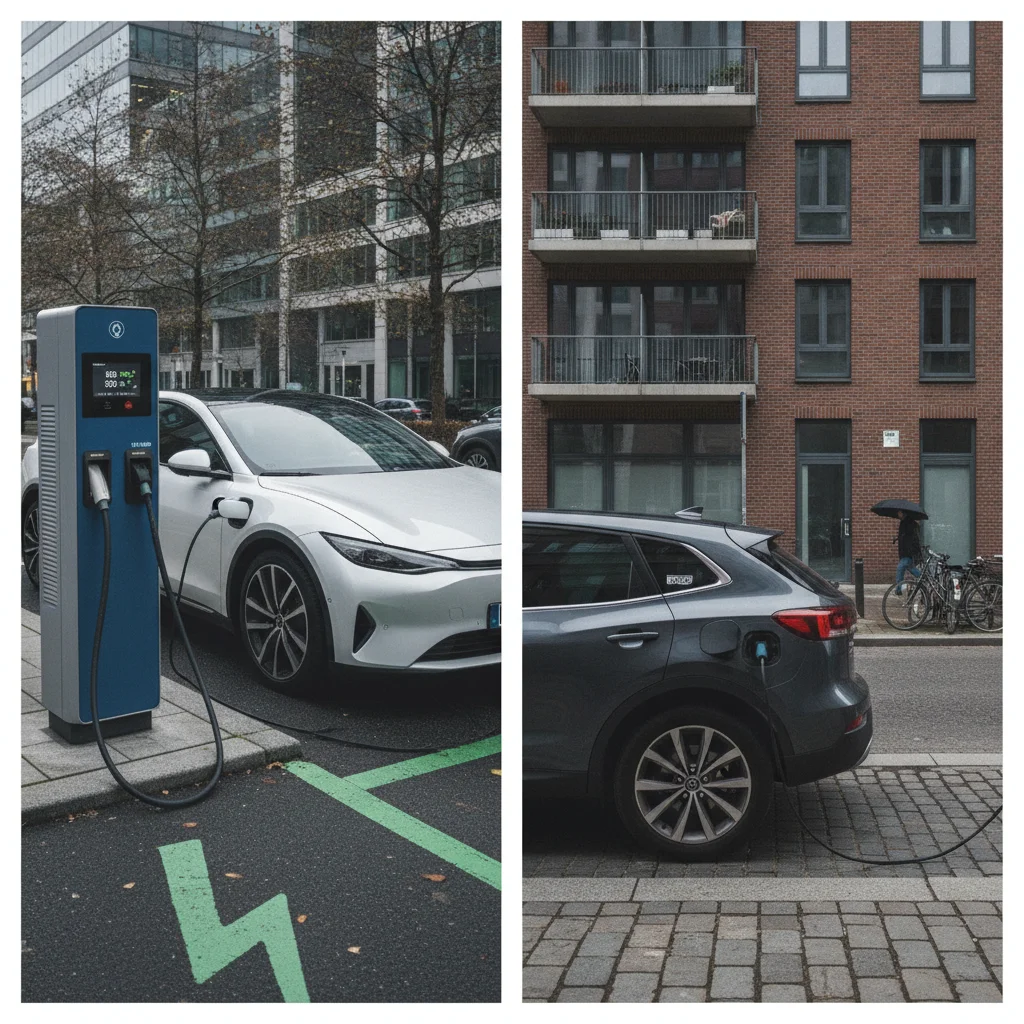
You live in Chicago, Boston, or Seattle. You park on the street or in an uncharging-equipped garage. The nearest DC fast charger is 0.8 miles away. Your commute is 12 miles each way.
In this situation, a BEV is workable but operationally annoying. You'd need to proactively visit a public charger two to three times a week, plan your schedule around charger availability, and accept higher per-kWh costs. The PHEV is far more forgiving — your 12-mile commute falls inside the electric range of most PHEVs (typically 20–50 miles), so you'd run electrically for a meaningful chunk of your miles just from occasional opportunity charging, and the gas tank backstops everything else.
Scenario 2: Suburban Renter, Parking Lot Without Charging
You rent a house in the suburbs with a landlord who won't allow outlet installation. Your round-trip commute is 35 miles. There's a Level 2 charger at your workplace.
Here, a BEV becomes viable again. Workplace Level 2 charging over an 8-hour shift can add 25–40 miles of range depending on the charger output. If your workplace charger is free or subsidized, the economics improve substantially. A PHEV also works well here, likely covering most of your commute electrically — but the BEV's lower per-mile operating cost starts to reassert itself when you have consistent access to Level 2 power.
Scenario 3: Rural Driver, Limited Public Infrastructure
You live in a rural area, drive 60+ miles daily on mixed roads, and the nearest fast charger is 30 miles away. Home charging isn't installed, but you have a standard 120V outlet in your detached garage.
A Level 1 outlet at 120V adds roughly 3–5 miles of range per hour. Overnight (10 hours), that's 30–50 miles — enough to cover a PHEV's full electric range daily but not nearly enough for most BEVs. In this scenario, a PHEV is clearly the better fit. You'd capture meaningful electric miles from the slow home outlet, run on gas for longer trips, and never worry about running out of charge in an area with sparse public infrastructure. The relationship between charging infrastructure and EV type choice is especially stark in rural contexts.
Scenario 4: City Driver Near Dense Charging Network
You live in Los Angeles or San Francisco, park in a shared building garage without chargers, but have three or four public Level 2 and DC fast charging stations within a five-minute walk. You drive under 80 miles a day.
This is where a BEV can still make economic sense despite no home charging. The density of the public network partially substitutes for home charging. The key question is whether your schedule accommodates regular charging stops — and whether the math works at local public charging rates versus gasoline. See how public DC fast-charging networks compare to understand what to expect on cost and reliability across major providers.

What About Level 1 Charging at Home?
Even if you can't install a dedicated Level 2 charger, a standard 120V outdoor outlet — if accessible at your parking spot — adds meaningful range for a PHEV overnight. A 10-hour Level 1 session can deliver 30–50 miles of electric range, enough to cover most PHEV batteries fully. For a BEV, Level 1 is typically insufficient as a primary charging source for anyone driving more than 30–40 miles daily. If a standard outlet is your only home charging option, that single fact strongly tilts the decision toward a PHEV.
Renter Charging Rights Are Expanding
Several states — including California, Colorado, and Florida — have enacted laws giving renters the right to request EV charging installation at their expense, with landlords unable to unreasonably deny the request. If you rent, it's worth checking your state's renter charging access laws before assuming home charging is impossible. The landscape is changing faster than most renters realize.
Federal Tax Credits and How Charging Access Affects Their Value
Both BEVs and PHEVs can qualify for the federal Clean Vehicle Tax Credit under the Inflation Reduction Act — up to $7,500 for new vehicles meeting assembly and income requirements. However, the way you use each vehicle type affects whether that credit translates into real savings over time.
A BEV credit is straightforward: the vehicle runs entirely on electricity, and the credit offsets a larger share of the price premium over a comparable gas vehicle. But if you're paying elevated public charging rates for most of your energy, the per-mile savings that justify a BEV's higher sticker price take longer to materialize — potentially much longer.
PHEVs qualify for a smaller credit (up to $3,750 for many models) but benefit from lower purchase prices in many segments. More importantly, a PHEV's value proposition isn't as dependent on cheap electricity — it can arbitrage between gas and electric power depending on which is cheaper and more available at any given time. If you happen to have free workplace charging, you capture that. If you're road-tripping through Montana with no chargers in sight, you run on gas and lose nothing.
The practical decision framework for choosing between electrified vehicle types walks through how to factor incentives into a full cost comparison across BEVs, PHEVs, and HEVs.
What Most Buyers Overlook: The Opportunity Charging Advantage
One concept that changes the PHEV calculus significantly is opportunity charging — plugging in whenever a charger is available, even if you don't strictly need to. Grocery store Level 2 stations, library parking lots, hotel chargers, a friend's outdoor outlet — none of these require planning a dedicated charging trip. You just plug in when the opportunity presents itself.
For a BEV driver without home charging, opportunity charging is a necessity, not a bonus. You need to be intentional about keeping the battery from running low. For a PHEV driver, every opportunity charge is pure upside. You started the day with a full gas tank, so there's no pressure. Any electric miles you add reduce your gasoline spend without creating dependency.
This asymmetry matters because it reframes how you think about public infrastructure. A BEV driver without home charging has to rely on public chargers. A PHEV driver without home charging can take advantage of public chargers opportunistically while never being at their mercy.
Before committing to either type, work through these practical questions about your commute and charging habits — particularly around how often you'd realistically plug in outside your home.

If you're still on the fence about whether a PHEV is the right category, this breakdown of who PHEVs are actually designed for cuts through the marketing and explains the real use case. And if you're weighing a PHEV against a standard full hybrid that requires no plugging in at all, this comparison of full hybrids versus PHEVs is worth reading before you finalize your shortlist.
The Bottom Line: Making the Call for Your Situation
Here's the honest summary: if you can't reliably charge at home, a BEV is a workable choice only in specific conditions — high public charging density, consistent workplace charging, or daily mileage well within your planned charging rhythm. Outside of those conditions, the convenience, flexibility, and economic resilience of a PHEV are hard to argue against.
That doesn't make PHEVs universally superior. They cost more to maintain than BEVs over time, carry more mechanical complexity, and don't offer the same clean-slate zero-emission operation. But for the driver who can't control their charging environment, a PHEV provides something a BEV fundamentally cannot: a genuine fallback that doesn't require you to change your behavior or your parking situation.
The worst outcome in this decision isn't choosing the wrong drivetrain — it's choosing a BEV based on an idealized charging scenario that doesn't reflect how you actually live and park today. Be honest about your situation, map your nearest public charging options, ask your employer about workplace charging, and then make the call based on the charging access you actually have, not the access you hope to get.
- No charging access at all: PHEV wins clearly.
- Occasional opportunity charging only: PHEV wins, but a BEV is viable with behavioral adjustment.
- Reliable workplace Level 2 charging: BEV becomes competitive for commuters.
- Dense urban public fast-charging network: Either can work; run the numbers on local charging rates vs. gas prices.
- Rural area, sparse public infrastructure: PHEV wins unless home charging installation is feasible.

All claims are backed by peer-reviewed research. Sources on request.