Key Takeaways
Why Electrified Vehicle Type Actually Matters
The term "electrified vehicle" covers a wide spectrum — from a mild hybrid that slightly reduces fuel consumption to a fully battery-electric car that never visits a gas station. The difference between those two endpoints is enormous in terms of cost, lifestyle adjustment, and long-term value. Getting this choice wrong means years of frustration: a BEV owner with no reliable charging, or a hybrid buyer who could have eliminated their gas bill entirely.
This guide walks you through a structured decision process — not a sales pitch for any particular technology. By the end, you'll have a clear match between your actual driving life and the vehicle type that fits it best.
If you want a broader self-assessment before diving into specifics, the questions to ask before choosing an EV type is a useful companion piece. This article focuses on the step-by-step mechanics of making the call.
The Three Main Categories at a Glance
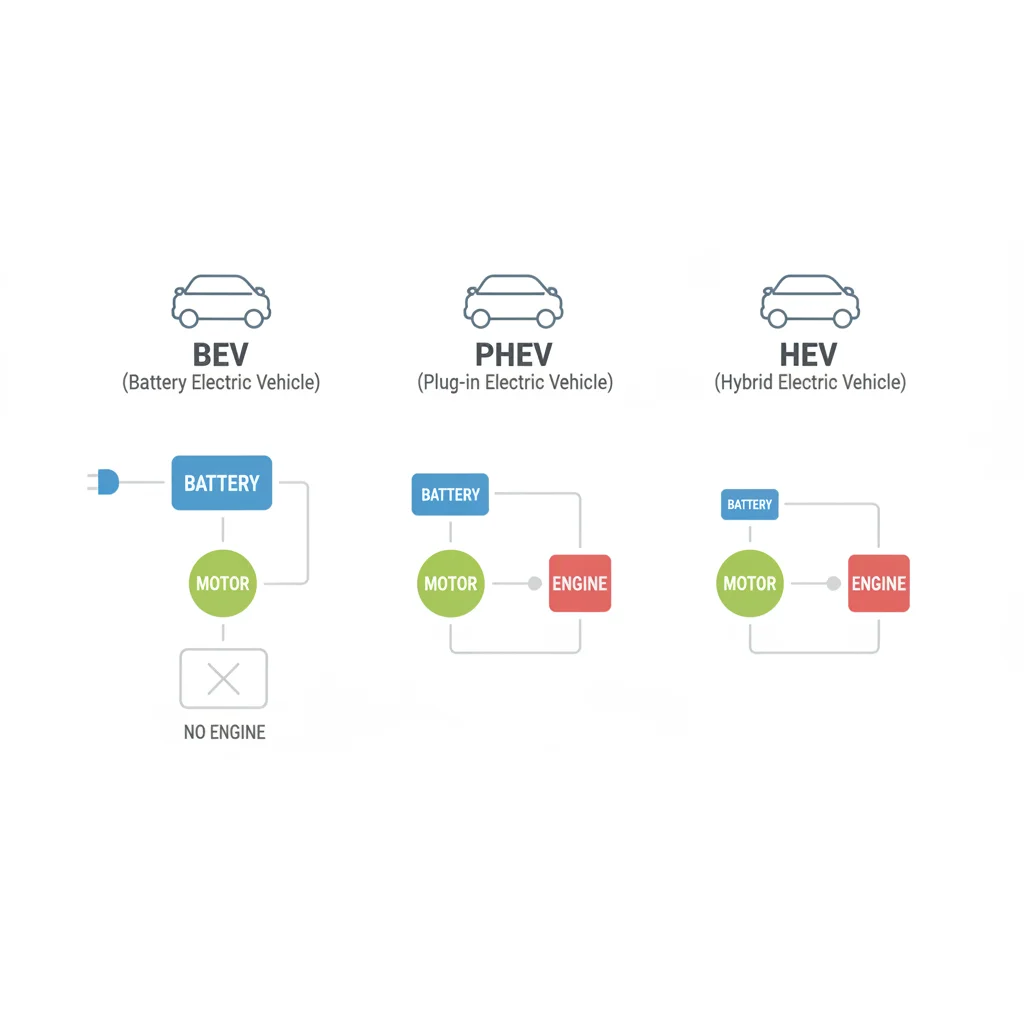
| Type | Abbr. | Charges via Plug? | Uses Gasoline? | Typical Electric Range |
|---|---|---|---|---|
| Battery Electric Vehicle | BEV | Yes | No | 150–400+ miles |
| Plug-In Hybrid | PHEV | Yes | Yes | 15–50 miles |
| Conventional Hybrid | HEV | No | Yes | 1–2 miles (assist only) |
There are also extended-range EVs (EREVs) and fuel-cell vehicles (FCEVs) at the edges of the market. If you think one of those niche categories might apply to you, see the guide to EREVs and FCEVs for a clear breakdown.
What You Need Before You Start
Before working through the decision steps below, gather a few concrete data points about your life. Estimates and gut feelings will produce a fuzzy answer. Specific numbers — even rough ones — produce a much sharper match.
What you will need
Once you have these in hand, the steps below take about 10–20 minutes to work through. You can also revisit specific steps if your situation changes — say, if you move, change jobs, or your household adds a second vehicle.
PlugShare App or Website
Locate and review user-reported EV charging stations near your home, workplace, and frequent destinations.
A Better Route Planner (ABRP)
Plan long-distance EV routes with realistic charging stops based on your specific vehicle's range and charging curve.
fueleconomy.gov Vehicle Search
Compare EPA-rated fuel economy, electric range, and federal tax credit eligibility across electrified vehicle models.
IRS Clean Vehicle Credit Tool
Verify whether a specific BEV or PHEV model qualifies for the federal clean vehicle credit and confirm income limits.
Odometer Records or Navigation App History
Establish your actual average daily and annual mileage rather than relying on estimates.
Step-by-Step: Narrowing Down Your Electrified Vehicle Type
Follow each step in order. Some steps will eliminate one or more vehicle types from your shortlist. By Step 7 you should have a clear primary recommendation and, in most cases, a logical backup option.
Calculate Your Real Daily Mileage
Pull up your phone's mapping or navigation history for the past 90 days — or check your odometer against a service record — and calculate an honest daily average. Include errands, school runs, and anything else that's part of your regular pattern. Don't use your work commute alone unless that genuinely represents your full driving life.
- Under 40 miles/day: All three types are viable. Proceed to the next step.
- 40–80 miles/day: BEV and PHEV remain viable; HEV is a fallback. Continue.
- Over 80 miles/day consistently: A BEV needs robust charging access to work. PHEV or HEV may be more practical.
Assess Your Home Charging Reality
This is the most consequential single variable in the decision. Answer these questions honestly:
- Do you park in a private garage or dedicated parking space you control?
- Would your landlord, HOA, or building management permit EV charger installation?
- Is a 120V outlet (Level 1) already accessible within reach of where you park? What about 240V for a Level 2 install?
If you answered yes to at least the first two, a BEV is technically feasible from a charging standpoint. If you answered no to most of these, you're dependent on public or workplace charging — factor that into cost and convenience estimates.
Map Your Workplace and Public Charging Access
If home charging isn't available or is marginal, determine what your next-best option is:
- Check your employer's parking facilities for Level 2 chargers — more companies offer this than employees realize, and it's often free or subsidized.
- Use PlugShare, the Department of Energy's Alternative Fuels Station Locator, or your preferred EV network app to count DC fast chargers within a 5-mile radius of your daily destinations.
- Note whether those chargers are from a single network (e.g., Tesla Supercharger) or multi-network. Multi-network charging requires either a CCS/CHAdeMO adapter or separate accounts.
If you find consistent, affordable public or workplace charging along your routine, a BEV is still a strong candidate. If options are sparse or unreliable, move toward PHEV or HEV.
Identify Your Long-Trip Frequency and Tolerance
Long-distance driving exposes the key practical difference between BEVs and other electrified types. Ask yourself:
- How often do you drive more than 200 miles in a single day? (Monthly? A few times a year? Weekly?)
- Are you comfortable adding 20–40 minutes at a DC fast charger on those trips?
- Do your long-trip routes have adequate fast-charging coverage? (Check ABRP — A Better Route Planner — for a realistic corridor assessment.)
If long trips are rare (a few times a year) and you're comfortable planning stops, a BEV handles this fine for most people. If long trips are frequent and unpredictable, the flexibility of a PHEV or HEV starts to look more attractive — you can fill up anywhere in 5 minutes.
Establish Your Budget Range — Including Incentives
Set a realistic all-in monthly budget for the vehicle, including financing or lease payment, insurance, fuel/energy, and anticipated maintenance. Then layer in incentives:
- The federal Clean Vehicle Credit (up to $7,500) is available for qualifying new BEVs and PHEVs — subject to MSRP limits, income limits, and North American assembly requirements under current IRA rules.
- Used EV credits (up to $4,000) are available for qualifying pre-owned BEVs and PHEVs purchased from a dealer.
- Many states offer additional credits, rebates, or HOV lane access for BEVs and PHEVs. Check your state's energy office website.
- HEVs do not currently qualify for federal tax credits.
If the federal credit brings a BEV or PHEV within your budget range, that changes the math significantly. If you're over income thresholds or the vehicles you're considering don't qualify, recalibrate.
Factor In Household Vehicle Composition
If this is your only vehicle, the range and charging requirements need to cover 100% of your driving scenarios — including the occasional outlier. If this is a second vehicle in a household that already has an ICE car, the calculus changes dramatically:
- A BEV as a second vehicle is far less risky — you have the ICE vehicle as backup for long trips or charging emergencies.
- A PHEV as the sole vehicle offers better flexibility than a BEV for single-car households with imperfect charging access.
- An HEV is the most flexible single-vehicle option when charging is unreliable and mileage is high.
Multi-vehicle households can rationally choose a more electric-focused primary daily driver because the risk of being stranded without charge is effectively zero.
Match Your Profile to a Vehicle Type
Based on your answers in Steps 1–6, apply this decision logic:
- Choose a BEV if:
- You have reliable home or workplace charging, drive under 200 miles on most days, take long trips infrequently or are comfortable planning charging stops, and the federal credit brings the price into your budget.
- Choose a PHEV if:
- Your charging access is partial or inconsistent, your daily mileage falls within typical PHEV electric range (15–50 miles), or you take frequent long trips and want the gasoline range as a genuine backup — not just a theoretical one. You must commit to plugging in regularly for the PHEV value proposition to hold.
- Choose an HEV if:
- You have no reliable charging access, drive high daily or annual mileage, frequently take long unpredictable trips, or simply want the improved fuel economy of electrification with zero lifestyle change.
If you're still undecided between two types, a test drive and a frank conversation with a non-commissioned advisor (like a credit union auto loan officer or an independent EV consultant) can help resolve the tie.
Once you've completed the steps, you'll have a shortlist of one or two vehicle types. At that point the search narrows to specific models, trim levels, and financing — the practical next layer of the decision.
Don't Confuse "Available" With "Convenient" Charging
Public charging stations exist in most metro areas, but availability during peak hours is not guaranteed. A charging station that's routinely occupied, out of service, or located 10 minutes out of your way is not a reliable daily charging solution. Test the actual network near your home and workplace before committing to a BEV without home charging.
Understanding Total Cost of Ownership Across Types
Sticker price comparisons between a BEV and an HEV can be misleading. A BEV typically costs more upfront but less per mile to operate — sometimes dramatically less. The math depends on your local electricity rate, local gas prices, annual mileage, and how long you plan to keep the vehicle.

A Simplified TCO Example (60,000 Miles Over 5 Years)
| Factor | BEV | PHEV | HEV |
|---|---|---|---|
| Avg. purchase premium vs. ICE equivalent | +$8,000–$15,000 | +$4,000–$8,000 | +$1,500–$4,000 |
| Fuel/energy cost (60k miles) | ~$2,400–$4,200 | ~$3,500–$6,000 | ~$6,000–$9,000 |
| Routine maintenance savings vs. ICE | Highest (no oil changes, fewer brake jobs) | Moderate | Moderate |
| Federal tax credit eligibility (2024) | Up to $7,500 | Up to $7,500 | None |
The federal Clean Vehicle Credit (IRC §30D) can dramatically shift the BEV and PHEV math. But eligibility has income caps, MSRP caps, and vehicle-assembly requirements under the Inflation Reduction Act. Always verify your specific vehicle and income situation against IRS guidance or a tax professional before factoring the credit into your budget.
Use the Point-of-Sale Credit to Your Advantage
If you qualify for the federal Clean Vehicle Credit and your dealer participates in the transfer program, you can receive the credit as an upfront price reduction rather than waiting until you file taxes. This effectively lowers your required down payment or reduces your financed amount. Ask the dealer explicitly whether they've registered to offer this — not all have.
Dual-Vehicle Households Have More Flexibility
If you have a second ICE vehicle in the household, you can rationally choose a BEV with more confidence — even if your charging access isn't perfect. Use the BEV for daily driving and the ICE vehicle for long trips or emergencies. Many households find this split dramatically reduces their overall fuel spend without requiring any lifestyle compromise.
PHEVs occupy an interesting middle ground: if you plug in consistently, your fuel spend approaches BEV territory for daily driving. If you rarely plug in, you're essentially paying a premium for a heavier conventional hybrid. The PHEV value proposition is almost entirely dependent on charging discipline.
Charging Access: The Variable That Overrides Everything Else
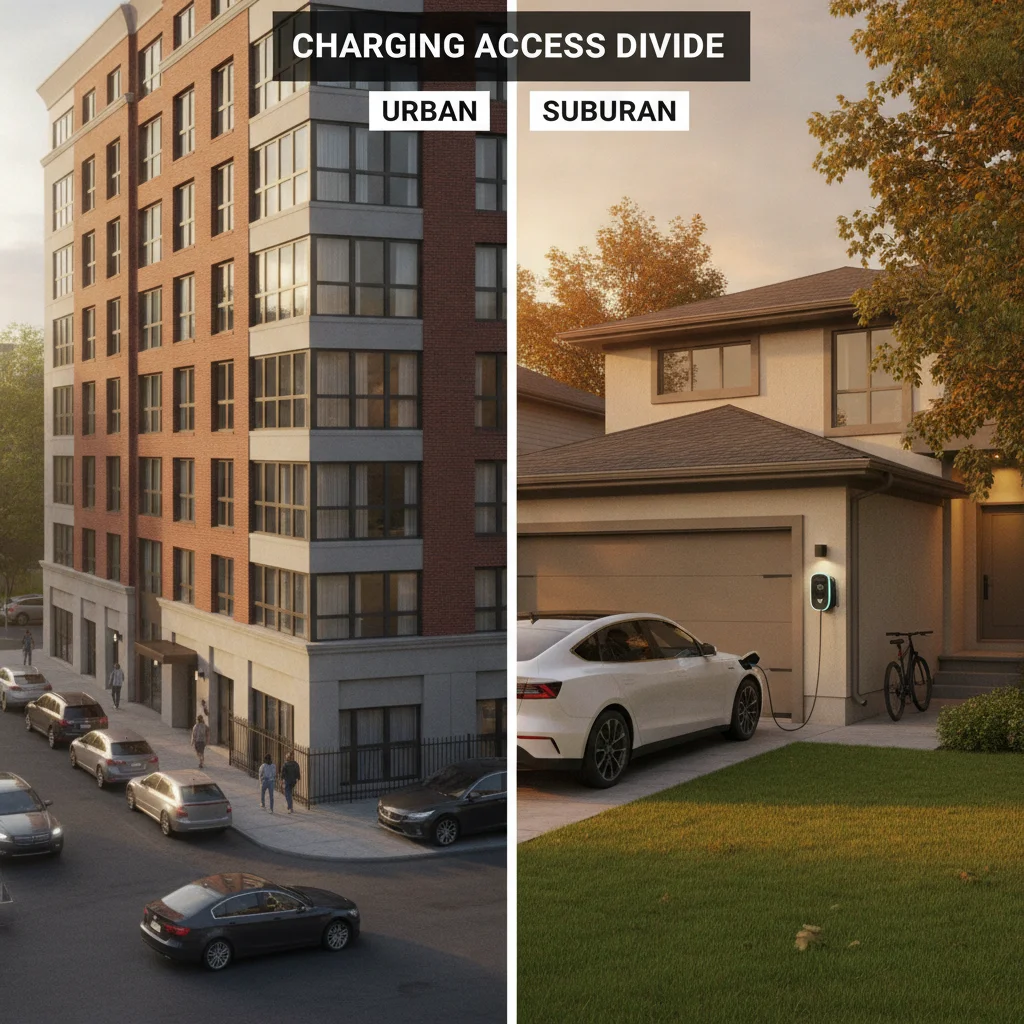
More than any other single factor, your realistic access to charging determines whether a BEV is practical for you. This is not about whether charging stations exist somewhere in your city — it's about whether you can charge conveniently and affordably in your daily routine.
The full guide to how charging infrastructure should shape your EV type decision covers this in depth. The short version:
- Home charging (Level 1 or Level 2): The single biggest predictor of BEV success. If you can plug in overnight, range anxiety largely disappears. See home charging setup options for what installation involves and costs.
- Workplace charging: A strong substitute for home charging — effectively the same benefit if your employer offers it.
- Public DC fast charging only: Workable for many BEV drivers, but adds planning friction and higher per-kWh cost. Review public charging network comparisons to understand network reliability in your region.
- No reliable charging access: A HEV is the rational choice. A PHEV becomes a fuel-only vehicle if it's never plugged in, negating most of its value.
No Home Charging Changes the Entire Equation
If you cannot reliably charge at home or work, a BEV is a high-friction choice for most drivers — not an impossible one, but one that requires consistent extra effort. Be honest with yourself here. A PHEV without regular charging provides almost no electric-mile benefit and costs more than a comparable HEV. If your charging access is genuinely unreliable, an HEV is very likely your most cost-effective option until your situation changes.
Apartment and condo dwellers face a specific challenge: building charging access in the U.S. is improving, but it remains inconsistent. If you rent or own in a multi-unit building, investigate your building's charging policy before buying a BEV. A PHEV or HEV may be the more practical interim choice while you wait for infrastructure to catch up.
Common Decision Scenarios and Likely Best Fits
Abstract frameworks are useful, but concrete scenarios make the logic stick. Below are six common buyer situations mapped to their most rational vehicle type choice.
Scenario Matching Table
| Buyer Situation | Best Fit | Runner-Up |
|---|---|---|
| Urban commuter, 25 miles/day, home garage with L2 charger | BEV | PHEV |
| Suburban family, 40 miles/day, workplace L2 charging available | BEV or PHEV | HEV |
| Sales rep, 200+ miles/day, unpredictable routes | HEV | PHEV |
| Apartment renter, no home charging, 30 miles/day | HEV or PHEV | BEV (if public network is robust) |
| Rural driver, 50 miles/day, no DC fast chargers nearby | HEV | PHEV with home L1 charging |
| Dual-car household, second vehicle is ICE, 35 miles/day | BEV or PHEV | HEV |
These aren't rigid prescriptions — they're starting points. Your financing situation, brand preferences, and specific model availability all feed into the final call. But if your scenario closely matches one of these, the best-fit column gives you a strong baseline to pressure-test against your own research.
Use the Point-of-Sale Credit to Your Advantage
If you qualify for the federal Clean Vehicle Credit and your dealer participates in the transfer program, you can receive the credit as an upfront price reduction rather than waiting until you file taxes. This effectively lowers your required down payment or reduces your financed amount. Ask the dealer explicitly whether they've registered to offer this — not all have.
Dual-Vehicle Households Have More Flexibility
If you have a second ICE vehicle in the household, you can rationally choose a BEV with more confidence — even if your charging access isn't perfect. Use the BEV for daily driving and the ICE vehicle for long trips or emergencies. Many households find this split dramatically reduces their overall fuel spend without requiring any lifestyle compromise.
A Note on Future-Proofing
Some buyers try to future-proof by choosing a BEV today even though their charging situation is marginal. That can work if you have a concrete plan — say, an L2 charger installation scheduled, or a move coming up that will provide home charging access. Buying a BEV on the assumption that charging infrastructure will improve in your area is a riskier bet, especially in rural and semi-rural markets where build-out timelines are uncertain.
Conversely, buying a plain HEV as a hedge against EV uncertainty is entirely rational — especially if you plan to keep the vehicle 8–10 years and don't yet know how your living situation may change. There's no shame in the pragmatic choice.

All claims are backed by peer-reviewed research. Sources on request.