Key Takeaways
HVAC Range Impact in EVs
HVAC (Heating, Ventilation, and Air Conditioning) range impact refers to how much battery energy a climate control system consumes while driving an electric vehicle. Unlike gasoline engines — which generate waste heat that can be redirected to warm the cabin — EVs must produce heating and cooling entirely from stored battery electricity. This creates a direct trade-off: comfort costs miles.
Resistive heating elements can draw 3–7 kW continuously, while modern EV heat pumps reduce that load to roughly 1–3 kW under moderate cold conditions. Air conditioning compressors typically draw 1–3 kW depending on ambient temperature and cabin size.
Why EVs Have an HVAC Problem Gasoline Cars Don't
Every gasoline-powered vehicle produces enormous amounts of waste heat as a byproduct of combustion. Your car's heater is essentially free — it redirects heat that would otherwise be dumped into the atmosphere through the radiator. Cooling still costs fuel, but heating is essentially a side benefit of running a thermally inefficient engine.
Electric drivetrains are far more efficient at converting energy to motion — typically 85–95% efficient versus 20–40% for a combustion engine — but that efficiency eliminates the convenient waste heat. There is no exhaust manifold to tap, no coolant loop running at 200°F. When the temperature drops and you want a warm cabin, the EV must generate that heat from the same battery that moves the car.
The consequence is mathematically straightforward: every kilowatt-hour spent on climate control is a kilowatt-hour not available for propulsion. On a 75 kWh battery pack with 200 miles of EPA range, a 5 kW heating load running for one hour consumes roughly 2.5% of usable capacity — but because that load runs continuously during the drive, the cumulative impact on range can be severe.
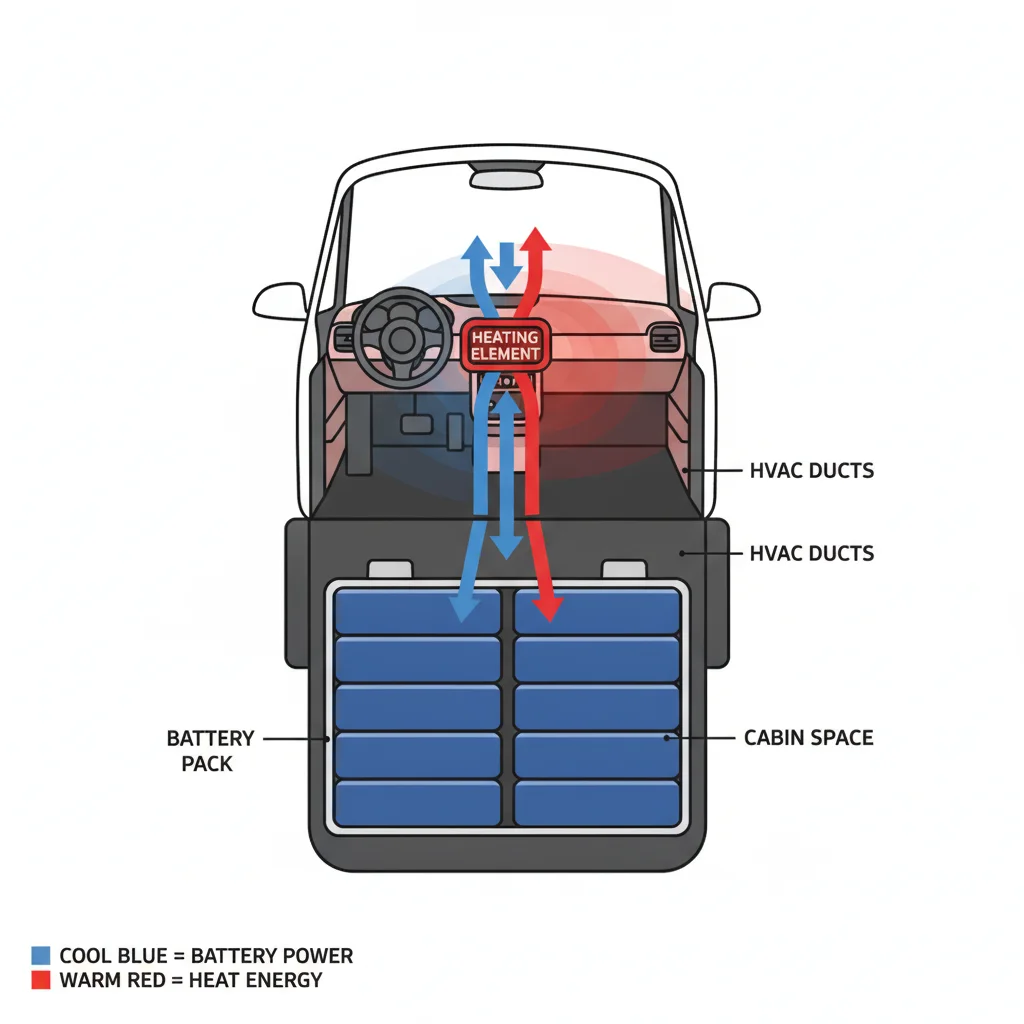
EPA range estimates are measured at approximately 72°F (22°C) with climate control minimized. The moment you move outside that narrow comfort zone, the gap between the sticker number and your actual range begins to widen.
The Numbers: How Much Power Does HVAC Actually Draw?
To understand the scale of the problem, it helps to look at HVAC power consumption in concrete terms. These figures vary by vehicle model, ambient temperature, and system design, but real-world testing and published automaker data provide useful benchmarks.
41%
Average range loss at 20°F with heater on
According to AAA testing of multiple EV models driving at 20°F (-7°C) with cabin heating active.
17%
Average range loss at 95°F with AC on
AAA testing found air conditioning in summer heat caused significantly less range reduction than winter heating.
3–7 kW
Peak resistive heating power draw
Resistive cabin heaters in EVs can consume 3–7 kilowatts continuously at very low ambient temperatures.
2–3x
Heat pump efficiency advantage over resistive heating
Heat pumps deliver 2–3 kWh of thermal energy per 1 kWh of electricity consumed under moderate cold conditions.
10–20%
Range recovered through pre-conditioning
Pre-conditioning the cabin while plugged in can recover a significant share of the range otherwise lost to HVAC demand.
Resistive heating — the electric equivalent of a toaster coil — is the biggest culprit in cold climates. It draws power in proportion to the heat it needs to generate, and cold air requires a lot of heat. At 0°F (-18°C), a mid-size EV may need 5–7 kW just to maintain a 68°F cabin temperature while driving. At 20°F (-7°C), expect 3–5 kW. Even at 40°F (4°C), a steady 1.5–3 kW is typical.
Air conditioning compressors are more moderate but still meaningful. At 95°F (35°C) ambient temperature, cooling a cabin might draw 2–4 kW. At 80°F (27°C), the same cabin might only need 1–1.5 kW to maintain comfort. Critically, the A/C compressor cycles on and off rather than running continuously, so average draw is often lower than peak draw.
Battery Thermal Management Is a Separate Load
HVAC for passenger comfort and thermal management for the battery pack are distinct systems with separate energy draws. In extreme heat, the battery's cooling loop may consume 0.5–2 kW independently of whether you've set the cabin to a comfortable temperature. This means your total climate-related energy use in summer can be higher than the A/C setting alone suggests.
Elevation Adds to the Calculation
On mountain routes in winter, HVAC load and elevation-related energy demand compound each other. Cold temperatures increase heating load while climbing grades increase drivetrain demand simultaneously. For a full picture of how topography interacts with your range budget, see our detailed look at <a href="/electric-vehicles/ev-basics/ev-range-efficiency/how-elevation-change-affects-ev-range-on-hilly-and-mountain-routes">how elevation change affects EV range on hilly routes</a>.
The interaction between HVAC and battery thermal management adds another layer. In extreme heat, the battery pack itself may require active cooling to prevent degradation — this is a separate energy draw from cabin cooling and can add another 0.5–2 kW. You can read more about this dynamic in our coverage of how extreme heat affects battery chemistry and range.
Heating vs. Cooling: Which Season Hurts More?
The seasonal asymmetry in HVAC range loss surprises many EV owners. Most assume that blasting the air conditioner on a hot summer day is the worst-case scenario. In practice, winter heating is typically far more damaging to range — for two compounding reasons.
First, the power demand is higher. Resistive heating at 0°F can draw more than twice the peak wattage of air conditioning at 95°F. Second, cold temperatures reduce lithium-ion battery capacity independently of HVAC use. A battery pack that delivers 100% of its rated capacity at 70°F might only deliver 70–80% at 20°F before HVAC is even considered. Stack a 4 kW heating load on top of reduced battery capacity and the range hit is multiplicative, not additive.
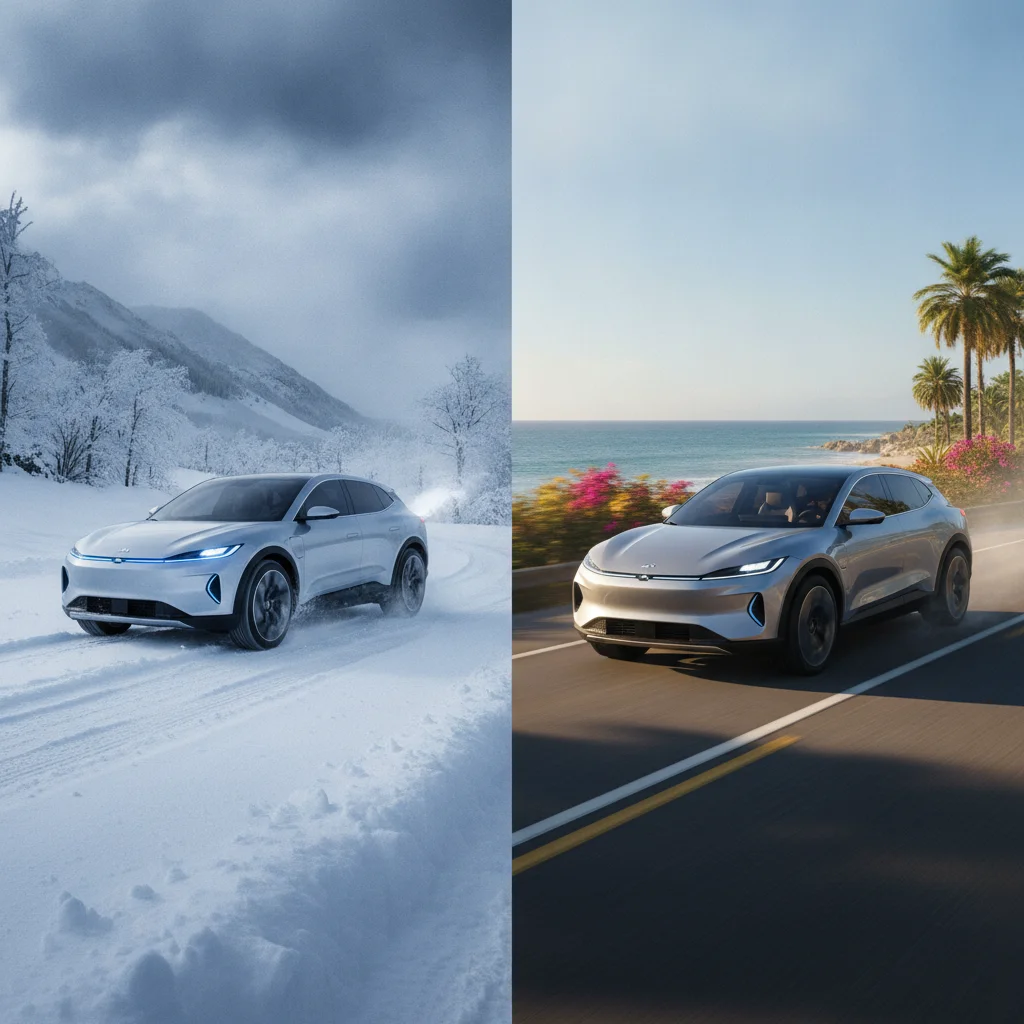
Research by the American Automobile Association (AAA) found that at 20°F with the heater on, EVs tested lost an average of 41% of their rated range. At 95°F with air conditioning running, the same vehicles lost an average of 17%. Those figures align with what owners report in practice and what we've observed in extended testing.
For a deeper look at how low temperatures compound this effect at the chemistry level, see our analysis of why cold weather reduces EV battery range. And if you're comparing how different EV architectures — BEV, PHEV, and HEV — respond differently to winter conditions, this breakdown of cold-weather performance by EV type covers the distinctions in detail.
“The impact of temperature on EV range is not subtle. Our testing shows that in real-world winter conditions, drivers may experience range reductions that significantly exceed what many expect based on the window sticker — and cabin heating is the dominant factor.”
— Greg Brannon, Director of Automotive Engineering, American Automobile Association (AAA)
Heat Pumps: The Technology That Changes the Equation
A heat pump doesn't generate heat — it moves it. By extracting thermal energy from outside air (even cold air contains usable heat energy above absolute zero) and concentrating it inside the cabin, a heat pump can deliver 2–3 kWh of heating for every 1 kWh of electricity consumed. That's a coefficient of performance (COP) of 2–3, compared to a COP of exactly 1.0 for a resistive heater.
The practical implication: at 32°F (0°C), an EV with a heat pump might use 1.5–2 kW to heat the cabin where a resistive system would use 3–4 kW. The energy savings translate directly to preserved range.
Check for Heat Pump Before You Buy
When comparing EV models, verify whether heat pump HVAC is standard or optional on the trim you're considering. On some vehicles, the heat pump is exclusive to higher trims and adds $1,000–$2,500 to the price. In climates that regularly see temperatures below 32°F, that cost can pay back quickly in reduced charging frequency over a winter season.
Layer Up to Reduce Range Loss
Dressing warmly for short winter drives and relying primarily on seat heaters rather than full cabin heating is one of the most effective — and free — range-preservation strategies available. Setting the cabin to 60°F instead of 72°F while wearing a jacket can cut heating load by 30–40% in mild cold conditions, recovering meaningful miles on a long commute or road trip.
Heat pump efficiency does fall as temperatures drop — below -13°F (-25°C), most automotive heat pumps struggle to extract sufficient ambient heat and must supplement with resistive elements. But in the temperature ranges most drivers encounter most often — 10°F to 40°F (-12°C to 4°C) — a heat pump provides meaningful, real-world savings.
Not all EVs include heat pumps as standard equipment, and some offer them only on higher trim levels or as optional add-ons. If winter range is a priority, understanding how heat pumps work and which vehicles include them is a worthwhile step before purchase.
Practical Strategies to Reduce HVAC Range Loss
You can't eliminate HVAC energy consumption, but you can manage it intelligently. The following strategies are ranked by impact, from highest to lowest.
1. Pre-condition while plugged in
Pre-conditioning — warming or cooling the cabin before you unplug — is the single highest-impact tactic available. It draws power from the grid rather than the battery, so you arrive at your starting range with a comfortable cabin already at temperature. Most EVs allow you to schedule pre-conditioning through their companion apps. For a complete guide to timing and settings, see how pre-conditioning works and when it's worth using.
2. Use seat heaters and steering wheel heaters instead of cabin heat
A seat heater draws roughly 40–100 watts per seat. A cabin heater draws 3,000–7,000 watts. Warming the occupant rather than the air volume of the entire cabin is a dramatic efficiency gain. Most drivers find that seat heat plus a mild fan setting (to prevent fogging) is fully comfortable down to the mid-20s Fahrenheit.
3. Set a moderate target temperature
The HVAC system works harder — and draws more power — to maintain extreme temperatures. Targeting 65–68°F rather than 72–74°F in winter, or 72°F rather than 68°F in summer, meaningfully reduces the continuous load. Even a 4°F shift in target temperature can reduce heating load by 15–25% in mild cold conditions.
4. Use recirculation mode strategically
Recirculating already-conditioned cabin air instead of pulling in outside air reduces the amount of heating or cooling required. In summer, recirculation is particularly effective — outside air at 95°F requires far more cooling than cabin air already at 72°F. In winter, recirculation reduces the volume of cold outside air the system must heat, though it must be balanced against window fogging.
5. Park in shade or a garage when possible
A cabin pre-heated by solar gain in summer — or super-cooled in winter — requires the HVAC system to work significantly harder at departure. Parking in shade or a climate-controlled garage reduces the initial load and extends the benefit of pre-conditioning.
For context on how HVAC compares to other aerodynamic range factors — like whether open windows are actually worse than air conditioning at highway speeds — the A/C vs. open windows efficiency analysis offers useful perspective across vehicle types.
Check for Heat Pump Before You Buy
When comparing EV models, verify whether heat pump HVAC is standard or optional on the trim you're considering. On some vehicles, the heat pump is exclusive to higher trims and adds $1,000–$2,500 to the price. In climates that regularly see temperatures below 32°F, that cost can pay back quickly in reduced charging frequency over a winter season.
Layer Up to Reduce Range Loss
Dressing warmly for short winter drives and relying primarily on seat heaters rather than full cabin heating is one of the most effective — and free — range-preservation strategies available. Setting the cabin to 60°F instead of 72°F while wearing a jacket can cut heating load by 30–40% in mild cold conditions, recovering meaningful miles on a long commute or road trip.
How to Set Realistic Range Expectations in Any Weather
The gap between EPA-rated range and real-world range is a persistent source of frustration for EV owners — and HVAC is one of the primary contributors. Setting honest expectations requires accounting for ambient temperature, drive duration, and your personal climate preferences before you leave the driveway.
A practical framework: start with EPA range, apply a temperature correction factor, then subtract estimated HVAC load.
| Ambient Temperature | Estimated Range Retention (no HVAC) | Estimated Range Retention (with HVAC) |
|---|---|---|
| 72°F (22°C) | ~100% | 95–100% |
| 50°F (10°C) | ~95% | 80–90% |
| 32°F (0°C) | ~85% | 65–75% |
| 20°F (-7°C) | ~75% | 55–65% |
| 0°F (-18°C) | ~65% | 45–55% |
| 95°F (35°C) | ~90% | 75–85% |
These are general estimates; your specific vehicle, HVAC technology (heat pump vs. resistive), driving speed, and highway vs. city mix all shift these figures. Many newer EVs display real-time energy consumption broken down by drivetrain, climate, and ancillary loads — checking that screen regularly builds a calibrated sense of your own vehicle's behavior.
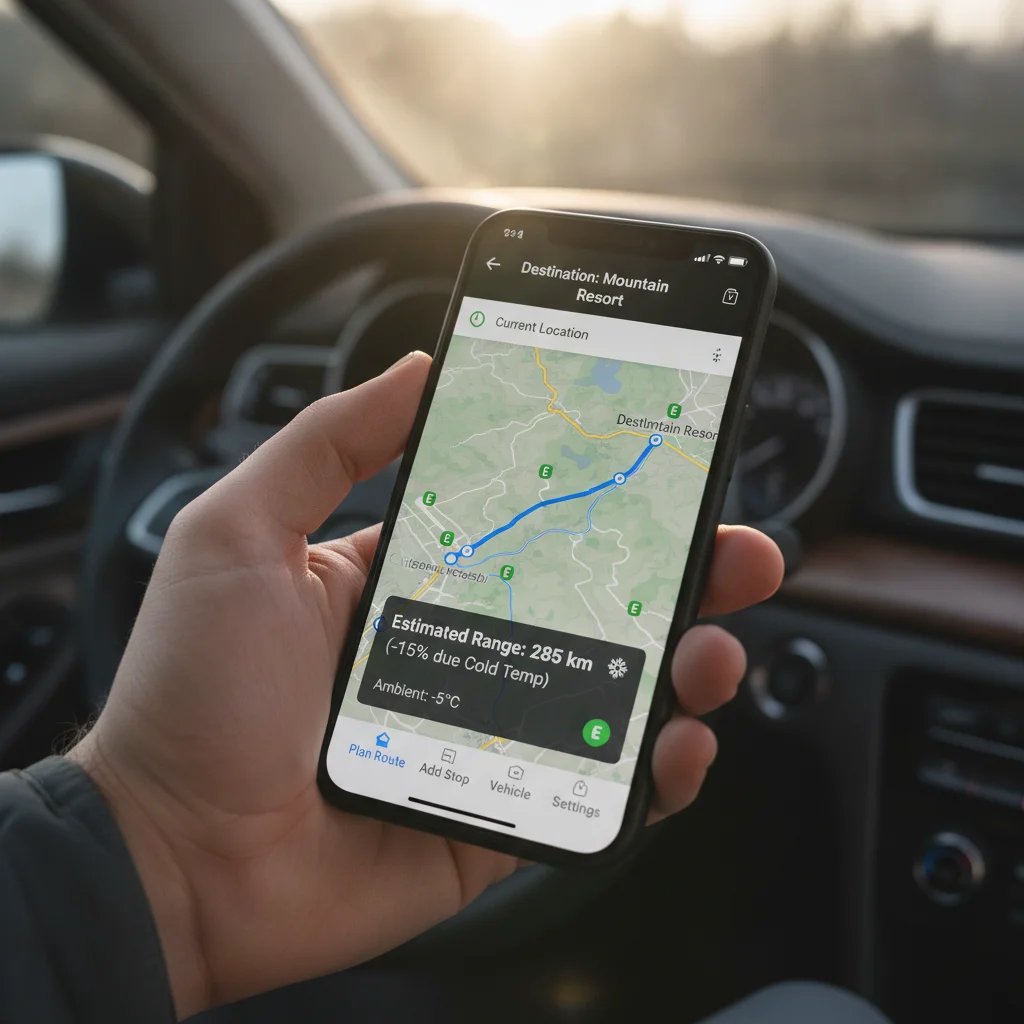
Route planning tools like A Better Routeplanner (ABRP) incorporate temperature and HVAC assumptions into their calculations, making them more accurate than in-car estimates in many cases. If you're planning a long winter trip, inputting the actual forecast temperature produces a significantly more reliable range projection than relying on the factory estimate.
For a broader look at all the factors that push real-world range below the advertised number — including highway speeds, payload, and tire pressure — our analysis of why EVs rarely hit their rated range covers the full picture. And if you're weighing the cost implications of HVAC-driven charging frequency, our charging costs and savings hub can help you estimate the financial impact.
Battery Thermal Management Is a Separate Load
HVAC for passenger comfort and thermal management for the battery pack are distinct systems with separate energy draws. In extreme heat, the battery's cooling loop may consume 0.5–2 kW independently of whether you've set the cabin to a comfortable temperature. This means your total climate-related energy use in summer can be higher than the A/C setting alone suggests.
Elevation Adds to the Calculation
On mountain routes in winter, HVAC load and elevation-related energy demand compound each other. Cold temperatures increase heating load while climbing grades increase drivetrain demand simultaneously. For a full picture of how topography interacts with your range budget, see our detailed look at <a href="/electric-vehicles/ev-basics/ev-range-efficiency/how-elevation-change-affects-ev-range-on-hilly-and-mountain-routes">how elevation change affects EV range on hilly routes</a>.
All claims are backed by peer-reviewed research. Sources on request.