Key Takeaways
EV Heat Pump
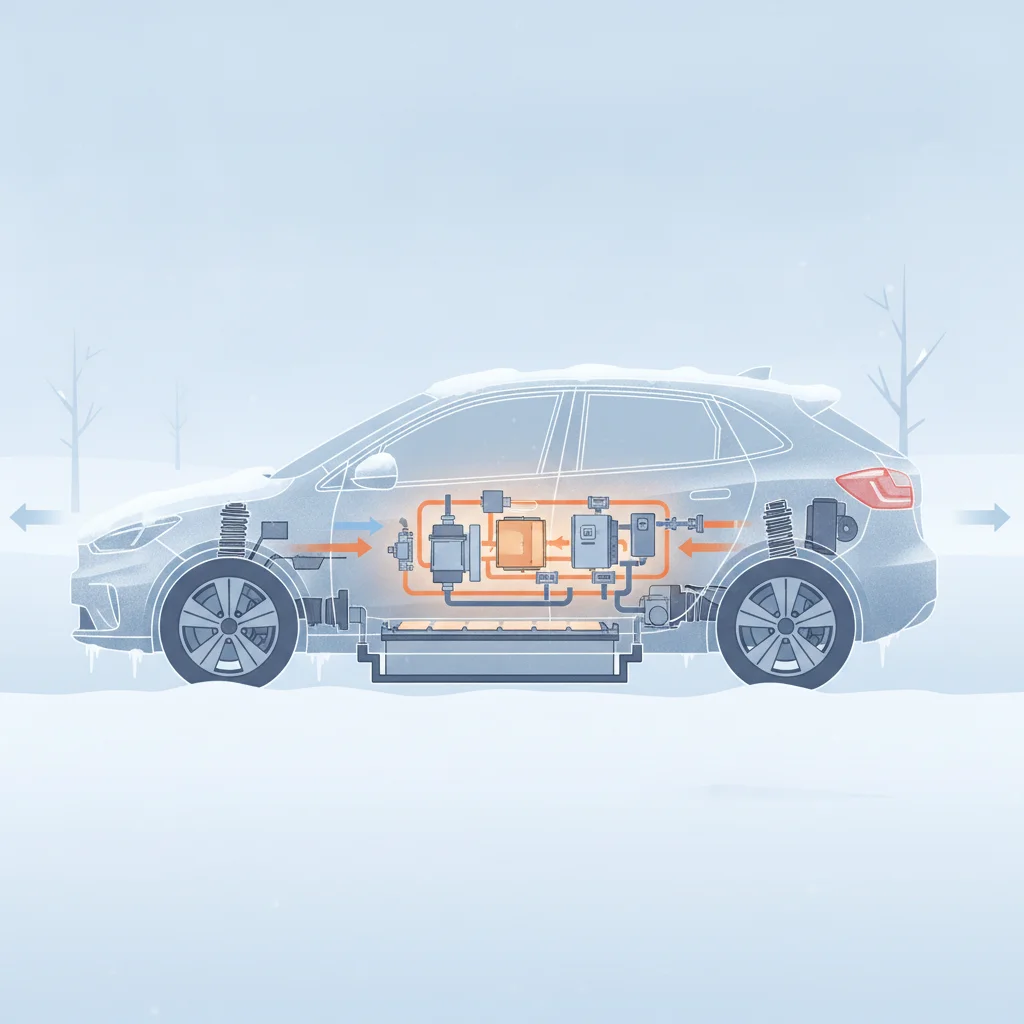
A heat pump is a climate system that moves heat from one place to another instead of generating it by burning energy. In an electric vehicle, it extracts heat from the outside air (or other vehicle components) and transfers it into the cabin. Because it moves existing heat rather than creating new heat, it uses significantly less battery power than a resistive heater — the traditional alternative. The result is better range retention in cold weather.
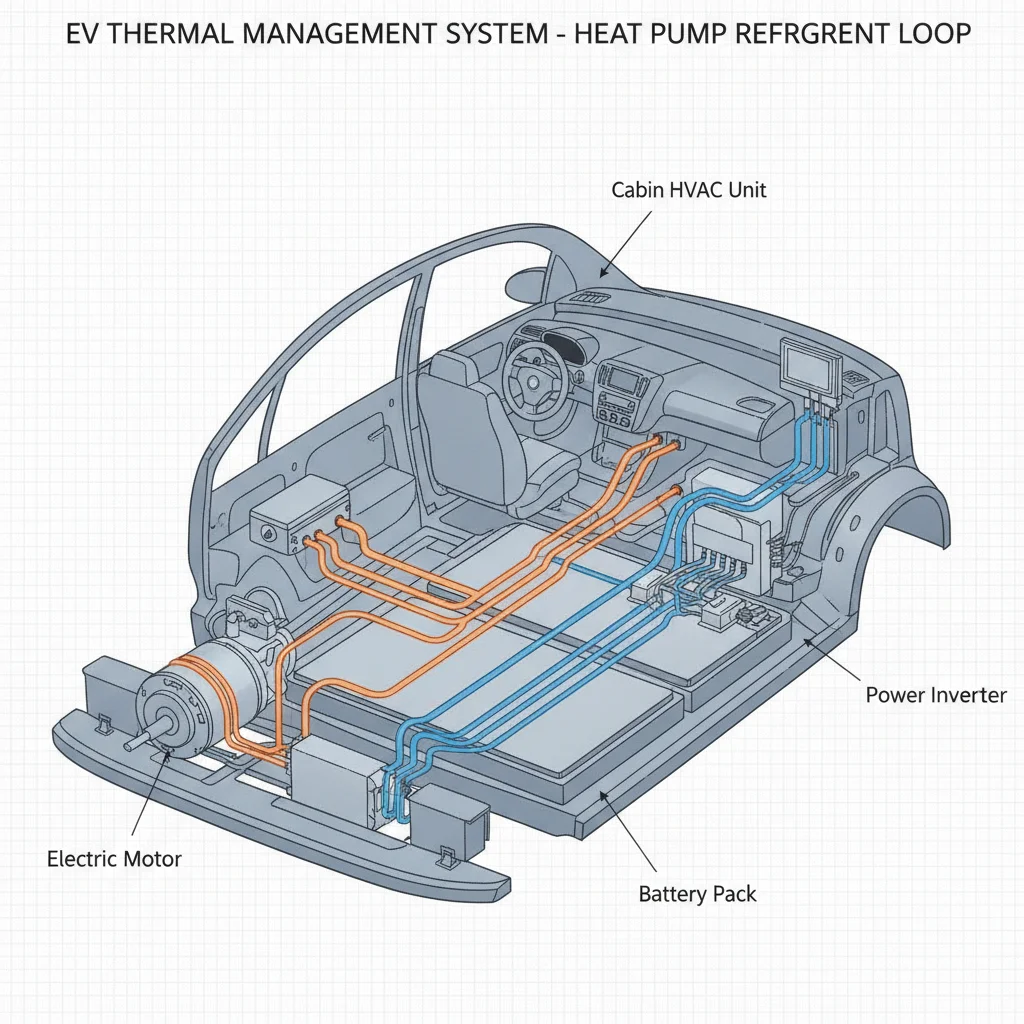
EV heat pumps operate on the refrigeration cycle (vapor-compression cycle), using a refrigerant that absorbs heat at low pressure and releases it at high pressure. Some advanced systems, like the one in the Tesla Model Y and Hyundai IONIQ 5, also scavenge waste heat from the motor, inverter, and battery to improve efficiency at very low ambient temperatures.
The Cold-Weather Range Problem Nobody Warns You About
EV range estimates printed on the window sticker are tested under controlled, moderate-temperature conditions. Drive that same car through a Minnesota January and you may find 30–40% of your rated range has quietly evaporated. Some of that loss comes from the battery itself reacting poorly to cold — lithium-ion chemistry slows down below 40°F (4°C). But a significant, often underestimated chunk comes from one simple demand: heating the cabin.
Unlike a gas-powered car, which generates enormous waste heat as a byproduct of combustion and pipes it into the cabin for free, an EV has no combustion engine to exploit. Every degree of warmth inside has to come from somewhere in your battery pack. In most EVs — especially older or budget models — that somewhere is a resistive heater: an electric coil that converts electrical energy directly into heat. It works fine, but it is brutally inefficient by design.
Heating and cooling together can draw 3–5 kW continuously from the battery. On a vehicle rated at 250 miles with a 75 kWh pack, running a 4 kW resistive heater constantly is the equivalent of adding a persistent, invisible passenger who does nothing but drain your battery. The heat pump exists to solve exactly this problem.
How a Heat Pump Works — Without the Engineering Degree
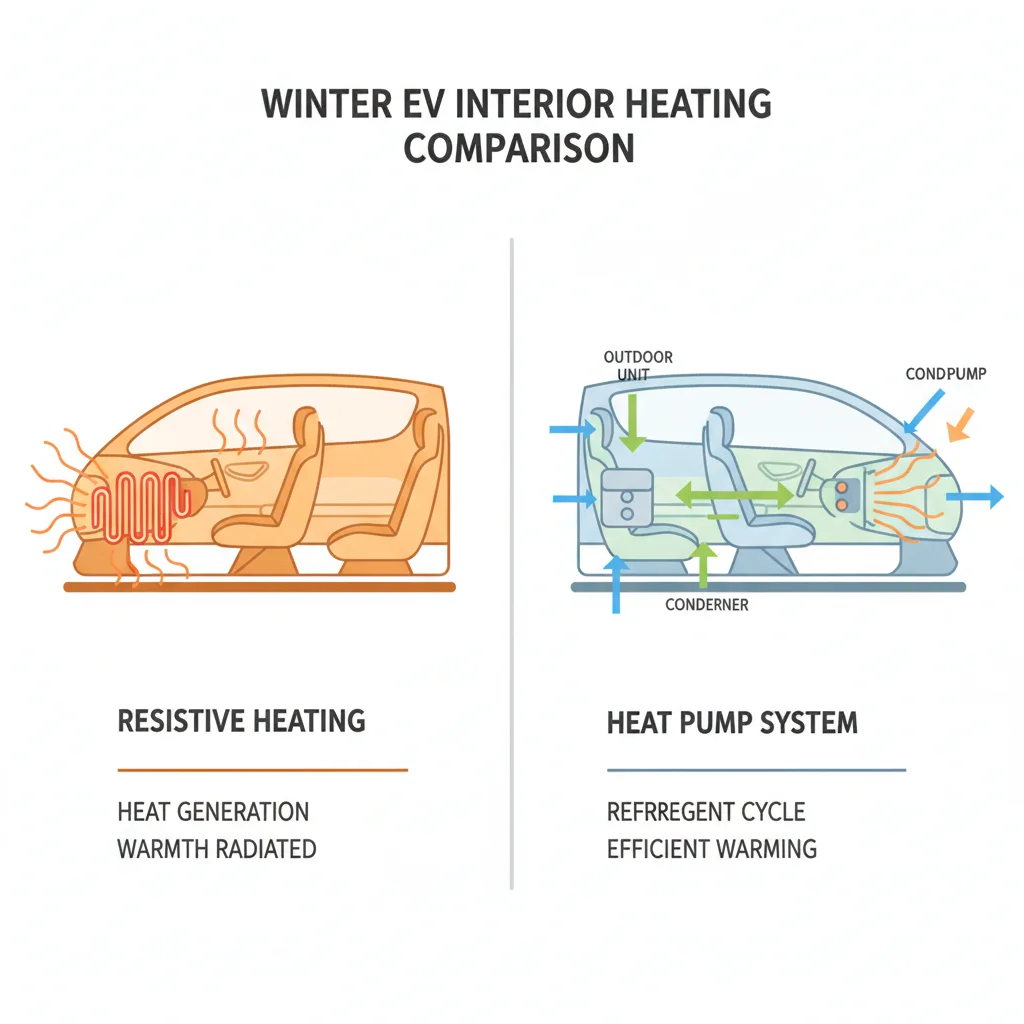
The phrase "heat pump" sounds technical, but the concept is simpler than it appears. Think about how a refrigerator works: it doesn't create cold air, it moves heat from inside the fridge box to the coils on the back, dumping that heat into your kitchen. A heat pump does the same thing in reverse — it pulls heat from outside the car and moves it inside.
Even at 20°F (-7°C), there is still usable thermal energy in the outdoor air. The heat pump uses a refrigerant fluid that circulates through a compression cycle: it absorbs heat from the outside air at low pressure, a compressor raises the pressure (which raises the temperature), and that now-warm refrigerant releases its heat into the cabin. The cycle repeats continuously.
The critical point is this: the system is only moving energy, not generating it. Moving energy is far cheaper electrically than creating it from scratch. A heat pump can deliver 2–3 units of heat energy for every 1 unit of electrical energy it consumes — a ratio engineers call the Coefficient of Performance (COP). A resistive heater, by contrast, always has a COP of exactly 1.0. You put in 1 kW, you get 1 kW of heat. There is no mechanical advantage.
“The heat pump is probably the single most impactful feature for cold-climate EV owners — more so than most buyers realize when they're focused on range numbers at the dealership. It's the difference between an EV that's practical in January and one that makes you nervous every time the temperature drops.”
— Bjørn Nyland, Independent EV reviewer and long-range cold-climate tester, known for extensive Nordic EV range testing
Modern EV heat pumps go a step further. Rather than relying solely on ambient air, advanced multi-source systems — found in vehicles like the Hyundai IONIQ 6, BMW iX, and Tesla Model Y — also scavenge waste heat from the electric motor, inverter, and battery pack itself. This makes them far less vulnerable to the limitations of cold outside air and extends efficient operation to much lower temperatures. Learn how these thermal management systems also protect battery longevity.
Why Ambient Temperature Affects Heat Pump Efficiency
Heat pumps work by extracting thermal energy from outside air. As air temperature falls, there is less available heat to extract, and the system must work harder — meaning efficiency (COP) declines. At extreme cold, the refrigerant can no longer absorb enough heat from the air alone. This is why multi-source systems that also tap motor and inverter waste heat are a meaningful engineering advancement for cold-climate owners.
Resistive Heating as a Backup — Not a Failure
Most heat pump-equipped EVs retain resistive heating elements as a supplemental or emergency backup. When the heat pump's efficiency falls at extreme cold, the system blends in resistive heat automatically. This is intended design behavior, not a flaw. The heat pump still reduces overall heating load even when it's not running alone, so range is still better than a resistive-only system.
Resistive Heater vs. Heat Pump: What the Numbers Look Like
To make the efficiency difference concrete, consider a real-world scenario. You're driving at 20°F (-7°C) on a 100-mile highway trip in an EV with a 70 kWh usable battery pack.
| Heating System | Power Draw | Energy Used (1 hr) | Effective Range Impact |
|---|---|---|---|
| Resistive heater | ~4.0 kW | 4.0 kWh | ~15–18 miles lost |
| Heat pump (COP ~2.5) | ~1.5 kW | 1.5 kWh | ~6–7 miles lost |
The difference across a full winter day of driving adds up fast. Multiply that over a season of commutes and the heat pump advantage becomes genuinely significant — not just a spec-sheet footnote.
30–40%
Typical EV range loss in cold weather
AAA testing found EVs lose an average of 12% range at 20°F without cabin heat; adding cabin heat pushes total winter range loss to 30–40% in many vehicles.
2–3x
Heat pump efficiency vs. resistive heating (COP)
A heat pump operating at a COP of 2.5 delivers 2.5 units of heat for every 1 unit of electrical energy consumed, compared to a fixed 1:1 ratio for resistive heaters.
3–5 kW
Continuous power draw for cabin heating
HVAC systems in EVs, particularly resistive heaters running at full output, can consume 3–5 kW continuously — equivalent to driving a second, invisible vehicle.
~25%
Range improvement with heat pump in winter
Out of Spec Studios and similar independent testers have documented roughly 20–30% better range retention in heat pump-equipped EVs vs. resistive-only vehicles at similar temperatures.
-22°F
Lowest effective temperature for advanced heat pumps
Multi-source heat pump systems found in modern EVs like the Tesla Model Y and IONIQ 5 can maintain positive efficiency to as low as -22°F (-30°C) by supplementing air-source heat with drivetrain waste heat.
It's also worth noting what happens at the margins. As outside temperatures drop below about 14°F (-10°C), the efficiency gap starts to narrow because it becomes physically harder to extract heat from very cold air. At extreme lows — say, -10°F (-23°C) — some heat pump systems will automatically fall back on resistive heating as a supplement or primary source. This is normal and expected. The best modern systems (particularly those using multiple heat sources) maintain positive efficiency well below that threshold.
Cold weather affects BEV, PHEV, and HEV types differently — PHEVs, for instance, can use their combustion engine for cabin heat, sidestepping this issue entirely. For pure battery-electric vehicles, the heat pump is the single most impactful thermal hardware upgrade available.
Which EVs Include a Heat Pump — and Which Don't
Heat pump availability varies widely across the market. Here's a practical overview as of recent model years:
- Standard equipment
- Tesla Model Y (all trims), Tesla Model 3 (refreshed Highland), Hyundai IONIQ 5 and IONIQ 6 (all trims), Kia EV6 and EV9, BMW iX and i4, Volkswagen ID.4 (US models), Rivian R1T and R1S, Polestar 2 (Long Range dual motor).
- Optional or trim-dependent
- Some older Model 3 variants, certain Nissan LEAF configurations (higher trims in some markets), select Ford Mustang Mach-E packages. Always verify by checking the specific trim's feature sheet.
- Not included
- Chevrolet Bolt EV and EUV (uses resistive heating), some entry-level trims from various brands. Budget EVs are more likely to rely on resistive heating to keep costs down.
If a heat pump is not listed explicitly in the specs, assume resistive heating. The automaker's configurator or a call to the dealer can confirm. Do not rely on the salesperson's general impression — pull up the technical specification sheet.
Check the Spec Sheet, Not the Brochure
Marketing materials often describe climate systems vaguely. Always locate the vehicle's technical specification document — available on the automaker's website or from the EPA's fuel economy database — and look specifically for "heat pump" under the HVAC section. If it isn't listed, it isn't included. Don't rely on a salesperson's assurance that the car has "efficient heating."
Pair Your Heat Pump With Pre-Conditioning
A heat pump works best when the cabin and battery are already near operating temperature. Scheduling pre-conditioning through your EV's app while the car is still plugged in means you're drawing that warm-up energy from the grid, not your battery — and the heat pump starts the drive with a reduced load. This combination delivers the best cold-weather range results of any approach short of a combustion heater.
Understanding which EV type fits your lifestyle also informs how much the heat pump matters: a PHEV driver has a combustion backup for heat, but a BEV driver in Wisconsin depends on efficient thermal management for everyday usability.
Is a Heat Pump Worth Prioritizing for Your Situation?
The honest answer depends on where you live and how you drive. Here's a direct breakdown:
High priority if you:
- Live in states where winter regularly brings temperatures below 25°F (-4°C) — think the upper Midwest, New England, Mountain West, or Great Plains.
- Have a shorter-range EV (under 250 miles EPA-rated) where winter losses hit harder proportionally.
- Primarily charge at home overnight and want to maximize how far each charge takes you through cold months.
- Do not have a PHEV with combustion backup heating.
Lower priority if you:
- Live in mild-winter climates — Southern California, Florida, Texas (most years), the Gulf Coast.
- Drive a long-range vehicle (300+ miles) where winter losses are more comfortable to absorb.
- Have consistent access to charging at work or destination, reducing anxiety about range.
If the heat pump is a paid option and you're on the fence, think in terms of payback. If the option costs $500–$1,000 and saves you 15–20% range on winter days you drive regularly, you will almost certainly recover that in range-related quality of life and reduced charging frequency within the first two or three winters.
Combining a heat pump with smart pre-conditioning while still plugged in is the most effective cold-weather strategy available. Pre-conditioning brings the cabin and battery to operating temperature before you unplug — so the heat pump starts its day with a lighter load and your range estimate reflects actual driving conditions, not a cold-soak penalty.
Practical Steps Before You Buy
Knowing that heat pumps matter is useful. Knowing how to act on that knowledge during the car-buying process is better. Here's a simple checklist:
- Pull the spec sheet, not just the brochure. Search for the vehicle's technical specifications page on the automaker's website. Look for "heat pump" under HVAC or Climate systems. If it says "resistive" or doesn't mention heat pump, assume you're not getting one.
- Check by trim level. Some automakers include the heat pump only on mid or upper trims. If you're cross-shopping trims primarily on price, factor in the cold-weather value of the heat pump before dropping to the base model.
- Ask about software control. Not all heat pump implementations are equal. Some vehicles give you granular control over how aggressively the system runs; others manage it entirely in the background. Better software integration means better real-world results.
- Look at owner forums for your target vehicle. Real-world winter range data from owners in your climate is more useful than any EPA estimate. Websites like Teslanomics, Out of Spec Studios, and EV-specific Reddit communities regularly publish cold-weather tests.
- Factor in pre-conditioning capability. A heat pump combined with scheduled pre-conditioning is the gold standard for cold-weather EV ownership. Confirm both features are present before finalizing your decision.
Cold-weather EV ownership involves more than just the heating system — tire choice, battery preconditioning for DC fast charging, and driving habits all play a role. But getting the thermal hardware right at purchase is the one decision you can't revisit later.
Why Ambient Temperature Affects Heat Pump Efficiency
Heat pumps work by extracting thermal energy from outside air. As air temperature falls, there is less available heat to extract, and the system must work harder — meaning efficiency (COP) declines. At extreme cold, the refrigerant can no longer absorb enough heat from the air alone. This is why multi-source systems that also tap motor and inverter waste heat are a meaningful engineering advancement for cold-climate owners.
Resistive Heating as a Backup — Not a Failure
Most heat pump-equipped EVs retain resistive heating elements as a supplemental or emergency backup. When the heat pump's efficiency falls at extreme cold, the system blends in resistive heat automatically. This is intended design behavior, not a flaw. The heat pump still reduces overall heating load even when it's not running alone, so range is still better than a resistive-only system.
The Bottom Line on Heat Pumps
A heat pump is not a luxury feature. In cold climates, it is one of the most consequential items on an EV's spec sheet — more impactful on daily usability than an extra 20 miles of rated range under ideal conditions. The physics are straightforward: moving heat is cheaper than creating it, and an EV running resistive heating in January is leaving a meaningful amount of its battery capacity on the table.
For buyers in the northern tier of the US, a vehicle without a heat pump should require a deliberate justification — lower price, longer range buffer, or a plug-in hybrid setup that sidesteps the problem. For buyers in mild climates, it remains a nice-to-have rather than a necessity, and the money saved on a resistive-heat vehicle might be better spent elsewhere.
Either way, now you know what to look for — and why it matters. Dig deeper into the full thermal management ecosystem that keeps your battery healthy across all seasons, not just winter.
Check the Spec Sheet, Not the Brochure
Marketing materials often describe climate systems vaguely. Always locate the vehicle's technical specification document — available on the automaker's website or from the EPA's fuel economy database — and look specifically for "heat pump" under the HVAC section. If it isn't listed, it isn't included. Don't rely on a salesperson's assurance that the car has "efficient heating."
Pair Your Heat Pump With Pre-Conditioning
A heat pump works best when the cabin and battery are already near operating temperature. Scheduling pre-conditioning through your EV's app while the car is still plugged in means you're drawing that warm-up energy from the grid, not your battery — and the heat pump starts the drive with a reduced load. This combination delivers the best cold-weather range results of any approach short of a combustion heater.

All claims are backed by peer-reviewed research. Sources on request.