Key Takeaways
Charger Downtime
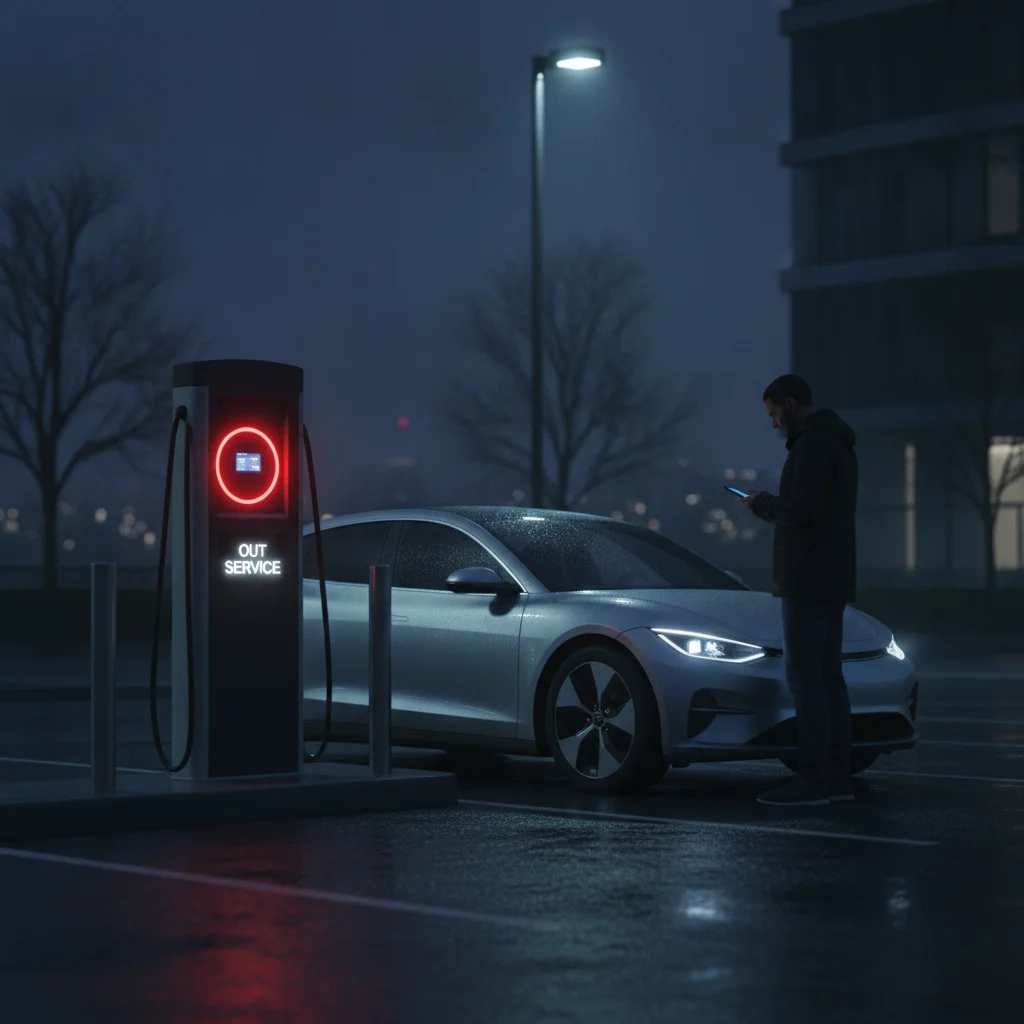
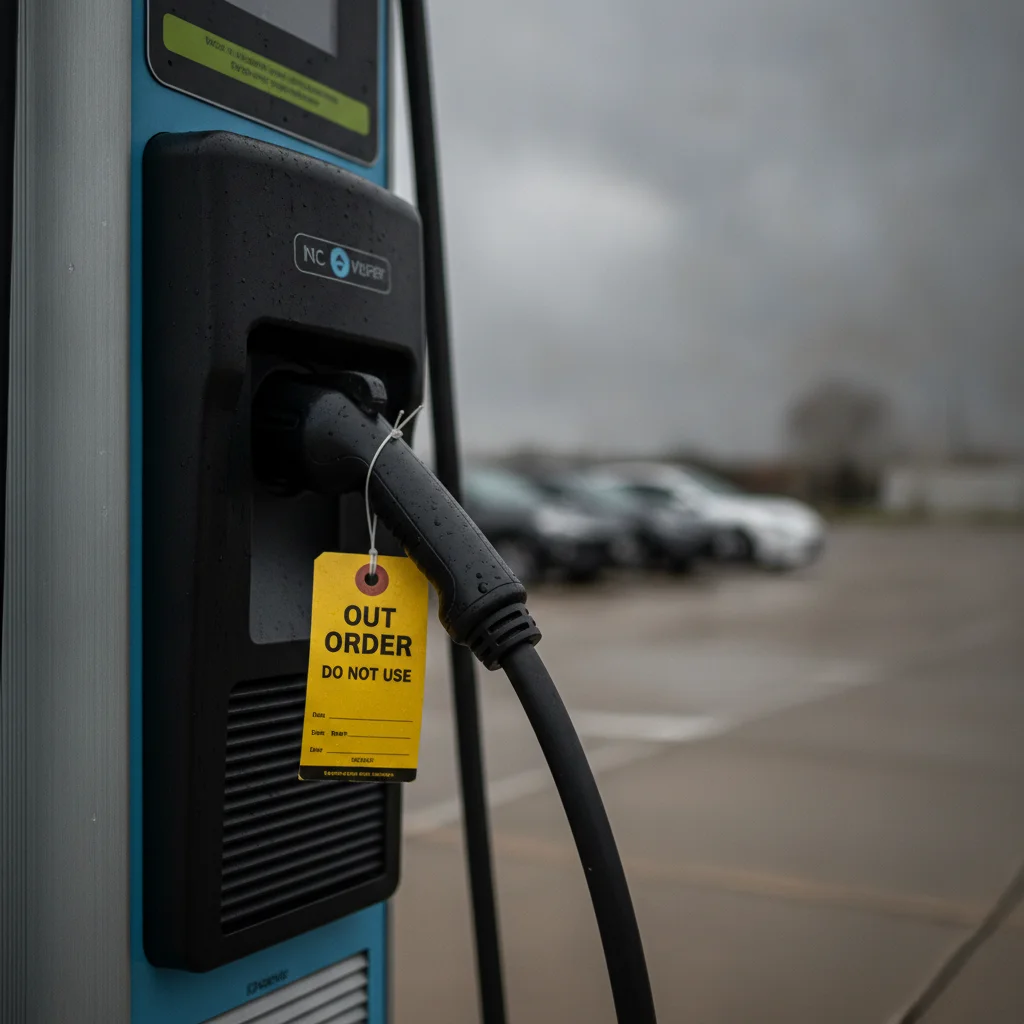
Charger downtime refers to any period when a public EV charging station is unavailable for use — whether due to a hardware fault, software glitch, network connectivity failure, or physical damage. From a driver's perspective, downtime means arriving at a station and finding it unable to initiate, complete, or even acknowledge a charging session. It is distinct from a station being occupied by another vehicle.
In the industry, uptime is typically measured as the percentage of time all charging ports at a station are ready to successfully deliver power. A 95% uptime target, often cited in federal grant requirements, means a charger can be offline roughly 18 days per year — a threshold many networks have historically failed to meet.
The Scale of the Problem
Walk up to a public EV charger today and you're dealing with what researchers politely call an "uptime problem." A 2022 field audit by UC Berkeley researchers sampled 657 chargers across the San Francisco Bay Area — one of the most EV-saturated markets in the country — and found that 27.5% of DC fast charger visits resulted in a failed charging session. For Level 2 chargers the number was lower but still alarming: about 15% failure rate.
Those aren't edge-case numbers from rural dead zones. They came from a metro area with relatively high infrastructure investment and dense coverage. The implication for less-served markets is worse.
27.5%
DC fast charger failure rate per visit
UC Berkeley field audit of 657 public chargers in the San Francisco Bay Area, published 2022.
97%
Uptime required under NEVI funding rules
The US Joint Office of Energy and Transportation mandates 97% per-port uptime for stations receiving NEVI federal grant funding.
80%+
EV charging that occurs at home
Multiple surveys including data from the US Department of Energy's Alternative Fuels Data Center consistently show most EV owners charge primarily at home.
4 hours
Maximum fault response time under NEVI
NEVI program requirements mandate operators acknowledge and begin resolving reported faults within four hours of notification.
$5B
Federal NEVI charging infrastructure investment
Authorized by the Infrastructure Investment and Jobs Act of 2021, distributed over five years to states for corridor charging buildout.
This matters not just as a convenience issue but as a structural barrier to EV adoption. Drivers who have experienced a broken charger — especially on a road trip — frequently cite it as a reason they'd hesitate to recommend an EV to others. The anxiety isn't irrational; it's calibrated to a real pattern.
For a broader picture of how the US public charging landscape is structured, see the complete overview of public EV charging networks — understanding who operates what helps explain why reliability varies so dramatically by location.
Why Chargers Fail: The Four Root Causes
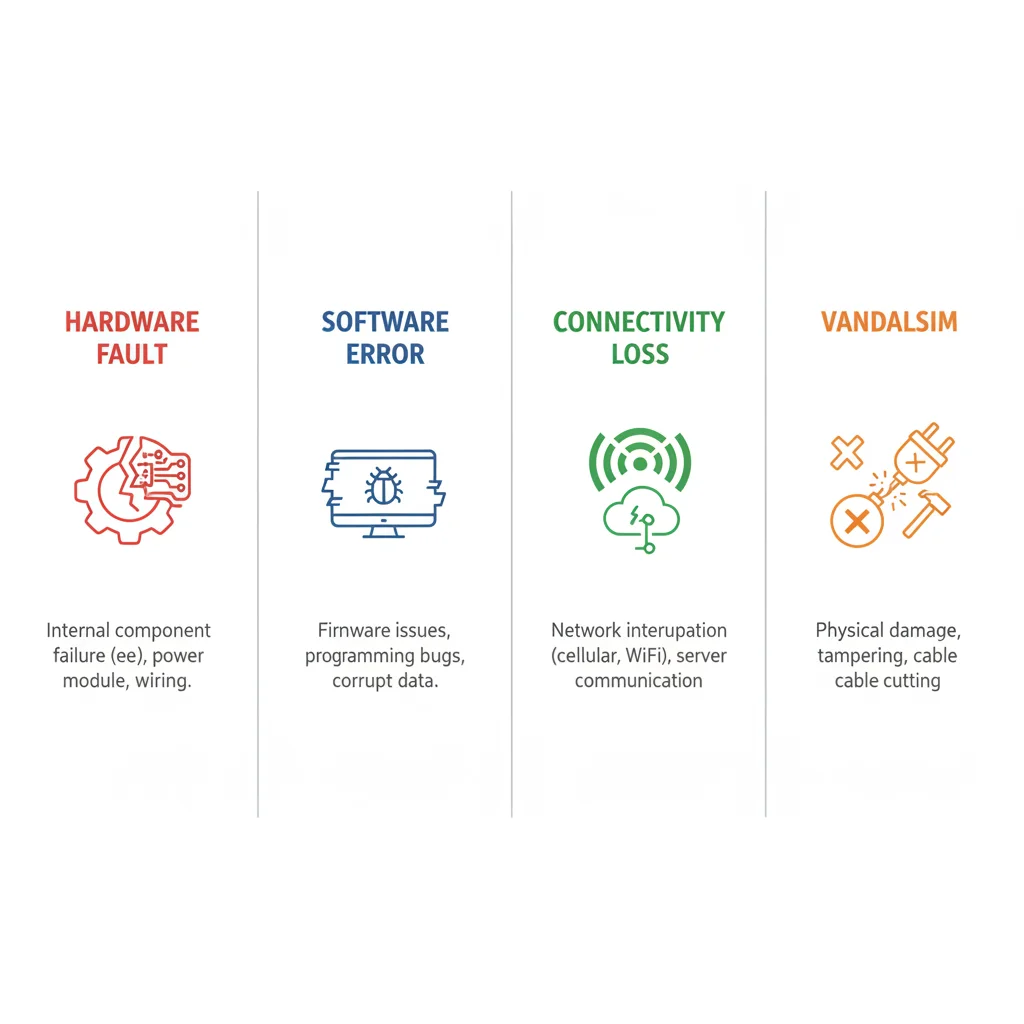
Charger downtime isn't a single problem with a single fix. It stems from at least four distinct failure categories, each with its own technical profile and solution path.
1. Hardware Failures
Physical components degrade. Cables crack from repeated bending in cold weather. Connector latches wear out. Internal power modules overheat after sustained high-power sessions. Liquid cooling systems — which keep DC fast charger electronics within safe temperature ranges — develop leaks. These are the most visible failures: a charger that simply won't turn on, shows a blank screen, or produces an error code before a session even starts.
DC fast chargers are especially vulnerable here. Operating at power levels between 50 kW and 350 kW creates thermal and electrical stresses that simply don't exist on a standard Level 2 unit. The analogy to gasoline infrastructure is imperfect but instructive: a DC fast charger is far closer in mechanical complexity to a high-throughput fuel dispenser than to the basic wall outlet Level 2 charging resembles.
2. Software and Firmware Bugs
Modern chargers run embedded operating systems that manage communication between the vehicle, the charger, and the network backend. These systems handle session authentication, payment processing, power delivery negotiation, and safety monitoring simultaneously. Bugs in any layer — or a failed firmware update pushed remotely — can render a charger non-functional without any physical component failing.
This category is particularly insidious because the charger may appear powered on and functional yet still reject every session attempt. A driver sees a lit screen and assumes the unit is working; the underlying software is quietly failing every handshake attempt.
3. Network Connectivity and Payment System Failures
Most public chargers require a live connection to a backend server to authenticate users and authorize payments. When that cellular or Wi-Fi connection drops — or when the payment processor has an outage — the charger may refuse to start a session even though its hardware is perfectly intact. Some charger models have no offline fallback mode, meaning a single dropped connection renders the entire unit useless.
Not All Downtime Looks the Same
A charger can be "down" in meaningfully different ways: it may be completely dark and unresponsive, lit but rejecting every session, able to start sessions but dropping them mid-charge, or functioning on only some of its ports. Network uptime statistics often measure whether a unit is "reachable" by the backend system — not whether it actually successfully completes a charging session. That distinction matters when evaluating reliability claims from operators.
Plug-and-Charge Removes a Common Failure Point
ISO 15118 plug-and-charge capability — now required on all NEVI-funded stations — allows a vehicle and charger to authenticate each other automatically via encrypted certificates when the cable is connected. This eliminates the payment authorization step that causes a significant share of session-start failures on current networks. Broader vehicle and charger adoption of this standard is one of the most promising near-term reliability improvements on the horizon.
4. Vandalism and Physical Damage
Cable theft, deliberate screen damage, and connector abuse are a documented and growing problem, particularly at stations in high-crime or unsupervised locations. Copper cable theft has driven some operators to move toward shorter, reinforced cables or holstered designs. Vandalized units can sit offline for days or weeks waiting for replacement parts and a maintenance visit.
Report Every Broken Charger You Find
Most networks prioritize maintenance dispatch based on reported fault frequency. A charger that fails silently — where drivers just give up and leave without calling it in — may sit broken for weeks. Taking 90 seconds to report a fault through the network app or the number on the unit directly speeds up the repair queue and protects the next driver.
Arrive With a Buffer, Not on Empty
When routing through public charging, plan to arrive at each stop with at least 10–15% state of charge remaining. This buffer gives you enough range to reach the nearest backup station if the primary charger is down — without triggering range anxiety or requiring an emergency call. Apps like ABRP (A Better Route Planner) can calculate backup stations automatically as part of your route.
Why Some Networks Are More Reliable Than Others
Not all downtime is equal, and not all networks suffer equally. The variance across charging operators is substantial — and the gap is largely explained by three structural factors: vertical integration, maintenance contracts, and capital investment in hardware quality.
The Tesla Advantage: Vertical Integration
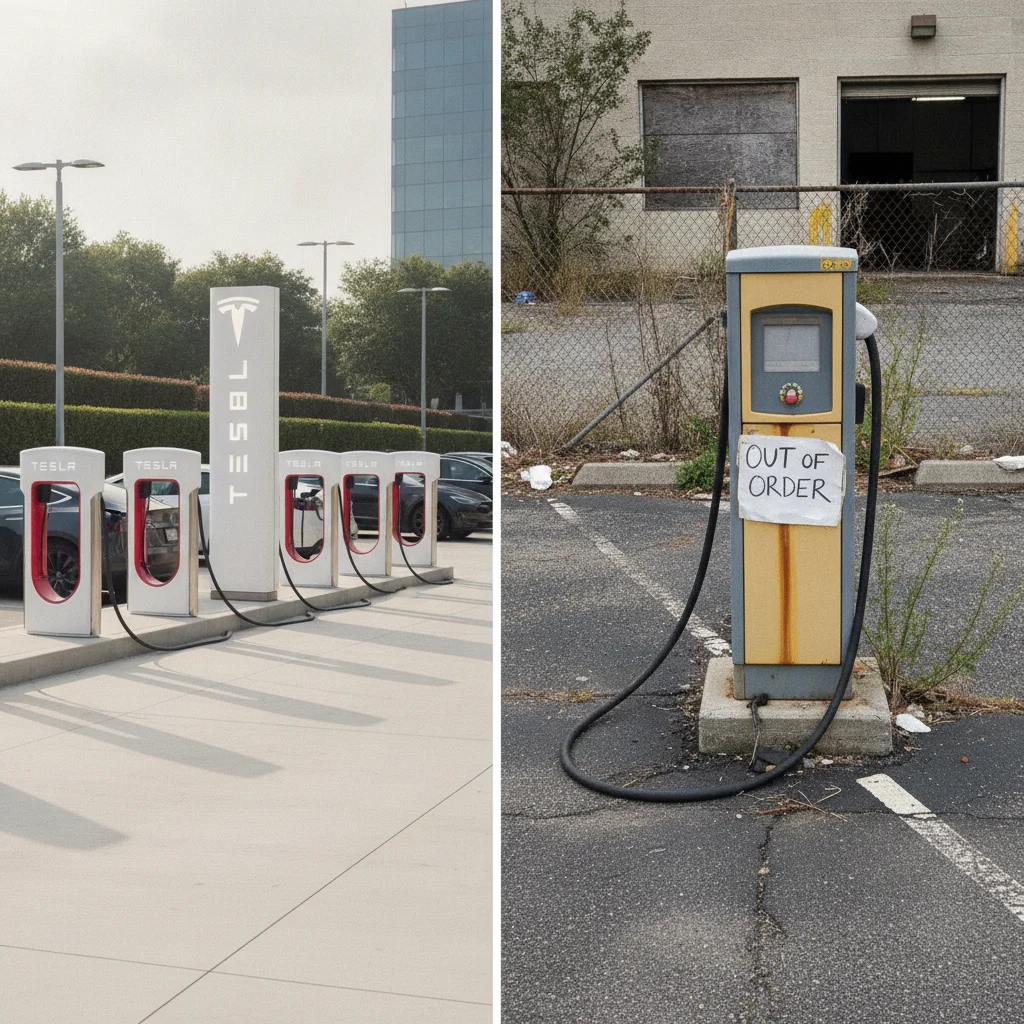
Tesla's Supercharger network has consistently outperformed open networks in reliability surveys and driver satisfaction ratings. The structural reason isn't mysterious: Tesla designs the charger hardware, writes the firmware, builds the vehicle software that communicates with it, and employs or directly contracts the technicians who service units. When something breaks, one company owns the entire failure chain and can diagnose problems remotely through telemetry data it collects from both the charger and the connected vehicle.
Third-party networks by contrast operate in a more fragmented ecosystem. A ChargePoint station might use hardware from one manufacturer, run payment software from another vendor, connect via a cellular modem from a third party, and be maintained by a local contractor with no direct relationship to the network operator. Each handoff between parties is a potential point of failure — and a potential source of finger-pointing when something goes wrong.
The Open Network Challenge
Electrify America, EVgo, ChargePoint, and Blink all operate on some version of this distributed model. Reliability varies not just across networks but within them — a well-maintained Electrify America station at a Walmart in California may perform very differently from a neglected Blink unit in a hotel parking lot in the Midwest. To see how these networks compare on coverage, speed, and pricing alongside reliability, the side-by-side comparison of major charging networks provides a detailed breakdown.
EVgo has made documented investments in hardware upgrades and remote monitoring over the past two years, and its uptime metrics have improved in markets where those upgrades have rolled out. ChargePoint's reliability record is complicated by the fact that its business model involves selling hardware to third-party hosts — businesses and property owners — who then bear responsibility for maintenance. A property owner who doesn't prioritize their parking lot charger creates a reliability problem that ChargePoint the network operator has limited ability to force-resolve.
“The charger has to work every time. People don't accept a 10 percent failure rate at gas stations. If we want EV adoption to scale beyond early adopters, we have to hold charging infrastructure to the same standard — and right now, we're not there yet.”
— Alexia Latortue, Former Deputy Assistant Secretary for Clean Energy, US Department of Treasury
The Federal Funding Lever: What NEVI Changes
The single most consequential policy intervention in US charging reliability may be the uptime requirements attached to NEVI — the National Electric Vehicle Infrastructure program funded by the 2021 Infrastructure Investment and Jobs Act.
NEVI provides $5 billion over five years to build out charging along designated Alternative Fuel Corridors, primarily Interstate highways. To receive that funding, operators must meet a 97% uptime requirement per port, provide 24/7 live customer support, and maintain a four-hour maximum response time for reported faults. These requirements apply not just at initial installation but on an ongoing basis — failure to maintain uptime can trigger clawback provisions on federal funds.
For context, independent audits have found many existing networks operating well below that threshold. Electrify America, which received substantial Volkswagen settlement funding under similar accountability requirements, has still struggled to consistently hit 95% uptime in some markets. Getting the industry to 97% as a floor — and sustaining it — will require operational changes that go beyond simply installing better hardware.
The NEVI requirements also mandate ISO 15118 plug-and-charge capability on new stations, which allows vehicles to authenticate and begin charging automatically without a card tap or app login. This removes one of the most common session-start failure points — the payment authorization step — from the interaction entirely.
Not All Downtime Looks the Same
A charger can be "down" in meaningfully different ways: it may be completely dark and unresponsive, lit but rejecting every session, able to start sessions but dropping them mid-charge, or functioning on only some of its ports. Network uptime statistics often measure whether a unit is "reachable" by the backend system — not whether it actually successfully completes a charging session. That distinction matters when evaluating reliability claims from operators.
Plug-and-Charge Removes a Common Failure Point
ISO 15118 plug-and-charge capability — now required on all NEVI-funded stations — allows a vehicle and charger to authenticate each other automatically via encrypted certificates when the cable is connected. This eliminates the payment authorization step that causes a significant share of session-start failures on current networks. Broader vehicle and charger adoption of this standard is one of the most promising near-term reliability improvements on the horizon.
What the Industry Is Actually Doing
Beyond regulatory pressure, operators and hardware manufacturers are pursuing several technical strategies to reduce downtime.
Remote Monitoring and Predictive Maintenance
Newer charger management systems collect real-time telemetry — temperature readings, power delivery logs, error codes, session completion rates — and flag anomalies before they become full failures. EVgo and Electrify America have both invested in network operations centers that monitor station health around the clock. The goal is to dispatch a technician proactively rather than waiting for a driver to call in a fault.
Modular Hardware Design
Some of the newest DC fast charger architectures — including products from ABB, BTC Power, and ChargePoint's newer hardware lines — use modular power cabinets that can be partially repaired without taking an entire unit offline. If one power module fails in a multi-cabinet installation, the remaining modules can continue operating at reduced capacity while the failed component is swapped out. This reduces the all-or-nothing failure dynamic that has characterized older hardware generations.
Offline Fallback Modes
Several network operators are implementing "freevend" or offline fallback modes that allow a charger to deliver power without backend authentication when connectivity is lost. This is a significant departure from the locked-down architecture of most current chargers but directly addresses the scenario where a hardware-functional unit is rendered useless by a dropped server connection.
Report Every Broken Charger You Find
Most networks prioritize maintenance dispatch based on reported fault frequency. A charger that fails silently — where drivers just give up and leave without calling it in — may sit broken for weeks. Taking 90 seconds to report a fault through the network app or the number on the unit directly speeds up the repair queue and protects the next driver.
Arrive With a Buffer, Not on Empty
When routing through public charging, plan to arrive at each stop with at least 10–15% state of charge remaining. This buffer gives you enough range to reach the nearest backup station if the primary charger is down — without triggering range anxiety or requiring an emergency call. Apps like ABRP (A Better Route Planner) can calculate backup stations automatically as part of your route.
Improved Site Selection and Physical Protection
Operators are also applying lessons about site design. Stations with good lighting, security cameras, and physical cable protection experience lower vandalism rates. Some networks now require bollard protection and cable-length restrictions as part of their site standards for new deployments.
What Drivers Can Do Right Now
While the industry works toward structural solutions, EV drivers navigating today's imperfect network can reduce their exposure to downtime with a few practical habits.
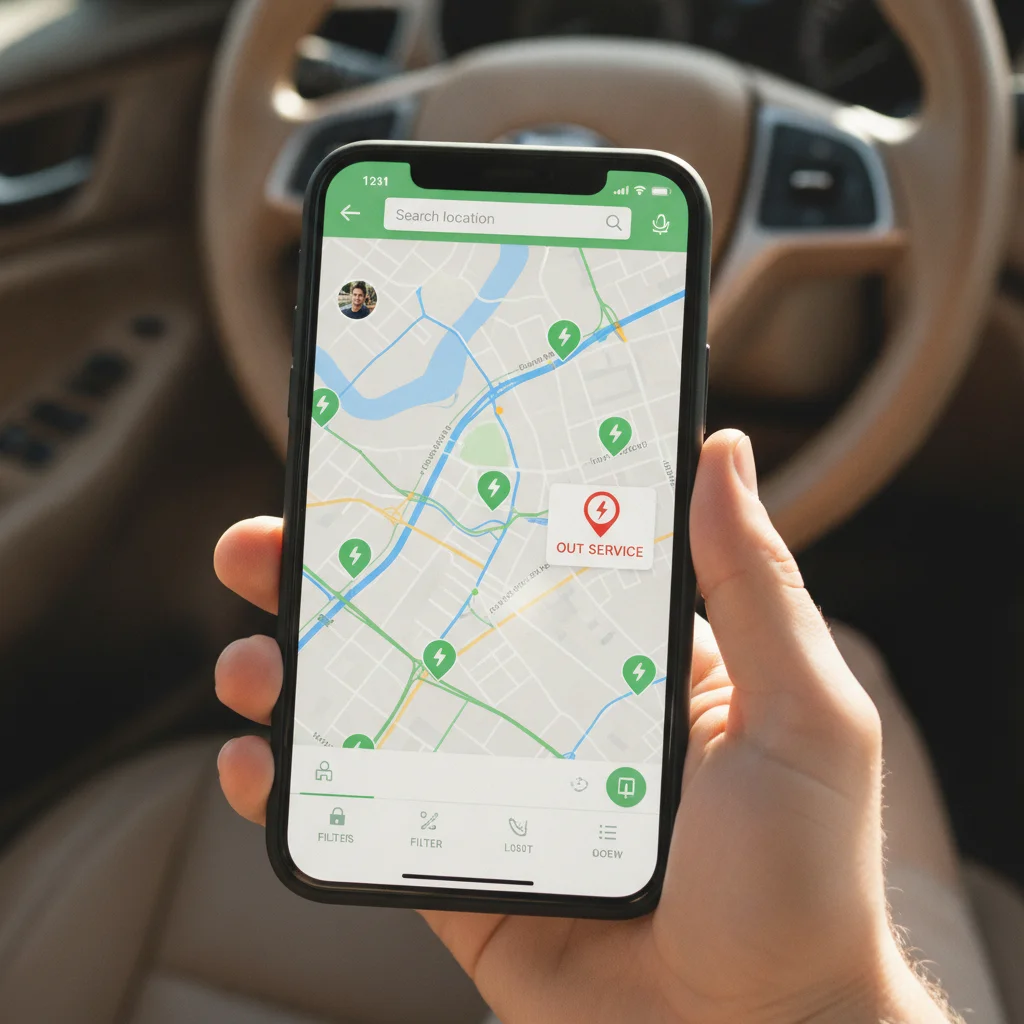
Check real-time status before you commit. Apps like PlugShare aggregate user check-ins and real-time station data, often surfacing broken chargers hours before a network operator has officially flagged them offline. The crowdsourced layer is particularly valuable because drivers update statuses in real time from parking lots.
Plan with redundancy on road trips. If your route depends on a single station for a critical charge, identify the nearest backup before you leave. Knowing there's a working alternative 15 miles off-route removes much of the anxiety from charger uncertainty. The article on how to recover when public charging fails walks through exactly this contingency planning in detail.
Report failures immediately. Every network has a support number printed on the unit and accessible through its app. Reporting a fault starts the repair clock and contributes to the data operators use to prioritize maintenance. If you don't report it, the next driver pays the same price you just did.
Understand your car's role. Vehicle-side software — how your car negotiates charging parameters with a station — can also contribute to session failures. Keeping your car's software updated and understanding its charging behavior (preconditioning in cold weather, for example) reduces the number of failures that are actually attributable to your vehicle rather than the charger.
If you're new to public charging and want to avoid the most common setup mistakes, common mistakes first-time public charger users make covers the predictable missteps that leave drivers frustrated before they've found their footing.
The Reliability Gap in Context
It's worth keeping the reliability problem in proportion. Public charger downtime is real and disruptive, but it coexists with a home charging reality that most EV owners actually rely on most of the time. Studies consistently show that 80% or more of EV charging in the US happens at home overnight — a context where public charger reliability is irrelevant.
The stakes of public charger downtime are highest for specific use cases: road trips, drivers without home charging access (apartment dwellers, renters without dedicated parking), and commercial fleets that depend on fast turnaround. For a typical suburban EV owner who charges at home most nights and uses public infrastructure occasionally, a broken charger is an inconvenience rather than a crisis.
That said, as EV adoption expands into urban markets where home charging setup is impractical, the reliability of public infrastructure becomes proportionally more critical. The future EV owner who lives in a city apartment has no fallback. For that driver, a 27% failure rate isn't a statistic — it's a reason to reconsider the purchase.
The myths about public EV charging that circulate online sometimes overstate the reliability problem to the point of distortion, but the underlying concern driving those myths is legitimate. Dismissing charger anxiety as irrational doesn't help anyone — fixing the chargers does.
The cost dimension of public charging also intersects with reliability in ways that aren't always visible. Drivers who pay premium per-kWh rates at DC fast chargers and arrive at a broken unit bear both a time cost and a planning cost that charging cost and savings analyses rarely account for. Reliability is part of the value proposition — and right now, it's the weakest part.
All claims are backed by peer-reviewed research. Sources on request.