Key Takeaways
Why First-Time Public Charging Goes Wrong
Public EV charging is genuinely simple once you've done it a few times. But the first session — or the first session at an unfamiliar network — has a way of surfacing assumptions you didn't know you were making. A connector that doesn't fit. An app that demands account creation before you can swipe a card. A charger that shows available on a map but greets you with a blinking red light.
These aren't freak occurrences. They are predictable, well-documented friction points that show up repeatedly in EV owner forums, J.D. Power charging satisfaction surveys, and first-hand driver reports. The encouraging news: virtually every one of them is avoidable with a small amount of preparation.
This guide maps the most common mistakes first-time public charger users make — why they happen, what the real-world consequences look like, and the specific steps that prevent them. Whether you're preparing for your first charging stop or trying to understand why your last one went sideways, the patterns below will look familiar.

For a broader orientation to the public charging landscape — including connector types, payment systems, and what to realistically expect — see the first-timer's field guide to public EV charging. This article focuses specifically on where things go wrong.
The Mistakes: What They Are, Why They Happen, and How to Avoid Them
The errors below aren't signs of carelessness. Most stem from reasonable assumptions that simply don't map onto how public charging infrastructure actually works. Understanding the gap between expectation and reality is the first step to closing it.
Assuming your EV's connector will fit every public charger without checking compatibility first.
Why it happens: New EV owners often conflate the charger's power level with its connector type. The fact that a station is labeled 'fast charger' doesn't mean it uses the connector your vehicle accepts.
Showing up at a public charger without a network account or payment method set up in advance.
Why it happens: Drivers accustomed to gas stations — where you swipe a card at the pump with zero pre-registration — assume public chargers work the same way. Many do not, especially older stations that require app-based authentication.
Trusting a map pin that shows a charger as 'available' without verifying real-time operational status.
Why it happens: Charging maps — including those built into vehicles — often display static availability data that doesn't reflect current hardware or software failures. A pin showing green doesn't mean the charger will actually dispense power.
Arriving at a public fast charger with the battery at or near zero percent state of charge.
Why it happens: Drivers new to EVs sometimes push range limits the same way they would in a gas vehicle — waiting until nearly empty before stopping to refuel. With EVs, extremely low battery states can trigger protective charging limits that reduce the maximum accepted charge rate.
Leaving the vehicle plugged in and unattended long after charging has completed.
Why it happens: First-time users often don't realize that charging completes well before they return, and that most networks begin billing idle fees — charged by the minute — after a short post-completion grace period.
Charging to 100% at a DC fast charger on every public stop, regardless of actual range needs.
Why it happens: The instinct to 'fill up completely' — natural at a gas station — doesn't translate well to DC fast charging. Above 80% state of charge, most EV battery management systems sharply reduce the accepted charge rate to protect battery chemistry.
Ignoring the difference between kilowatt-hour-based and per-minute-based pricing before starting a session.
Why it happens: Charging pricing structures are less intuitive than gasoline pricing, and many drivers assume all sessions work the same way. Per-minute billing can be significantly more expensive for vehicles with lower maximum charge rates.
Skipping the cable hang-up and leaving the charging connector on the ground after unplugging.
Why it happens: It's a small step that's easy to overlook, especially if you're in a hurry or unfamiliar with the station's physical layout. Gas station nozzles return to a cradle automatically; charging cables require manual replacement.
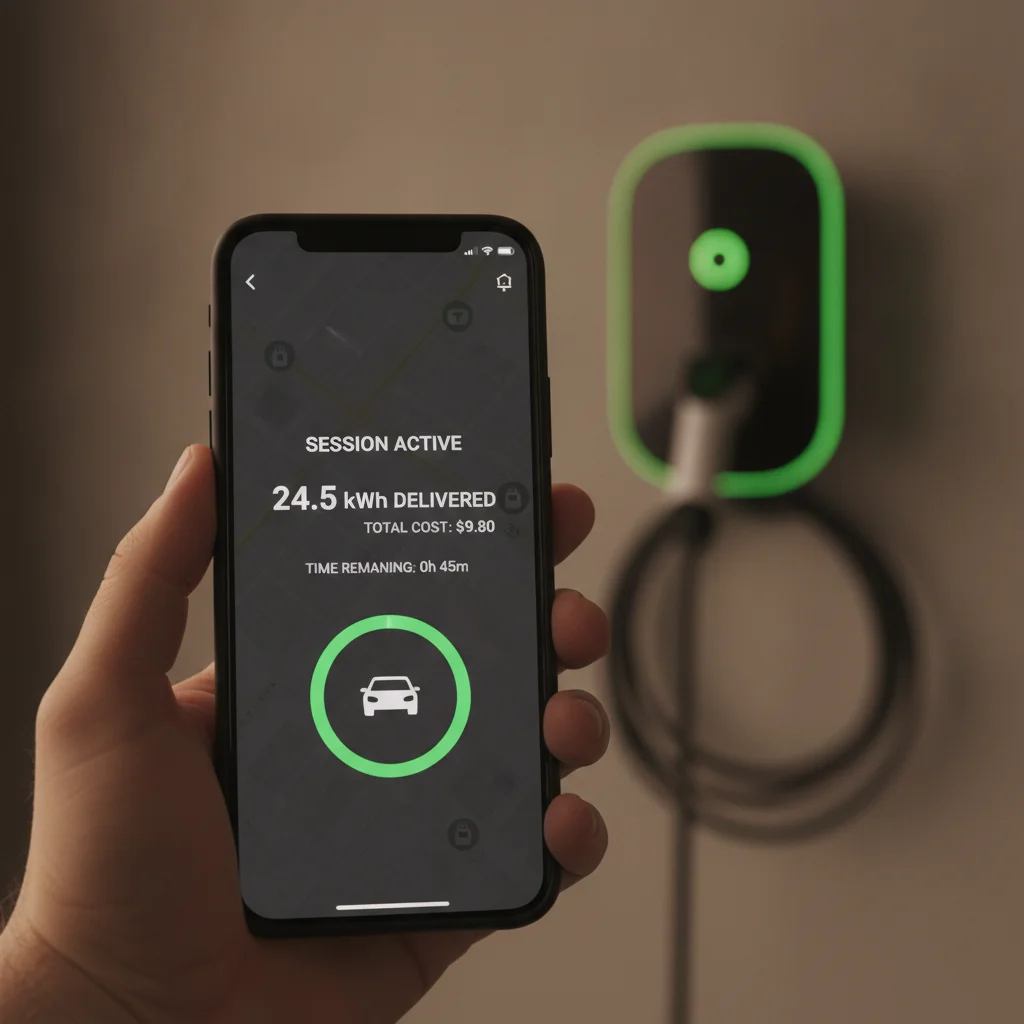
Charging costs add a second layer of complexity that catches many first-timers off guard. Networks charge differently — some bill per kilowatt-hour (kWh), others per minute, and a few still use session-flat pricing. The rate you pay can shift based on whether you're a subscriber, which tier of charger you're using, and even the time of day. For a detailed look at how these variables interact and where new EV owners lose money, the guide to charging cost mistakes that quietly drain EV savings is worth reading before your next road trip.
27%
Public chargers found non-functional on inspection
A 2023 UC Berkeley study of public charging stations in the San Francisco Bay Area found roughly 27% were non-operational at the time of the site visit.
$0.40–$1.00
Per-minute idle fee range across major networks
Networks including Electrify America and EVgo charge idle fees in this range once a vehicle remains plugged in beyond the post-charge grace period, typically 10 minutes.
20–80%
Optimal DC fast charging window for most EVs
Battery thermal and chemical management systems on most current EVs deliver peak charge rates within this state-of-charge range, making it the most time-efficient window for public fast charging.
7,000+
Public DC fast charging locations in the US
According to the U.S. Department of Energy's Alternative Fuels Station Locator, the United States had over 7,000 DC fast charging locations as of early 2024, a figure that continues to grow.
3–4
Major network apps worth pre-installing
ChargePoint, Electrify America, EVgo, and Blink collectively cover the majority of US public charging infrastructure — having accounts on all four minimizes friction on road trips crossing multiple networks.
The Reliability Problem: What to Do When the Charger Itself Fails
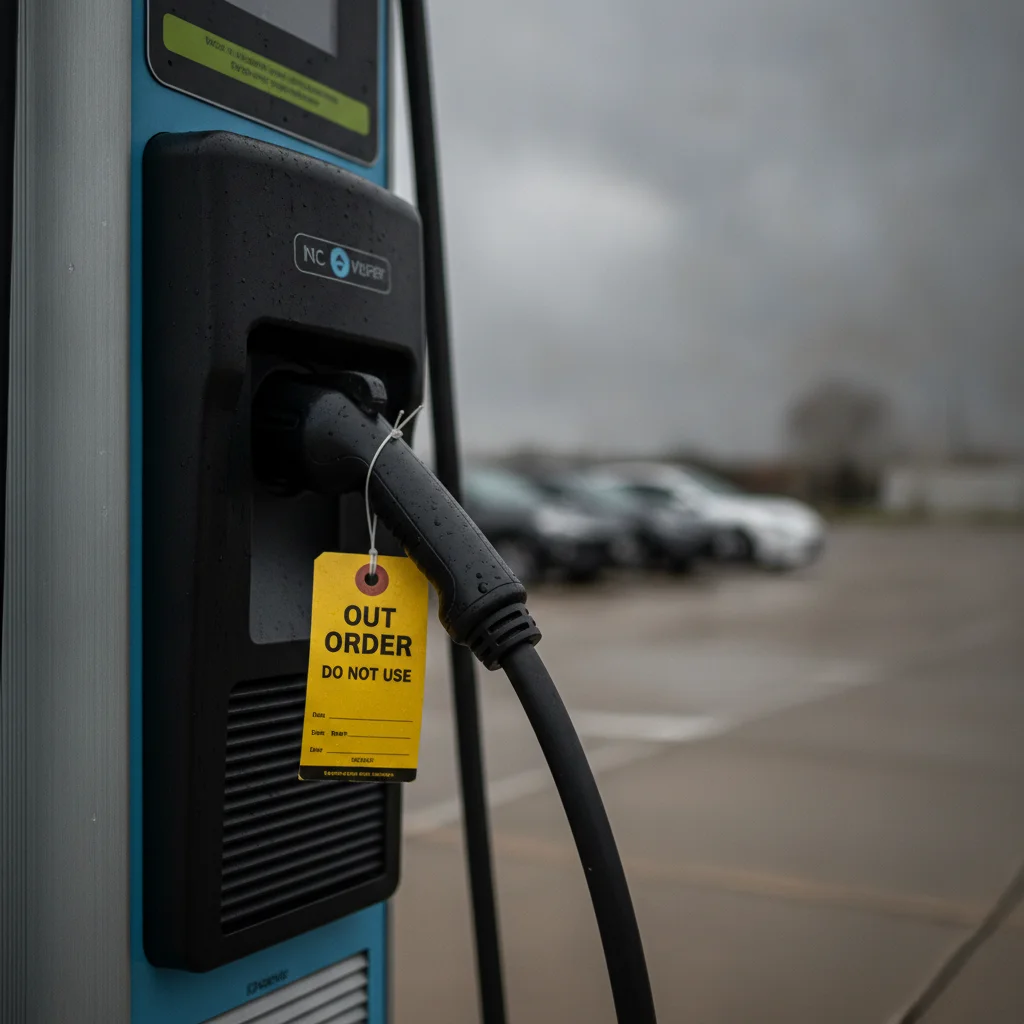
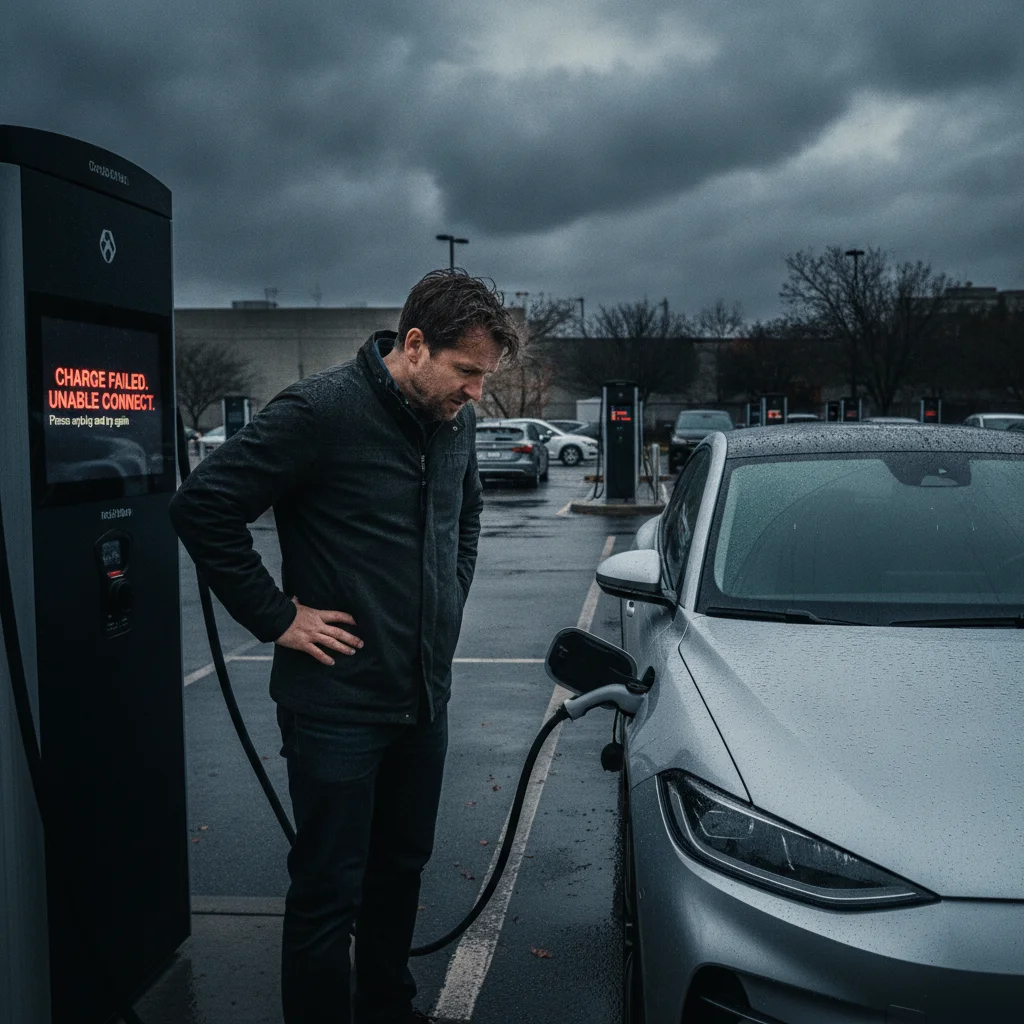
Even a perfectly prepared driver can arrive at a station that simply isn't working. Charger downtime remains one of the most-cited frustrations in EV ownership, and the causes range from software glitches and payment terminal failures to vandalism and grid connectivity issues.
Never Plan a Trip Around a Single Charger
Relying on one specific charger as your only option on a long-distance route is the highest-risk mistake a first-time road tripper can make. Hardware failures, occupied stalls, and unexpected closures are all real possibilities. Always identify at least one backup charging location within comfortable range before committing to a charging-dependent segment of your route.
Low Battery Limits Your Fast Charging Speed
Arriving at a DC fast charger with less than 5% state of charge can trigger battery protection protocols that cap the maximum accepted charge rate — sometimes significantly. This means you'll spend longer at the station than expected and may stress the battery pack in ways that affect long-term capacity. Plan stops at 10–20% to preserve both time and battery health.
Idle Fees Accumulate Faster Than Most Drivers Expect
At a rate of $0.40 to $1.00 per minute, a 30-minute delay in unplugging after charge completion can cost $12 to $30 — on top of your actual charging cost. Enable app notifications before every session and treat the charge-complete alert as a departure cue, not a suggestion.
A 2023 study by researchers at UC Berkeley found that roughly 27% of public chargers surveyed in the San Francisco Bay Area were non-functional at the time of the visit — a figure that, while regional and improving nationally, illustrates that downtime is a structural issue, not an anomaly.
Understanding why chargers go offline — and how networks are addressing it — can inform how you plan your charging stops. The explainer on why public chargers still go down breaks down the technical and logistical reasons behind reliability gaps and tracks what's being done to close them.
For in-the-moment recovery when you arrive at a dead charger, the playbook includes: checking the network's in-app status map before you exit the car, calling the charger's support line (usually printed on the unit), and having a backup station pre-loaded in your navigation. The guide to recovering when public charging fails covers each of these steps in detail.
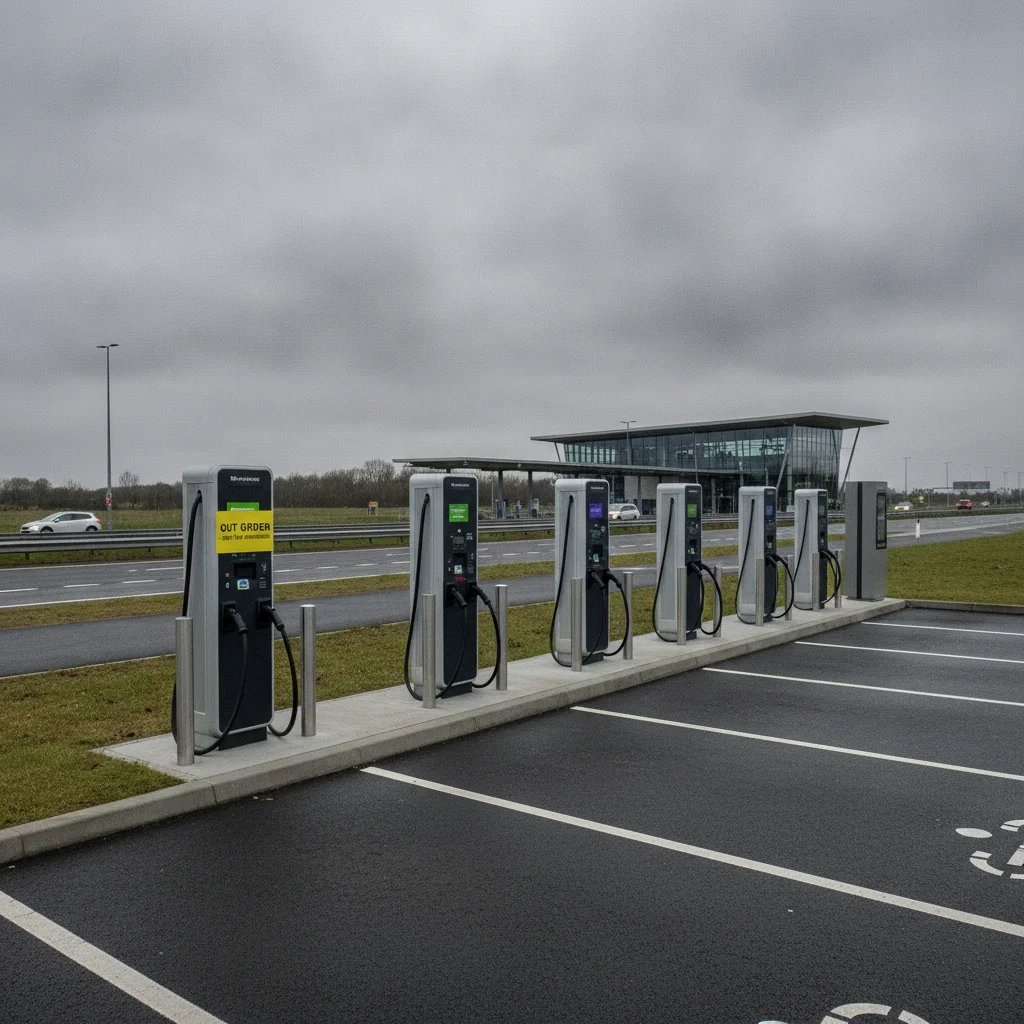
The broader takeaway: treat charger availability as probabilistic, not guaranteed. Building redundancy into your route — knowing the next-closest station before you need it — converts a potential emergency into a minor detour.
Charging Etiquette Mistakes That Affect Other Drivers
Some public charging mistakes don't just inconvenience you — they create friction for the drivers who arrive after you. Etiquette failures are common among first-timers not because new drivers are inconsiderate, but because the norms aren't posted on signs the way gas station rules are.
Connector Compatibility Is Not Universal
The EV industry is mid-transition between connector standards, with NACS (originally Tesla's design) being adopted by most major automakers alongside the older CCS1 standard. CHAdeMO is still found on older Nissan LEAFs and some other models. Before using any public DC fast charger for the first time, confirm which standard your vehicle uses and whether an adapter is required or available. Using the wrong connector — or assuming compatibility — is the single most common reason first-time users cannot initiate a session.
Pre-Trip Account Setup Is Non-Negotiable
Creating network accounts at a charging station — on a mobile phone with uncertain signal, under time pressure, with a low battery — is a recipe for a failed session. Some networks allow guest credit card tap-to-pay without an account, but this feature is inconsistent across hardware generations and may carry a higher per-session rate. Setting up accounts for ChargePoint, Electrify America, EVgo, and Blink before you need them eliminates the single most common point of failure for first-time users.
The most consequential etiquette mistake is leaving a fully charged vehicle plugged in and unattended. Once charging completes, the car occupies a stall that another driver may urgently need, and most networks begin charging idle fees — typically $0.40 to $1.00 per minute — after a short grace period. Those fees can accumulate faster than most drivers expect.
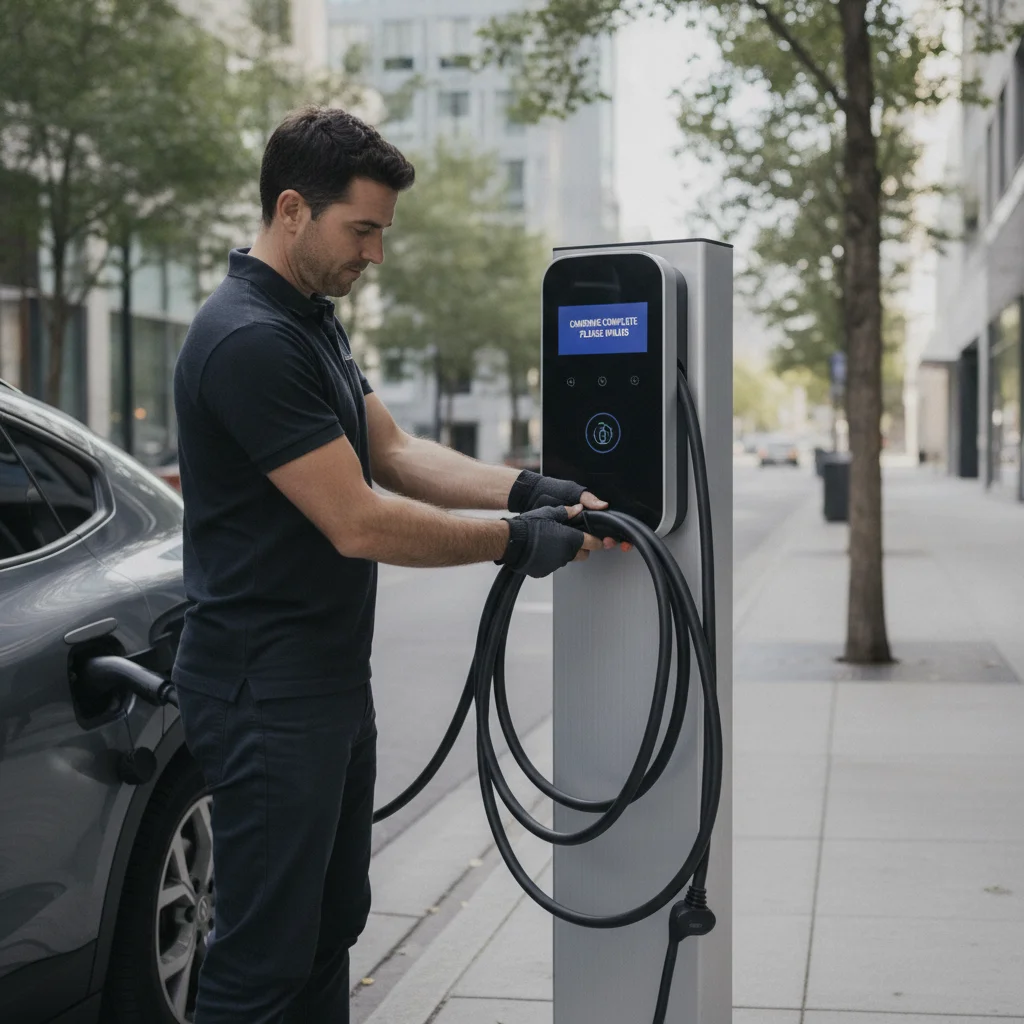
Connector cable management is a close second. Dropping charging cables on wet or dirty pavement, failing to hang them back on their hooks, or leaving them tangled can damage equipment and create hazards for the next user. It's a small act with disproportionate consequences at a high-traffic station.
For a comprehensive look at both the written rules (idle fee policies, time limits) and the unwritten conventions (lane courtesy, cable etiquette, behavior at shared L2 stations), the guide to public charging etiquette is an essential read for any new EV driver preparing to use public infrastructure regularly.
A note on ICEing — the practice, intentional or not, of internal combustion engine vehicles occupying EV charging stalls. If you arrive to find a non-EV blocking the only available charger, your options are limited to contacting the venue's management or, in jurisdictions with EV-lane laws, local parking enforcement. It's a reminder that public charging involves shared infrastructure with dynamics that go beyond the charger itself.
Understanding these social dimensions of public charging is just as important as the technical ones. Drivers who are both technically prepared and behaviorally considerate have the best experiences — and contribute to a charging environment that works better for everyone.
Building a Smarter Charging Habit From the Start
The mistakes covered in this article share a common thread: they are mostly solved by preparation done before you leave the driveway, not improvisation at the station. A checklist mindset — connector compatibility confirmed, app account created, payment method on file, backup station identified — converts the first-charger experience from stressful to routine in a single session.
Connector Compatibility Is Not Universal
The EV industry is mid-transition between connector standards, with NACS (originally Tesla's design) being adopted by most major automakers alongside the older CCS1 standard. CHAdeMO is still found on older Nissan LEAFs and some other models. Before using any public DC fast charger for the first time, confirm which standard your vehicle uses and whether an adapter is required or available. Using the wrong connector — or assuming compatibility — is the single most common reason first-time users cannot initiate a session.
Pre-Trip Account Setup Is Non-Negotiable
Creating network accounts at a charging station — on a mobile phone with uncertain signal, under time pressure, with a low battery — is a recipe for a failed session. Some networks allow guest credit card tap-to-pay without an account, but this feature is inconsistent across hardware generations and may carry a higher per-session rate. Setting up accounts for ChargePoint, Electrify America, EVgo, and Blink before you need them eliminates the single most common point of failure for first-time users.
A few habits that experienced EV drivers develop quickly:
- Pre-plan every public charging stop using PlugShare, the network's own app, or your vehicle's built-in navigation. Check real-time status, not just availability on a static map.
- Join the network's membership program if you'll use a given network more than a few times per month. The per-session savings on networks like Electrify America and EVgo typically recoup the membership fee within two to three sessions.
- Set a charge-complete alert in the network app so you can return to your vehicle promptly and avoid idle fees.
- Keep a backup payment method — a credit card that works without app authentication — for stations where the app flow fails.
- Target the 20–80% charge window at DC fast chargers. Charging slows significantly above 80% state of charge on most battery chemistries, meaning the final 20% takes disproportionately long and isn't worth the wait at a public fast charger unless you genuinely need the range.
For drivers who believe the public charging network is too sparse or unreliable to support their lifestyle, the data often tells a different story. The article on public charging myths examines common infrastructure concerns against current network coverage and growth trends.
Finally, it's worth noting that most of what makes public charging occasionally frustrating is infrastructure in transition, not infrastructure that's broken by design. The networks, the vehicles, and the regulatory environment are all improving rapidly. Drivers who understand the current friction points — rather than being caught off guard by them — are best positioned to navigate the gap between today's reality and tomorrow's seamlessly integrated charging ecosystem.
All claims are backed by peer-reviewed research. Sources on request.