Key Takeaways
NEVI Program
The National Electric Vehicle Infrastructure (NEVI) Formula Program is a federal initiative funded by the 2021 Infrastructure Investment and Jobs Act that distributes $5 billion over five years to all 50 states, Washington D.C., and Puerto Rico. The money is intended to build a nationwide network of publicly accessible EV fast-charging stations, prioritizing highway corridors so drivers can complete long-distance trips without range anxiety. States receive funds through annual formula allocations and must follow federal standards for station spacing, equipment quality, uptime, and pricing.
NEVI is administered by the Federal Highway Administration (FHWA) under 23 U.S.C. § 151. Stations must comply with the FHWA's EV Charging Minimum Standards Rule, which requires CCS (Combined Charging System) compatibility, 150 kW minimum per port, and 97% uptime measured on a 30-day rolling basis.
The Problem NEVI Was Built to Solve
Before NEVI, the US public charging landscape was fragmented in ways that genuinely frustrated EV adoption. Charging stations clustered in coastal metro areas and affluent zip codes, while large swaths of the interior — including long stretches of Interstates 10, 40, and 90 — had gaps of 100 miles or more between reliable DC fast chargers. A cross-country road trip required careful planning and significant tolerance for detours.
Private networks had expanded aggressively, but market incentives alone pushed investment toward high-traffic urban destinations rather than the less profitable rural corridors that connect them. Reliability compounded the problem: a 2023 study by J.D. Power found that roughly 21% of public charging sessions were abandoned by drivers due to equipment failures, network outages, or payment system errors.
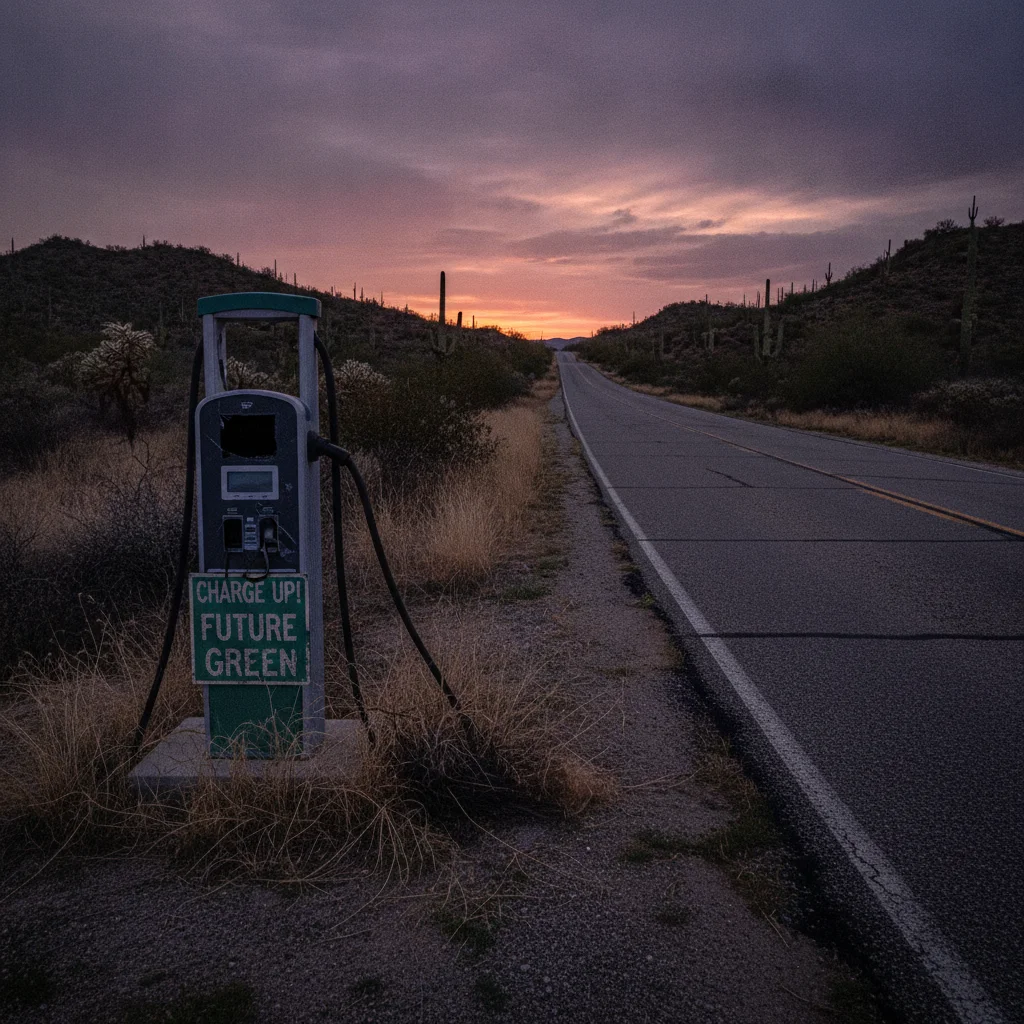
NEVI's architects identified two structural failures: inadequate coverage along highway corridors, and insufficient standards forcing operators to maintain equipment quality. The program attempts to fix both simultaneously — funding the gaps and mandating the standards as conditions of receiving that funding.
For a full picture of how the existing network looked before NEVI dollars began flowing, see the complete overview of US public EV charging networks.
Alternative Fuel Corridors: The Eligible Routes
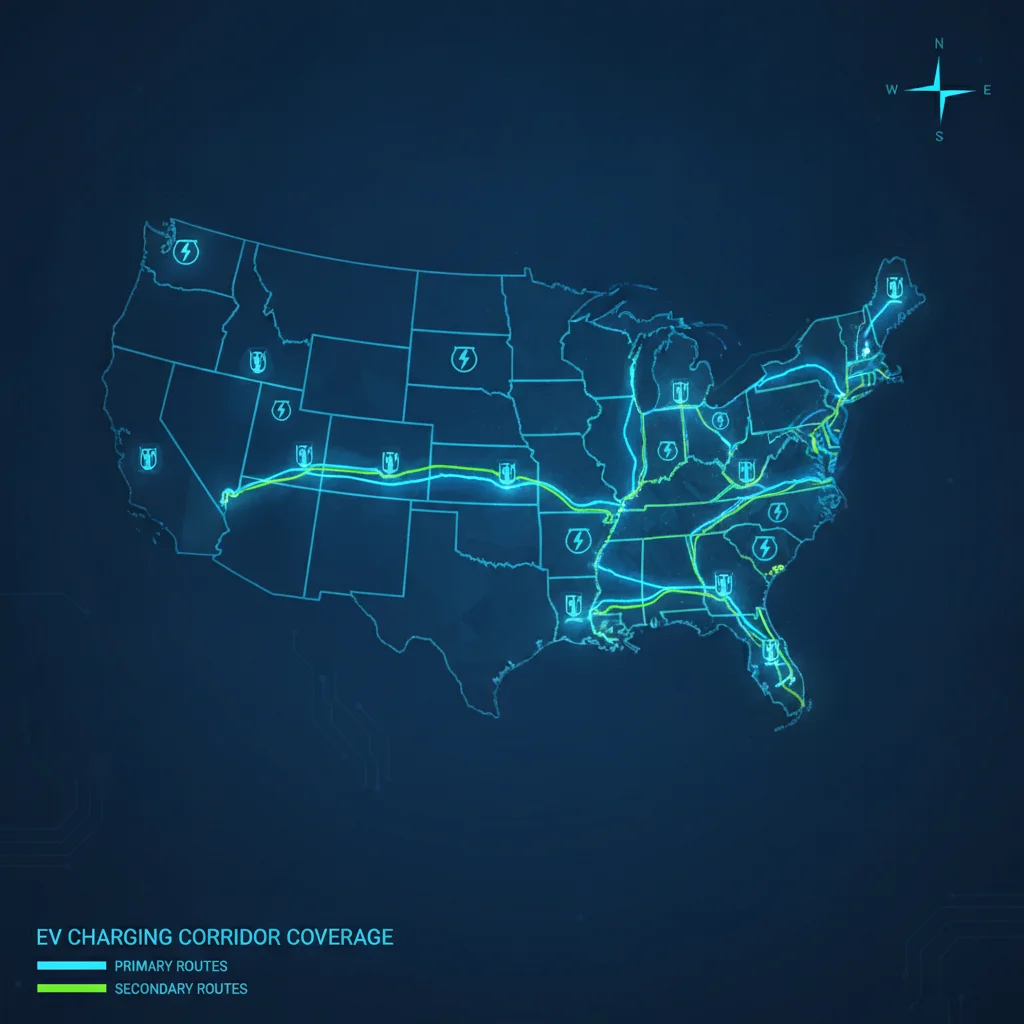
Not every US highway is a designated Alternative Fuel Corridor. The FHWA maintains a specific list of AFC-designated routes, and NEVI funds may only be spent on stations along those corridors. Drivers can check corridor designations at afdc.energy.gov/corridors. States may petition to add new corridor designations as their EV Infrastructure Deployment Plans evolve.
CFI Grants Target the Gaps NEVI Leaves
The Charging and Fueling Infrastructure (CFI) program distributes $2.5 billion through competitive grants aimed at community charging rather than highway corridors. Eligible applicants include local governments, utilities, nonprofits, and tribal entities. Priority is given to rural areas, low-income communities, and multi-unit dwellings where residents lack home charging access.
How the $5 Billion Is Allocated
NEVI distributes funds using a formula rather than a competitive grant process — a deliberate design choice meant to ensure every state receives money regardless of political landscape or administrative capacity. Each state's annual allocation is calculated based on a weighted combination of total lane miles of public roads, total vehicle miles traveled, and the number of alternative fuel corridors designated by the FHWA within that state.
$5B
Total NEVI federal funding over five years
Authorized by the 2021 Infrastructure Investment and Jobs Act, distributed annually to all 50 states, D.C., and Puerto Rico.
75,000+
Miles of designated Alternative Fuel Corridors
The FHWA's AFC network defines the highway mileage NEVI stations must cover with 50-mile maximum spacing.
97%
Required monthly uptime per NEVI port
Mandated by the FHWA's EV Charging Minimum Standards Rule, measured on a rolling 30-day basis per individual port.
150 kW
Minimum simultaneous power per charging port
Each of the four required ports at a NEVI site must deliver 150 kW simultaneously, not shared across a cabinet.
21%
Public charging sessions abandoned pre-NEVI
According to J.D. Power's 2023 US Electric Vehicle Experience Public Charging Study, due to equipment failures and payment errors.
Larger states with extensive highway networks — Texas, California, Florida — receive the largest nominal allocations, but the per-mile funding often favors smaller states with proportionally more designated corridors relative to their area. Wyoming, for example, receives a meaningful annual allocation because Interstates 25, 80, and 90 all cross its territory as major national corridors.
States must submit an EV Infrastructure Deployment Plan (EV IDP) to the FHWA, outlining how they intend to spend their allocation, which corridors they will prioritize, how they will solicit private operators, and how they plan to engage underserved communities. The FHWA reviews and approves each plan before funds are released. As of mid-2025, all 50 states have received approval for at least their first-phase plans.
It's worth noting that NEVI money does not go directly to charging operators. States receive the funds and then issue procurement contracts or grant agreements with private companies — ChargePoint, Electrify America, EVgo, Francis Energy, and others — to build and operate the stations to federal specifications.
Check Your State's EV Infrastructure Plan
Every state's FHWA-approved EV Infrastructure Deployment Plan is publicly available and lists exactly which corridors are being funded in each phase. Searching your state's Department of Transportation website for 'NEVI plan' will typically surface the document. Reviewing it before a road trip can help you identify which corridors have confirmed station timelines versus those still in planning.
Use the Joint Office Dashboard Before You Drive
The Joint Office of Energy and Transportation publishes a public NEVI station deployment dashboard updated quarterly. Before a long trip, cross-reference your route against current commissioned stations rather than relying solely on in-car navigation, which may not yet reflect recent openings. Apps like PlugShare allow user check-ins and real-time status reports that complement official data.
The Federal Standards Every NEVI Station Must Meet
The binding minimum standards established by the FHWA's EV Charging Minimum Standards Rule are arguably the most consequential part of NEVI — more important, in some respects, than the dollar amounts themselves. These rules create a floor that publicly funded charging infrastructure must meet, and they address nearly every pain point that early EV drivers catalogued about existing public stations.
Location Requirements
NEVI stations must be located on an FHWA-designated Alternative Fuel Corridor (AFC), within one mile of an interstate exit or highway interchange, and no more than 50 miles from the previous NEVI-compliant station in each direction along that corridor. This spacing requirement is the mechanism that eliminates charging deserts along major highways.
Equipment Specifications
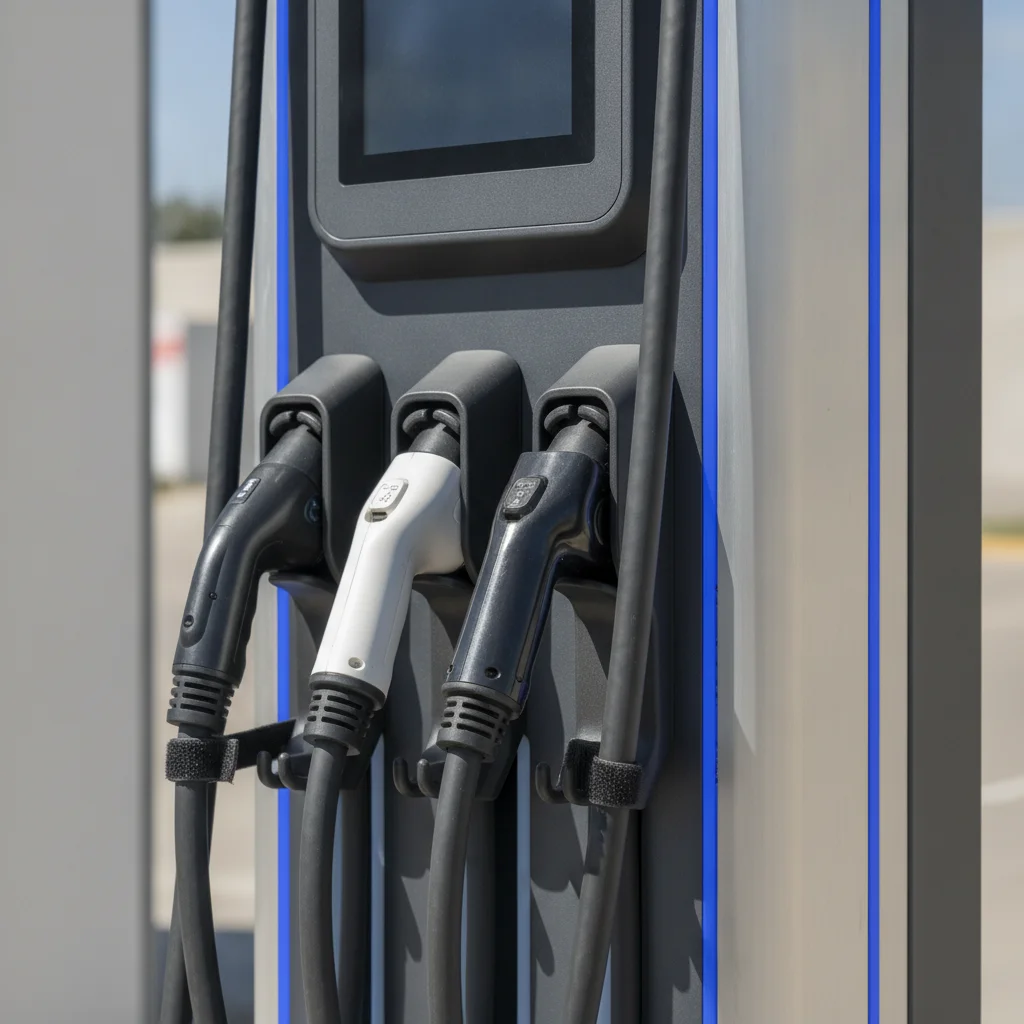
Each NEVI site must provide a minimum of four DC fast-charging ports, each capable of simultaneously delivering at least 150 kW to a connected vehicle. Simultaneous delivery is the critical phrase — a station cannot meet the requirement by having four ports share a single 150 kW power cabinet. Real power must be available to all four vehicles at once.
Connector Compatibility
All stations must support CCS1 connectors, which are standard on virtually all non-Tesla US-market EVs. The rules do not prohibit operators from adding NACS or CHAdeMO ports, and most operators are including NACS as Tesla's standard gains broader industry adoption through adapter and native-port agreements with Ford, GM, Rivian, and other automakers.
Uptime and Maintenance
The 97% uptime requirement — measured on a rolling 30-day basis per port — is the most operationally demanding standard. It effectively forces operators to staff or contract local maintenance technicians, because a single port that fails and isn't repaired within roughly 22 hours in a month will violate the requirement. This is a meaningful departure from the lax maintenance culture that plagued early public charging.
Pricing Transparency
Operators must display pricing clearly before a session begins and cannot require a paid subscription membership as the only way to access the charger. Ad-hoc pricing — what a driver without a network account pays — must be publicly posted and accessible through a contactless payment option.
“The minimum standards we've established aren't just about this program — they're about setting the expectation for what reliable public charging looks like across the entire industry.”
— Gabe Klein, Executive Director, Joint Office of Energy and Transportation
What NEVI Means for Highway Road Trippers
The most immediate, tangible benefit of NEVI for most EV drivers is the systematic elimination of charging gaps along the corridors most used for long-distance travel. The FHWA's Alternative Fuel Corridor network covers approximately 75,000 miles of US highways, and NEVI's 50-mile spacing rule means the fully built-out program will place reliable fast chargers within comfortable range of any EV sold today on every designated corridor.
For context, the average DC fast-charging session adds roughly 100–200 miles of range in 20–40 minutes depending on vehicle and charger power level. A 50-mile maximum gap means that even a vehicle with unusually low winter range has a safety margin without requiring emergency routing decisions.
The highway charging picture that NEVI is building connects directly to the broader corridor strategy described in our analysis of US highway EV charging corridors, which also covers the role of private investment alongside federal funding.
Drivers should understand that NEVI stations are being built and activated in phases. Some corridors in western states — where distances are greatest and the infrastructure gap was most acute — were among the first to receive funding priority. Other corridors, particularly in the Northeast where private networks are already dense, may see NEVI stations appear more gradually as states fill true gaps rather than building redundant infrastructure.
What NEVI Doesn't Cover — and the CFI Program's Role
NEVI is a highway corridor program. By design and by federal rule, it concentrates investment along interstates and designated corridors rather than in urban neighborhoods, rural communities off the main highway system, or destination charging at hotels, restaurants, and retail centers. This geographic focus is intentional but leaves significant needs unaddressed.
Urban apartment dwellers without home charging access — a genuine barrier to EV adoption in dense cities — are not the primary beneficiaries of NEVI. Nor are rural residents who live miles from any designated corridor. The Federal Highway Administration and Department of Energy acknowledged this gap explicitly when structuring the broader Infrastructure Act charging provisions.
The Charging and Fueling Infrastructure (CFI) Discretionary Grant Program, funded at $2.5 billion from the same legislation, is the complement to NEVI. Unlike NEVI's formula approach, CFI is competitive — communities, utilities, and nonprofits apply for grants — and it explicitly prioritizes underserved communities, rural areas, and community destinations like schools, libraries, and multi-unit housing complexes.
Alternative Fuel Corridors: The Eligible Routes
Not every US highway is a designated Alternative Fuel Corridor. The FHWA maintains a specific list of AFC-designated routes, and NEVI funds may only be spent on stations along those corridors. Drivers can check corridor designations at afdc.energy.gov/corridors. States may petition to add new corridor designations as their EV Infrastructure Deployment Plans evolve.
CFI Grants Target the Gaps NEVI Leaves
The Charging and Fueling Infrastructure (CFI) program distributes $2.5 billion through competitive grants aimed at community charging rather than highway corridors. Eligible applicants include local governments, utilities, nonprofits, and tribal entities. Priority is given to rural areas, low-income communities, and multi-unit dwellings where residents lack home charging access.
Smaller and regional charging networks have been particularly active in pursuing CFI grants to extend their footprints into areas the major networks haven't prioritized. Our guide to charging networks beyond the big five covers how operators like Francis Energy and others are filling geographic gaps that NEVI's corridor focus leaves open.
Together, NEVI and CFI are designed to work in tandem: NEVI builds the highway backbone that makes long-distance EV travel viable, while CFI addresses the last-mile and community access challenges that determine whether EVs are practical for everyday drivers in every type of community.
Funding, Reliability, and What Drivers Should Actually Expect
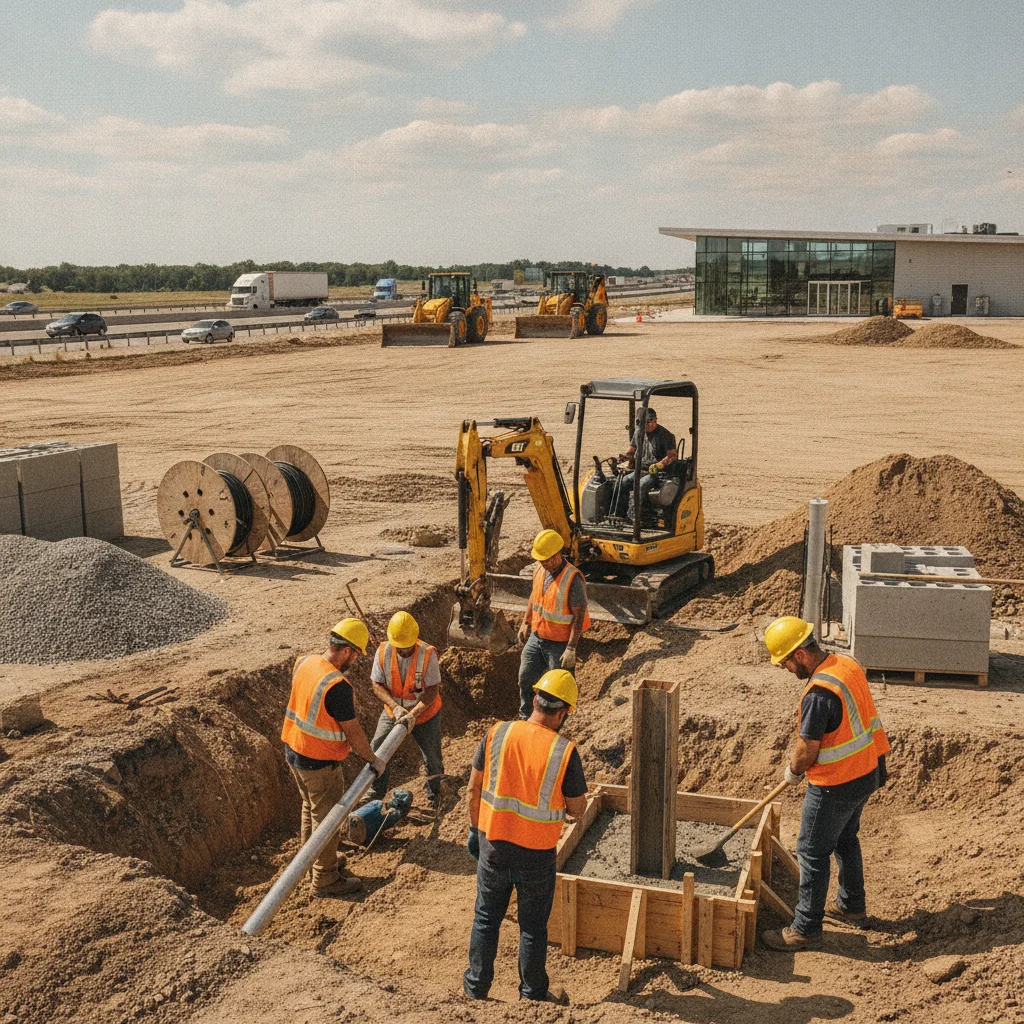
Federal funding creates real chargers — but not instantly, and not without complications. The gap between a state receiving NEVI approval and a driver being able to plug in at a new station involves site acquisition, utility interconnection, permitting, construction, and software commissioning. Utility interconnection has been the most cited bottleneck: getting sufficient grid power to a rural highway site can take 12–36 months in some utility territories, regardless of how quickly construction funding arrives.
Several states that moved quickly through the planning phase — Colorado, Ohio, and Utah among them — began commissioning NEVI-compliant stations in 2024. Others have faced slower timelines due to procurement complexity or utility delays. The Joint Office of Energy and Transportation publishes a quarterly dashboard tracking station deployment by state, which is the most accurate public source for current progress.
On cost, NEVI-funded stations will not be free. Pricing at NEVI sites is set by the private operators who win state contracts, and rates vary. Drivers in states with high commercial electricity rates — California, Hawaii, Connecticut — will pay more per kWh or per minute than those in states with cheaper grid power. For a detailed look at how electricity prices affect your actual charging bill, our state-by-state EV charging cost breakdown provides current comparisons.
The 97% uptime standard is enforceable through grant clawback provisions — operators who fail to meet it can lose funding or face penalties — but enforcement mechanisms are still being refined at the state level. Drivers should expect NEVI-compliant stations to be more reliable than the pre-NEVI average, but the standard will take time to become operationally routine across all operators and geographies.
Check Your State's EV Infrastructure Plan
Every state's FHWA-approved EV Infrastructure Deployment Plan is publicly available and lists exactly which corridors are being funded in each phase. Searching your state's Department of Transportation website for 'NEVI plan' will typically surface the document. Reviewing it before a road trip can help you identify which corridors have confirmed station timelines versus those still in planning.
Use the Joint Office Dashboard Before You Drive
The Joint Office of Energy and Transportation publishes a public NEVI station deployment dashboard updated quarterly. Before a long trip, cross-reference your route against current commissioned stations rather than relying solely on in-car navigation, which may not yet reflect recent openings. Apps like PlugShare allow user check-ins and real-time status reports that complement official data.
For drivers interested in reducing charging costs beyond just finding reliable infrastructure, both federal tax credits and state-level utility programs offer meaningful offsets. The guide to federal and state EV charging incentives covers home charger installation credits, time-of-use rate programs, and utility rebates that apply regardless of whether you're charging at a NEVI station or at home. See also the broader Charging Costs and Savings hub for tools to estimate your total cost of EV ownership.
The Bigger Picture: NEVI as Infrastructure Policy
NEVI represents the largest single federal investment in EV charging infrastructure in US history, and its impact extends beyond the chargers themselves. By establishing national minimum standards, the program is pushing the entire public charging industry — including privately funded stations not receiving NEVI dollars — toward higher reliability, payment interoperability, and pricing transparency norms.
Automakers have pointed to NEVI progress in their own electrification timelines, treating federal corridor commitments as partial backstop against the infrastructure chicken-and-egg problem that has historically slowed EV adoption. When a manufacturer can point to a federal program guaranteeing charger availability along major corridors, the range anxiety objection to buying an EV weakens.
The program also has a workforce development dimension that often goes underreported. NEVI requires recipients to comply with Davis-Bacon prevailing wage requirements and encourages — in some state plans, requires — apprenticeship programs for EV charging installers and maintenance technicians. This is building a skilled trade workforce that will be essential as the broader charging ecosystem grows well beyond NEVI's initial scope.
Critics of the program's pace are not wrong that deployment has been slower than the initial 2023 public targets suggested. Utility grid constraints, permitting delays, and supply chain issues for high-power charging equipment have all extended timelines. But the structural framework NEVI has established — standardized specs, mandatory uptime, transparent pricing, equitable access provisions — will shape public charging quality in the US for decades, regardless of which operators or networks ultimately build the stations.
Drivers making EV purchase decisions today can reasonably plan around a highway charging network that will be substantially more complete by 2026 than it was in 2022. That's a meaningful shift in the practical calculus of EV ownership, and NEVI is the primary reason why.
All claims are backed by peer-reviewed research. Sources on request.