Key Takeaways
Highway Charging Corridor
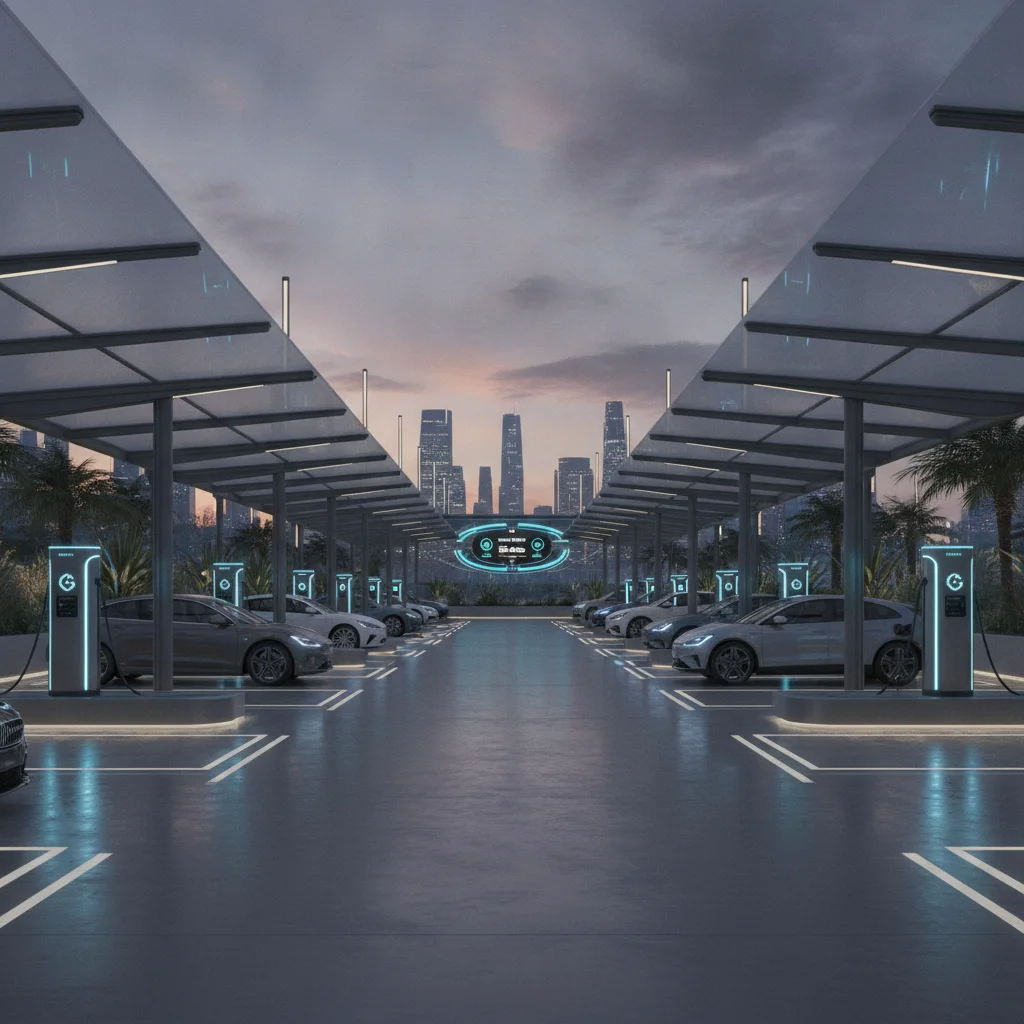
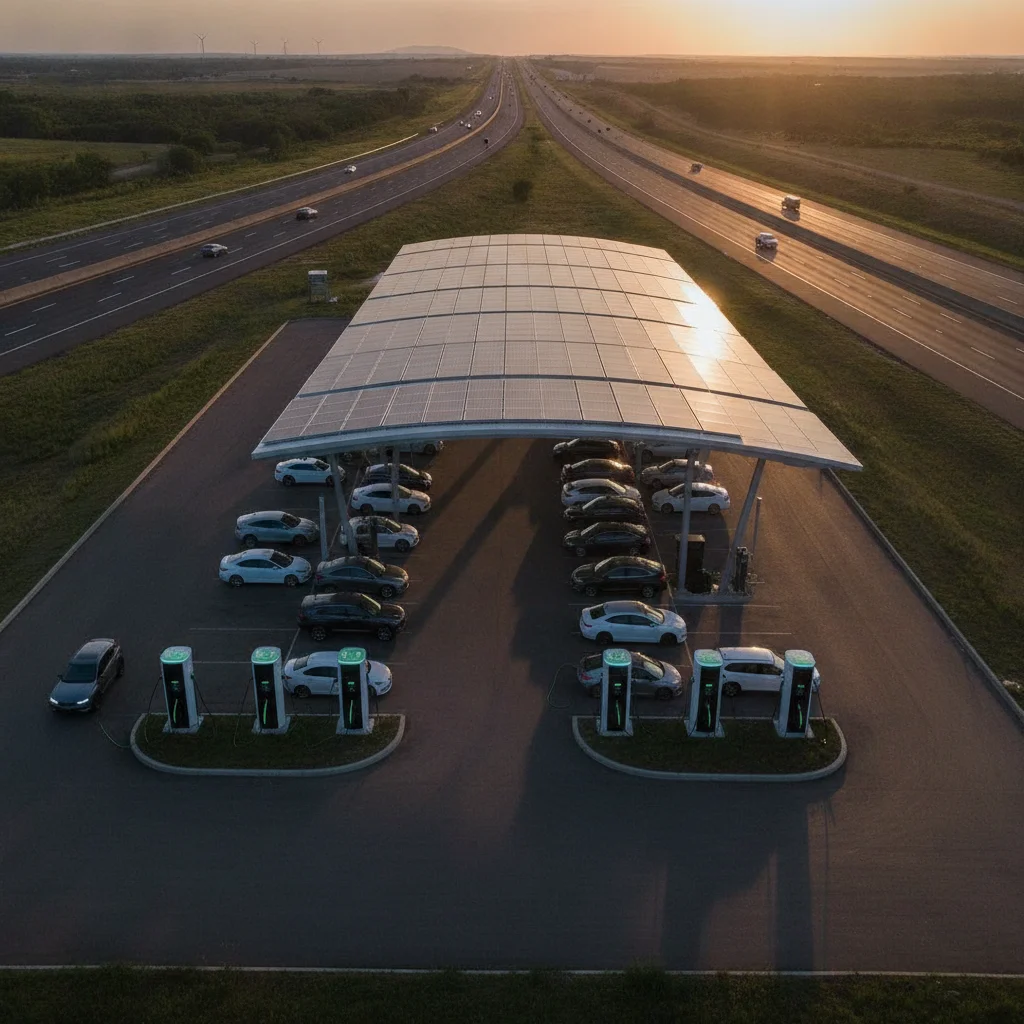
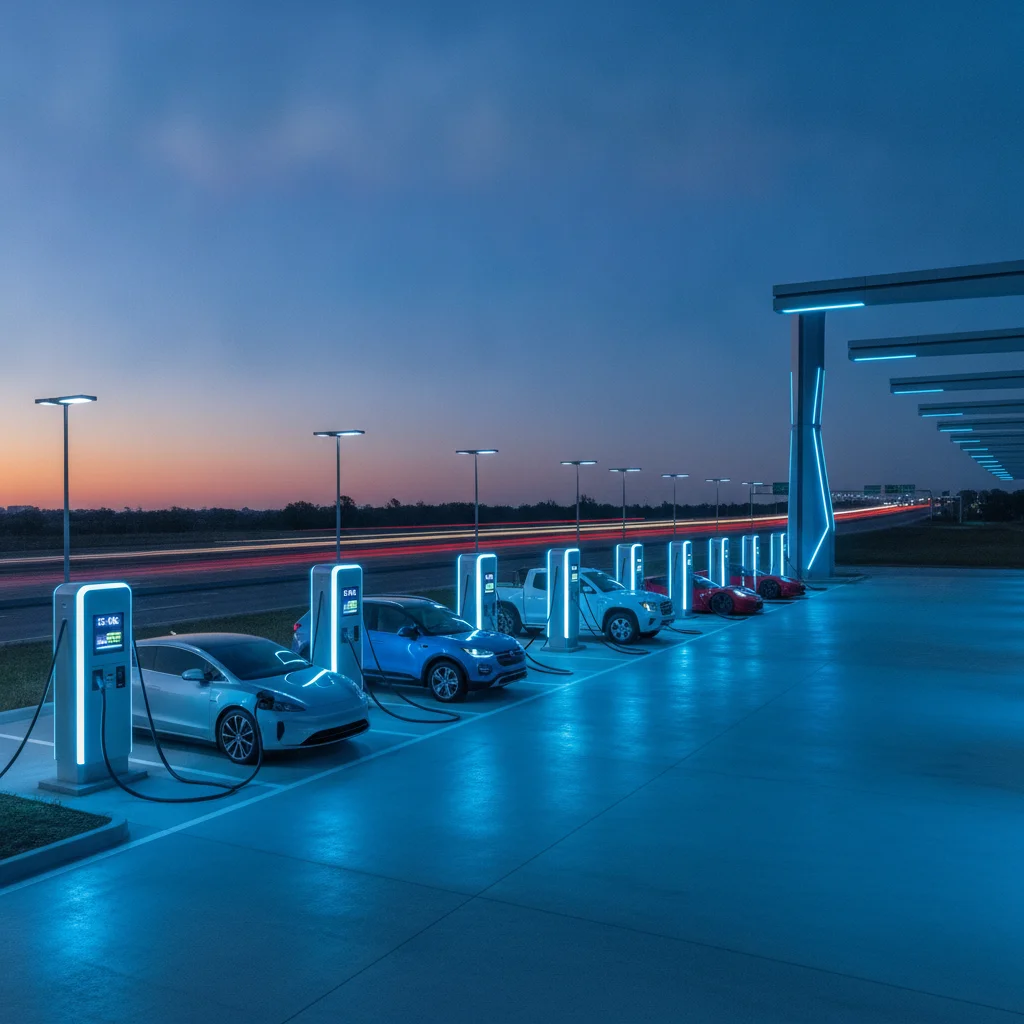
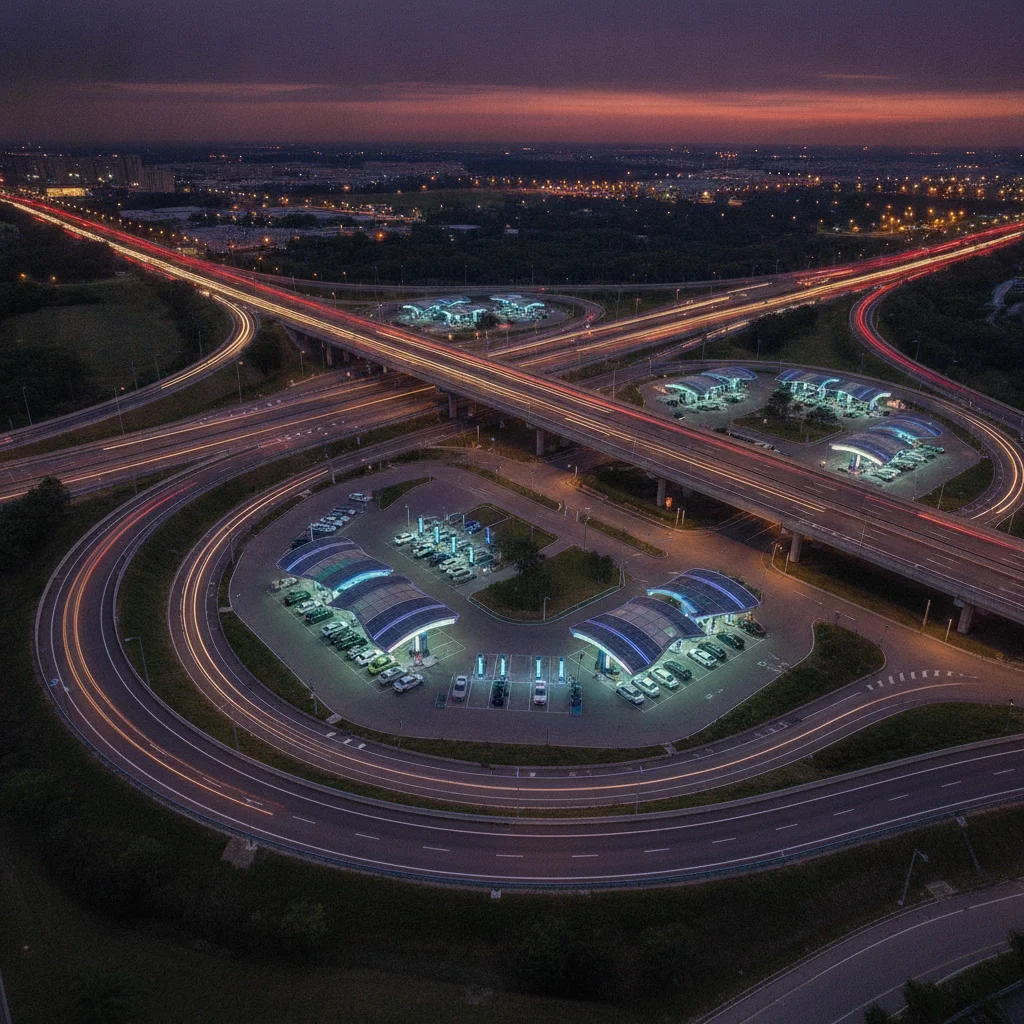
A highway charging corridor is a stretch of interstate or major highway equipped with DC fast-charging stations placed at regular intervals — typically every 50 miles — so that electric vehicle drivers can complete long-distance trips without range anxiety. These corridors form the backbone of a national EV charging network, connecting cities, states, and regions. The goal is to replicate the reliability and predictability that gas stations currently provide to combustion-engine drivers.
Under NEVI program standards, qualifying corridor stations must deliver at least 150 kW of power per port, maintain a 97% operational uptime, and be located within one mile of an interstate exit.
What a Charging Corridor Actually Means
The phrase "charging corridor" gets used loosely in EV coverage, but it has a precise regulatory meaning. Under the Federal Highway Administration's Alternative Fuel Corridors (AFC) program, a route earns corridor designation when it meets specific criteria for charger spacing, power output, and public accessibility. Think of it as a government seal of approval — an assurance that drivers who follow a designated corridor won't be stranded between charge points.
Corridors are not simply roads that happen to have chargers nearby. They are planned infrastructure routes, typically overlapping with the US interstate highway system, where federal and state governments coordinate with private operators to ensure coverage. The AFC program began designating corridors in 2016, but the real acceleration came with the 2021 Infrastructure Investment and Jobs Act and the NEVI program it created.
For road trippers, understanding corridors matters because it shapes where reliable fast charging actually exists versus where you're depending on luck. A corridor designation means chargers should be present, operational, and capable of meaningful charging speeds. Off-corridor routes are a different story — coverage is patchier, uptime less guaranteed, and speeds more variable.
For a broader view of how these corridor stations fit into the overall public charging picture, see our complete overview of US public EV charging networks.
The NEVI Program: Federal Money, State Execution
The National Electric Vehicle Infrastructure program is the most significant federal EV charging investment in US history. Authorized by the Bipartisan Infrastructure Law, it allocates $5 billion over five years to build out fast-charging stations specifically along designated Alternative Fuel Corridors. Every state, Washington D.C., Puerto Rico, and several tribal areas received funding allocations based on a formula tied to highway miles and population.
$5B
Total NEVI program federal investment
Authorized by the 2021 Bipartisan Infrastructure Law, distributed over five years to all 50 states plus D.C. and territories.
75%
AFC highway miles designated
As of 2024, approximately 75% of the US Alternative Fuel Corridor network has received designation, though station construction lags designation.
150 kW
Minimum NEVI port output required
Each NEVI-funded station must simultaneously deliver at least 150 kW per port across a minimum of four ports.
97%
Required operational uptime for NEVI stations
FHWA mandates 97% uptime for federally funded chargers — a standard that has historically challenged the broader public charging industry.
27%
Non-Tesla chargers found non-functional
A 2023 UC Berkeley study found more than one in four non-Tesla DC fast chargers in the San Francisco Bay Area were non-operational on a given visit.
The mechanics work like this: each state submits an EV Infrastructure Deployment Plan to the Federal Highway Administration. Once approved, the state issues contracts — typically through competitive procurement — to private charging operators. Those operators build the stations, but must comply with NEVI's technical standards to receive reimbursement.
Those standards are specific. Each NEVI station must include at least four DC fast-charging ports capable of simultaneously delivering 150 kW or more. Stations must be located within one mile of the interstate exit they serve, open 24 hours a day, 7 days a week, and maintain 97% operational uptime — a figure that has drawn scrutiny given how far below that bar many existing public chargers have historically performed. Stations must also accept payment without requiring a network-specific membership.
NEVI Funding Is Not a Blank Check
States receive NEVI allocations as reimbursements, not upfront grants. Charging operators must build stations meeting federal standards, then apply for reimbursement covering up to 80% of eligible costs. This structure means operators bear upfront capital risk, which has contributed to slower deployment timelines in some states where fewer operators bid on contracts.
CHAdeMO Is Being Phased Out
Older Nissan Leafs and a few other early EVs use the CHAdeMO connector standard, which is no longer supported on new vehicles sold in the US. Many highway fast chargers are removing CHAdeMO cables as they upgrade equipment. Drivers of CHAdeMO vehicles should verify connector availability carefully when planning highway routes, as options are narrowing.
For a deeper breakdown of what NEVI means for specific communities and coverage gaps, our analysis of the NEVI program's national impact covers the policy mechanics in full.
The rollout has been slower than optimists projected. Several states took until 2024 to finalize contracts, and construction timelines for new stations typically run 12–24 months after award. As of early 2025, a handful of NEVI-funded stations had opened in states including Ohio, Pennsylvania, and Utah, with hundreds more in various stages of permitting and construction.
Private Networks: Building Corridors on Their Own Timeline
Federal money is only part of the story. Private charging networks have been building highway infrastructure for years, operating on their own investment timelines and business logic — and in some cases, outpacing the NEVI rollout.
Tesla's Supercharger network remains the gold standard for highway reliability. With more than 2,000 US Supercharger locations, many strategically placed every 20–30 miles along busy travel corridors, Tesla built a usable long-distance network before NEVI existed. The network's 2023 opening to non-Tesla vehicles — initially via CCS adapters, and now natively for vehicles with NACS ports — dramatically expanded its relevance to all EV drivers.
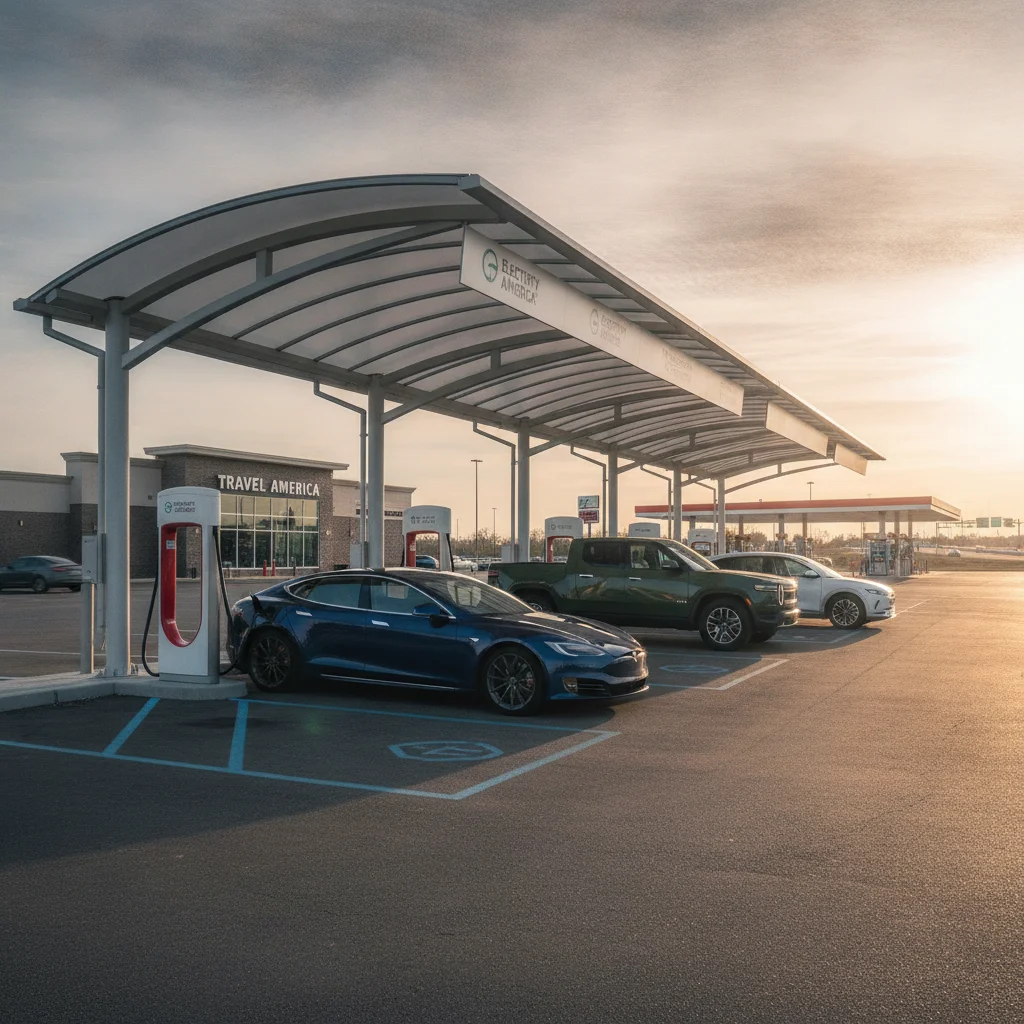
Electrify America, funded by Volkswagen's $2 billion Dieselgate settlement, has invested heavily in interstate coverage. Its stations are typically located at highway-adjacent retail locations — Walmart, Target, and travel centers — and deploy 150–350 kW chargers. Electrify America has also been an active NEVI contractor in multiple states, meaning some of its new stations receive partial federal funding.
EVgo and ChargePoint round out the major non-Tesla networks, though with different geographic priorities. EVgo concentrates on metro markets, so its highway presence is thinner. ChargePoint has a massive station count but skews toward Level 2 and lower-output DC fast charging, making it less relevant for time-sensitive highway stops. For a head-to-head comparison of the two largest non-Tesla fast-charging operators, our EVgo vs. Electrify America comparison breaks down coverage, pricing, and reliability.
“The charging network we need for mass EV adoption isn't just about counting stations — it's about ensuring those stations are fast enough, reliable enough, and spaced correctly for how Americans actually drive. Corridors are the right framework because they mirror how people move across the country.”
— David Slutzky, Founder of Forth Mobility, a nonprofit advancing transportation electrification
Where the Gaps Still Are
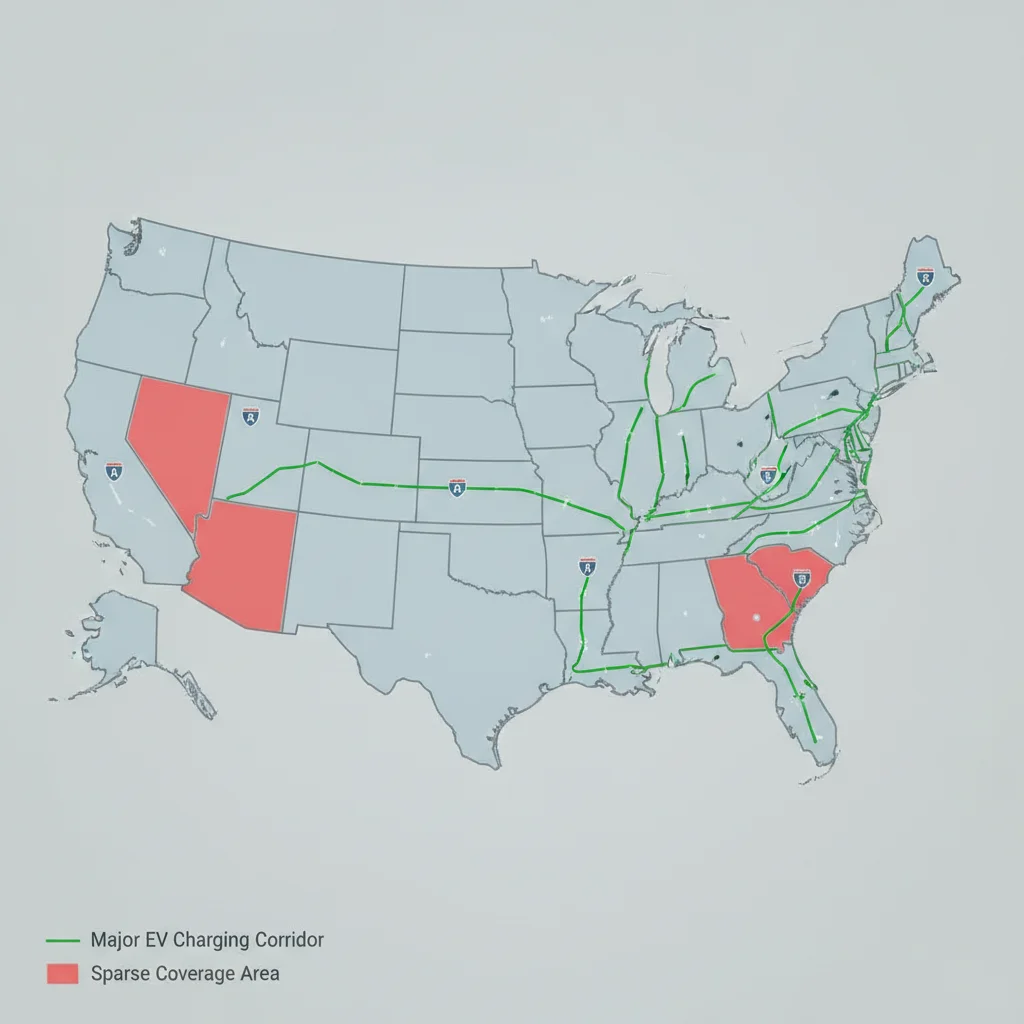
Even with federal funding and private investment flowing, significant gaps remain in the US highway charging map. They cluster in predictable places: rural Western states, the Great Plains, and portions of the South where traffic volumes don't justify the capital expense of fast chargers without subsidies.
States like Wyoming, Montana, North Dakota, and South Dakota present the starkest challenges. Interstate mileage is high, population density is low, and the economics of operating a charging station with limited daily throughput are unfavorable without government support. Some stretches of I-90 in Montana and I-80 in Wyoming still require careful route planning, particularly for vehicles with below-average range.
Always Check Real-Time Status Before Departing
Corridor designation and charging app maps show planned or nominal station locations — they don't always reflect whether a station is working right now. Check PlugShare for recent check-ins and user reports within the last 24–48 hours before committing to a route that depends on a specific charger. Alternatively, call the network's customer service line to verify operational status at critical stops.
Add a Buffer Stop in Sparse Regions
When traveling through rural Western corridors, plan your charging stops so you arrive at each station with at least 15–20% battery remaining rather than the minimum needed. This buffer covers scenarios where a station is occupied, offline, or slower than rated. On competitive urban corridors, tighter arrival states of charge are reasonable because backup options are nearby.
The Southeast has improved substantially over the past two years, driven by Electrify America buildouts and growing state-level investment, but coverage remains uneven once you leave the I-95 corridor or depart from major arterials. Mississippi, West Virginia, and parts of Arkansas still have stretches where charging options require detours of 10 miles or more from the highway.
For a state-by-state breakdown of where coverage is strong and where it's still thin, our state-by-state public charging coverage analysis maps the data in detail. The contrast between highway and urban charging needs is also worth understanding — those are fundamentally different infrastructure problems, as our urban vs. highway charging explainer explains.
Connector Standards: The Quiet Infrastructure Battle
No discussion of charging corridors is complete without addressing the connector chaos that complicated EV road trips for years — and how the industry is finally resolving it.
Until recently, EV drivers faced a fragmented landscape: Tesla vehicles used a proprietary connector, most other US EVs used CCS (Combined Charging System), and older Nissan Leafs used CHAdeMO. Highway charging stations had to stock multiple connector types or exclude certain vehicles entirely. Adapters helped but added friction.
The shift to NACS (North American Charging Standard), Tesla's connector design that was formally adopted by SAE International in 2023, has simplified this picture considerably. Ford, GM, Rivian, Nissan, Honda, and most other major automakers have announced or begun shipping vehicles with native NACS ports. New NEVI-funded stations are required to support both CCS and NACS connectors, and many private operators are retrofitting existing sites.
What this means practically: by 2026, most new EVs sold in the US will share a connector standard, and most highway fast chargers will support it natively. The days of arriving at a fast charger and discovering your vehicle's connector doesn't match should become increasingly rare. That said, drivers of current CCS vehicles will still need to verify adapter compatibility at Tesla Superchargers, and CHAdeMO support is being phased out at many sites.
Planning a Highway Trip Today: Tools and Realistic Expectations
Understanding the corridor network is useful background, but what matters on a road trip is knowing which specific stations will be open, functional, and fast when you need them. The gap between corridor designation and real-world reliability is still meaningful in 2025.
The most reliable planning tools combine real-time station status with route optimization. A Better Route Planner (ABRP) integrates live data from multiple networks, accounts for your vehicle's specific consumption curve, and adjusts charging stops dynamically. PlugShare offers crowdsourced check-ins that reveal uptime issues not captured in official data — a charger flagged as broken by three drivers in the last 24 hours is a useful signal official network apps often miss.
Always Check Real-Time Status Before Departing
Corridor designation and charging app maps show planned or nominal station locations — they don't always reflect whether a station is working right now. Check PlugShare for recent check-ins and user reports within the last 24–48 hours before committing to a route that depends on a specific charger. Alternatively, call the network's customer service line to verify operational status at critical stops.
Add a Buffer Stop in Sparse Regions
When traveling through rural Western corridors, plan your charging stops so you arrive at each station with at least 15–20% battery remaining rather than the minimum needed. This buffer covers scenarios where a station is occupied, offline, or slower than rated. On competitive urban corridors, tighter arrival states of charge are reasonable because backup options are nearby.
Most modern EVs also include built-in trip planning that routes through the automaker's preferred network (typically Superchargers for Tesla, Electrify America for VW Group vehicles). These work well on well-traveled corridors but may not surface the best option when crossing less-served regions.
Realistic expectations matter. Even with a 97% uptime requirement baked into NEVI contracts, the public fast-charging network as a whole has historically fallen short of that figure — a 2023 study from the University of California, Berkeley found that 27% of non-Tesla chargers in the San Francisco Bay Area were non-functional on any given visit. That number is improving as operators upgrade equipment and add redundancy, but it underscores why checking real-time status before departing — not just assuming a corridor exists — remains essential practice.
For context on how charging costs compare to gasoline across different corridor routes, the Charging Costs & Savings hub provides calculators and current rate comparisons across major networks.
What the Next Three Years Look Like
The trajectory of US highway charging infrastructure is sharply upward, even accounting for slower-than-expected NEVI deployment. Several converging factors will reshape the corridor map between now and 2028.
First, the NEVI construction pipeline is real and substantial. Even with delays, hundreds of state-contracted stations are in permitting and construction phases. The bulk of NEVI-funded stations are expected to come online between 2025 and 2027, filling the most critical rural and Midwestern gaps along designated corridors.
Second, automaker investment is accelerating. GM's joint venture with EVgo and the Tesla-Ford-GM Supercharger access agreements are adding charging locations directly tied to vehicle sales volumes. As more EVs enter the fleet, the business case for highway chargers in previously underserved locations improves.
Third, reliability standards are tightening. The combination of NEVI's 97% uptime requirement, new contractor accountability mechanisms, and a more competitive operator market is pushing the industry toward performance levels that make highway charging genuinely dependable rather than merely available.
For drivers considering an EV purchase today, the honest assessment is that the highway charging backbone is functional and improving — it just isn't yet as seamless as a gas station network. If most of your driving is urban or suburban, home charging setup covers the majority of your needs and highway charging is secondary. For genuine road trippers, corridor coverage is adequate along major interstates but still requires intentional planning in rural corridors. That balance is shifting, and shifting faster than most observers expected even two years ago.
All claims are backed by peer-reviewed research. Sources on request.