Key Takeaways
The "Just Plug It In" Trap
For most new EV owners, overnight charging feels like a solved problem. You pull into the garage, connect the cable, and wake up to a full battery. Simple. Except the details buried in that routine — when charging starts, how high the state of charge goes, and which level of equipment you're using — can quietly cost you hundreds of dollars a year while shortening the life of your most expensive component.
The mistakes aren't exotic. They're the product of default settings, misunderstood utility bills, and marketing language around Level 2 charging that obscures whether you actually need it. This article breaks down the most common overnight charging errors, why they happen, and the practical adjustments that fix them.
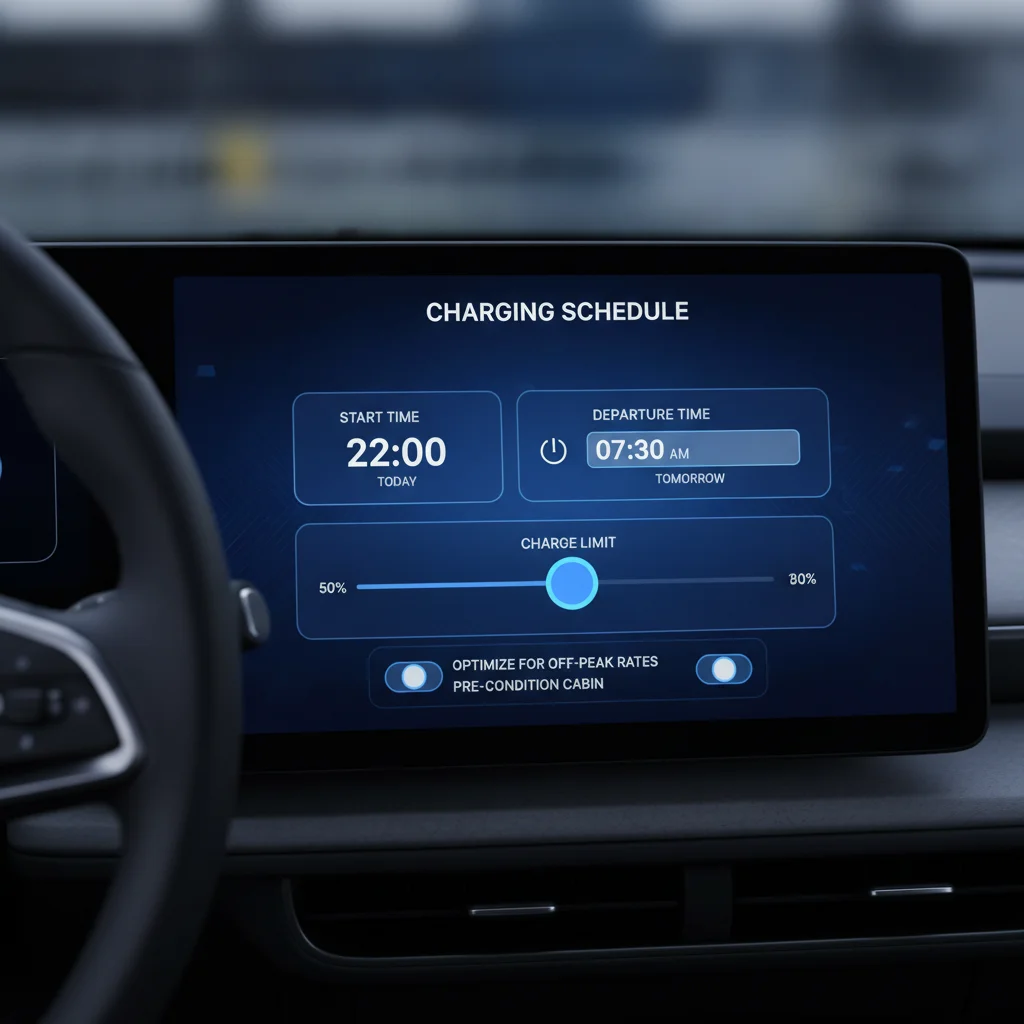
Before diving in, one framing point: there is no single universally correct charging schedule. Your utility's rate structure, your daily mileage, your EV's battery chemistry, and your departure time all interact. What follows are mistakes in the probabilistic sense — behaviors that are wrong for most owners under most conditions, with clear exceptions noted.
The Mistakes Killing Your Schedule (and Your Battery)
Each of the errors below maps to a pattern I see repeatedly among owners who assume their car's default behavior is optimized for their situation. It rarely is.
Starting the charge immediately upon arriving home, regardless of the time of day.
Why it happens: Plugging in immediately is the path of least resistance, and most EVs default to charging as soon as they're connected. Owners don't realize that 'plug in when you get home' and 'charge when it's cheapest' are two different actions.
Charging to 100% state of charge every night as a default habit.
Why it happens: The factory default charge limit on many EVs is 100%, and range anxiety drives owners to keep the battery topped up. The long-term degradation effect isn't immediately visible, so there's no feedback discouraging the behavior.
Installing a Level 2 charger when Level 1 charging is sufficient for actual daily mileage.
Why it happens: Marketing materials and EV forums emphasize Level 2 as an upgrade, and new owners often install it preemptively without calculating whether their overnight window and daily mileage actually require the faster charge rate.
Never enrolling in a time-of-use electricity rate plan despite qualifying for one.
Why it happens: Switching utility rate plans requires a proactive call or application, and many owners don't know EV-specific TOU plans exist. The savings aren't visible on the car's dashboard, so there's no obvious prompt to investigate.
Using a fixed start time rather than a departure-based charging schedule.
Why it happens: A fixed start time feels intuitive — 'charge at midnight' seems like a reasonable workaround for peak-rate avoidance. But it doesn't account for variable off-peak windows, seasonal utility changes, or the battery sitting at high charge for hours before departure.
Applying the 80% charge limit rule to LFP battery vehicles that actually benefit from regular full charges.
Why it happens: The 80% guideline is widely repeated online, and owners apply it uniformly without checking whether their specific battery chemistry warrants it. LFP batteries have different optimal charging behavior than NMC or NCA cells.
Never updating the charging schedule after the initial setup, even as driving patterns and utility rates change.
Why it happens: Scheduling the charger feels like a one-time setup task, not an ongoing maintenance activity. Owners configure it once and assume it remains optimal indefinitely.
If several of these apply to you simultaneously — say, you're charging to 100% every night on a peak-rate plan without a departure schedule — the compounding effect on cost and battery health is significant. Fixing even two of them typically produces a measurable improvement within the first billing cycle.
Level 1 vs. Level 2: The Decision Most Owners Rush
One of the most consequential — and least discussed — overnight charging decisions is which equipment level to use. The industry tends to push Level 2 as an obvious upgrade, and for some owners it genuinely is. For others, it's an expensive solution to a problem they don't have.
30–60%
Potential savings with off-peak TOU charging
Time-of-use electricity plans offered by major U.S. utilities typically price off-peak kWh at 30–60% less than peak-hour rates, depending on the utility and region.
$300–$1,500
Typical Level 2 home charger installation cost
According to the U.S. Department of Energy, Level 2 EVSE installation costs vary widely based on electrical panel capacity, wiring distance, and local labor rates.
3–5 mi/hr
Range added per hour on Level 1 charging
Standard 120V Level 1 charging adds approximately 3–5 miles of range per hour, sufficient for most drivers averaging under 40 miles per day on an overnight charge.
~20%
Long-term capacity loss from chronic 100% charging
Research published by battery degradation studies and EV manufacturer data suggests chronic full-charge habits can accelerate capacity loss by up to 20% over the battery's life compared to an 80% daily limit.
80%
Recommended daily charge limit for NMC/NCA batteries
Most major EV manufacturers — including Tesla, Hyundai, and GM — recommend an 80–90% daily charge limit for lithium-ion NMC and NCA battery packs to extend long-term capacity.
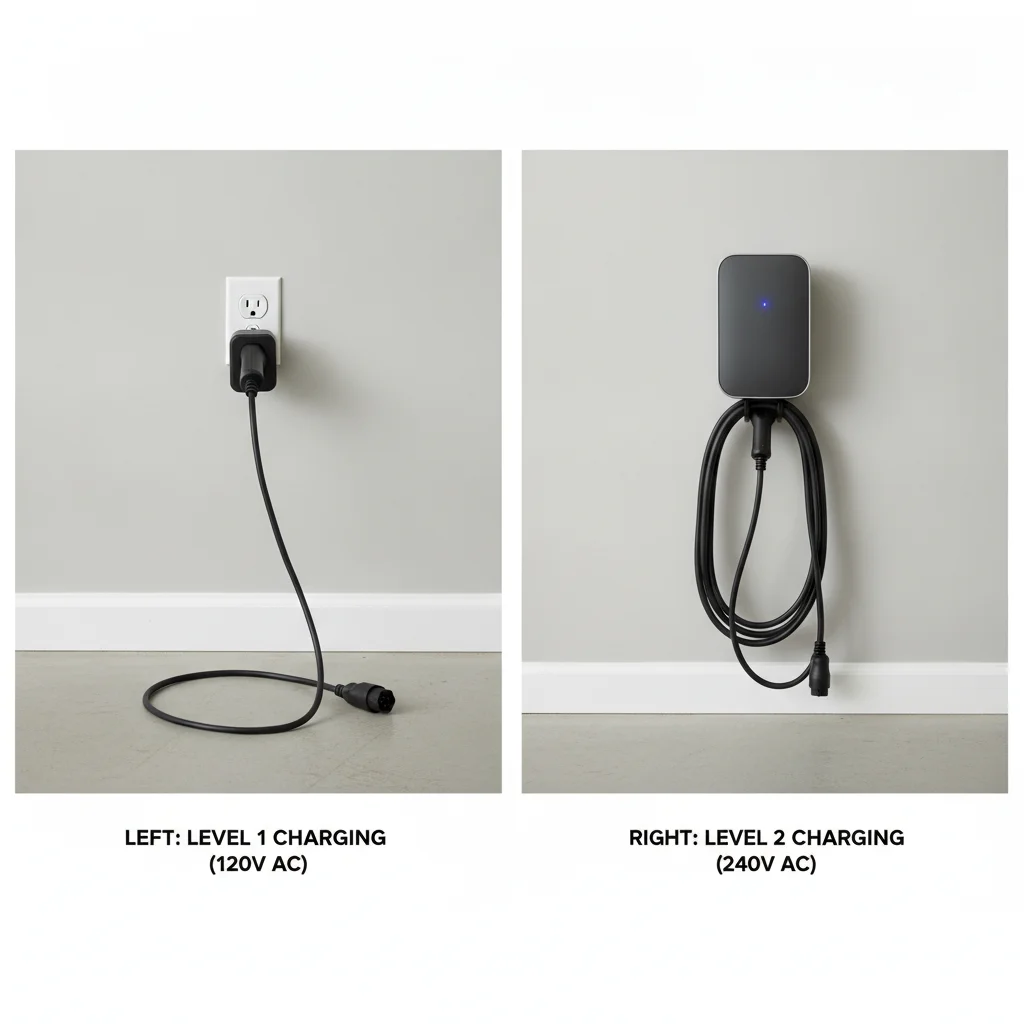
Level 1 (120V, standard outlet): Adds roughly 3–5 miles of range per hour of charging. For a driver covering 30–40 miles per day, that's 6–8 hours of charging required — well within an overnight window. Level 1 costs nothing to install beyond the included charging cable. If your daily driving stays under 40 miles and you have reliable overnight parking, Level 1 may be entirely adequate.
Level 2 (240V, dedicated circuit): Adds 10–30 miles of range per hour depending on the car's onboard charger and the EVSE's output. Installation typically runs $300–$1,500 depending on panel capacity and distance from the panel to your parking spot. The break-even period on that installation cost, compared to Level 1, only makes sense if you're regularly replacing a meaningful range deficit overnight.
Don't Assume Your Panel Can Handle Level 2
Many older homes have 100-amp or 125-amp electrical panels that are already near capacity. Adding a 40-amp Level 2 charging circuit without a panel assessment can create a safety risk and may require a costly panel upgrade. Get an electrician to evaluate your panel load before purchasing EVSE hardware.
Scheduled Charging Can Conflict with Battery Pre-Conditioning
Some EVs automatically pre-condition the battery before departure in cold weather, which draws power outside your scheduled window. This can create unexpected peak-rate charges or incomplete charging if your schedule cuts off too close to departure time. Build in a 15–30 minute buffer between your scheduled charge completion and actual departure.
The math that trips people up: if you drive 25 miles a day and have 10 hours overnight, Level 1 adds 40–50 miles — more than enough. Installing a $900 Level 2 charger to do the same job faster doesn't recoup the investment through any efficiency savings; it just adds convenience. That convenience can absolutely be worth it, but call it what it is. See our guide to smart charging schedules for more on how to match your equipment to your actual usage pattern.
Time-of-Use Rates: The Biggest Lever Most Owners Ignore
If you haven't looked at your utility's rate options since buying your EV, this is the section that will cost or save you the most money. Time-of-use (TOU) pricing charges different rates per kWh depending on when you draw power. Off-peak windows — typically 9 p.m. to 6 a.m. or midnight to 7 a.m., varying by utility — can be 30–60% cheaper per kWh than peak-hour rates.
Ignoring TOU Rates Is an Ongoing Cost, Not a One-Time Oversight
If you're charging during peak hours on a flat-rate plan without exploring TOU options, you're not just missing a discount — you're actively paying a premium every single night. For a 75 kWh battery on a full charge, the difference between a $0.13/kWh off-peak rate and a $0.35/kWh peak rate is over $16 per charge. Over a year of regular charging, that gap compounds into a significant unnecessary expense. Most utilities allow rate plan changes with a simple online request.
Your Charging Schedule Affects Your Battery Warranty
Several EV manufacturers include battery health guidelines in their warranty terms. Chronic overcharging to 100% for non-LFP batteries, or repeated deep discharges, can be cited as contributing factors in warranty disputes. Keeping your daily charge within the manufacturer-recommended range isn't just about efficiency — it's about maintaining your warranty coverage on a component that can cost $10,000 or more to replace.
The problem is that TOU plans require you to actively schedule charging, because the default behavior of most EVs is to start charging immediately upon connection. Plug in at 6:30 p.m. on a hot summer evening — peak demand, peak rate — and you're paying the maximum price for every kWh. For a 60 kWh battery at a $0.15/kWh off-peak rate versus a $0.34/kWh peak rate, the difference on a full charge is over $11. Do that five nights a week and you've added more than $2,800 in unnecessary electricity costs over a year.
Your EV's in-vehicle scheduling or your EVSE's companion app can delay charging start until the off-peak window begins. Most vehicles also allow you to set a departure time rather than a start time, which is smarter: the car calculates backward from when you need to leave, starts charging at the optimal off-peak moment, and finishes close to departure — minimizing the time the battery sits at high state of charge. Our deep dive on TOU pricing for EV charging walks through how to evaluate and switch rate plans with your utility.
One caution: TOU savings only materialize if your off-peak window aligns with your overnight schedule. If you regularly need the car charged before your utility's off-peak period ends, you may need to accept partial peak charging or reconsider the rate plan entirely. See getting the most from off-peak charging for strategies on making the windows work with irregular schedules.
State of Charge: The 80% Rule and When It Actually Applies
You've probably heard that charging to 80% — rather than 100% — is better for your battery. This is broadly true for lithium-ion chemistries (NMC, NCA), which are used in most EVs from Tesla, Hyundai, Kia, GM, and others. Holding a battery at high state of charge, especially at elevated temperatures, accelerates capacity fade over time.
But the rule gets misapplied in two directions. Some owners charge to 100% every night out of range anxiety — understandable, but costly long-term. Others apply the 80% cap so rigidly that they regularly arrive at their destination running low, then compensate with expensive DC fast charging stops that carry their own degradation costs. Understanding state of charge targets covers the chemistry in more depth, but the practical framework is straightforward:
- Daily use: Charge to 80–90%. Pick a number based on your actual range needs with a comfortable buffer.
- Long trips: Charge to 100% the night before departure, then drive. Don't let it sit at 100% for hours before you leave.
- LFP batteries (used in some Tesla Model 3/Y variants, some BYD vehicles): Manufacturers typically recommend charging to 100% regularly because LFP chemistry benefits from full-charge balancing. Check your owner's manual.
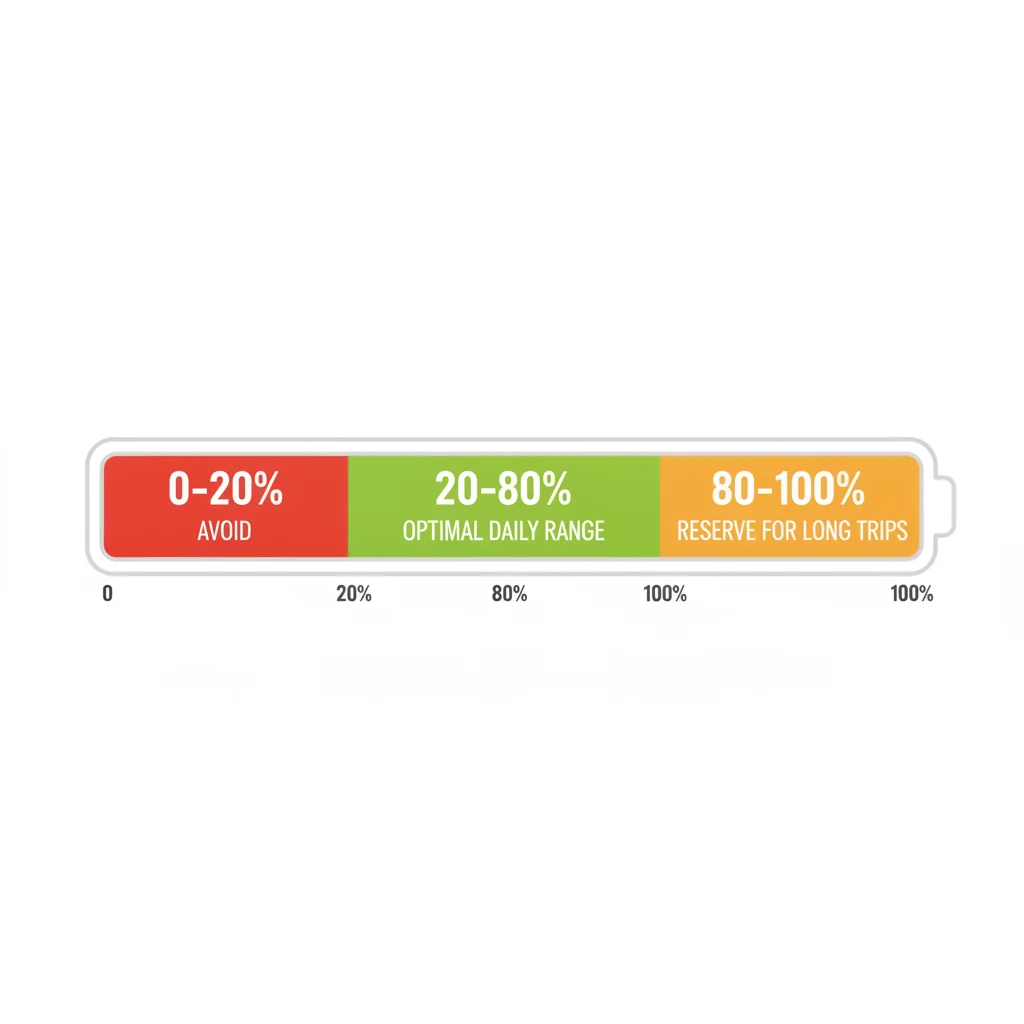
The default charge limit in many EVs ships at 100%. Manufacturers set it this way for the obvious reason that buyers expect maximum range on day one. Changing it to 80–90% in your vehicle settings takes about two minutes and is one of the highest-ROI actions an EV owner can take for long-term battery health. For a fuller look at how everyday habits compound over time, see charging habits that quietly degrade your EV battery.
Building a Schedule That Actually Works for Your Situation
The goal isn't to optimize for some abstract best practice — it's to build a charging routine that keeps costs low, protects your battery, and ensures you leave every morning with enough range. That requires combining three elements: the right equipment level, the right rate plan, and the right in-vehicle settings.
Here's a practical starting framework:
- Audit your daily mileage. Pull three months of actual driving data from your car's trip log or your phone's navigation history. Establish a realistic daily average and your occasional high-mileage days.
- Check your utility's TOU options. Most major utilities now offer EV-specific rate plans. Call or check their website. Compare the off-peak rate to your current flat rate against your actual charging pattern.
- Set a departure-time schedule, not a start-time schedule. Use your vehicle's built-in scheduling. Enter your regular weekday departure time. Let the car manage the charging window within the off-peak period.
- Set your charge limit to match your daily needs. Add 15–20% buffer above your average daily mileage, but don't reflexively cap at 100% unless you need it or have an LFP battery.
- Reassess quarterly. Driving patterns change. Rate plans change. A schedule that worked in January may be suboptimal in July when your utility shifts its peak window for summer demand.
Ignoring TOU Rates Is an Ongoing Cost, Not a One-Time Oversight
If you're charging during peak hours on a flat-rate plan without exploring TOU options, you're not just missing a discount — you're actively paying a premium every single night. For a 75 kWh battery on a full charge, the difference between a $0.13/kWh off-peak rate and a $0.35/kWh peak rate is over $16 per charge. Over a year of regular charging, that gap compounds into a significant unnecessary expense. Most utilities allow rate plan changes with a simple online request.
Your Charging Schedule Affects Your Battery Warranty
Several EV manufacturers include battery health guidelines in their warranty terms. Chronic overcharging to 100% for non-LFP batteries, or repeated deep discharges, can be cited as contributing factors in warranty disputes. Keeping your daily charge within the manufacturer-recommended range isn't just about efficiency — it's about maintaining your warranty coverage on a component that can cost $10,000 or more to replace.
Also worth flagging: the cost mistakes don't stop at home. If you're relying heavily on public DC fast charging to compensate for a poorly configured home setup, the economics get worse quickly. Our roundup of charging cost mistakes that quietly drain EV savings covers the full picture, including idle fees and network markup rates that many owners overlook.

Getting your overnight charging schedule right isn't a one-time configuration task — it's a periodic recalibration. The owners who come out ahead financially are the ones who treat it as actively as they track gas prices, not the ones who set it up on delivery day and forget it exists.

All claims are backed by peer-reviewed research. Sources on request.