Key Takeaways
J1772 Connector Standard
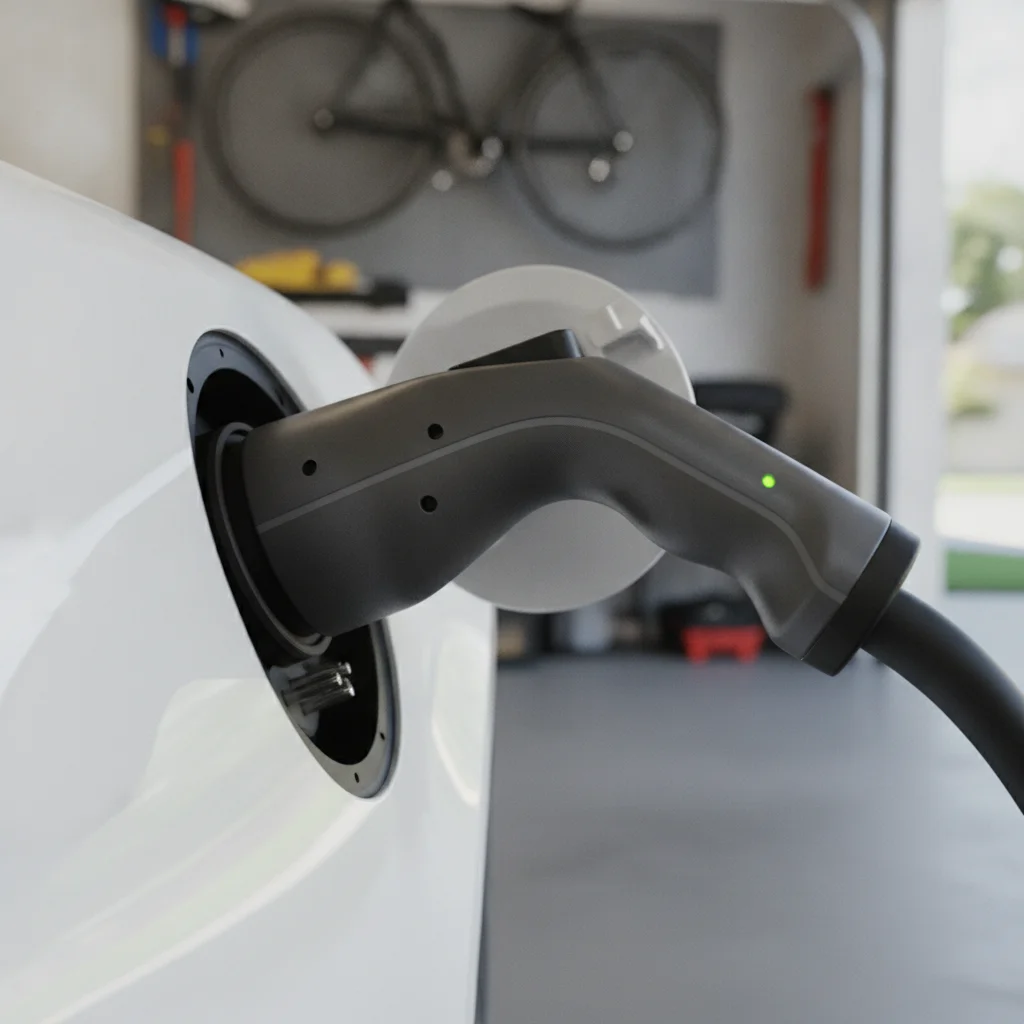
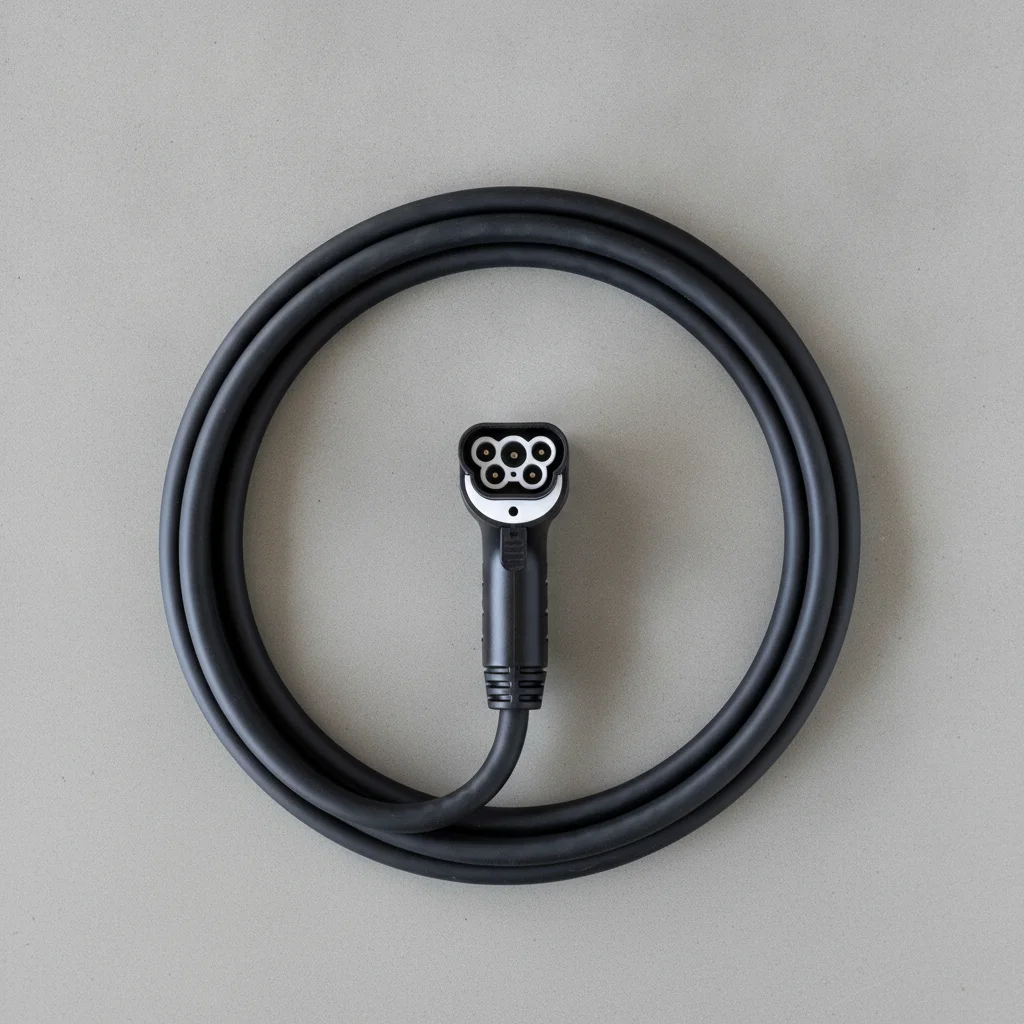
The J1772 (sometimes called the "J plug" or "Type 1" connector) is the North American standard for AC electric vehicle charging. It's the plug on the end of virtually every Level 1 and Level 2 home charging cord sold in the U.S., and it's what your EVSE (Electric Vehicle Service Equipment) uses to communicate with your car before delivering power. Almost every non-Tesla EV sold in North America before 2023 has a J1772 port built in.
Formally designated SAE J1772, the standard governs not just the physical connector shape but also the pilot signal protocol — a low-voltage communication line that allows the charger and vehicle to negotiate safe power delivery before current flows.
Why J1772 Matters Before You Buy a Home Charger
When you start shopping for a home EV charger — officially called an EVSE — you'll see J1772 mentioned constantly. It's not marketing language. It's the standard that determines whether your charger and your car will actually talk to each other. Understanding it before you buy anything will save you money and prevent a frustrating discovery in your driveway.
The short version: if you own a non-Tesla EV purchased before 2024, your car almost certainly has a J1772 inlet built in. Every Level 1 charging cord and nearly every Level 2 home charger on the market uses a J1772 connector. The two are designed to work together, and in most cases, compatibility is a non-issue. But as NACS spreads and connector standards shift, the picture gets slightly more complicated — and that's exactly what this article untangles.
For a broader look at what home charging installation actually involves — from panel upgrades to permit requirements — see Charging Your EV at Home: What the Setup Actually Involves.
What J1772 Actually Is (and What It Does)
The SAE J1772 standard was developed by SAE International and adopted by every major automaker selling EVs in North America. It defines two things simultaneously: the physical shape of the plug and the communication protocol that governs safe power delivery.
The Physical Connector
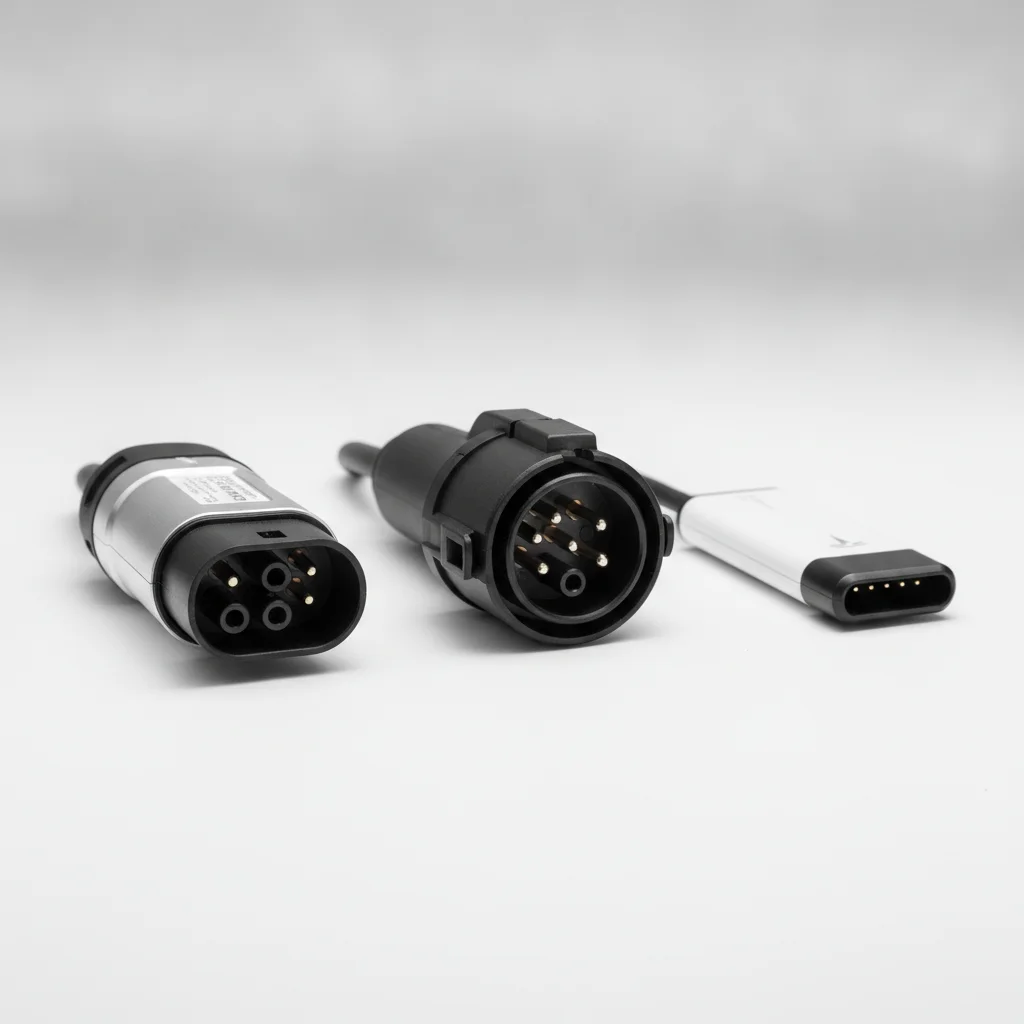
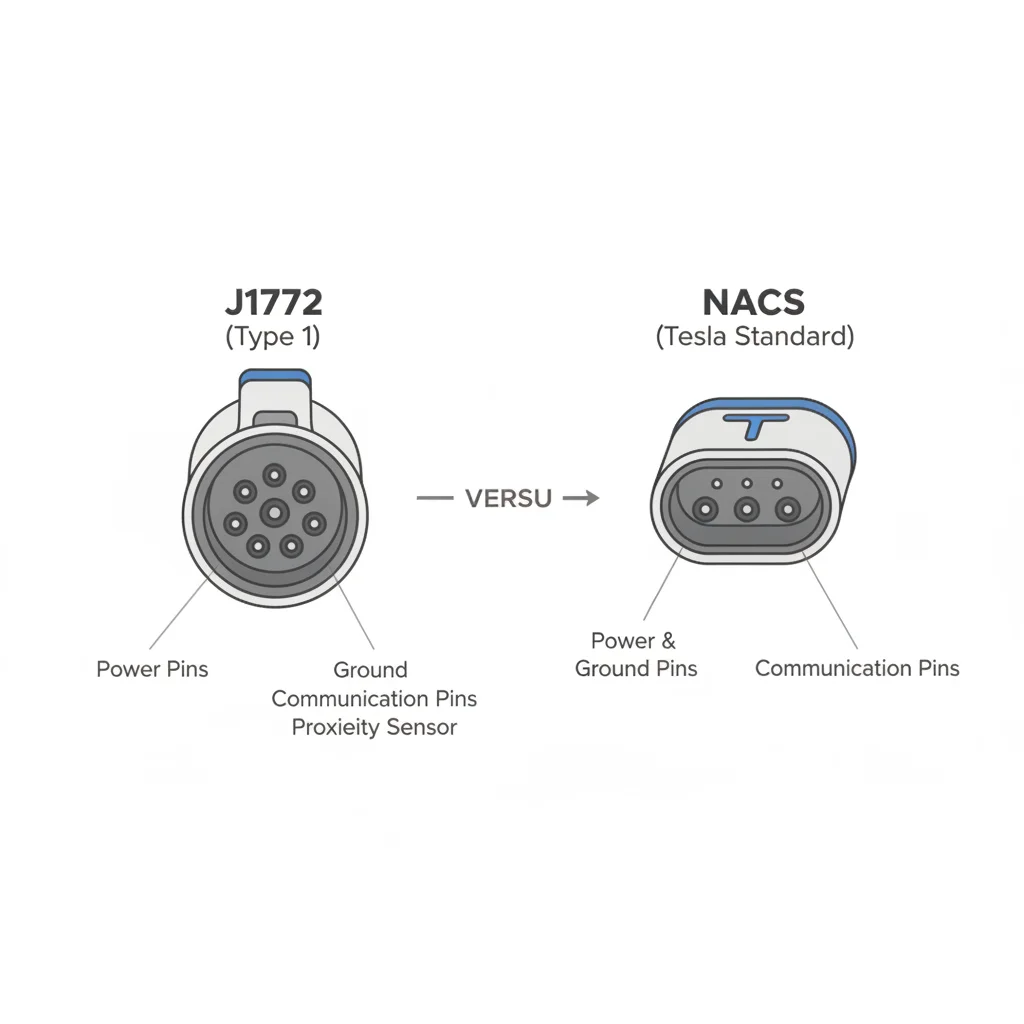
The J1772 connector has five pins:
- Line 1 (L1) and Line 2 (L2): The two AC power conductors
- Ground: Safety ground connection
- Pilot: The signal line that allows the charger and car to negotiate
- Proximity: Detects whether the connector is fully seated in the vehicle port
The plug is designed with a locking tab so it can't be accidentally pulled out while charging. The inlet on your car is recessed and protected by a flap — it's a deliberately simple, robust design built for daily use in all weather conditions.
The Pilot Signal: Why It's a Safety Feature, Not Just a Plug
The pilot pin is what makes J1772 meaningfully different from just plugging into an extension cord. Before any AC power flows, the EVSE sends a low-voltage pilot signal to the vehicle's onboard charger. The vehicle responds, confirming it's ready to accept power, what current level it can handle, and that the connector is properly latched. Only then does the EVSE close its relay and allow current to flow.
This handshake is why you can't accidentally energize a J1772 outlet and shock yourself — the outlet isn't live until a vehicle requests power through the protocol.
J1772 Is an AC-Only Standard
It's easy to conflate AC home charging with DC fast charging because both involve plugging in your car. But J1772 governs only AC charging — the kind that flows through your home's electrical system and is converted to DC by the charger built into your car. DC fast chargers use entirely different connectors (CCS, CHAdeMO, or NACS) and bypass your car's onboard charger entirely. Your home J1772 setup will never deliver DC fast charging speeds, regardless of charger amperage.
Utility Rebates Can Offset Installation Costs
Before finalizing your EVSE purchase, check with your utility provider. Many U.S. utilities offer rebates of $100–$500 on approved Level 2 chargers, and some cover partial installation costs as well. Programs vary widely by region, so a five-minute search on your utility's website — or a call to their EV customer line — can meaningfully change the math on your total setup cost.
Not All Onboard Chargers Are Equal
The maximum charging speed you see from a J1772 Level 2 EVSE is limited by whichever component has the lower capacity: the charger or the car. If your EV's onboard AC charger is rated at 7.2 kW, buying a 48-amp (11.5 kW) EVSE won't make it charge faster — you'll just be paying for capacity you can't use. Check your vehicle's onboard charger spec before sizing your EVSE purchase.
Level 1 vs. Level 2: Both Use J1772, But Very Differently
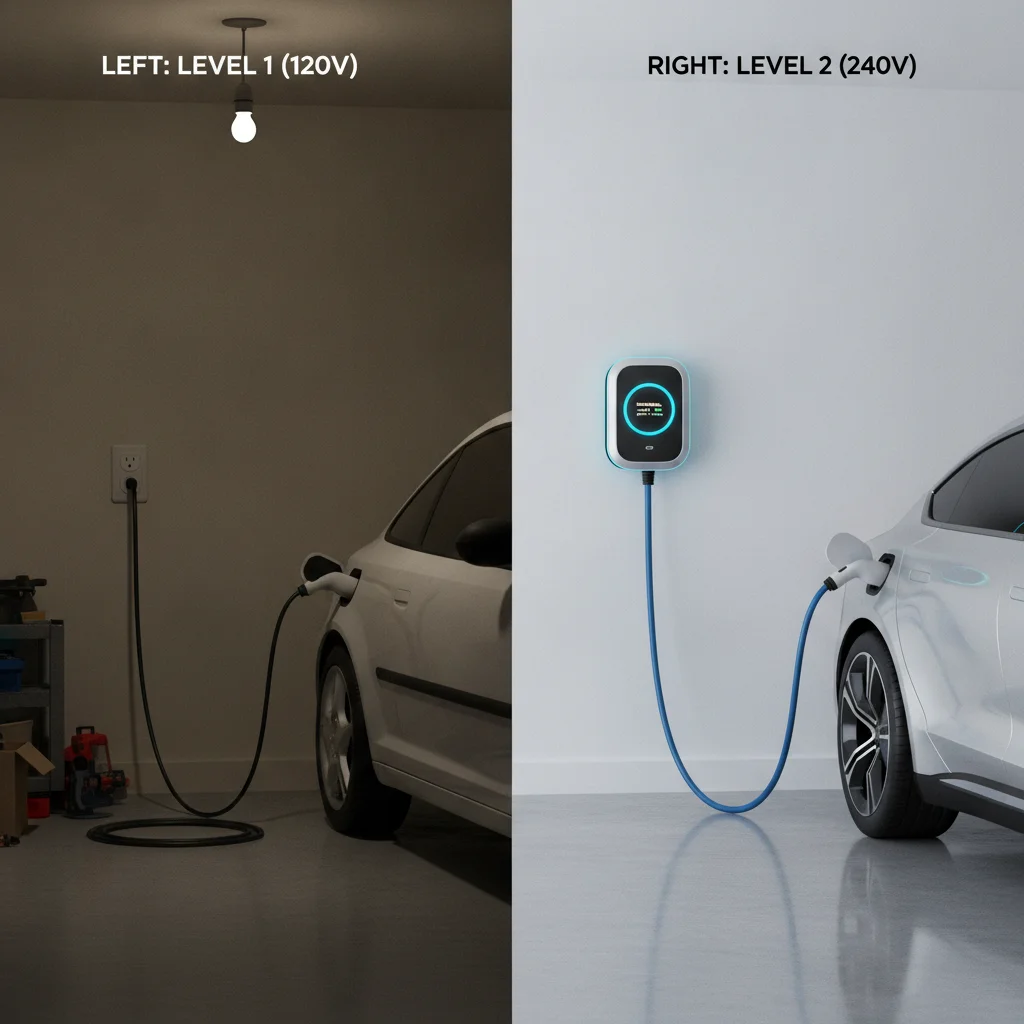
This is where a lot of new EV owners get confused: both Level 1 and Level 2 charging use the J1772 connector on the car side. The difference is in the power source and what's on the other end of the cord.
Level 1 Charging
Level 1 uses a standard 120V household outlet. The Mobile Connector (or EVSE cord) that comes in the box with most EVs has a J1772 connector on one end and a standard three-prong NEMA 5-15 plug on the other. You're drawing roughly 1.4 kW — enough to add 3–5 miles of range per hour. It's slow, but it works for drivers with short daily commutes or a plug-in hybrid with a small battery.
Level 2 Charging
Level 2 uses 240V — the same voltage as an electric dryer. A dedicated EVSE unit (hardwired or plugged into a NEMA 14-50 outlet) delivers the J1772 connector to your car's inlet, but now at 6–12 kW depending on your charger's amperage rating and your car's onboard charger capacity. At that rate, most EV batteries charge fully overnight.
~20–30 mi
Range added per hour on Level 2 J1772
Based on a typical 7.2 kW Level 2 charger; actual range gain varies by vehicle efficiency and onboard charger capacity.
3–5 mi
Range added per hour on Level 1 (120V)
Standard 120V outlet charging at roughly 1.4 kW — adequate for plug-in hybrids and low-mileage daily drivers.
$300–$800
Typical Level 2 installation cost (panel-ready home)
Estimated cost range for adding a 240V circuit and outlet in a home with adequate panel capacity; panel upgrades can add $1,500–$4,000.
80%
Continuous load rule for breaker sizing
NEC requires EV chargers to draw no more than 80% of breaker capacity continuously — a 40A breaker supports a 32A charger.
11.5 kW
Maximum output of a 48-amp J1772 Level 2 charger
Achievable only if the vehicle's onboard AC charger supports the higher rate; many EVs cap at 7.2–11 kW AC input.
For a detailed breakdown of how these two charging levels compare in real-world daily driving scenarios, see Level 1 vs Level 2 Home Charging: What the Speed Difference Actually Means for Daily Driving.
Buy More Amperage Than You Think You Need
If your electrical panel can support it, installing a 48-amp charger rather than a 32-amp unit costs only marginally more upfront but gives you headroom if you upgrade to a larger-battery EV later. The electrician labor cost is essentially the same regardless of charger size, so the incremental upgrade cost is mostly in the hardware — often $50–$150 more.
Future-Proof With a Dual-Connector or Adapter-Ready EVSE
Some newer EVSE models ship with both a J1772 cable and a NACS adapter, or are designed to have the connector swapped in the field. If you're buying a home charger today and expect your next vehicle may have a NACS port, look for units that support this flexibility — it's a minor cost difference at purchase and can save you from buying a new charger in two or three years.
Which EVs Use J1772 — and Which Ones Don't
J1772 compatibility across major EV brands is nearly universal for AC charging, but the details matter depending on which car you drive.
Non-Tesla EVs (Most Models Through 2023)
Chevrolet Bolt, Nissan Leaf, Hyundai Ioniq 5, Kia EV6, Ford Mustang Mach-E, Volkswagen ID.4, BMW iX, Rivian R1T (pre-2024), and virtually every other non-Tesla EV sold in North America through 2023 have a J1772 inlet for AC charging. Plug in any J1772 Level 2 charger and it works. No adapter, no negotiation required.
Tesla Vehicles
Tesla has historically used its proprietary connector for both AC and DC charging at its Supercharger network. For home charging on older Teslas, the car ships with a J1772 adapter. You attach it to your J1772 charger's cable, plug it into your Tesla's port, and it works just like any other EV. If you've misplaced your adapter, third-party options are readily available and inexpensive.
NACS-Equipped Vehicles (2024 and Beyond)
Starting with Tesla's shift and subsequently adopted by Ford, GM, Rivian, Honda, and others, the North American Charging Standard (NACS) connector is becoming the new default. Newer vehicles with NACS ports — including the 2024+ Ford F-150 Lightning, Chevy Silverado EV, and Rivian R2 — cannot accept a J1772 connector without a NACS-to-J1772 adapter. Most automakers are bundling these adapters or making them available for purchase.
The broader connector landscape — including CCS, CHAdeMO, and NACS for DC fast charging — is covered in detail in EV Charging Connector Standards: CCS, CHAdeMO, and NACS Decoded. And for the full picture on what the NACS shift means for every EV driver, see NACS Adoption: What the Tesla Connector Standard Means for All EV Drivers.
J1772 and DC Fast Charging: Understanding the Boundary
One point that trips up a lot of EV shoppers: J1772 is strictly an AC charging standard. It has nothing to do with DC fast charging, even though the connector shapes can look similar at first glance.
When you plug into a public DC fast charger (a Level 3 charger), you're using a completely different connector — most commonly CCS (Combined Charging System) on non-Tesla EVs, or NACS on Tesla and newer models. CCS actually extends the J1772 connector shape by adding two larger DC pins below it, which is why they look related — but the two systems are electrically distinct. Your home J1772 charger cannot deliver DC power.
This distinction matters practically: if you're trying to understand home charging compatibility, J1772 is your entire world. Public fast charging is a separate conversation involving different hardware, different networks, and different connectors. See our hub on Public Charging Networks for that side of the equation.
“The beauty of J1772 is that it solved a real standardization problem — instead of every automaker shipping incompatible home chargers, you had one plug that worked everywhere. The challenge now is managing the transition to NACS without leaving existing owners behind.”
— Tom Moloughney, EV charging infrastructure analyst and longtime EV advocate
Choosing a J1772 Home Charger That Won't Become Obsolete
Given the connector transition underway with NACS, it's fair to ask whether buying a J1772 home charger today is a safe long-term bet. The honest answer: yes, with a caveat.
Why J1772 Home Chargers Remain a Sound Investment
The installed base of J1772-compatible EVs in the U.S. is enormous and will remain so for the next decade. Even NACS-equipped vehicles can use J1772 chargers with an adapter. Major EVSE manufacturers like ChargePoint, Emporia, Grizzl-E, and JuiceBox still ship J1772 as the default connector, and your existing home charger won't stop working because a new connector standard has emerged.
What to Look for When Buying
- Amperage rating: A 40-amp (32-amp continuous) charger delivers roughly 7.7 kW — sufficient for most EVs. A 48-amp unit pushes 11.5 kW and is worth considering for large-battery vehicles like the GMC Hummer EV or Ford F-150 Lightning.
- Hardwired vs. plug-in: Hardwired units are slightly more efficient and look cleaner; plug-in units (using a NEMA 14-50) are easier to take if you move.
- Smart features: Wi-Fi connectivity, scheduling, and energy monitoring are available on mid-range and premium units — useful for charging during off-peak rate hours.
- Cable length: 25 feet is the practical minimum for most garages. Longer cables offer flexibility but add cost.
Buy More Amperage Than You Think You Need
If your electrical panel can support it, installing a 48-amp charger rather than a 32-amp unit costs only marginally more upfront but gives you headroom if you upgrade to a larger-battery EV later. The electrician labor cost is essentially the same regardless of charger size, so the incremental upgrade cost is mostly in the hardware — often $50–$150 more.
Future-Proof With a Dual-Connector or Adapter-Ready EVSE
Some newer EVSE models ship with both a J1772 cable and a NACS adapter, or are designed to have the connector swapped in the field. If you're buying a home charger today and expect your next vehicle may have a NACS port, look for units that support this flexibility — it's a minor cost difference at purchase and can save you from buying a new charger in two or three years.
If you're just starting out and want a comprehensive walk-through of every decision involved in home charging setup, Home EV Charging Setup: Everything You Need to Know Before You Begin covers the full process. New EV owners can also start with Starting EV Ownership: Understanding Your Home Charging Options from Day One.
Installation Requirements for a J1772 Level 2 Charger
The charger itself is only part of the equation. Getting J1772 Level 2 charging working at home requires compatible electrical infrastructure — and this is where some homeowners run into unexpected costs.
What Your Home Needs
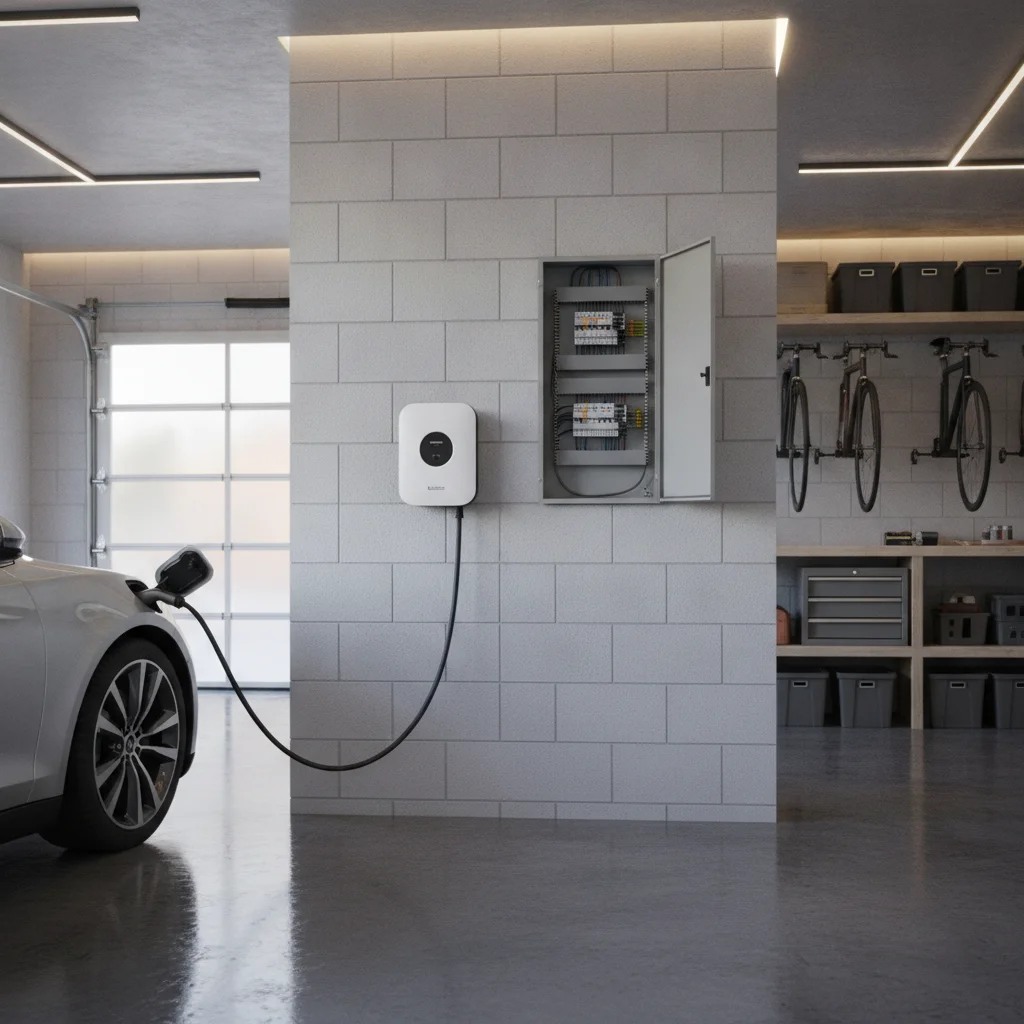
A Level 2 EVSE requires a dedicated 240V circuit with adequate amperage. For a 32-amp charger, you need a 40-amp breaker (the 80% continuous load rule). For a 48-amp charger, you need a 60-amp breaker. Your electrical panel needs enough spare capacity to support that circuit without overloading the service.
Older homes with 100-amp panels and already-loaded circuits may need a panel upgrade before installation — a cost that can run $1,500–$4,000 depending on your area. Homes with 200-amp panels and available breaker slots typically only need the new circuit and outlet, which runs $300–$800 in most markets.
Permits and Inspections
Most jurisdictions require a permit for a new 240V circuit installation. A licensed electrician will know local requirements. Don't skip this step — unpermitted electrical work creates liability problems and can complicate home sales.
Utility Incentives
Many electric utilities offer rebates on EVSE purchase and installation, sometimes covering $200–$500 of the cost. Check your utility's website before you buy. Some also offer time-of-use rates that make overnight charging significantly cheaper — a J1772 charger with scheduling capability lets you take automatic advantage of these rates. For more on managing charging costs, see the Charging Costs & Savings hub.
J1772 Is an AC-Only Standard
It's easy to conflate AC home charging with DC fast charging because both involve plugging in your car. But J1772 governs only AC charging — the kind that flows through your home's electrical system and is converted to DC by the charger built into your car. DC fast chargers use entirely different connectors (CCS, CHAdeMO, or NACS) and bypass your car's onboard charger entirely. Your home J1772 setup will never deliver DC fast charging speeds, regardless of charger amperage.
Utility Rebates Can Offset Installation Costs
Before finalizing your EVSE purchase, check with your utility provider. Many U.S. utilities offer rebates of $100–$500 on approved Level 2 chargers, and some cover partial installation costs as well. Programs vary widely by region, so a five-minute search on your utility's website — or a call to their EV customer line — can meaningfully change the math on your total setup cost.
Not All Onboard Chargers Are Equal
The maximum charging speed you see from a J1772 Level 2 EVSE is limited by whichever component has the lower capacity: the charger or the car. If your EV's onboard AC charger is rated at 7.2 kW, buying a 48-amp (11.5 kW) EVSE won't make it charge faster — you'll just be paying for capacity you can't use. Check your vehicle's onboard charger spec before sizing your EVSE purchase.

All claims are backed by peer-reviewed research. Sources on request.