Key Takeaways
Why Time-of-Use Rates Matter for EV Owners
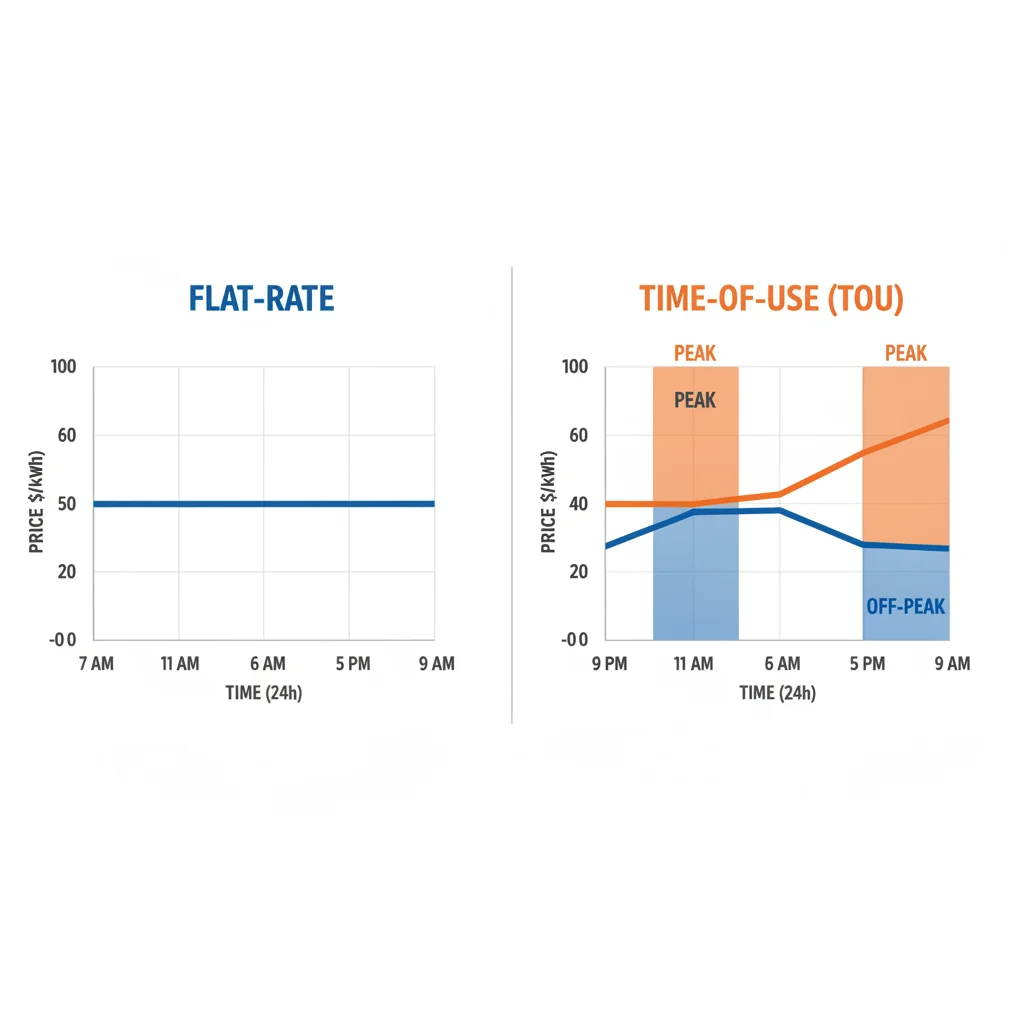
Electricity isn't priced like gasoline — you don't pay the same price per unit regardless of when you fill up. Under a time-of-use (TOU) rate plan, your utility charges different prices per kilowatt-hour depending on what time of day you draw power from the grid. Peak windows — typically weekday afternoons when air conditioning and business demand spike — carry the highest rates. Off-peak windows, usually overnight and early morning, carry rates that can be 40–60% lower.
For the average EV owner who adds 30–40 miles of range daily, the difference between always charging at peak versus always charging off-peak can easily amount to $300–$600 per year in avoided electricity cost. That math improves further if you drive more than average, own a large-battery truck or SUV, or live in a state with high base electricity rates like California, Connecticut, or Hawaii.
The catch: most utilities don't automatically enroll you in TOU pricing. You have to opt in — and you have to actually shift your charging behavior to match off-peak windows. This guide walks you through both sides of that equation, from choosing the right rate plan to configuring your vehicle or charger to charge on a schedule.
If you want to understand exactly how your electricity consumption translates into monthly bill increases, see our breakdown of home EV charging's real impact on your electricity bill. But if your goal right now is to minimize those costs through smarter rate planning, start here.
Understanding TOU Rate Structures: The Basics
Before you can work the math in your favor, you need to understand the structure of your utility's TOU plan. Most TOU plans share these core elements:
- Peak hours: Typically 4 PM–9 PM on weekdays (varies by utility). Some plans also have a super-peak window. Rates during peak hours can range from $0.35 to $0.55/kWh in high-cost states.
- Off-peak hours: Usually 9 PM or 10 PM through 6 AM or 8 AM. Rates commonly fall between $0.10 and $0.22/kWh — sometimes lower with a dedicated EV rate tier.
- Partial-peak or shoulder hours: A middle tier some utilities use in the morning or early evening. Rates fall between peak and off-peak.
- Weekend and holiday pricing: Many utilities treat weekends and holidays as all-day off-peak. This can be significant for weekend charging flexibility.
Some utilities offer a dedicated EV rate plan with a separate meter for your charging equipment, enabling even lower overnight rates — sometimes below $0.10/kWh. These plans require a second meter installation and a separate monthly fee, so the economics only work if you're charging enough volume to offset that fixed cost.
To understand how to read TOU charges as they appear on your actual bill, the EV owner's guide to reading an electricity bill breaks down every relevant line item.
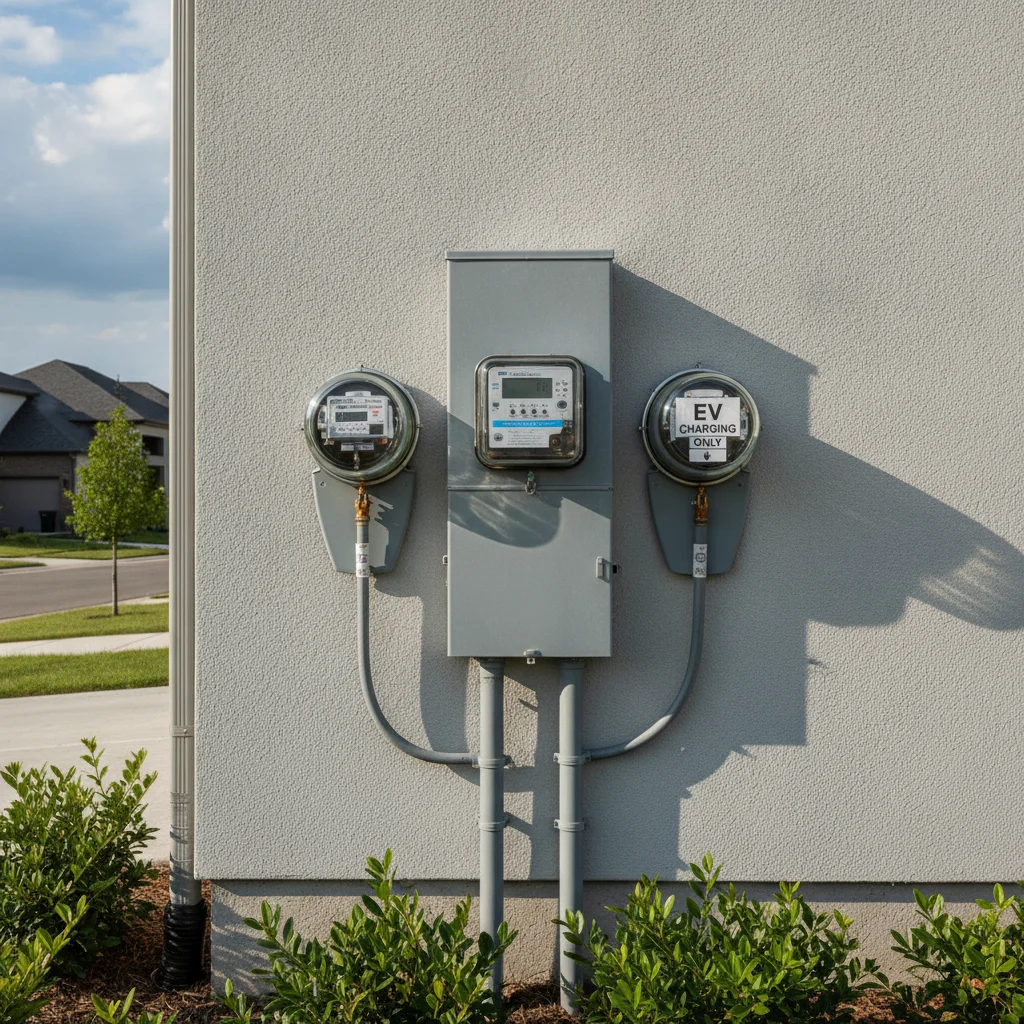
Your utility's website should have a rate comparison tool. If not, call their residential energy line and ask specifically about EV-friendly TOU plans — many utilities have introduced dedicated EV tariffs in recent years that don't appear prominently on their homepage.
Switching Rate Plans Can Backfire Without Behavioral Change
Enrolling in a TOU plan and then continuing to charge at peak times will almost certainly increase your total electricity bill compared to a flat-rate plan. Peak TOU rates are significantly higher than flat rates — the savings come entirely from shifting consumption to off-peak windows. Don't switch until your charging schedule is configured and tested.
Level 1 vs. Level 2: Which Charging Setup Actually Fits Your TOU Window
Your charging hardware determines how much range you can recover within a single off-peak window — and that constraint matters more than most people realize.
Level 2 EVSE (Electric Vehicle Supply Equipment)
Provides 240V charging at 16–50 amps, allowing full battery recharge within a single off-peak window for most EVs.
Smart EVSE with scheduling app
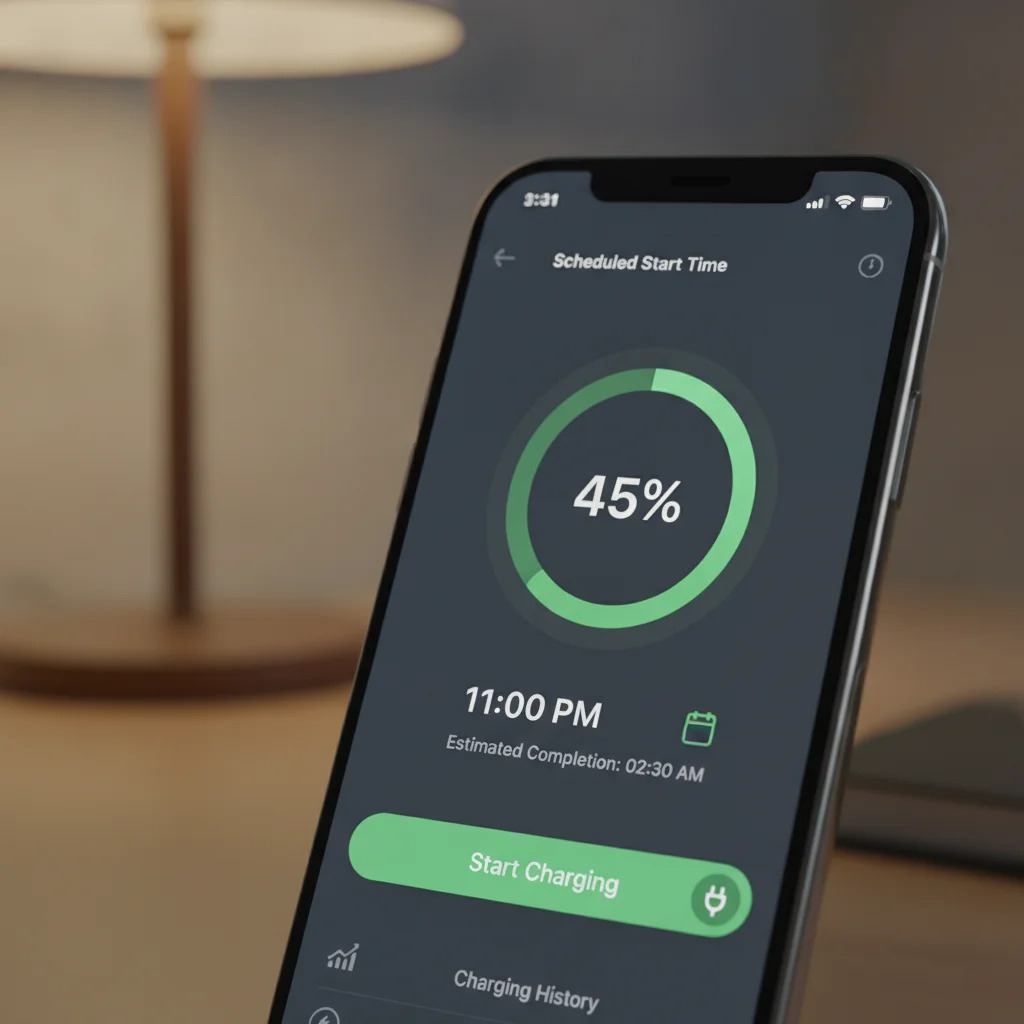
Allows you to set precise charging start and stop times from a smartphone, ensuring charging occurs only during off-peak hours.
Smart plug or smart outlet (120V)
For Level 1 charging setups, a smart plug can enforce off-peak scheduling without requiring an upgraded EVSE.
Vehicle manufacturer app (e.g., Tesla, MyChevrolet, MyHyundai)
Allows in-app scheduling of charging start times, charge limit setting, and monitoring of charging status remotely.
Utility rate comparison tool
Available on most utility websites; estimates your bill under different rate plans based on your historical consumption.
Home energy monitor (e.g., Sense, Emporia Vue)
Tracks real-time electricity usage by circuit, allowing you to verify that EV charging is occurring during off-peak windows and measure actual kWh consumed.
Level 1 charging (standard 120V outlet) delivers roughly 3–5 miles of range per hour. If your off-peak window is 9 PM to 6 AM — nine hours — you can recover approximately 27–45 miles of range. For commuters driving under 30 miles daily, that's often sufficient. But if you drive 60+ miles in a day, Level 1 won't fully recharge your battery before peak rates kick in, meaning you'd still accumulate some peak-rate charging every morning.
Level 2 charging (240V, 16–50 amps depending on your EVSE) delivers 12–30+ miles of range per hour depending on your vehicle's onboard charger capacity. A mid-range Level 2 EVSE at 32 amps adds roughly 25 miles per hour. In that same nine-hour off-peak window, you'd recover 200+ miles — more than most EVs can even hold. You can fully recharge the largest EV batteries available today inside that window with room to spare.
The practical conclusion: if you want true flexibility to charge entirely within off-peak hours regardless of how much range you depleted, Level 2 is the enabling technology. Level 1 can work for predictable low-mileage drivers, but it leaves you exposed on high-drive days.
For a deeper look at what the Level 1 vs. Level 2 decision involves beyond TOU considerations, see our guide to making TOU pricing work for your charging setup.
Step-by-Step: Setting Up TOU-Optimized Home Charging
Once you understand the rate structure and your hardware constraints, the setup process is straightforward. Work through these steps in order — each one builds on the previous.
What you will need
Audit Your Current Utility Rate Plan
Log into your utility's online account portal and locate your current rate plan name. Common non-TOU residential plan names include "Residential Service," "Tier 1/Tier 2," or "Tiered Rate." If you see anything with "TOU," "Time-of-Use," or "EV" in the plan name, you may already be on a TOU plan — but confirm the details regardless.
Download your last three months of billing statements. Note the per-kWh rate(s) you're currently paying and your average monthly kWh consumption. You'll use these numbers to calculate before-and-after savings once you've switched plans.
Identify and Enroll in the Best Available TOU Plan
Call your utility's residential line or use the online portal to request enrollment in their TOU or EV rate plan. Ask specifically about these plan types:
- Standard TOU plan: Applies to your whole home. Simple to enroll, no new meter needed.
- EV-specific TOU plan: May offer lower off-peak rates for charging, sometimes with a separate meter for your EVSE circuit. Ask if your utility offers this and what the second-meter installation cost and monthly fee are.
- Demand response programs: Some utilities offer bill credits for allowing brief grid-event reductions during strain events. These pair well with TOU plans and carry minimal inconvenience.
Ask the representative to confirm in writing: the off-peak window start and end times, the peak rate per kWh, the off-peak rate per kWh, and any seasonal changes to those windows. Get this in an email or as a printable rate schedule PDF.
Confirm Your Off-Peak Window and Set a Charging Start Time
Once enrolled, identify the precise start and end of your utility's off-peak window. Common examples:
- PG&E (California) EV2-A: Off-peak midnight–9 AM (weekdays), all day weekends
- Xcel Energy (Colorado): Off-peak 9 PM–9 AM
- Duke Energy (Carolinas): Off-peak 9 PM–6 AM
- Consumers Energy (Michigan): Off-peak 11 PM–7 AM
Set your charging start time to 15–30 minutes after the off-peak window begins as a buffer against any grid-side timing discrepancies. Set an end time if your charger supports it — aim to finish charging at least 30 minutes before off-peak ends so the battery is fully topped off without risk of bleeding into peak hours.
Configure Scheduled Charging in Your Vehicle or EVSE
You have three places you can set a charging schedule — choose the approach that your specific setup supports best:
- In-vehicle schedule (most EVs): Navigate to the charging settings in your vehicle's infotainment system or companion app. Look for "Scheduled Charging," "Charge Timer," or similar. Set the start time. Many vehicles also let you configure a charge limit and plug-in behavior (charge immediately vs. wait for schedule).
- Smart EVSE schedule: If you have a networked Level 2 charger (ChargePoint Home Flex, Emporia Energy, Wallbox, etc.), the manufacturer's app typically includes scheduling. This is the most reliable method if your EVSE respects the schedule regardless of the car's setting.
- Smart plug (Level 1 only): For 120V charging, a smart outlet (TP-Link Kasa, Amazon Smart Plug) can cut power to the charger on a schedule via app. Simple, low-cost, and effective for Level 1 use cases.
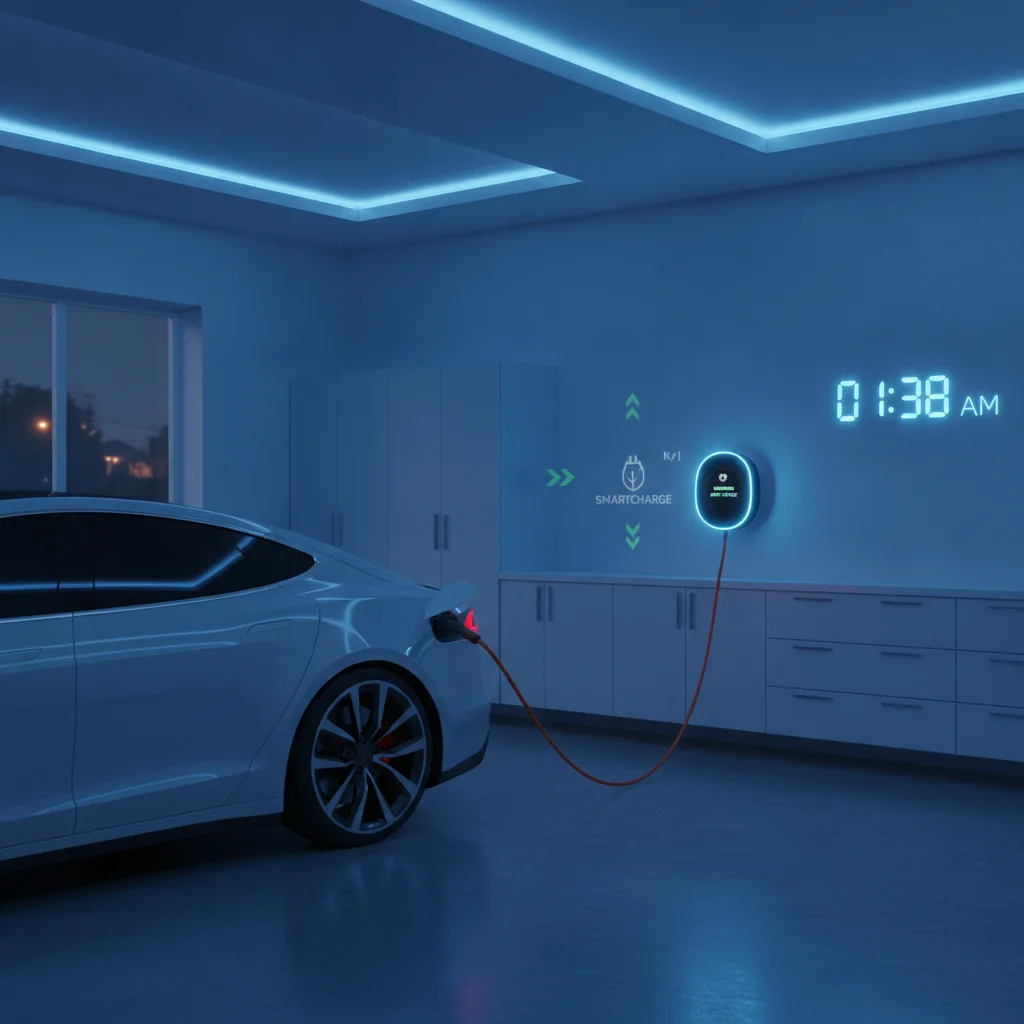
After configuration, test it: plug in the vehicle mid-day and confirm it does not begin drawing power immediately. Watch the vehicle's charging status indicator or the charger's app to verify it's in a waiting state.
Validate Your First Month's Bill
After your first full billing cycle on the TOU plan with scheduled charging in place, compare your bill to the pre-switch baseline you captured in Step 1. Look for:
- Confirmation that the rate plan name on the bill matches what you enrolled in
- A clear breakdown of kWh consumed during peak vs. off-peak windows (many TOU bills show this)
- The per-kWh rates charged for each window matching what you were quoted
- Your total bill amount relative to the pre-switch estimate
If something looks off — peak consumption is higher than expected, or rates don't match — call your utility with the bill in front of you. Billing errors and delayed plan switches are not uncommon in the first cycle.
Adjust Seasonally and Monitor Ongoing
TOU optimization is not a set-it-and-forget-it task. Build in a quarterly check-in:
- Review your utility's seasonal rate schedule at the start of summer and winter — peak windows and rates often change.
- Update your vehicle or charger schedule if peak windows shift.
- If your utility introduces a new EV-specific rate tier, compare it to your current plan using your actual consumption data.
- Watch for demand response event notifications (if enrolled) — these are usually brief and can earn bill credits.
Over time, as you build a history of monthly kWh and cost data, you'll have a clear picture of your actual cost-per-mile for home charging — one of the most useful metrics for understanding your total EV ownership cost.
After completing these steps, your EV should be drawing electricity almost entirely during your utility's lowest-rate window. From here, the remaining opportunity is to refine and monitor. Our article on setting up smart charging schedules that cut costs without sacrificing convenience goes deeper on automation options, and proven practices for getting the most from off-peak charging covers behavioral strategies that compound your savings over time.
Pre-Conditioning Fits Into Off-Peak Too
Many EVs offer scheduled pre-conditioning — heating or cooling the cabin while still plugged in. Schedule pre-conditioning to run just before you leave in the morning, while the car is still on off-peak power. This reduces the range you burn on climate control after departure, and it costs you only a few cents at off-peak rates rather than drawing from the battery mid-drive.
Stack TOU Savings With Federal and State Incentives
The federal EV charger tax credit (Form 8911) covers 30% of Level 2 EVSE installation costs up to $1,000 for residential installs in eligible census tracts. Many states and utilities offer additional rebates. Lowering your upfront hardware cost shortens the payback period on a Level 2 install significantly — check the Database of State Incentives for Renewables and Efficiency (DSIRE) for your state.
Use Trip-Planning to Stay Off-Peak Even on Busy Days
If you know tomorrow will be a high-mileage day, plug in the night before and charge to 100% rather than your usual 80% limit. This prevents the situation where you arrive home with a very low battery and feel pressure to start charging immediately — potentially during peak hours. A little forward planning keeps you firmly in the off-peak window almost every day.
Running the Numbers: What TOU Optimization Is Actually Worth
Let's do concrete math so you know whether the effort is worth it for your situation.
Scenario: 2024 Tesla Model 3 Long Range (82 kWh usable battery), driving 40 miles/day in California on PG&E's EV2-A rate plan
| Metric | Peak Charging | Off-Peak Charging |
|---|---|---|
| Rate (approx.) | $0.48/kWh | $0.13/kWh |
| Daily kWh consumed | ~13 kWh | ~13 kWh |
| Daily charging cost | $6.24 | $1.69 |
| Annual charging cost | $2,278 | $617 |
| Annual savings | — | $1,661 |
That savings figure assumes complete migration to off-peak charging. Even if you capture 80% off-peak and 20% peak — a realistic outcome for most drivers — you'd still save over $1,300 per year in this scenario. In lower-rate states like Texas or the Pacific Northwest, the absolute savings are smaller but the percentage savings can be similar because TOU spreads are proportionally large.
The one-time cost of a Level 2 EVSE installation typically runs $800–$1,500 all-in (equipment plus electrician labor). At $1,300+ in annual TOU savings, the payback period is often under 18 months. After that, the savings are essentially free money — captured through scheduling alone.
One Missed Peak-Hour Charging Session Can Cost More Than You Think
In a high-rate state like California, charging a large-battery EV from 10% to 100% during peak hours can cost $30–$40 in a single session — compared to $8–$10 during off-peak. A habit of plugging in when you get home at 6 PM rather than waiting until 9 PM can entirely eliminate the financial benefit of your TOU plan. The schedule has to be consistent, not occasional.
For a broader picture of how charging costs factor into your total EV ownership math, explore the Charging Costs & Savings hub, which covers everything from cost-per-mile comparisons to public charging network economics.
Common Pitfalls and How to Avoid Them
Even owners who do everything right can leave money on the table — or inadvertently create problems — by overlooking a few key issues.
Not verifying your rate plan enrollment
Calling your utility and requesting a TOU plan doesn't always mean you're immediately switched over. Enrollment can take one to two billing cycles. Check your first bill after the switch to confirm the new rate structure appears. If you see a flat per-kWh rate with no time differentiation, call back.
Relying on the vehicle schedule without checking the charger's override behavior
Some EVSEs, particularly older or budget models, don't respect the vehicle's internal schedule and begin charging the moment you plug in. If your Level 2 charger has this behavior, set the schedule on the charger — not in the car — or use a smart outlet solution to enforce the delay. Never assume both the car and charger are coordinated unless you've tested it.
Forgetting about summer peak rate changes
Many utilities seasonally shift peak windows or add super-peak tiers during summer months. A schedule that worked perfectly in February may start catching peak rates in July. Check your utility's TOU calendar at the start of each season and adjust your charging schedule accordingly.
Ignoring demand charges if they apply to you
Most residential TOU plans don't include demand charges, but some utility territories do bill residential customers for peak demand (measured in kW, not kWh). If your plan has a demand charge component, charging at full Level 2 speed during any peak window — even briefly — can inflate that line item significantly. If you see a demand charge on your bill, review the EV owner's guide to reading an electricity bill before finalizing your charging schedule.
Using public DC fast charging without understanding its cost
DC fast charging at public stations is priced completely independently from your home TOU rate — and it's typically far more expensive per kWh. It serves a useful role for long trips, but it shouldn't be a substitute for home off-peak charging when you're home overnight. See the Public Charging Networks hub if you need to evaluate fast-charging costs for road trips versus home charging.

All claims are backed by peer-reviewed research. Sources on request.