Key Takeaways
Home EV Charging Cost
Home EV charging cost refers to the additional amount added to your monthly electricity bill as a result of charging an electric vehicle at your residence. It depends on three core variables: how many miles you drive, your vehicle's energy efficiency (measured in kWh per mile), and what your utility charges per kilowatt-hour. Unlike gasoline, electricity pricing varies significantly by location, time of day, and utility rate structure.
EV energy consumption is rated in kWh per 100 miles (or miles per kWh). Onboard charger efficiency losses — typically 10–15% — mean you pull slightly more kWh from the wall than the battery actually stores, a factor often overlooked in back-of-envelope calculations.
The Basic Math: How Charging Adds to Your Bill
Before worrying about charger types or rate plans, it helps to understand the simple arithmetic driving your monthly charging cost. Every mile you drive in an EV consumes a measurable amount of electricity, and that consumption is what shows up on your bill.
Here's the core formula:
Monthly charging cost = (Monthly miles ÷ Vehicle efficiency in miles/kWh) × Electricity rate per kWh
Let's run a concrete example. Say you drive 1,100 miles per month — close to the U.S. average — in a vehicle rated at 3.5 miles per kWh (a reasonable mid-range efficiency figure). At the national average electricity rate of around $0.16/kWh:
- 1,100 ÷ 3.5 = 314 kWh consumed by the battery
- Add ~12% for charging losses: 314 × 1.12 = ~352 kWh drawn from the wall
- 352 × $0.16 = ~$56 per month
That's it. About $56 a month — or roughly what many households spend on streaming services combined. Compare that to fueling a 28 MPG gas car at $3.50/gallon over the same mileage: about $138/month. The savings case is real, but so is the variability depending on where you live.
$56/mo
Average home EV charging cost for typical U.S. driver
Based on 1,100 miles/month, 3.5 miles/kWh efficiency, and the U.S. average electricity rate of ~$0.16/kWh as of 2024 (U.S. Energy Information Administration).
10–15%
Energy lost to charging inefficiency (wall-to-battery)
Onboard charger and cable conversion losses mean you pull more kWh from the wall than the battery stores — a consistent factor across Level 1 and Level 2 charging.
37%
Potential savings from switching to a TOU off-peak rate
Based on a California example comparing on-peak ($0.45/kWh) to off-peak ($0.17/kWh) rates — savings vary by utility and usage pattern.
$500–$2,000
Typical all-in Level 2 home charging installation cost
Includes EVSE hardware ($200–$800) and licensed electrician installation ($300–$1,200), excluding panel upgrades (U.S. industry estimates, 2024).
4–5 mi
Range added per hour via Level 1 (120V) charging
Reflects standard 1.4 kW delivery rate on a 120V/12A circuit — adequate for low-mileage use cases but impractical for most full BEV owners.
For a deeper breakdown of the efficiency and rate variables, see The True Cost of Charging an EV — it covers what the math actually shows when you account for real-world driving patterns.
Level 1 vs. Level 2 Charging: What Actually Changes
The debate between Level 1 and Level 2 home charging isn't really about cost per mile — it's about speed, convenience, and whether your daily driving patterns give you a margin for error.
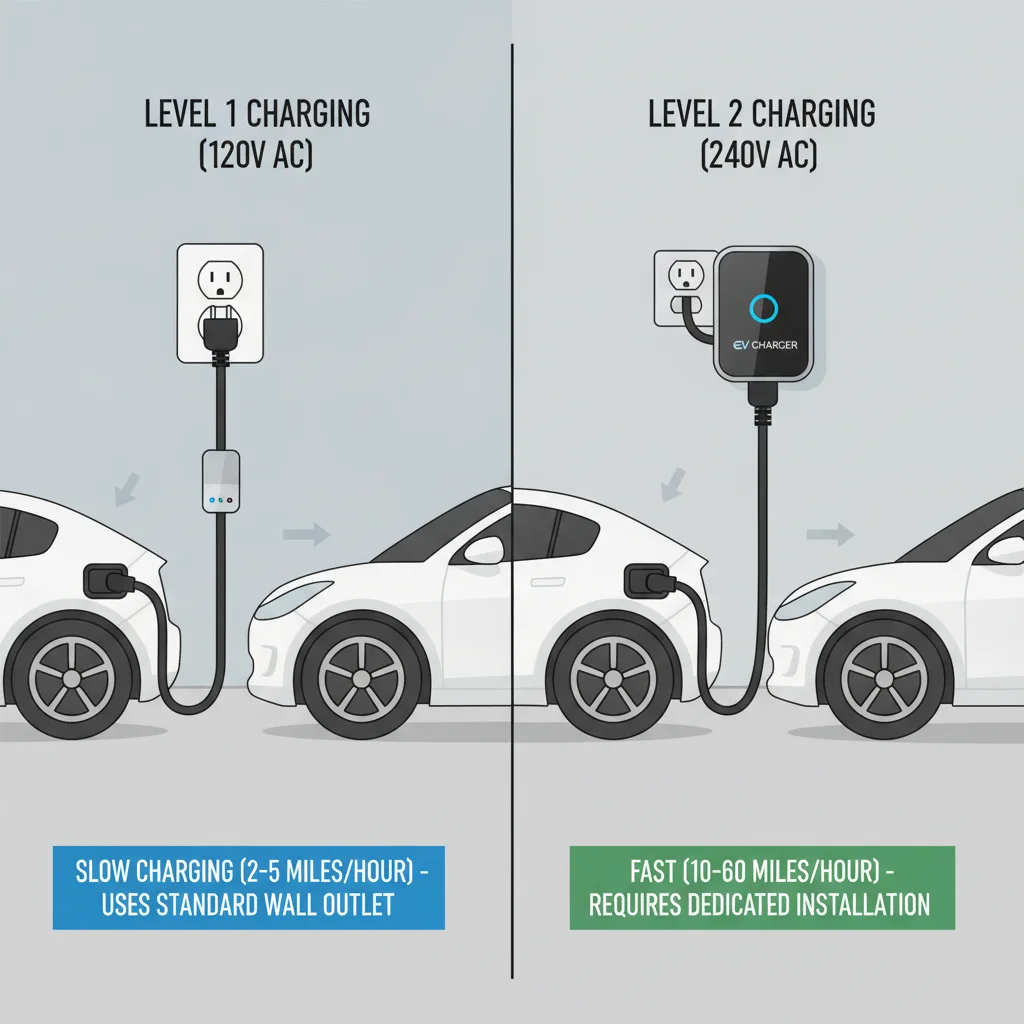
Level 1 Charging (120V Standard Outlet)
Every EV comes with a Level 1 cordset that plugs into a standard household outlet. The electrical math is straightforward: at 120V and 12 amps, you're delivering about 1.4 kW of power. That translates to roughly 4–5 miles of range per hour of charging.
For a vehicle with a 75 kWh battery and 250 miles of range, a full charge from empty takes 50+ hours. In practice, most owners don't drain to zero, so overnight Level 1 charging can work — but only if your daily driving stays under 40–50 miles.
- Upfront cost: $0 (cable included with the vehicle)
- Installation cost: $0 (uses existing outlet)
- Range added per hour: ~4–5 miles
- Best for: Low-mileage drivers, plug-in hybrids, secondary vehicles
Level 2 Charging (240V Dedicated Circuit)
A Level 2 charger — properly called an EVSE (Electric Vehicle Supply Equipment) — operates on the same voltage as your dryer or electric range. At 240V and 32–48 amps, you're delivering 7.7–11.5 kW of power, adding 20–35 miles of range per hour.
That same 75 kWh battery charges from near-empty in 7–10 hours, which fits comfortably in an overnight window. For most EV owners, this is the right setup.
- Upfront equipment cost: $200–$800 for the EVSE unit
- Installation cost: $300–$1,200 for a licensed electrician (panel upgrades can add more)
- Range added per hour: ~20–35 miles
- Best for: Most EV owners, long daily commuters, households with one or more EVs
Check for Utility Rebates Before You Buy
Many U.S. utilities offer $200–$500 rebates on Level 2 EVSE equipment and may subsidize installation costs as well. Some states stack additional incentives on top. Before purchasing any home charging hardware, visit your utility's website or call their EV support line — the rebate process is usually simple and can meaningfully reduce your out-of-pocket cost.
Schedule Charging to Maximize Off-Peak Savings
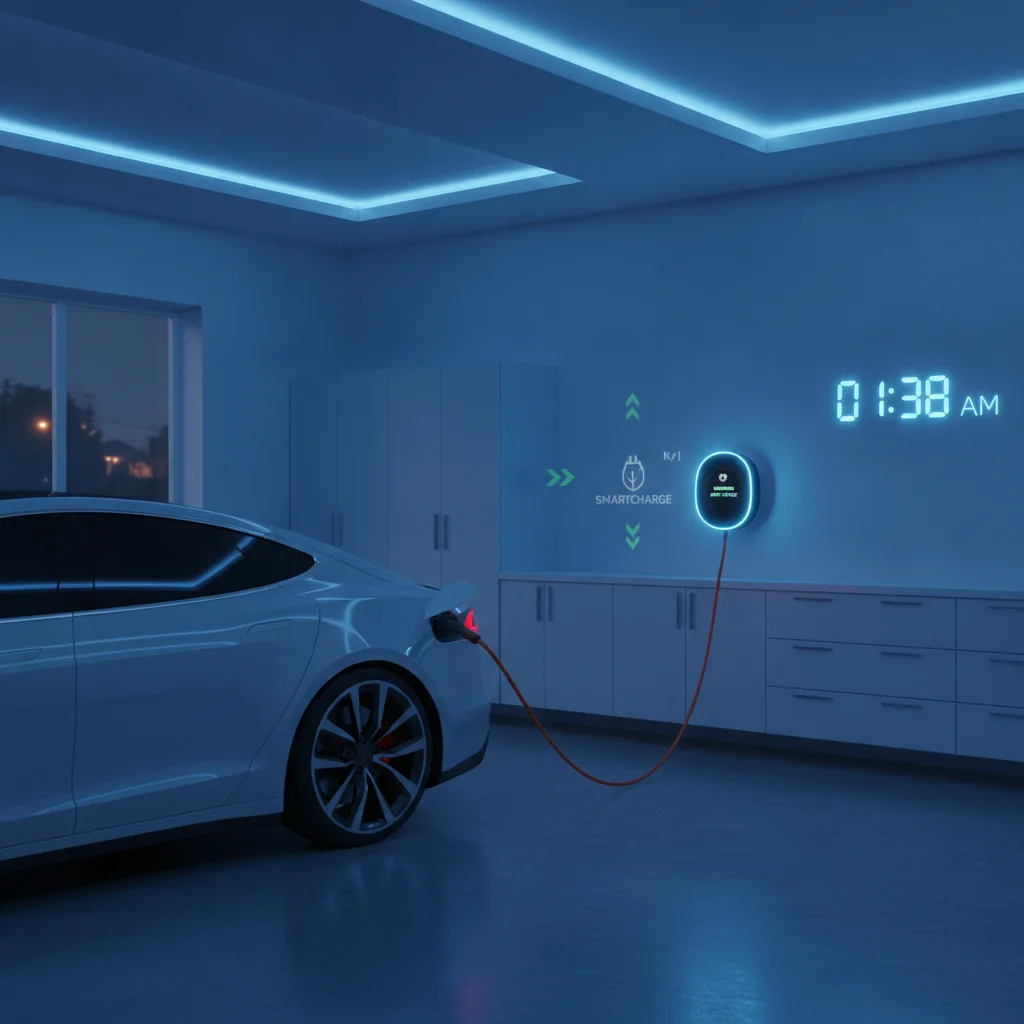
Nearly every modern EV's infotainment system includes a scheduled charging feature, and most Level 2 EVSEs have it too. Set your charge start time to align with your utility's off-peak window — usually after 9 PM or midnight — and you'll automatically capture the lower rate every night. If you're unsure of your utility's TOU windows, check your bill or the utility's website for the rate schedule.
Precondition Your Battery While Plugged In
In cold weather, running your EV's cabin heater and battery preconditioning while still plugged in — rather than on stored battery power — reduces range loss during your drive. Most EVs let you schedule a departure time so the car is warm and ready when you leave. This keeps your effective miles-per-kWh higher, which directly lowers your cost per mile.
The electricity cost per mile is identical whether you use Level 1 or Level 2 — both draw the same total kWh from your home to deliver the same amount of charge to the battery. Level 2 just does it faster.
How Your Electricity Rate Shapes Everything
Here's the uncomfortable truth for anyone trying to estimate their EV charging costs in advance: your utility rate matters more than almost anything else. A driver in Louisiana paying $0.09/kWh spends roughly half what a driver in California paying $0.27/kWh does — for the exact same vehicle driving the exact same miles.
Using the same 1,100 miles/month and 352 kWh wall draw from the earlier example:
| State (approx. rate) | Monthly Charging Cost | Annual Charging Cost |
|---|---|---|
| Louisiana (~$0.09/kWh) | ~$32 | ~$381 |
| U.S. Average (~$0.16/kWh) | ~$56 | ~$675 |
| California (~$0.27/kWh) | ~$95 | ~$1,141 |
| Hawaii (~$0.38/kWh) | ~$134 | ~$1,605 |
These figures swing dramatically — and they illustrate why you cannot use a national average to estimate your actual costs without checking your local rate first.
Charging Losses Are Real — Budget for Them
When you see an EV rated at 3.5 miles per kWh, that figure reflects battery efficiency, not wall-to-wheel efficiency. Every Level 1 and Level 2 charging session loses 10–15% of energy to heat and conversion in the charger hardware. This means your actual electricity consumption — and therefore your bill — will be 10–15% higher than a battery-only calculation suggests. Always include this factor in your estimates.
Tiered vs. Flat vs. TOU Rates: Know Which Applies to You
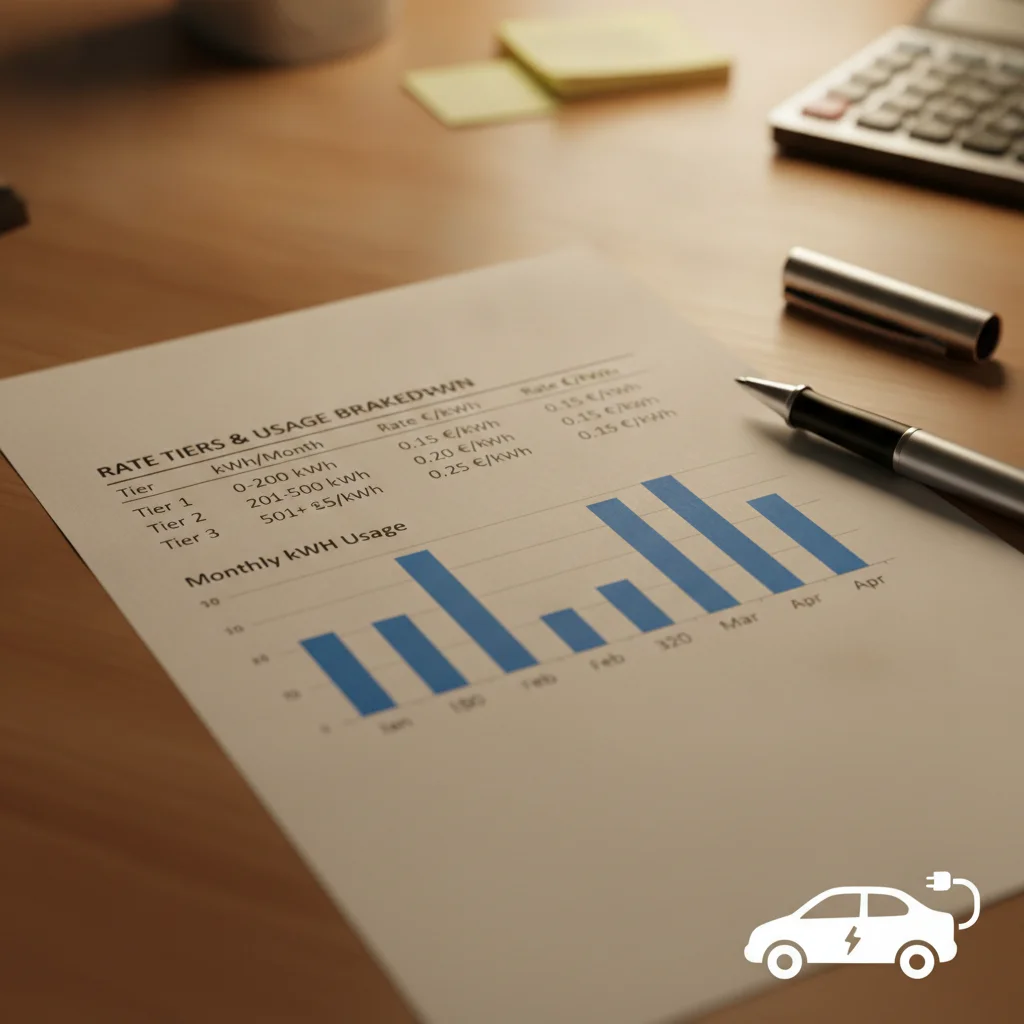
Many utilities use tiered pricing, where the rate per kWh increases after you exceed a monthly usage baseline. Adding EV charging can push you into a higher tier, meaning the marginal cost of your charging kWh is higher than your average rate. Understanding your specific rate structure before estimating costs is essential — your bill may show a blended average that masks the true cost of added consumption.
Panel Upgrades Can Significantly Affect Your Total Cost
Older homes with 100-amp electrical panels may not have capacity to add a 240V circuit without a panel upgrade, which can cost $1,500–$4,000 or more depending on your area. Before getting EVSE installation quotes, ask an electrician to assess your panel first. Some utilities also offer financing or rebates for panel upgrades done in connection with EV charging installation.
Beyond the flat rate per kWh, your utility's rate structure — flat rate, tiered pricing, or time-of-use — adds another layer of complexity. For a full explanation of how these structures interact with EV charging, see How Electricity Rates Affect What You Pay to Charge an EV.
Time-of-Use Rates: The Biggest Lever Most Owners Ignore
If your utility offers a time-of-use (TOU) rate plan — and most major U.S. utilities do — signing up and scheduling your EV to charge overnight is probably the single highest-impact action you can take to reduce your monthly bill. Some utilities have also created EV-specific rate plans with even steeper off-peak discounts.
“The electric vehicle driver who ignores their utility rate structure is leaving money on the table every single month. Signing up for a time-of-use plan and scheduling overnight charging is the closest thing to a free lunch in personal energy management.”
— Severin Borenstein, Professor of Business Administration and Public Policy, UC Berkeley Energy Institute at Haas
The concept is simple: electricity costs more when demand is high (weekday afternoons) and less when demand is low (late night to early morning). A TOU plan exposes you to these price differences rather than charging a flat average.
Here's what that looks like in practice for a California utility customer:
- On-peak rate (4–9 PM weekdays): ~$0.45/kWh
- Off-peak rate (9 PM–8 AM): ~$0.17/kWh
Charging entirely off-peak rather than on-peak would cut the California driver's monthly charging cost from roughly $95 to approximately $60 — a 37% reduction from the same electricity used at the same home.
Check for Utility Rebates Before You Buy
Many U.S. utilities offer $200–$500 rebates on Level 2 EVSE equipment and may subsidize installation costs as well. Some states stack additional incentives on top. Before purchasing any home charging hardware, visit your utility's website or call their EV support line — the rebate process is usually simple and can meaningfully reduce your out-of-pocket cost.
Schedule Charging to Maximize Off-Peak Savings
Nearly every modern EV's infotainment system includes a scheduled charging feature, and most Level 2 EVSEs have it too. Set your charge start time to align with your utility's off-peak window — usually after 9 PM or midnight — and you'll automatically capture the lower rate every night. If you're unsure of your utility's TOU windows, check your bill or the utility's website for the rate schedule.
Precondition Your Battery While Plugged In
In cold weather, running your EV's cabin heater and battery preconditioning while still plugged in — rather than on stored battery power — reduces range loss during your drive. Most EVs let you schedule a departure time so the car is warm and ready when you leave. This keeps your effective miles-per-kWh higher, which directly lowers your cost per mile.
Almost every modern EV and Level 2 EVSE allows you to schedule charging start times. Set it to begin after 9 PM or whatever your utility's off-peak window starts, and you capture the discount automatically. See how TOU rates and home EV charging work together for a step-by-step approach to making this work in your favor.
Real-World Variables That Change Your Bill
The formula is clean; real life is messier. Several factors can push your actual monthly charging cost higher or lower than your estimates.
Factors That Push Costs Higher
- Cold weather: Lithium-ion batteries lose 15–30% efficiency in sub-freezing temperatures. If you live in Minnesota or upstate New York, expect meaningfully higher kWh consumption per mile in winter months.
- Highway driving: EVs are most efficient in stop-and-go city traffic, where regenerative braking recaptures energy. Sustained highway speeds above 70 mph can cut real-world efficiency by 20–30% versus EPA estimates.
- Cabin heating: Unlike gas vehicles that generate waste heat, EVs must use resistive heating (or a heat pump, in newer models) to warm the cabin, which draws directly from the battery.
- Panel upgrades: If your home has an older 100-amp service panel, adding a 240V circuit for Level 2 may require a panel upgrade costing $1,500–$4,000 — a one-time but significant cost.
Factors That Push Costs Lower
- Rooftop solar: Pairing an EV with a solar array can dramatically reduce or eliminate grid electricity costs during daylight hours, depending on system size and local net metering policy.
- Utility rebates: Many utilities offer $200–$500 rebates on Level 2 EVSE equipment purchases. Some also offer free EV rate plan enrollment with additional credits.
- Efficient driving habits: Smooth acceleration, using Eco mode, and preconditiong the battery while plugged in (rather than on battery power) all reduce per-mile energy consumption.
Charging Losses Are Real — Budget for Them
When you see an EV rated at 3.5 miles per kWh, that figure reflects battery efficiency, not wall-to-wheel efficiency. Every Level 1 and Level 2 charging session loses 10–15% of energy to heat and conversion in the charger hardware. This means your actual electricity consumption — and therefore your bill — will be 10–15% higher than a battery-only calculation suggests. Always include this factor in your estimates.
Tiered vs. Flat vs. TOU Rates: Know Which Applies to You
Many utilities use tiered pricing, where the rate per kWh increases after you exceed a monthly usage baseline. Adding EV charging can push you into a higher tier, meaning the marginal cost of your charging kWh is higher than your average rate. Understanding your specific rate structure before estimating costs is essential — your bill may show a blended average that masks the true cost of added consumption.
Panel Upgrades Can Significantly Affect Your Total Cost
Older homes with 100-amp electrical panels may not have capacity to add a 240V circuit without a panel upgrade, which can cost $1,500–$4,000 or more depending on your area. Before getting EVSE installation quotes, ask an electrician to assess your panel first. Some utilities also offer financing or rebates for panel upgrades done in connection with EV charging installation.
To understand every line item on your electricity bill — including delivery charges and demand charges that can affect your total — see The EV Owner's Guide to Reading an Electricity Bill.
Estimating Your Specific Monthly Cost Before You Buy
If you're still in the shopping phase and want a reliable cost projection before committing to an EV, the process is straightforward — and doing it yourself takes about five minutes.
- Find your average monthly mileage. Pull your last 3–6 months of odometer readings, or divide your annual mileage by 12. The U.S. average is about 1,100 miles/month but your number might be 700 or 1,800 — use yours.
- Look up the vehicle's EPA efficiency rating. The U.S. Department of Energy's fueleconomy.gov lists every EV's miles per kWh (or kWh per 100 miles). Use the combined city/highway figure as your baseline.
- Find your electricity rate. Check a recent electricity bill — look for the rate in cents per kWh. If you see a tiered structure, use the rate for your highest current tier, since EV charging will likely push you into it.
- Apply the formula: (Monthly miles ÷ efficiency) × 1.12 (for charging losses) × rate per kWh.
- Compare to a TOU off-peak rate if your utility offers one — you may want to factor in that lower rate if you plan to charge overnight.
For a more interactive walkthrough of this process, see Estimating Your Monthly EV Charging Bill Before You Buy — it walks through the full calculation with adjustments for different driving patterns.

The broader picture of EV ownership costs — including insurance — is worth reviewing before you finalize a purchase. The EV Insurance Guide covers how EV premiums differ from gas car coverage and what to budget for.
Making the Level 1 vs. Level 2 Decision Practically
Given everything above, here's a plain-English decision framework for choosing your home charging setup:
Stick with Level 1 if:
- You drive fewer than 35–40 miles per day consistently
- You have overnight parking with access to a standard 120V outlet
- You own a plug-in hybrid (PHEV) with a smaller battery pack (10–20 kWh)
- You want to avoid any upfront installation cost
Install Level 2 if:
- You drive 40+ miles per day or have unpredictable daily mileage
- You own a full BEV with 60+ kWh of battery capacity
- You want the flexibility to leave home fully charged every morning without thinking about it
- You plan to own the EV for 3+ years (the convenience payoff accumulates)
Check for Utility Rebates Before You Buy
Many U.S. utilities offer $200–$500 rebates on Level 2 EVSE equipment and may subsidize installation costs as well. Some states stack additional incentives on top. Before purchasing any home charging hardware, visit your utility's website or call their EV support line — the rebate process is usually simple and can meaningfully reduce your out-of-pocket cost.
Schedule Charging to Maximize Off-Peak Savings
Nearly every modern EV's infotainment system includes a scheduled charging feature, and most Level 2 EVSEs have it too. Set your charge start time to align with your utility's off-peak window — usually after 9 PM or midnight — and you'll automatically capture the lower rate every night. If you're unsure of your utility's TOU windows, check your bill or the utility's website for the rate schedule.
Precondition Your Battery While Plugged In
In cold weather, running your EV's cabin heater and battery preconditioning while still plugged in — rather than on stored battery power — reduces range loss during your drive. Most EVs let you schedule a departure time so the car is warm and ready when you leave. This keeps your effective miles-per-kWh higher, which directly lowers your cost per mile.
Household with Two EVs
If you're adding a second EV, a single Level 2 charger shared between two vehicles can still work if both drivers rarely drain to empty in the same day. Some households install two Level 2 units on a load-sharing system that splits available amperage dynamically, keeping installation costs manageable while doubling charging capacity.
Whatever direction you go, get at least two quotes from licensed electricians before committing to an installation price — rates vary significantly by region and panel complexity. And check your state and local utility for available rebates before purchasing the EVSE unit itself.
$56/mo
Average home EV charging cost for typical U.S. driver
Based on 1,100 miles/month, 3.5 miles/kWh efficiency, and the U.S. average electricity rate of ~$0.16/kWh as of 2024 (U.S. Energy Information Administration).
10–15%
Energy lost to charging inefficiency (wall-to-battery)
Onboard charger and cable conversion losses mean you pull more kWh from the wall than the battery stores — a consistent factor across Level 1 and Level 2 charging.
37%
Potential savings from switching to a TOU off-peak rate
Based on a California example comparing on-peak ($0.45/kWh) to off-peak ($0.17/kWh) rates — savings vary by utility and usage pattern.
$500–$2,000
Typical all-in Level 2 home charging installation cost
Includes EVSE hardware ($200–$800) and licensed electrician installation ($300–$1,200), excluding panel upgrades (U.S. industry estimates, 2024).
4–5 mi
Range added per hour via Level 1 (120V) charging
Reflects standard 1.4 kW delivery rate on a 120V/12A circuit — adequate for low-mileage use cases but impractical for most full BEV owners.

All claims are backed by peer-reviewed research. Sources on request.