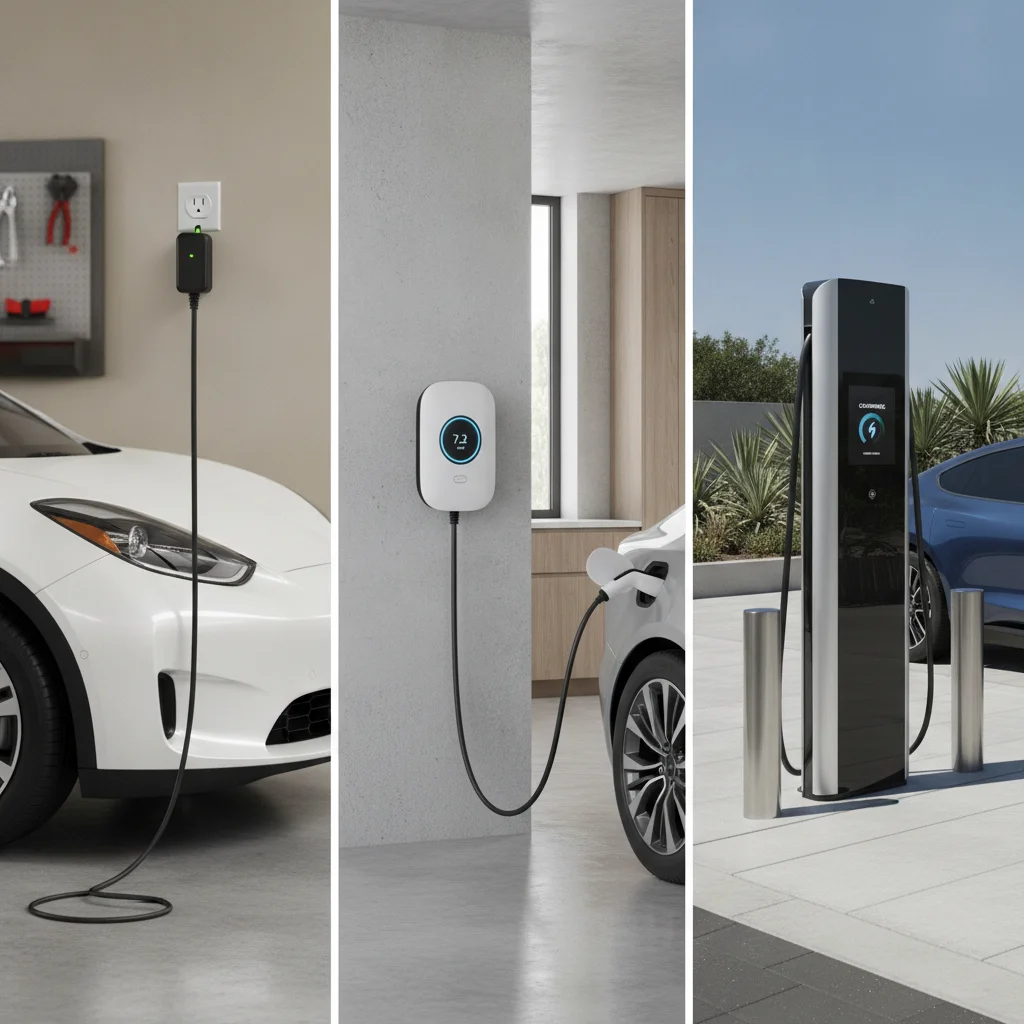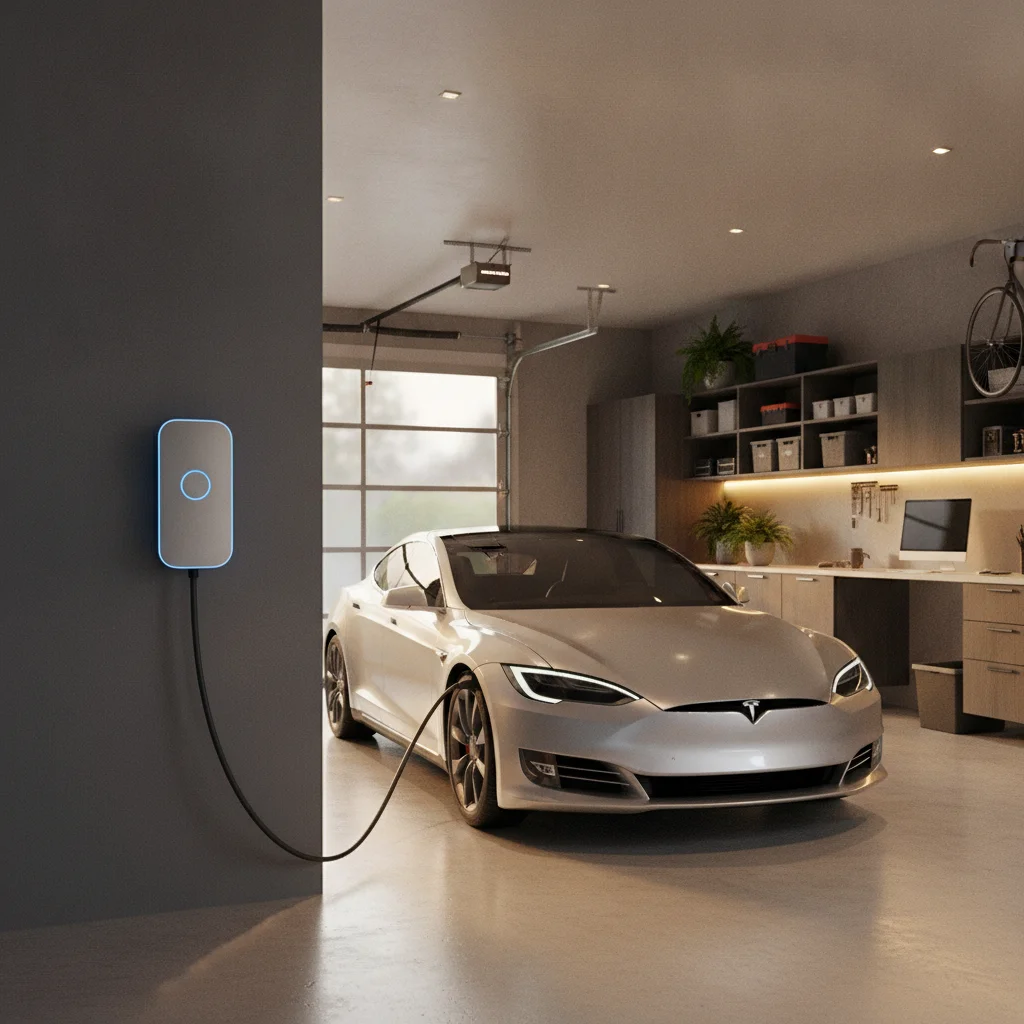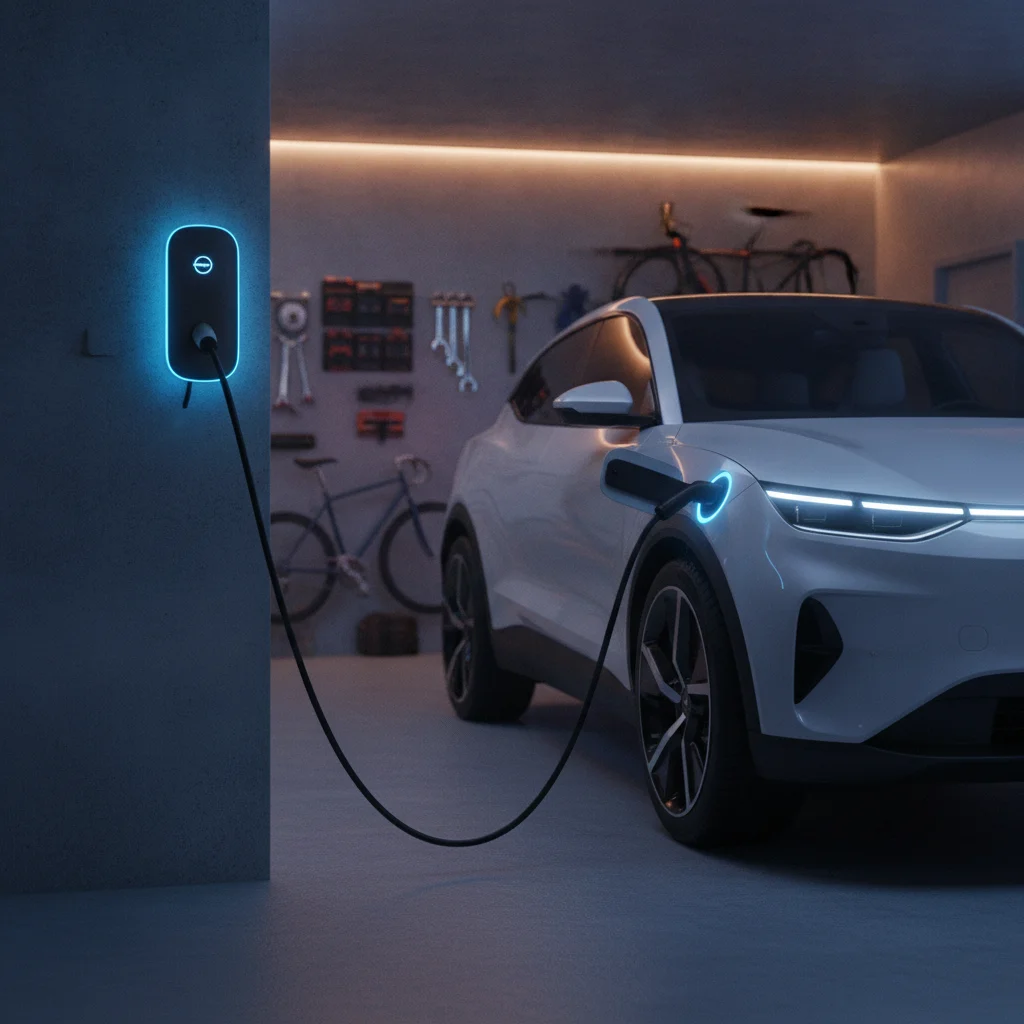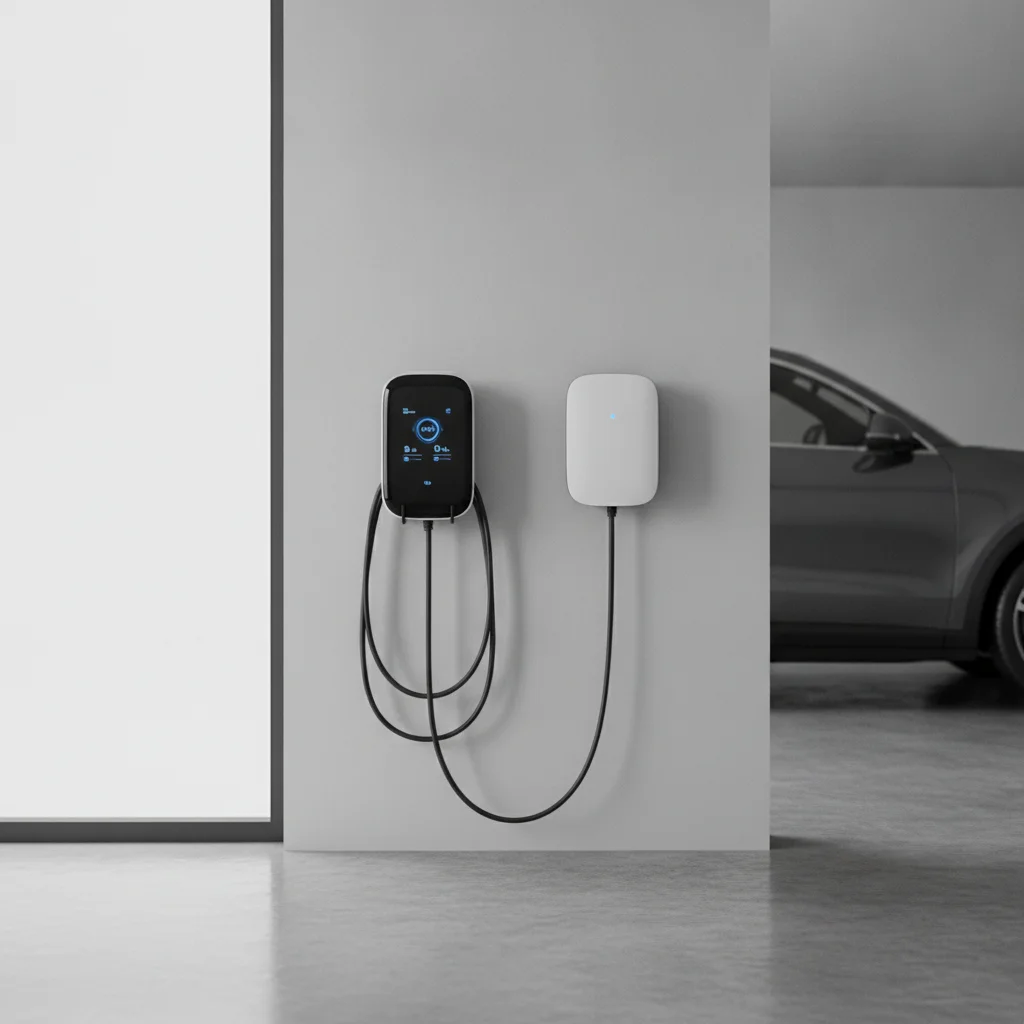
Key Takeaways
Option A
Smart EV Charger
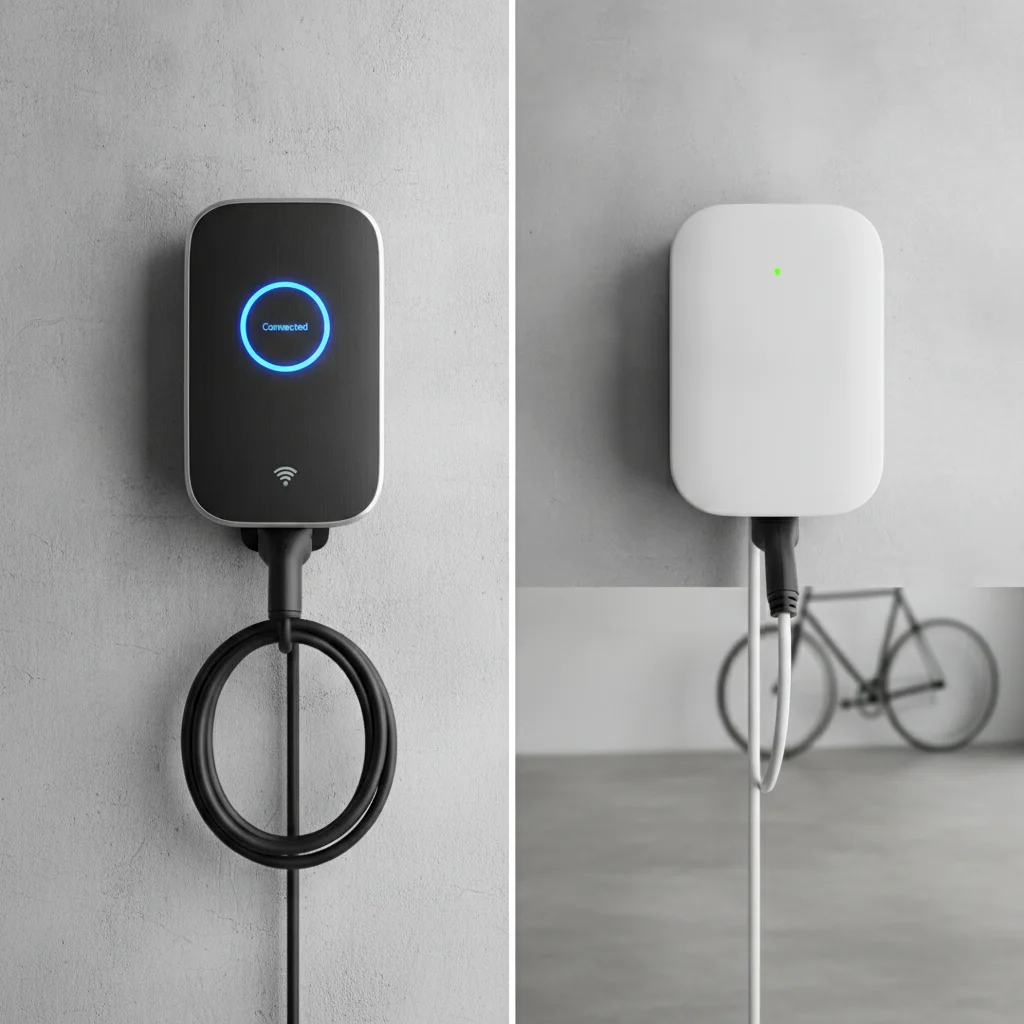
The connected, programmable home charging station.
Best for: Homeowners who want to schedule off-peak charging, monitor energy use, and integrate with smart home systems.
Option B
Basic EV Charger
The plug-in-and-go Level 2 charging solution.
Best for: Drivers who want reliable, fast home charging without the cost or complexity of app-connected hardware.
If you're on a time-of-use electricity rate and drive more than 40 miles daily
Smart EV Charger
Scheduled off-peak charging can save $20–$60 per month depending on your rate plan, making the premium hardware cost easy to recover within a year or two.
If you drive fewer than 30 miles per day and just want reliable overnight charging
Basic EV Charger
A basic Level 2 EVSE delivers all the charge speed you need at a lower total installed cost — no app required.
If you're renting your home or plan to move within two years
Basic EV Charger
A portable or hardwired basic unit is simpler to uninstall and reinstall, and the lower upfront investment makes more financial sense for a temporary setup.
If you have a home solar system or a smart home ecosystem
Smart EV Charger
Smart chargers can integrate with solar inverters and home energy management systems to prioritize solar generation, reducing your net grid consumption significantly.
If you want the lowest possible total cost of ownership with no frills
Basic EV Charger
No subscription fees, simpler hardware, and lower purchase price make basic chargers the budget-rational choice for straightforward home charging needs.
What Actually Separates a Smart Charger from a Basic One
Strip away the marketing language and the difference between a smart EV charger and a basic one comes down to three things: connectivity, programmability, and data visibility. Both types are overwhelmingly Level 2 devices — meaning they run on a 240-volt circuit and can add roughly 20–30 miles of range per hour of charging. The electrons themselves don't move faster because the charger has a Wi-Fi chip.
A basic Level 2 charger (technically called Electric Vehicle Supply Equipment, or EVSE) is a dumb conduit. You plug in, power flows, and your car charges at whatever rate its onboard charger supports. There's no app, no scheduling, and no usage data. Many basic models do offer adjustable amperage settings via a physical dial or button — a useful feature if you want to share a circuit or manage load — but that's about the extent of the sophistication.
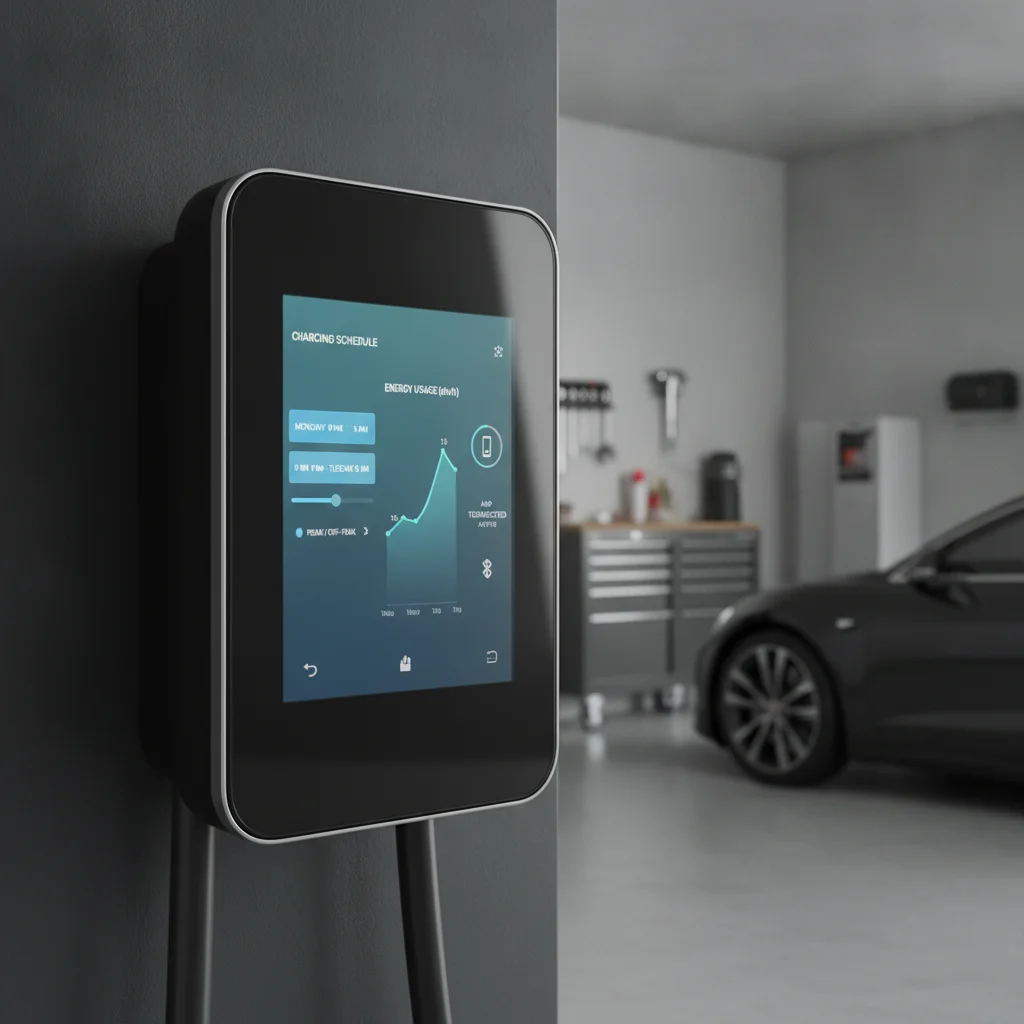
A smart charger adds a network layer on top of that same hardware. Wi-Fi or cellular connectivity lets you control and monitor the unit through a smartphone app or web portal. Key features typically include:
- Scheduled charging: Set start and stop times to align with off-peak electricity windows.
- Energy monitoring: Track kilowatt-hours consumed, session history, and monthly cost estimates.
- Load management: Some models dynamically reduce charging rate when other high-draw appliances are running.
- Remote control: Start, stop, or modify a charging session from anywhere.
- Smart home integration: Works with platforms like Amazon Alexa, Google Home, or directly with solar inverters.
- Utility program participation: Some smart chargers can enroll in demand-response programs managed by your utility, which may offer bill credits.
Before diving into cost and value comparisons, it's worth reviewing the basics of charging levels — our breakdown of Level 1, Level 2, and DC fast charging costs and speeds covers the speed and cost math in detail.
The Real Cost Comparison: Hardware, Installation, and Ongoing Fees
Sticker price is only one dimension of cost. Here's the full picture across both categories.
| Criterion | Smart EV Charger | Basic EV Charger |
|---|---|---|
| Typical hardware cost | $350–$700+ | $150–$350 |
| Installation cost | $200–$600 (same as basic) | $200–$600 |
| Charge speed (Level 2) | Up to 48A / ~11.5 kW | Up to 48A / ~11.5 kW |
| Scheduled off-peak charging | Yes — via app | No (rely on vehicle scheduler) |
| Energy monitoring | Yes — session & monthly data | No |
| Utility rebate eligibility | Often higher / required | Sometimes eligible |
| Smart home integration | Yes — Alexa, Google, solar | No |
| Subscription fees | Some brands: $50–$100/yr | None |
| Reliability / simplicity | Moderate (firmware dependency) | High (minimal failure points) |
| Best payback scenario | TOU rates + high daily mileage | Flat rates or low daily mileage |
Hardware cost: Basic Level 2 chargers from reputable brands like Grizzl-E, Emporia, or ChargePoint's entry-level units run $150–$350. Smart chargers from brands like Wallbox, JuiceBox, ChargePoint Home Flex, or Emporia Smart start around $350 and can climb to $700+ for units with higher amperage or premium features.
Installation: Both require a licensed electrician to install a dedicated 240V circuit if one doesn't already exist. Expect $200–$600 for a straightforward installation, potentially more if your panel needs an upgrade. The charger type doesn't meaningfully change this cost.
Subscription fees: This is where smart charger owners get surprised. Some features — particularly detailed energy reporting, software updates, or load management — are locked behind annual subscriptions on certain brands. Fees typically run $4–$10/month or $50–$100/year. Read the fine print before buying: the free tier on many brands is adequate, but it's worth knowing what's locked.
Rebates and incentives: This is a legitimate differentiator for smart chargers. Many utilities specifically require a smart, Wi-Fi-connected EVSE to qualify for installation rebates — because utilities want the ability to integrate those chargers into demand-response programs. Rebates of $100–$500 are available in states like California, Michigan, and New York. The federal Section 30C Alternative Fuel Vehicle Refueling Property Credit (30% of equipment and installation cost, up to $1,000 for personal use) applies to both types, though income limits and location requirements apply. Check the Database of State Incentives for Renewables and Efficiency (DSIRE) for your state.
$500
Average utility EVSE rebate for smart chargers
Several major utilities including PG&E, Consumers Energy, and National Grid offer rebates specifically for Wi-Fi-connected Level 2 chargers, per DSIRE database listings.
30%
Federal tax credit on EVSE equipment and installation
The Section 30C credit covers 30% of qualified EV charger costs up to $1,000 for individuals, subject to income and location requirements under the Inflation Reduction Act.
$0.12 vs $0.35
Off-peak vs peak rate per kWh (example TOU plan)
PG&E's EV2-A time-of-use rate illustrates the scale of potential savings from scheduling charging during overnight off-peak windows.
65%
EV owners who charge primarily at home
According to the U.S. Department of Energy's 2023 EV Consumer Behavior Survey, the vast majority of EV charging happens at home — making home charger selection a high-impact decision.
For a comprehensive view of the full installation process, see our guide on home EV charging setup — it covers electrical requirements and what to expect from an installer.
Where Smart Chargers Actually Earn Their Premium
Smart chargers pay for themselves only in specific circumstances. Here's an honest breakdown of when the premium is justified and when it's money left on the table.
Time-of-Use Rate Arbitrage
This is the biggest legitimate payoff. Many utilities offer time-of-use (TOU) rate plans where electricity is significantly cheaper at night — often 50–70% less than peak daytime rates. In California, for example, PG&E's EV rate plan charges roughly $0.12/kWh off-peak versus $0.35/kWh on-peak. For a driver adding 1,000 kWh per month (approximately 40 miles/day in a typical EV), that's a difference of $230/month — or nearly $2,800/year. Scheduling charging to run 11 PM–6 AM automatically is the core value proposition of a smart charger.
Yes, your EV's onboard system can often schedule charging too — and if it does this well enough for your needs, a basic charger may suffice. But the app-side scheduling on a smart EVSE tends to be more flexible, reliable, and platform-agnostic. Our article on smart charging schedules goes deeper on exactly how to configure this.
Energy Monitoring and Tax Documentation
If you use your EV for business, or want to understand your actual home energy consumption, kilowatt-hour tracking is genuinely useful. Smart chargers give you session-level data that basic units can't provide. Some accountants and IRS guidance support using actual kWh consumed for business mileage reimbursement calculations — smart charger data makes that defensible.
Solar Integration
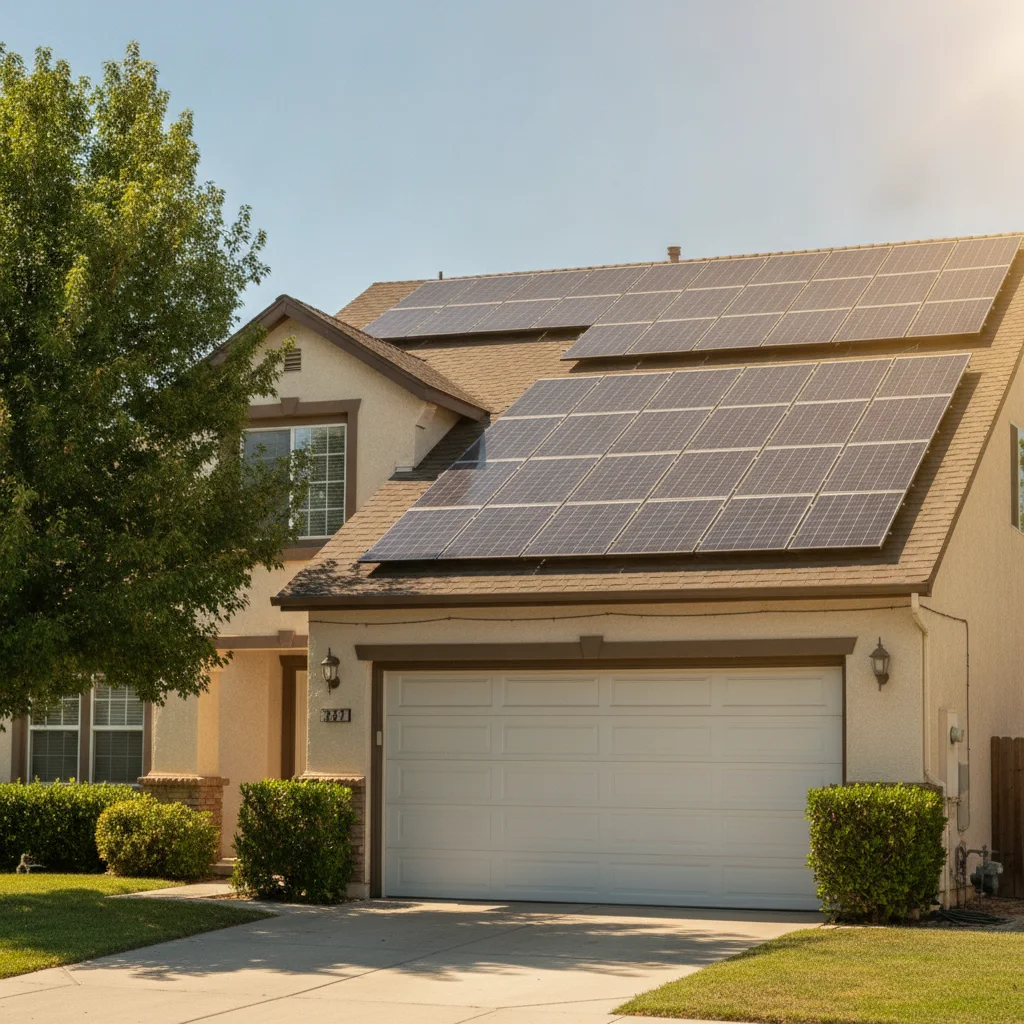
If you have rooftop solar, a smart charger that can respond to your inverter's export signals — charging only when solar generation exceeds home consumption — can meaningfully reduce your net metering balance. Brands like Wallbox and some SolarEdge-compatible chargers support this natively. A basic charger is completely blind to your solar output.
Utility Demand-Response Programs
Some utilities will pay you (in credits) to allow them to temporarily reduce your charger's output during grid stress events. This requires a smart, connected charger. It's a modest benefit — typically $25–$75/year — but it's free money if you're already buying a smart unit.
Your EV May Already Schedule Charging
Before investing in a smart EVSE, check your vehicle's settings. Most EVs sold since 2020 — including Tesla, Chevrolet Bolt, Hyundai Ioniq 5, Ford F-150 Lightning, and Rivian models — include onboard departure time or off-peak scheduling that works with any Level 2 charger. If your vehicle handles this reliably, the primary economic argument for a smart EVSE weakens considerably.
Subscription Fee Transparency Varies by Brand
Not all smart charger brands are upfront about what's free versus paid. ChargePoint Home Flex currently offers core scheduling and monitoring at no ongoing cost. Some other brands lock energy reporting or smart features behind a paywall after a trial period. Always verify the current pricing structure on the manufacturer's website before purchasing — subscription models can change after you've installed the hardware.
Where Basic Chargers Hold Their Own
The case for a basic charger is straightforward, and it's underappreciated in coverage that gravitates toward shinier tech.
Reliability and Simplicity
A basic charger has fewer components to fail. No Wi-Fi radio, no firmware update dependencies, no app to maintain. Owners of smart chargers report a persistent frustration: connectivity dropouts that cause scheduled charging to miss, firmware updates that temporarily brick functionality, or app-side bugs that prevent remote control. A basic charger that works every single time is not a trivial advantage.
Lower Total Cost for Low-Mileage Drivers
If you drive 15–25 miles per day, you're adding perhaps 4–6 kWh to your battery nightly. At even a peak electricity rate of $0.30/kWh, that's $1.50–$1.80 per night — roughly $55/month. The TOU savings from a smart charger might be $10–$15/month in this scenario. At that rate, the $200–$350 smart charger premium takes 1.5–3 years to recover — if the features work as expected and no subscription fees eat into the savings.
Portability
Several popular basic chargers (and some smart ones) are plug-in models using a NEMA 14-50 outlet rather than hardwired installation. If you rent, or expect to move, a portable plug-in unit is easy to take with you. Basic plug-in chargers from brands like Grizzl-E and Lectron offer solid build quality for under $250. If you're new to EV ownership, our overview of home charging options for new EV owners is a useful starting point before committing to any hardware.
No App, No Problem
Not everyone wants to manage their car's charging through a smartphone app. If your EV's native charging scheduler handles off-peak timing adequately — as many newer vehicles from Tesla, GM, Hyundai, and Ford do — you can capture most of the TOU savings without paying for a smart EVSE at all.
Head-to-Head: Feature Matrix and Who It's For
Smart features cluster around three personas: the energy optimizer, the data tracker, and the smart home integrator. If none of those describes you, you're paying for functionality you won't use.
Consider the following framing: a smart charger is a good investment if at least two of the following are true for you:
- Your utility offers TOU rates and the off-peak discount exceeds $0.10/kWh versus peak.
- You drive more than 30 miles per day, meaning daily charging volume is significant enough to amplify savings.
- You have or plan to install rooftop solar within the next two years.
- Your utility offers rebates specifically tied to smart/Wi-Fi-connected EVSEs.
- You actively use smart home automation and want EV charging integrated into that ecosystem.
If only one or none applies, a well-built basic Level 2 charger — properly sized to your car's maximum onboard charge rate — will serve you just as well for significantly less money.
It's also worth noting that the broader landscape of EV charging costs and savings involves more than just your home hardware choice. Public charging network use, membership plans, and your vehicle's onboard charging software all interact with your total cost picture.
Making the Decision: A Practical Framework
Here's how to arrive at a clear answer without overanalyzing it.
Step 1: Check Your Utility Rate Structure
Log into your utility's website and look for EV rate plans or TOU options. If off-peak rates are more than $0.08–$0.10/kWh cheaper than peak rates, smart scheduling has meaningful value. If your utility has flat-rate pricing, TOU arbitrage doesn't exist — and neither does the primary economic argument for a smart charger.
Step 2: Check Available Rebates
Search your utility and state energy office for EVSE rebates. If a rebate of $200+ is available specifically for smart/networked chargers, that can close or eliminate the cost gap versus a basic unit. DSIRE (dsireusa.org) is the most comprehensive public database for this.
Step 3: Assess Your Daily Mileage
Under 25 miles/day: a basic charger is almost certainly the better value. 30–50+ miles/day: a smart charger's TOU savings compound meaningfully and the payback window shortens to a reasonable 12–24 months.
Step 4: Evaluate Your Vehicle's Native Scheduling
Look up whether your EV has built-in scheduled charging. Most 2021+ vehicles do. If yours works reliably, you may already have 80% of a smart charger's core value baked into your car — for free.
Step 5: Factor in Your Living Situation
Renters, frequent movers, or anyone in a multi-unit dwelling with shared electrical infrastructure should lean toward a portable basic charger. Homeowners with long time horizons get more benefit from investing in a permanent, potentially smart, hardwired unit.
Your EV May Already Schedule Charging
Before investing in a smart EVSE, check your vehicle's settings. Most EVs sold since 2020 — including Tesla, Chevrolet Bolt, Hyundai Ioniq 5, Ford F-150 Lightning, and Rivian models — include onboard departure time or off-peak scheduling that works with any Level 2 charger. If your vehicle handles this reliably, the primary economic argument for a smart EVSE weakens considerably.
Subscription Fee Transparency Varies by Brand
Not all smart charger brands are upfront about what's free versus paid. ChargePoint Home Flex currently offers core scheduling and monitoring at no ongoing cost. Some other brands lock energy reporting or smart features behind a paywall after a trial period. Always verify the current pricing structure on the manufacturer's website before purchasing — subscription models can change after you've installed the hardware.
If you're evaluating whether to go further and sign up for a public charging network membership alongside your home setup, our analysis of EV charging network membership plans applies the same kind of break-even math.

All claims are backed by peer-reviewed research. Sources on request.