Key Takeaways
Option A
Gasoline
The familiar, infrastructure-rich incumbent.
Best for: Drivers in areas with low gas prices, long-distance travelers without home charging access, or buyers of used vehicles with no EV option.
Option B
Electricity
The lower per-mile cost leader in most U.S. markets.
Best for: Drivers with home charging access, high-mileage commuters, and anyone in a state with below-average utility rates.
If you charge primarily at home overnight
Electricity
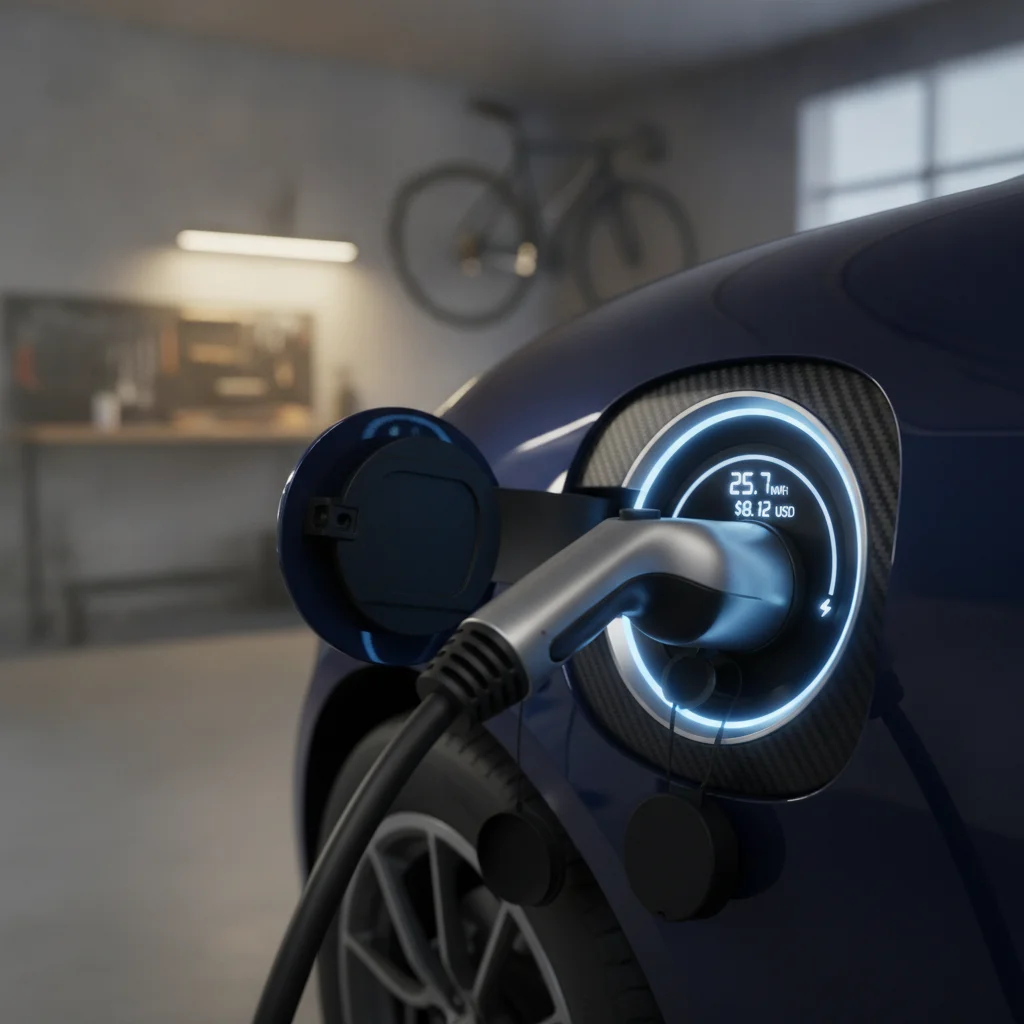
Home Level 2 charging at the U.S. average of $0.16/kWh produces per-mile costs well under $0.05 for most EVs — roughly half or less what gasoline costs per mile.
If you rely exclusively on DC fast chargers
Gasoline
DC fast charging at commercial network rates of $0.35–$0.48/kWh can push per-mile electricity costs on par with or above a 35-MPG gas vehicle at $3.50/gallon.
If you drive 15,000 or more miles per year
Electricity
The per-mile savings compound quickly at high mileage. A home-charging EV driver can save $800–$1,500 annually versus an equivalent gas vehicle across most U.S. regions.
If you live in a high-electricity-rate state like California or Hawaii
Gasoline
Retail electricity above $0.28/kWh can significantly shrink the EV fuel advantage, especially when combined with time-of-use rate restrictions and fast-charge dependency.
If you own a large gas-powered SUV or truck and want to lower fuel spend
Electricity
Even large electric trucks like the F-150 Lightning cost roughly $0.05–$0.07/mile to operate on home power, versus $0.14–$0.18/mile for their V8 gas counterparts at $3.50/gallon.
The Formula: How Per-Mile Fuel Cost Actually Works
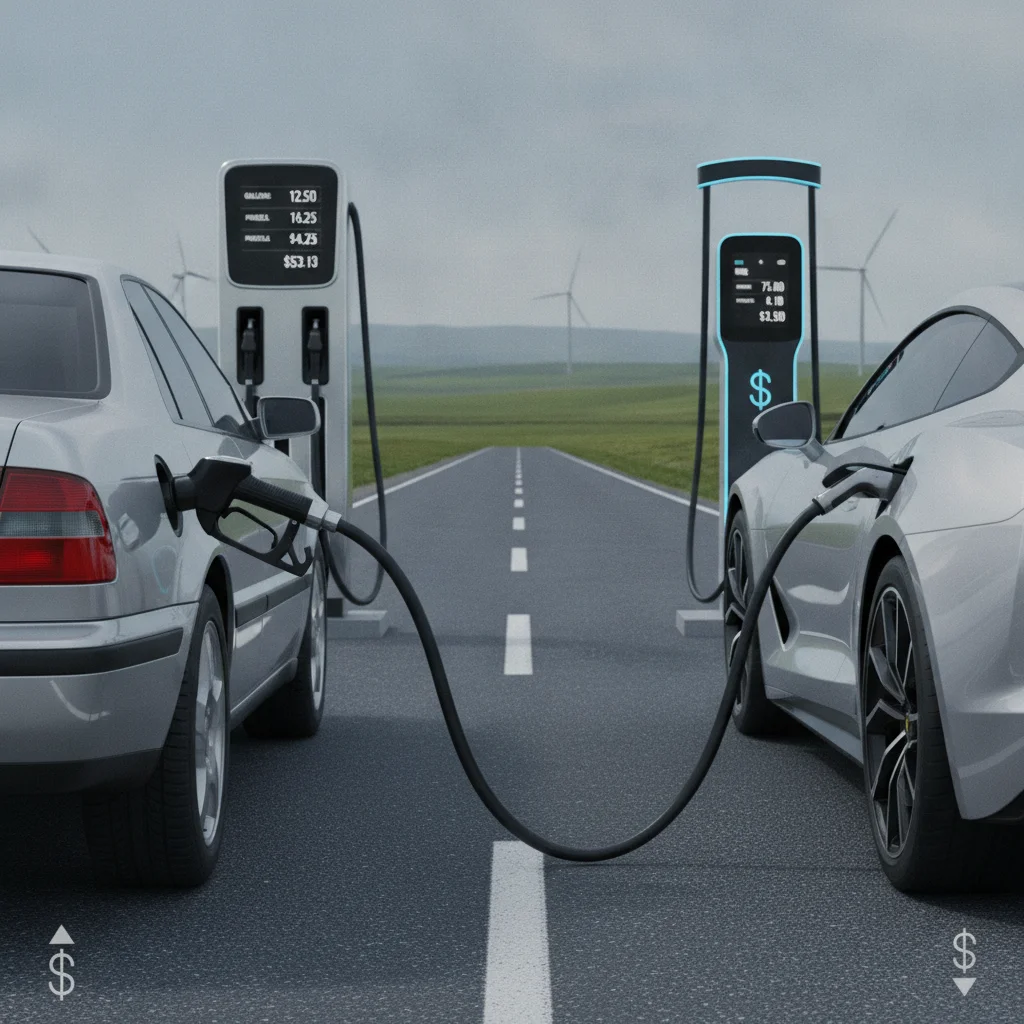
Comparing gasoline and electricity head-to-head requires a common unit. That unit is cost per mile, and arriving at it is straightforward — but only if you account for efficiency correctly. Most consumers anchor to sticker prices: dollars per gallon or cents per kilowatt-hour. Neither figure means anything without vehicle efficiency layered on top.
For a gasoline vehicle, the formula is simple:
Cost per mile = Price per gallon ÷ MPG
A car getting 30 MPG with gas at $3.60/gallon costs $0.12 per mile to fuel. Bump gas to $4.20 and that same car now costs $0.14 per mile. The relationship is direct and linear.
For an electric vehicle, the equivalent calculation uses kilowatt-hours per mile (kWh/mile) rather than miles per gallon:
Cost per mile = Price per kWh × kWh per mile
A Tesla Model 3 Long Range consuming roughly 0.25 kWh/mile, charged at the U.S. residential average of $0.16/kWh, costs $0.04 per mile. The EPA's MPGe rating can serve as a reference point, but for cost purposes, actual kWh/mile consumption — which you'll find in your car's energy display — is far more useful.
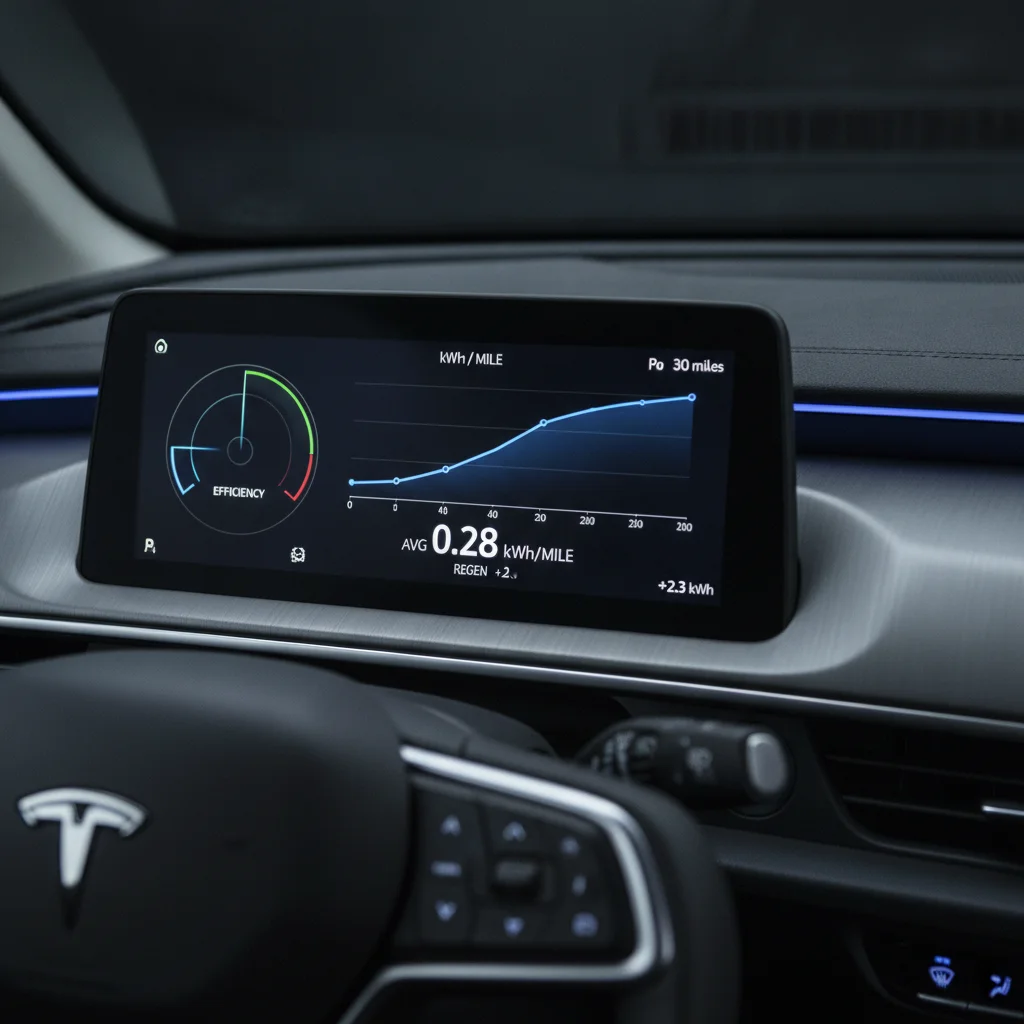
One important nuance: EVs vary significantly in efficiency. A compact sedan like a Chevy Equinox EV consumes about 0.28 kWh/mile. A performance-tuned Porsche Taycan Turbo S at speed can climb to 0.40+ kWh/mile. Just as a V8 truck's 15 MPG dwarfs a hybrid sedan's 50 MPG in cost impact, EV efficiency ranges widely and must be factored in for any honest comparison.
MPGe Is a Reference, Not a Billing Tool
The EPA's MPGe (miles per gallon equivalent) metric is designed to let consumers compare EV energy use to gas consumption on a familiar scale. It assumes 33.7 kWh equals one gallon of gasoline. It is useful for apples-to-apples efficiency rankings but does not directly tell you what you'll pay per mile — that requires your actual electricity rate and the vehicle's real-world kWh/mile consumption, both of which can be found in your car's energy display or trip computer.
Time-of-Use Rates Can Change the EV Math
Many U.S. utilities offer time-of-use (TOU) electricity plans that charge significantly lower rates during off-peak hours — often midnight to 6 a.m. In California, some TOU plans drop to $0.13/kWh overnight versus $0.35+/kWh during peak hours. EV owners who schedule overnight charging can dramatically reduce their effective per-mile electricity cost, sometimes cutting it nearly in half compared to standard residential rates. Check your utility's rate options before concluding electricity is expensive in your area.
Charging Efficiency Losses Add a Small but Real Cost
Not every kilowatt-hour you pay for at the wall makes it into your battery. Level 2 home chargers typically operate at 85–92% efficiency, meaning roughly 8–15% of the electricity consumed is lost as heat. DC fast chargers and Level 1 outlets have varying loss rates. For precise per-mile cost calculations, multiplying your kWh/mile figure by a factor of 1.10–1.15 gives a more accurate picture of actual wall electricity consumed per mile driven.
Current U.S. Averages: Setting the Baseline
As of mid-2025, the U.S. Energy Information Administration pegs the national average retail gasoline price at approximately $3.45 per gallon for regular unleaded. The U.S. Energy Information Administration places the average residential electricity rate at $0.163 per kWh. Those two numbers anchor our baseline comparison.
| Criterion | Gasoline | Electricity (Home) |
|---|---|---|
| Fuel price (U.S. average) | $3.45 per gallon | $0.163 per kWh |
| Compact sedan (30 MPG / 0.26 kWh/mi) | $0.115 per mile | $0.042 per mile |
| Midsize SUV (28 MPG / 0.30 kWh/mi) | $0.123 per mile | $0.049 per mile |
| Full-size truck (17 MPG / 0.43 kWh/mi) | $0.203 per mile | $0.070 per mile |
| Annual cost (12,000 mi, midsize SUV) | ~$1,476 | ~$588 |
| Rate volatility | High (seasonal swings) | Low (utility-regulated) |
| Cheapest charging scenario | Wholesale club stations | Home Level 2 overnight |
| Most expensive scenario | Highway premium stations | DC fast charger peak rates |
The table above makes the cost advantage of home electricity unmistakable under average conditions. But averages obscure a volatile reality. Gas prices can swing $1.00 per gallon within a single year. Electricity rates, while more stable, still vary threefold across U.S. states. A driver in Louisiana pays roughly $0.10/kWh; one in Massachusetts pays closer to $0.27/kWh; Hawaii residents face $0.36/kWh or higher.
$0.04
Average per-mile home charging cost (compact EV)
Based on U.S. average residential electricity rate of $0.163/kWh and 0.25 kWh/mile consumption (EIA, 2024).
3.4×
Gas cost multiple vs. home electricity per mile
A 28-MPG gas SUV at $3.45/gallon costs 3.4 times more per mile than the same-class EV charged at home at U.S. average rates.
40%
EV maintenance cost reduction vs. gas vehicles
Consumer Reports' 2020 analysis of owner-reported maintenance and repair costs across multiple vehicle segments.
$0.36/kWh
Hawaii average residential electricity rate
The highest in the contiguous U.S. and nearly 2.2 times the national average, compressing the EV fuel advantage significantly (EIA, 2024).
$1,600
Annual fuel savings — electric vs. gas full-size truck
Calculated at 12,000 miles annually comparing an F-150 V8 at 17 MPG/$3.45 per gallon to an F-150 Lightning at 0.43 kWh/mile/$0.163/kWh.
Regional variation matters so much that a meaningful per-mile comparison can flip outcomes entirely. A Hawaii EV owner on public charging at $0.35/kWh with an average-efficiency SUV (0.35 kWh/mile) pays $0.12 per mile — identical to what a 30-MPG gas car costs per mile at $3.60/gallon. There is no universal winner. There is only your situation.
For deeper context on what EV charging really costs once rates, efficiency, and habits combine, see The True Cost of Charging an EV: What the Math Actually Shows.
Vehicle Class Comparisons: Sedans, SUVs, and Trucks
Per-mile fuel cost varies dramatically by vehicle class regardless of powertrain. A compact gas sedan and a full-size gas pickup inhabit completely different cost universes — and the same is true for their electric equivalents. Running the numbers across three common segments clarifies where electricity saves the most.
Compact Sedans
A Toyota Camry Hybrid averaging 46 MPG at $3.45/gallon costs $0.075/mile in fuel — already impressively low. Its closest EV competitor, the Tesla Model 3 Standard Range at 0.24 kWh/mile, costs $0.039/mile on home electricity. The EV is nearly half the price per mile. However, a Camry non-hybrid at 32 MPG costs $0.108/mile — still not catastrophic, and the EV advantage is even wider.
Midsize SUVs
A Honda CR-V at 30 MPG costs $0.115/mile on gas. Its EV counterpart, a Hyundai Ioniq 5 AWD at roughly 0.30 kWh/mile, costs $0.049/mile at home rates. That's a 57% per-mile reduction. Across 12,000 annual miles, that difference amounts to approximately $792 per year in fuel savings.
Full-Size Trucks
This is where electricity's advantage becomes most dramatic. A Ford F-150 with a 5.0-liter V8 averaging 17 MPG costs $0.203/mile in fuel — over twenty cents for every mile driven. The F-150 Lightning at 0.43 kWh/mile on home power costs $0.070/mile. That is a 65% reduction, or roughly $1,600 in annual fuel savings on 12,000 miles. For high-mileage truck owners, the case for electrification is financially compelling.
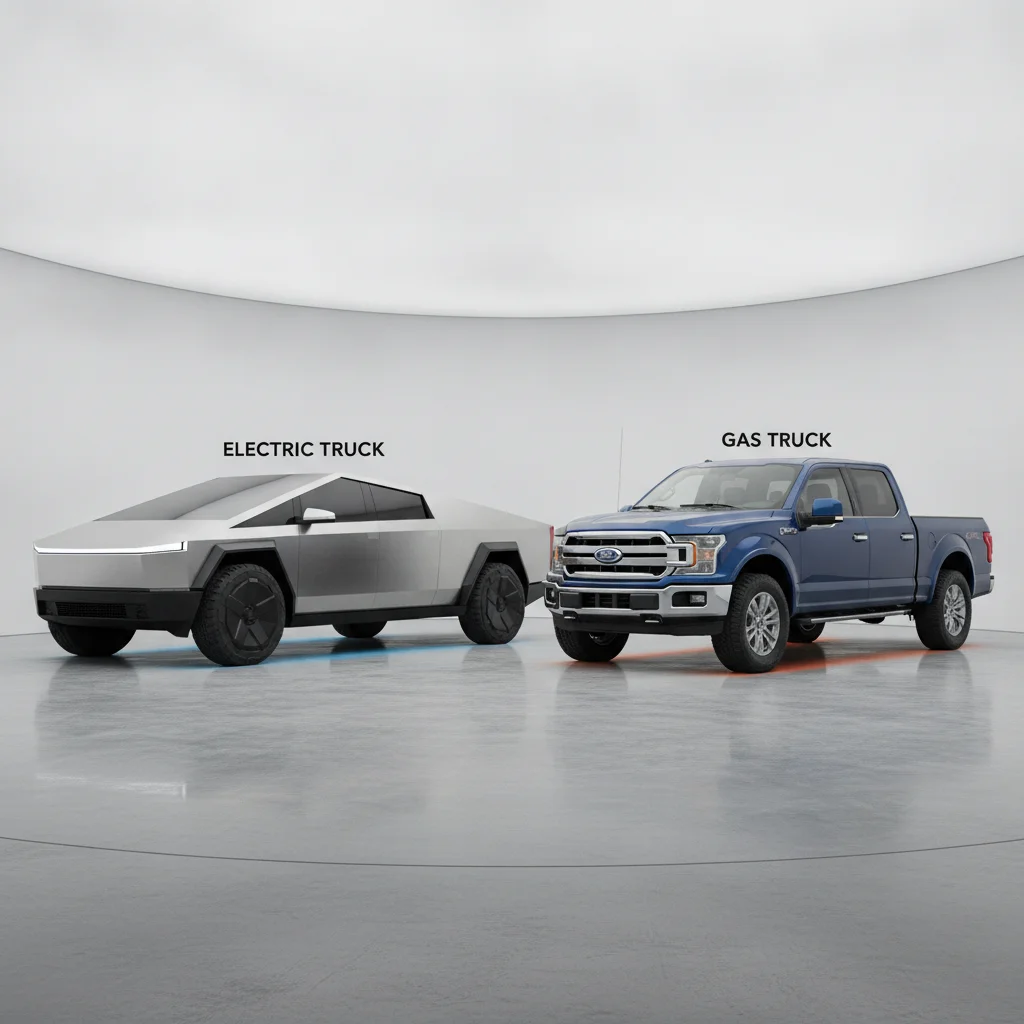
To understand how those savings scale based on your annual driving habits, High-Mileage vs. Low-Mileage Drivers: Which EV Type Saves You More breaks down the math at different usage levels.
Home Charging vs. Public Charging: The Variable That Changes Everything
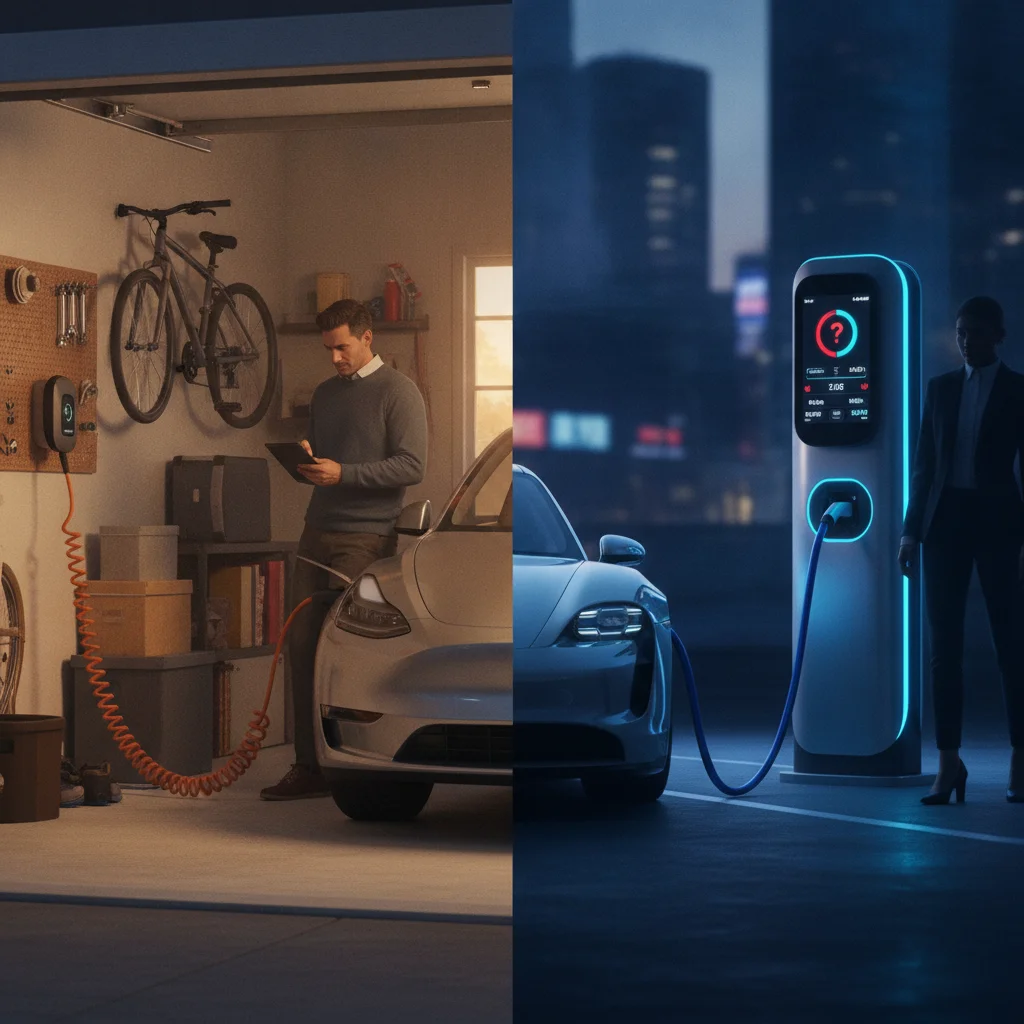
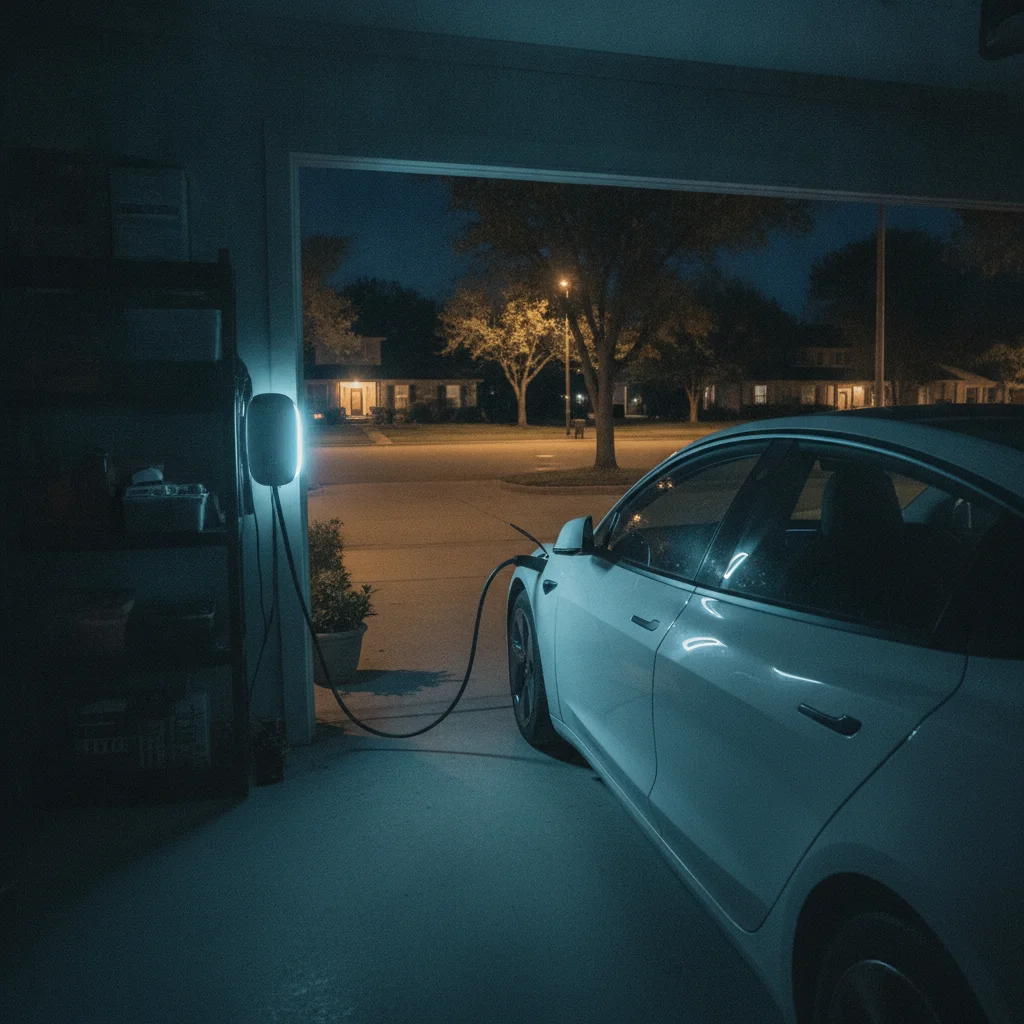
Electricity's per-mile cost advantage is not fixed — it depends heavily on where you charge. Home charging is consistently the cheapest option. Public Level 2 charging is moderate. DC fast charging is where the math can turn against EVs.
Here is how the per-mile cost stacks up across charging scenarios for a vehicle consuming 0.30 kWh/mile:
- Home Level 1 (120V): ~$0.16/kWh → $0.048/mile
- Home Level 2 (240V): ~$0.16/kWh → $0.048/mile (same rate, much faster)
- Public Level 2 (e.g., ChargePoint): ~$0.25–$0.35/kWh → $0.075–$0.105/mile
- DC Fast Charging (e.g., Electrify America): ~$0.35–$0.48/kWh → $0.105–$0.144/mile
- Tesla Supercharger (non-Tesla): ~$0.35–$0.42/kWh → $0.105–$0.126/mile
At the upper end of fast-charging rates, an EV's per-mile fuel cost matches or exceeds a 32-MPG gas car at $3.45/gallon. This is not a theoretical edge case — it's a real-world scenario for drivers who live in apartments without home charging access or who routinely take long interstate trips.
The practical implication: access to home charging is the single most important variable in determining whether electricity will save you money on fuel. Renters, condo dwellers, or anyone without a dedicated parking space should carefully model their actual charging mix before assuming EV fuel savings are inevitable.
Home Charging vs. Public Charging: Where Your Money Goes provides a detailed breakdown of exactly how each option affects your annual charging budget.
Regional Fuel Cost Maps: Where You Live Determines What You Save
The U.S. is not one energy market — it's dozens. The combination of local electricity rates and local gas prices creates dramatically different per-mile cost outcomes depending on your state. Below are four representative scenarios:
Louisiana: Strong EV Advantage
Average electricity: $0.099/kWh. Average gas: $3.10/gallon. A 0.30 kWh/mile EV on home power costs $0.030/mile. A 30-MPG gas car costs $0.103/mile. The EV is 71% cheaper per mile — the widest margin in the contiguous U.S.
Texas: Solid EV Advantage
Average electricity: $0.125/kWh. Average gas: $3.20/gallon. EV home cost: $0.038/mile. Gas car: $0.107/mile. Still over 60% cheaper per mile on electricity, aided by deregulated electricity markets that often offer competitive overnight rates.
California: Narrow EV Advantage
Average electricity: $0.268/kWh. Average gas: $4.60/gallon. EV home cost: $0.080/mile. Gas car: $0.153/mile. The EV is still meaningfully cheaper (48%), but California's high electricity rates compress the margin. Time-of-use rates — often $0.13–$0.16/kWh overnight — can widen it again for drivers who charge off-peak.
Hawaii: No Clear Winner
Average electricity: $0.360/kWh. Average gas: $4.80/gallon. EV home cost: $0.108/mile. Gas car: $0.160/mile. The EV still wins, but add public fast-charging at $0.40/kWh and you're at $0.120/mile — essentially tied with a fuel-efficient gas car. Hawaii EV owners benefit most from rooftop solar to escape retail electricity pricing.
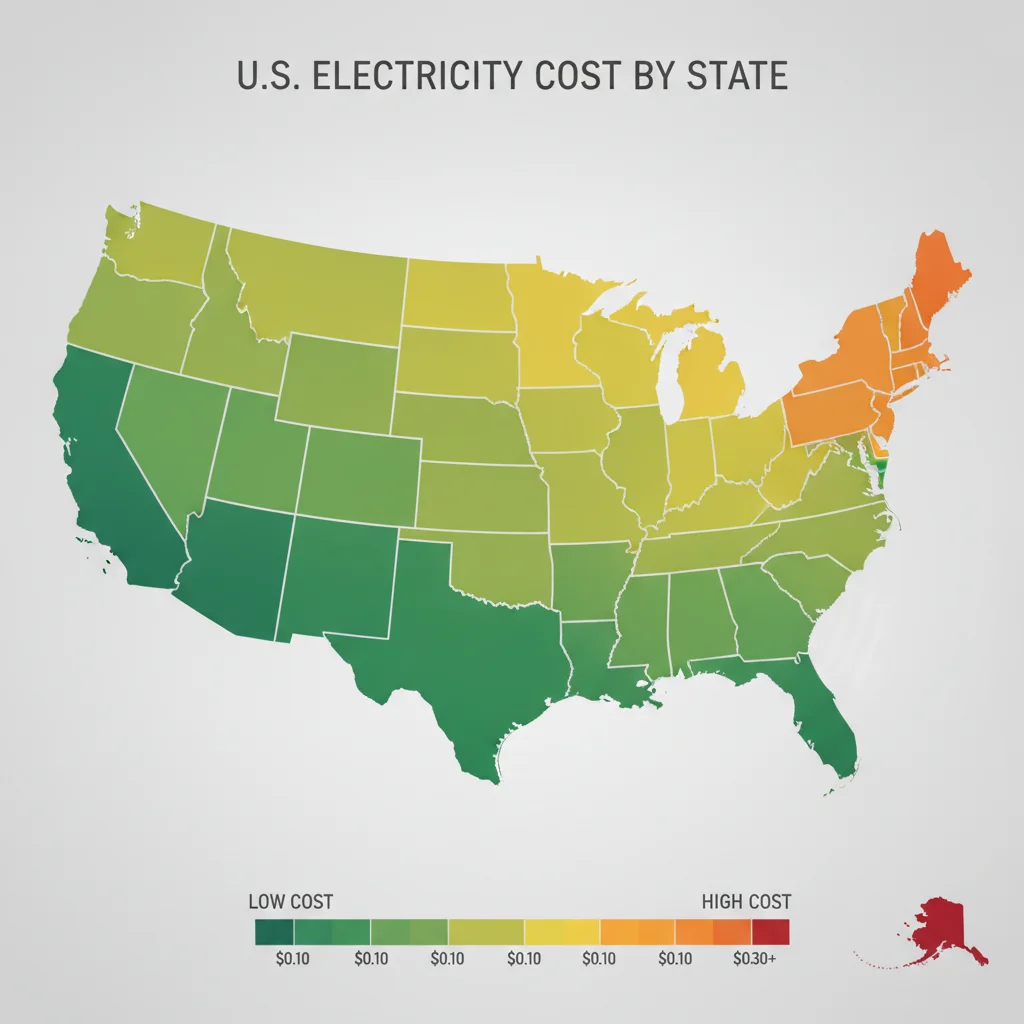
The takeaway: before assuming electricity is cheaper in your region, look up your utility's residential rate (it's on your bill) and run the formula yourself. Your local reality may look very different from the national average.
Beyond Fuel: How the Full Ownership Picture Shifts
Fuel cost is the most visible operational expense, but it doesn't exist in isolation. A complete financial comparison between gasoline and electric powertrains must account for maintenance, insurance, and depreciation — and EVs hold advantages in some of these areas too.
Maintenance Savings
EVs eliminate oil changes, transmission fluid services, spark plug replacements, and exhaust system repairs. According to a 2020 study by Consumer Reports, EV owners spend roughly 40% less on maintenance and repairs than gas car owners over the vehicle's lifetime. For a driver putting 15,000 miles per year on a vehicle, that typically translates to $600–$1,200 in annual maintenance savings on top of fuel savings. EV Maintenance vs. Gas Car Maintenance: A Full Cost and Task Breakdown covers every line item in detail.
Insurance Costs
EV insurance tends to run 10–20% higher than comparable gas vehicles, primarily because EV repair costs are elevated due to specialized parts and battery considerations. Over five years, this can offset $1,500–$3,000 of fuel and maintenance savings depending on the vehicle and insurer. Understanding how EV premiums are priced is important context for any ownership cost analysis — the EV Insurance Guide explains the key factors.
The Long-Run Fuel Picture
For those weighing a hybrid against a full EV, the fuel cost comparison shifts at different mileage thresholds. EV vs. Hybrid: Which Is Cheaper to Fuel Over 100,000 Miles? runs the long-range numbers across driving patterns and electricity rates.
The bottom line: fuel cost math strongly favors electricity in most U.S. scenarios — but only by meaningful margins when you have consistent access to home charging, your electricity rate is at or below the national average, and you drive enough miles to overcome any higher insurance costs. Model your specific inputs, and the right answer becomes clear.
All claims are backed by peer-reviewed research. Sources on request.