Key Takeaways
Why Cancellation Myths Are Expensive Mistakes
Canceling a car insurance policy sounds like a five-minute task. Call the insurer, say you're done, hang up. But the process has real financial and legal teeth — and the assumptions most drivers carry into that call are often wrong enough to cost them hundreds of dollars, or worse, leave them uninsured at exactly the wrong moment.
The myths around policy cancellation aren't just harmless misunderstandings. They shape the decisions people make during critical life transitions: selling a car, switching insurers, moving to a new state, or simply trying to lower a monthly bill. Getting those decisions wrong can trigger rate increases, coverage gaps, and even license suspensions in states with continuous coverage requirements.
Below, we break down the most persistent misconceptions about canceling car insurance — and replace them with the straight facts you need to protect yourself.
Myth
You can cancel your car insurance any time without any financial penalty.
Fact
Many insurers apply a short-rate cancellation penalty if you cancel mid-term, meaning you receive less than the pro-rata share of your unused premium.
The idea that you can walk away from a policy and get a clean, proportional refund is one of the most widely believed — and most costly — myths in auto insurance. Whether you get a full pro-rata refund or a penalized short-rate refund depends entirely on your insurer's cancellation terms, which are spelled out in your policy documents (usually buried in the fine print).
A pro-rata refund returns exactly the unused portion of your premium. If you've paid for six months and cancel halfway through, you get three months of premium back. A short-rate refund returns less than the pro-rata amount — the insurer keeps an administrative penalty, often around 10% of the unearned premium, in addition to the earned premium.
Some carriers also charge a flat cancellation fee — $25 to $50 is common — regardless of when in the policy term you cancel. The bottom line: before you cancel, call your insurer or check your declarations page to find out exactly what you'll receive back. Don't assume the refund covers what you think it does.
Myth
If you sell your car, your insurance automatically cancels.
Fact
Selling a vehicle does not trigger automatic policy cancellation — you must contact your insurer directly to end coverage or transfer it.
This myth leads to two distinct problems. The first: drivers who sold their car assume coverage ended, stop paying premiums, and end up with a lapse on their record. The second: drivers who bought a new vehicle assume the old policy somehow migrated to the new car.
Insurance policies are contracts. They don't self-terminate based on vehicle transfers. When you sell a car, the policy continues in force until either the term expires or you formally cancel it. If you've set up automatic premium payments, those continue debiting your account too.
The practical move: as soon as a sale is complete, call your insurer to cancel or adjust the policy. If you're buying a replacement vehicle immediately, ask your insurer to swap the vehicle on the policy rather than starting fresh — this typically preserves your coverage history and any applicable discounts. If there's a gap between selling and buying, talk to your agent about a non-owner policy to keep your coverage history intact.
Myth
A short coverage gap doesn't really matter — you can just restart your policy.
Fact
Even a brief lapse in coverage is recorded in insurance industry databases and can result in higher premiums for years after the fact.
Insurers don't just take your word for it when you apply for a new policy. They query industry databases — primarily CLUE (Comprehensive Loss Underwriting Exchange) and state DMV records — to verify your prior coverage history. A lapse shows up, and underwriters treat it as a risk signal.
The penalty isn't always dramatic for a lapse of a week or two, but it can be. Some carriers have hard rules: any lapse of 30 days or more within the past 12 months pushes you into a higher risk tier, sometimes adding 10% to 40% to your base rate. In states with continuous coverage requirements — Virginia, New Hampshire, and others have their own rules — a lapse can also trigger license or registration consequences.
The myth that you can simply "restart" without consequence misunderstands how insurance history works. The gap is already in the record before you pick up the phone to get a new policy. Prevention is the only real solution: never let old coverage lapse before new coverage begins.
Myth
You have to wait until your renewal date to cancel or switch insurers.
Fact
You can cancel a car insurance policy at any point during the term — you are not locked in until renewal.
This myth keeps a lot of drivers in underperforming policies longer than necessary. People find a better rate mid-term and assume they're stuck. They're not. Every standard auto insurance policy allows for mid-term cancellation by the policyholder, with reasonable notice — typically 10 to 30 days, depending on your state and insurer.
The only real cost considerations are the potential short-rate penalty (see Myth #1) and the administrative friction of switching. If a competing insurer is offering a meaningfully lower premium — say, 15% or more — the math usually still favors switching mid-term even after accounting for any cancellation fee.
The cleanest approach: get your new policy fully bound and active first, then initiate cancellation with your current insurer. Set the cancellation effective date to match the new policy's start date. That eliminates any gap and gives you a clean transition. Don't wait for a renewal date that's months away if the savings are available now.
Myth
Canceling your insurance has no effect on your future rates.
Fact
Voluntary cancellation followed by a coverage gap directly affects your risk profile and can raise rates with your next insurer.
There's an important nuance here. A voluntary cancellation with no gap — where new coverage picks up immediately — generally doesn't damage your insurability. The issue is that most people who cancel don't have new coverage lined up, and that gap is the problem, not the cancellation itself.
But even in cases where there's no gap, some insurers view frequent policy switching as a soft negative signal. Loyalty, in the insurance world, has actuarial value — long-tenured customers with the same carrier tend to be lower risk by some metrics, and carriers price for that through tenure discounts. Frequent cancellations and restarts can forfeit those discounts over time.
The practical implication: switching insurers to save money is absolutely worth doing when the numbers are right. Just do it deliberately, with overlap rather than gaps, and don't make a habit of churning policies every few months for marginal savings. The rate history you build with a carrier over several years has real monetary value.
Myth
Your insurer can cancel your policy at any time for any reason.
Fact
After the initial binding period — typically 60 days — state laws strictly limit the grounds on which an insurer can cancel your policy mid-term.
This myth runs in the opposite direction from most — it makes drivers feel more vulnerable than they actually are. The reality is that once you're past the initial underwriting window (usually the first 60 days of a new policy), you have significant legal protection against arbitrary mid-term cancellation.
State insurance codes require that mid-term cancellations by the insurer be based on specific, legally recognized grounds: nonpayment of premium, material misrepresentation on the application, suspension or revocation of your driver's license, or fraud. Some states allow additional grounds, such as a DUI conviction or certain medical conditions. But "we've decided we don't want to insure you anymore" is not a valid mid-term cancellation reason in any U.S. state after that initial period.
Insurers who want to exit a customer relationship they've grown uncomfortable with typically do so at renewal, through non-renewal. That's a separate process with its own notice requirements and implications. Knowing the difference — and knowing your rights — matters if you ever receive a cancellation notice. The full rundown of legal mid-term cancellation triggers explains exactly what your insurer can and can't do.
Myth
Canceling and getting a new policy with the same insurer is the same as keeping your existing policy.
Fact
Canceling and restarting — even with the same carrier — can reset your loyalty discounts, tenure rating factors, and sometimes your deductible options.
Some drivers cancel their policy hoping to renegotiate better terms, then plan to re-enroll with the same insurer. What they don't realize is that most carriers treat the new policy as a fresh account — the loyalty discount that built up over three or five years is gone, any tenure-based rate reductions reset to zero, and the new application goes through underwriting as if you're a brand-new customer.
In some cases, canceling and restarting can also remove you from a grandfathered rate tier that's no longer available to new customers. Insurance pricing changes frequently, and a rate tier you're currently in may be better than anything currently on offer for new policies.
If you're trying to lower your premium with your current insurer, a direct negotiation — asking for a loyalty discount, bundling home and auto, raising your deductible, or taking a defensive driving credit — is almost always preferable to the cancel-and-restart approach. Cancellation should be reserved for situations where switching to a genuinely different carrier offers a real, documented advantage.

The Real Risks of a Coverage Gap
Even a brief lapse in coverage — a single day without an active auto policy — creates a paper trail that follows you. Insurers check prior coverage history when you apply for a new policy, and a gap is a yellow flag that often translates directly into higher premiums.
10–40%
Premium increase after a coverage lapse
Drivers with a gap in coverage of 30 days or more often face this premium penalty range when applying with a new insurer, according to industry underwriting data.
67%
Drivers unaware of short-rate cancellation fees
A 2022 J.D. Power survey found most policyholders don't review cancellation terms before initiating a mid-term cancellation, leading to unexpected out-of-pocket costs.
60 days
Standard insurer underwriting window
Most state laws allow insurers to cancel a new policy for any reason within the first 60 days; after that, cancellation grounds are legally restricted.
$150–$400
Average annual penalty for a prior lapse
Insurance industry rate filings reviewed by the Consumer Federation of America show this is the typical added annual cost for drivers re-entering the market after a lapse.
The financial hit from a coverage gap isn't theoretical. A 2023 analysis by the Consumer Federation of America found that drivers with even a 30-day lapse paid meaningfully higher premiums when they re-entered the market, with the penalty varying by state and insurer. Some carriers classify a lapse of 30 days or more as a major rating factor, similar to an at-fault accident.
The underlying logic from the insurer's perspective: a driver who let coverage lapse — even voluntarily — is statistically more likely to file a claim or have an undisclosed gap in their driving history. Whether that logic is fair to you personally is beside the point. What matters is that it's baked into their underwriting models.
Force-Placed Insurance Is Costly and Covers Very Little
If you have a financed vehicle and cancel your insurance without notifying your lender, your lender will purchase a force-placed policy — also called collateral protection insurance — and charge you for it. These policies typically cost two to ten times the market rate and only protect the lender's financial interest, not yours. You'd still be uninsured for liability and collision claims. Always secure replacement coverage and notify your lienholder before canceling.
State Continuous Coverage Laws Can Trigger License Suspension
Several states require proof of continuous auto insurance coverage to maintain a valid vehicle registration. Canceling your policy — even temporarily — in one of these states can trigger an automatic registration suspension and, in some cases, a driver's license suspension. Reinstatement often requires a fee and a new SR-22 filing. Check your state's specific rules before you cancel.
Don't Rely on a Phone Confirmation Alone
Verbal cancellation confirmations over the phone can be misrouted, misdated, or misrecorded. If your insurer's records show a different cancellation date than you intended, you could face a premium charge or — worse — find out you were never actually canceled when you thought you were. Always request written confirmation with the exact effective cancellation date before considering the matter closed.
If you're between cars, traveling abroad, or simply trying to reduce costs, there are smarter options than canceling outright. A reduced-coverage policy, a named non-owner policy, or even a short suspension of coverage (where state law allows) can preserve your insurance history while lowering your costs. See our guide to canceling without gaps for a step-by-step approach.
Cancellation vs. Non-Renewal: Two Very Different Outcomes
A lot of drivers use the terms "cancellation" and "non-renewal" interchangeably. They're not the same thing, and the distinction matters — both for your rights as a policyholder and for how future insurers view your history.
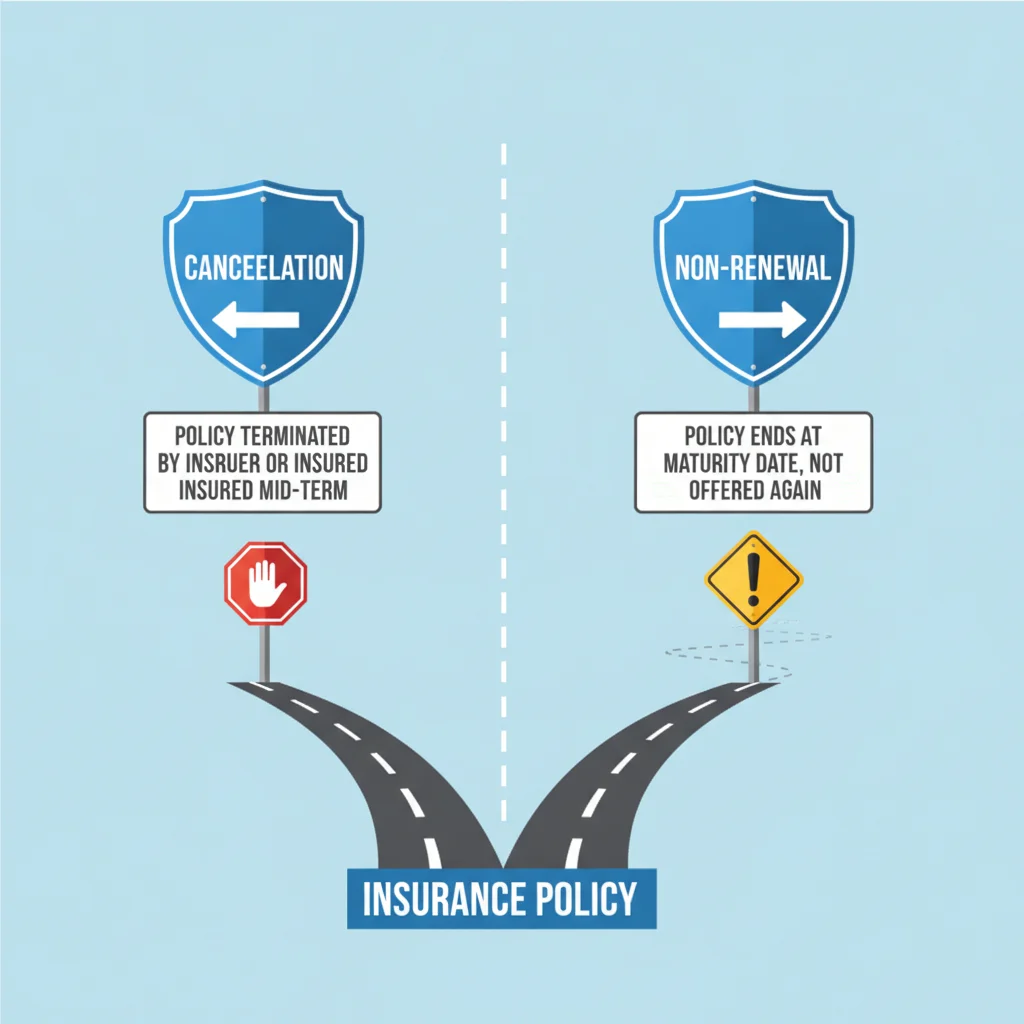
Cancellation means the policy is terminated before its expiration date. It can be initiated by you or by the insurer. When an insurer cancels mid-term, state law typically requires advance written notice — often 10 to 30 days — and limits the valid reasons for doing so after the policy's initial binding period (usually the first 60 days). After that window, most states restrict mid-term cancellations to specific causes: nonpayment, fraud, license suspension, or material misrepresentation.
Non-renewal means the insurer simply declines to offer you a new policy when your current term ends. It requires longer advance notice in most states (often 30 to 60 days) and doesn't carry the same stigma as a mid-term cancellation. From an underwriting standpoint, a non-renewal on your record is less damaging than a cancellation for cause.
When you initiate the cancellation yourself — say, because you're switching carriers — it's recorded as a voluntary cancellation and generally has no negative mark on your insurance record, provided there's no gap. The full breakdown of cancellation vs. non-renewal is worth reading before you make any move with your current insurer.
An Insurer-Initiated Cancellation for Cause Follows You
If your insurer cancels your policy mid-term for cause — fraud, misrepresentation, or a DUI — it appears in the CLUE database and is visible to future insurers for up to seven years. Many standard-market carriers will decline to write a policy for drivers with a for-cause cancellation on record. You may be forced into the non-standard market, where premiums can be double or triple what you paid before. If you receive a cancellation notice, consult your state's insurance commissioner office about your rights before the effective date passes.
Never Assume Non-Renewal and Cancellation Are Interchangeable
A non-renewal at term end is far less damaging to your insurability than a mid-term cancellation for cause. If your insurer notifies you of non-renewal, you typically have 30 to 60 days to shop for a replacement policy under normal market conditions. A mid-term cancellation for cause can shrink that window dramatically and limit your carrier options. Understanding which process is happening — and why — determines how urgently you need to act and what documentation you should gather.
What to Do Before You Cancel
The single most protective step you can take before canceling is to have your replacement policy already active. Not in progress. Not approved pending payment. Active. The new policy effective date should be the same day — ideally the same hour — as your cancellation date on the old one.
Beyond timing, here's a practical checklist worth running through before you notify your current insurer:
- Compare actual total costs, not just premiums. A lower monthly payment with a higher deductible may not be a better deal after you account for the coverage difference. See how the numbers stack up against common myths about cheaper auto insurance before you commit.
- Check for cancellation fees. Review your declarations page or call your insurer to ask directly. Some carriers charge a flat fee; others use short-rate calculation. Know which applies to you.
- Confirm your refund timeline. Refunds for prepaid premiums typically arrive within 2 to 4 weeks, but it varies. Get it in writing if possible.
- Notify your lender if you have a financed vehicle. Your lienholder is a named interested party on your policy. Canceling without notifying them — and ensuring the new policy lists them — can trigger force-placed insurance, which is expensive and provides you minimal actual protection.
- Request written confirmation of cancellation. Don't rely on a verbal confirmation over the phone. Get an email or letter that includes the exact cancellation date and any refund amount owed.
Also consider the discounts you might be leaving behind. Loyalty discounts, multi-policy bundles, and pay-in-full discounts can offset a competitor's lower base rate. Check the full list of common discounts to make sure you're comparing apples to apples on your new quote.

When Your Insurer Cancels You — and What That Means
Most drivers think about cancellation as something they initiate. But insurers can cancel you, too — and the scenarios that trigger it are worth understanding because they can happen without warning.
The most common causes of insurer-initiated mid-term cancellation are nonpayment of premium, a discovered misrepresentation on the application, a DUI or major traffic conviction, and — in some states — a medical condition that impairs driving ability. After the initial 60-day binding period, most state insurance codes restrict insurers to these specific grounds, so a carrier can't simply drop you mid-term because you filed a claim.
What happens after an insurer cancels you for cause is more serious than a voluntary cancellation. Future insurers will see it, and some carriers won't write a policy for a driver with a for-cause cancellation on record within the past three to five years. You may end up in the non-standard market, paying significantly higher premiums. For a detailed look at the specific legal grounds insurers can use, the article on when insurers can legally cancel mid-term covers each trigger and your response options.
An Insurer-Initiated Cancellation for Cause Follows You
If your insurer cancels your policy mid-term for cause — fraud, misrepresentation, or a DUI — it appears in the CLUE database and is visible to future insurers for up to seven years. Many standard-market carriers will decline to write a policy for drivers with a for-cause cancellation on record. You may be forced into the non-standard market, where premiums can be double or triple what you paid before. If you receive a cancellation notice, consult your state's insurance commissioner office about your rights before the effective date passes.
Never Assume Non-Renewal and Cancellation Are Interchangeable
A non-renewal at term end is far less damaging to your insurability than a mid-term cancellation for cause. If your insurer notifies you of non-renewal, you typically have 30 to 60 days to shop for a replacement policy under normal market conditions. A mid-term cancellation for cause can shrink that window dramatically and limit your carrier options. Understanding which process is happening — and why — determines how urgently you need to act and what documentation you should gather.
If you receive a cancellation notice from your insurer, act immediately. You typically have the right to appeal within a short window, and in some cases — particularly for nonpayment — you can reinstate the policy by curing the default before the cancellation date. Don't assume you have more time than you do.

Bottom Line: Treat Cancellation Like a Financial Transaction
Canceling car insurance is not an administrative formality. It's a financial decision with downstream consequences that can follow you for years. The myths covered here persist because they feel intuitive — of course selling your car ends the policy, of course you can cancel and restart without penalty. But insurance doesn't work on common sense; it works on contracts and actuarial tables.
The drivers who come out ahead are the ones who treat a policy change the way they'd treat refinancing a loan or switching bank accounts: with documentation, timing, and a clear picture of what the transition actually costs. That means having new coverage locked in before you cancel the old, understanding your refund rights, and knowing whether the insurer or the state has any rules that apply specifically to your situation.
For a deeper look at related misconceptions that could affect your premiums and coverage decisions, the articles on auto insurance myths that hurt claim outcomes and discount myths that cost drivers money are worth your time. And if you're in the market for a used vehicle where insurance cost is part of the equation, don't miss the used car myths that cost buyers real money piece — some of those misconceptions directly intersect with coverage decisions.

All claims are backed by peer-reviewed research. Sources on request.