
Key Takeaways
Option A
Policy Cancellation
The mid-term termination with strict legal triggers.
Best for: Understanding what happens when a policy ends before its natural expiration date — either by you or your insurer.
Option B
Non-Renewal
The end-of-term exit that carries fewer restrictions.
Best for: Understanding what happens when an insurer or policyholder decides not to continue coverage when the current policy term expires.
If your insurer stops your coverage unexpectedly mid-term
Policy Cancellation
This is what you're dealing with — and you need to act fast. Know your state's notice requirements and your right to dispute before scrambling for new coverage.
If you receive a letter saying your insurer won't continue coverage at renewal
Non-Renewal
You have more time and options here. Use the notice period to shop for a replacement policy and avoid any gap in coverage.
If you want to switch insurers before your policy ends
Policy Cancellation
You're initiating a voluntary cancellation. Understand whether a short-rate penalty applies and line up your new policy first to avoid a coverage gap.
If you're trying to understand how either event affects your insurance record
Policy Cancellation
An insurer-initiated mid-term cancellation — especially for nonpayment or fraud — has a stronger negative effect on future insurability than a simple non-renewal.
If you received a non-renewal notice and want to know your options
Non-Renewal
You have time to shop, dispute the decision in some states, and transition cleanly to a new carrier without the urgency that a mid-term cancellation demands.
Why the Distinction Matters More Than You Think
Most drivers treat the words "cancellation" and "non-renewal" as interchangeable. They're not — and conflating them can leave you scrambling for coverage, paying higher premiums, or missing a window to dispute your insurer's decision.
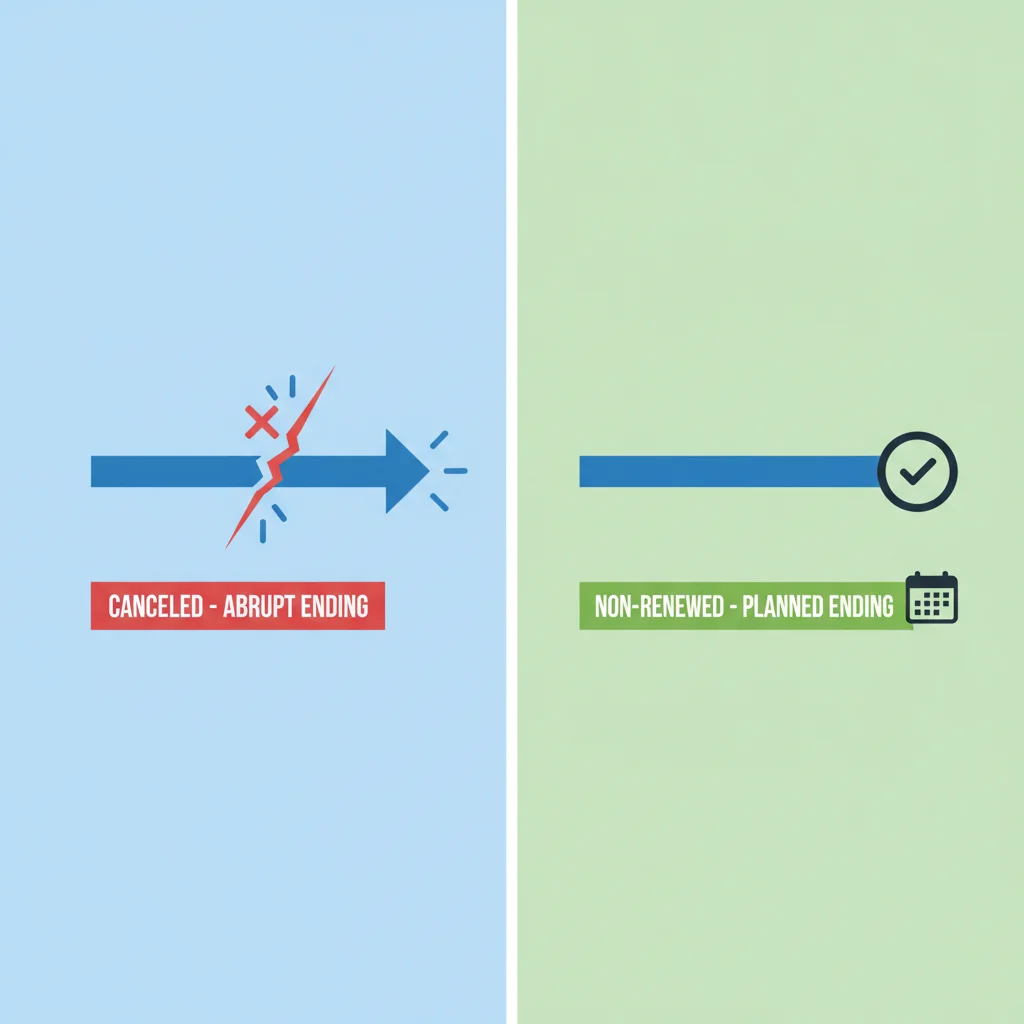
At the core, cancellation is the termination of an active policy before its scheduled expiration date. Non-renewal is the decision — by you or your insurer — not to continue the policy once the current term ends. Same result (no more coverage), but completely different legal frameworks, timelines, and consequences.
Understanding which situation you're in determines what you can do next, how much time you have, and what it means for your insurance record. This article breaks both down so you can navigate either one with a clear head.
It's also worth noting that similar terminology appears across other areas of driving law. For example, the difference between a license suspension and a revocation is just as meaningful — see our breakdown of suspension vs. revocation for context on how legal distinctions shape your options and timeline.
Policy Cancellation: What It Is and When It Happens
A policy cancellation ends your auto insurance coverage before the policy term expires. There are two types: voluntary cancellation (you initiate it) and insurer-initiated cancellation (your insurance company does).
Voluntary Cancellation
You have the right to cancel your policy at any time. Common reasons include switching to a new insurer, selling your vehicle, or relocating to a state where your carrier doesn't operate. When you cancel voluntarily, you're generally entitled to a refund of unused premium — but the method matters. If your insurer uses a pro-rata calculation, you get back exactly the unused portion. If they use a short-rate calculation, they keep a small penalty for the early termination. Always ask which method applies before you cancel.
See our guide on canceling a policy without gaps in coverage for the exact steps to do this cleanly.
Insurer-Initiated Cancellation
This is where it gets more consequential. Your insurer can cancel your policy mid-term, but most states impose strict limits on when they can do so and why. Generally speaking, after a policy has been in force for 60 days, insurers can only cancel for a narrow set of reasons:
- Nonpayment of premium — the most common trigger by far
- Material misrepresentation or fraud on the application
- Suspension or revocation of your driver's license
- Loss of driving privileges by any household member listed on the policy
Within the first 60 days of a new policy, insurers typically have broader latitude to cancel — this is often called the "underwriting period," during which the insurer is still assessing whether to accept the risk.
The 60-Day Underwriting Window
During the first 60 days of a new auto insurance policy, most states allow insurers to cancel for virtually any reason with proper notice. This is the underwriting period — insurers are still evaluating whether the risk is acceptable. After day 60, the legal grounds for cancellation narrow significantly. If you've recently started a new policy, be especially careful to make your first payment on time and ensure all application information is accurate.
State Law Governs the Details
The rules around cancellation and non-renewal are not federal — they're set at the state level. Required notice periods, acceptable cancellation reasons, and dispute rights all vary by state. If you receive a cancellation or non-renewal notice, your state's Department of Insurance website is the definitive source for what rules apply to your situation. Most state DOI websites have consumer complaint portals if you believe the insurer acted improperly.
Cancellation for Nonpayment Is More Common Than You Think
Nonpayment is by far the leading cause of mid-term policy cancellations in the U.S. Many drivers assume they have a grace period built in — and while some insurers offer one, it is not guaranteed and varies by carrier and state. Setting up autopay for your premium is one of the simplest ways to eliminate cancellation risk entirely. Check whether your insurer offers a discount for autopay enrollment, as many do.
For a full breakdown of what legally permits your insurer to end your coverage mid-term, read our article on when insurers can legally cancel your policy.
Non-Renewal: What It Is and How It Differs
Non-renewal is simpler in concept but no less important in practice. When a policy term ends — typically after 6 or 12 months — both you and your insurer have the right to walk away. If your insurer chooses not to offer you another term, that's a non-renewal.
Insurer Non-Renewal
Unlike mid-term cancellation, insurers have considerably more discretion to non-renew a policy. They don't need to meet the same narrow criteria. Common reasons for insurer non-renewal include:
- Too many at-fault accidents or claims over the policy period
- Multiple traffic violations or a DUI conviction
- The insurer exiting your state or coverage area entirely
- Underwriting strategy changes (e.g., the company decides to stop writing certain vehicle types or driver profiles)
- Your home territory being reclassified as too high-risk
Crucially, insurers must still provide advance written notice — most states require 30 to 60 days before the expiration date. This gives you a meaningful window to find replacement coverage.
If your policy renews automatically and you haven't been paying attention, you could easily miss a non-renewal notice buried in your inbox. Our article on understanding automatic renewal explains exactly what to watch for.

Policyholder Non-Renewal
You can also choose not to renew. This is effectively the cleanest way to exit a policy — there are no short-rate penalties, no mid-term complications. You simply don't accept the renewal terms. That said, you still need to have your next policy in place before the old one expires. A single day without coverage can have real consequences, from legal exposure to higher premiums on your next application.
Side-by-Side Comparison
The table below captures the key structural differences between a policy cancellation and a non-renewal. These distinctions vary somewhat by state, but the broad framework holds across most of the U.S.
| Criterion | Policy Cancellation | Non-Renewal |
|---|---|---|
| When it occurs | Mid-term, before policy expires | At the end of the policy term |
| Who can initiate | Policyholder or insurer | Policyholder or insurer |
| Insurer restrictions | Strict — limited legal grounds after 60 days | Broader discretion for insurers |
| Required notice (insurer) | 10–45 days depending on reason and state | Typically 30–60 days before expiration |
| Premium refund | Pro-rata or short-rate (if you cancel) | No refund — term already ended |
| Impact on insurance record | Higher — especially for nonpayment or fraud | Lower — but still disclosed to future insurers |
| Common insurer reasons | Nonpayment, fraud, license suspension | Too many claims, violations, market exit |
| Policyholder penalty | Possible short-rate fee if self-initiated | None if you choose not to renew |
| Risk of coverage gap | High — requires immediate action | Moderate — notice period provides time to shop |
60 days
Insurer grace window before stricter cancellation rules apply
Most U.S. states restrict mid-term cancellation to specific causes after the first 60 days of a new policy's effective date.
30–60 days
Typical advance notice required for non-renewal
State insurance regulations generally require insurers to provide written non-renewal notice 30 to 60 days before the policy expiration date.
~13%
U.S. drivers estimated to have a coverage lapse each year
Industry data suggests roughly one in eight drivers experiences at least a brief lapse in auto insurance coverage annually, often tied to cancellation or non-renewal events.
Up to 35%
Premium increase after a coverage lapse
Drivers who allow their policy to lapse — even briefly — may face premium surcharges of 20–35% when applying for a new policy, according to consumer insurance rate analyses.
One common misconception is that if you've never filed a claim, your insurer will always renew you. That's not guaranteed — insurers can non-renew based on changes to your risk profile, shifts in their business strategy, or even your credit history in states that allow credit-based insurance scoring. Don't assume good behavior means automatic continuity.
For more on how these decisions are made, and what myths surround cancellation in particular, see our piece on myths about canceling car insurance.
Impact on Your Insurance Record and Future Premiums
Both cancellations and non-renewals show up in your insurance history, but they don't carry equal weight.
Insurer-Initiated Cancellation
A mid-term cancellation — particularly for nonpayment or fraud — is the more damaging mark. Future insurers will ask whether you've ever had a policy cancelled, and an affirmative answer raises an immediate red flag. You may be forced into a nonstandard or high-risk insurance market, where premiums are substantially higher. Some standard insurers may decline to quote you at all for a period.
Non-Renewal
A non-renewal, while still worth disclosing on applications, typically carries less stigma — especially if the insurer was the one who chose not to continue. It signals to future carriers that your prior insurer reassessed the risk, not that you defaulted on obligations or committed misrepresentation. You'll still need to explain it, and multiple non-renewals in a short window will raise questions, but a single non-renewal doesn't automatically push you into the high-risk pool.
The Coverage Gap Problem
Regardless of whether it's a cancellation or non-renewal, the real financial danger is a lapse in coverage. Even a brief gap can:
- Trigger higher premiums on your next policy
- Expose you to personal liability for any accidents during the gap
- Put you in violation of state minimum coverage laws
- Cause your lender to force-place expensive insurance on a financed vehicle
The mechanics of avoiding those gaps are different depending on which situation you're in — that's covered in our guide on avoiding coverage gaps when canceling.
What to Do When Either One Happens
Your action plan is different depending on which situation applies.
If Your Policy Is Cancelled Mid-Term by Your Insurer
- Verify the reason in writing. Insurers are required to state the reason on the cancellation notice. Get it in writing if it wasn't provided.
- Check the notice period. In most states, you're entitled to at least 10 days' notice for nonpayment and 20–45 days for other reasons. If your insurer didn't comply, you may have grounds to dispute.
- Resolve the underlying issue if possible. If it's a nonpayment cancellation, many insurers will reinstate the policy if you pay the overdue balance within the notice period.
- Start shopping immediately. Don't wait until the cancellation date. Use the remaining days to compare quotes and secure a new policy before coverage lapses.
If You Receive a Non-Renewal Notice
- Note the effective date. You typically have 30–60 days. Use that full window to compare alternatives.
- Ask your insurer for the reason. Many states require insurers to provide one upon request. Knowing the reason helps you anticipate how other insurers will view your application.
- Shop your current profile. If the non-renewal is driven by your risk profile (claims, violations), be upfront with prospective carriers. Getting declined repeatedly because you weren't transparent is worse than the non-renewal itself.
- Consider your timing carefully. If you're weighing switching insurers at renewal vs. mid-policy anyway, see our comparison of switching at renewal vs. mid-policy to understand the financial trade-offs.
In either scenario, the moment you have a new policy in place, make sure your old one doesn't overlap unnecessarily — paying two premiums simultaneously is waste. But never cancel the old policy before the new one is confirmed active. Sequence matters.
If you're in the market for new coverage, it's also a smart moment to revisit your actual coverage needs. Our hub on comparing policies walks through how to evaluate quotes side by side without leaving critical coverage off the table.

All claims are backed by peer-reviewed research. Sources on request.