Key Takeaways
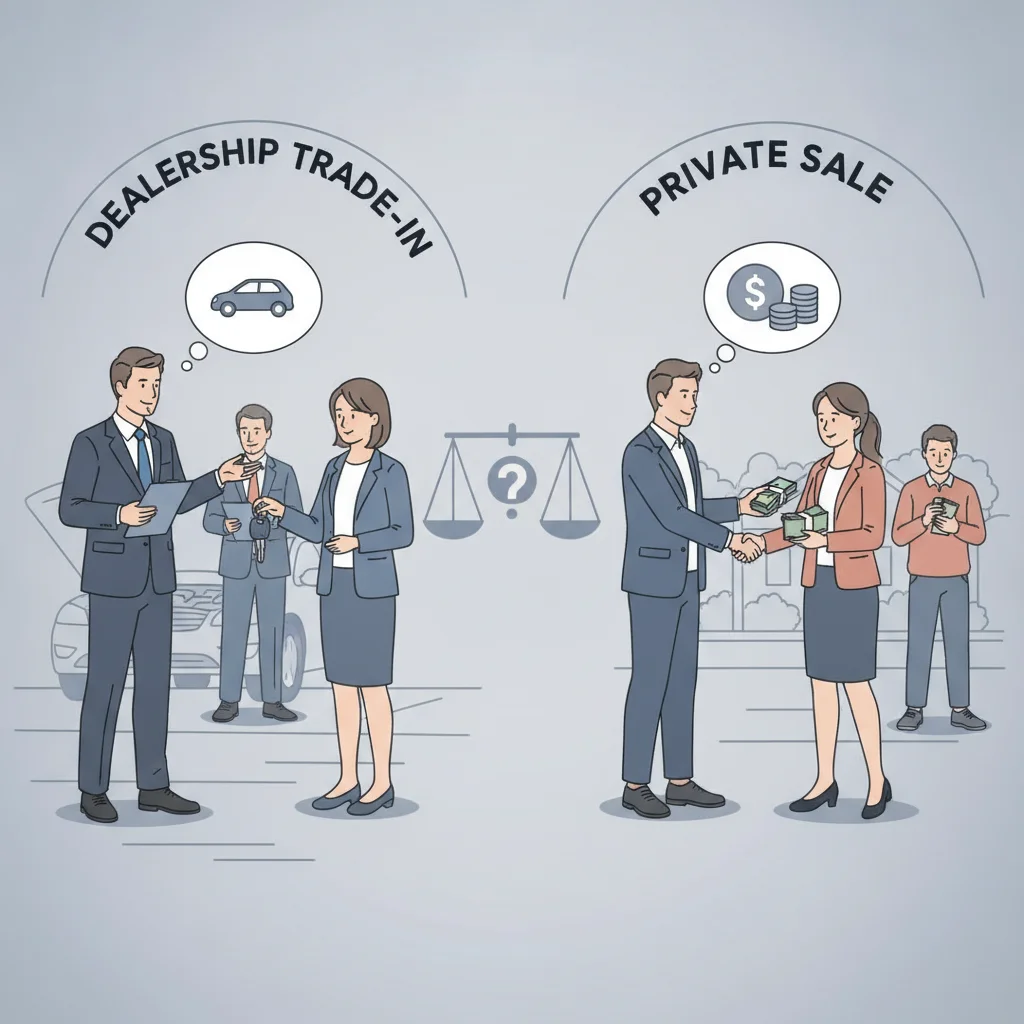
Option A
Trade-In Value
The convenient, discounted exit strategy.
Best for: Sellers who want to close the deal fast and roll equity directly into a new vehicle purchase.
Option B
Private Sale Price
The higher-effort, higher-return option.
Best for: Sellers willing to invest time in listing, negotiating, and transferring title in exchange for significantly more money.
If you're buying your next car at the same dealership
Trade-In Value
Rolling the trade into the purchase simplifies financing and can reduce sales tax on the new vehicle in most states, partially offsetting the lower offer price.
If your car is in excellent condition with high private-market demand
Private Sale Price
Well-maintained, popular vehicles command premiums from private buyers that a dealer will never match — the extra effort pays off substantially.
If your car has high mileage, mechanical issues, or cosmetic damage
Trade-In Value
Problem vehicles are hard to sell privately without deep discounting, and dealer trade-ins are often the path of least resistance for high-risk inventory.
If you need money quickly and aren't buying another car right away
Private Sale Price
Instant cash offers from platforms like CarMax, Carvana, or KBB Instant Cash Offer can bridge the speed gap while still beating most dealer trade-in figures.
If you want to avoid the hassle of buyers, test drives, and title transfers
Trade-In Value
The convenience premium you pay a dealer is real, but for sellers who value time over money, the tradeoff is often worth it.
Why the Numbers Are Never the Same
If you've ever punched your car into Kelley Blue Book or Edmunds and seen two different numbers — trade-in value and private party value — you already know there's a gap. What most sellers don't understand is where that gap goes. It doesn't evaporate. It transfers directly into a dealer's gross profit.
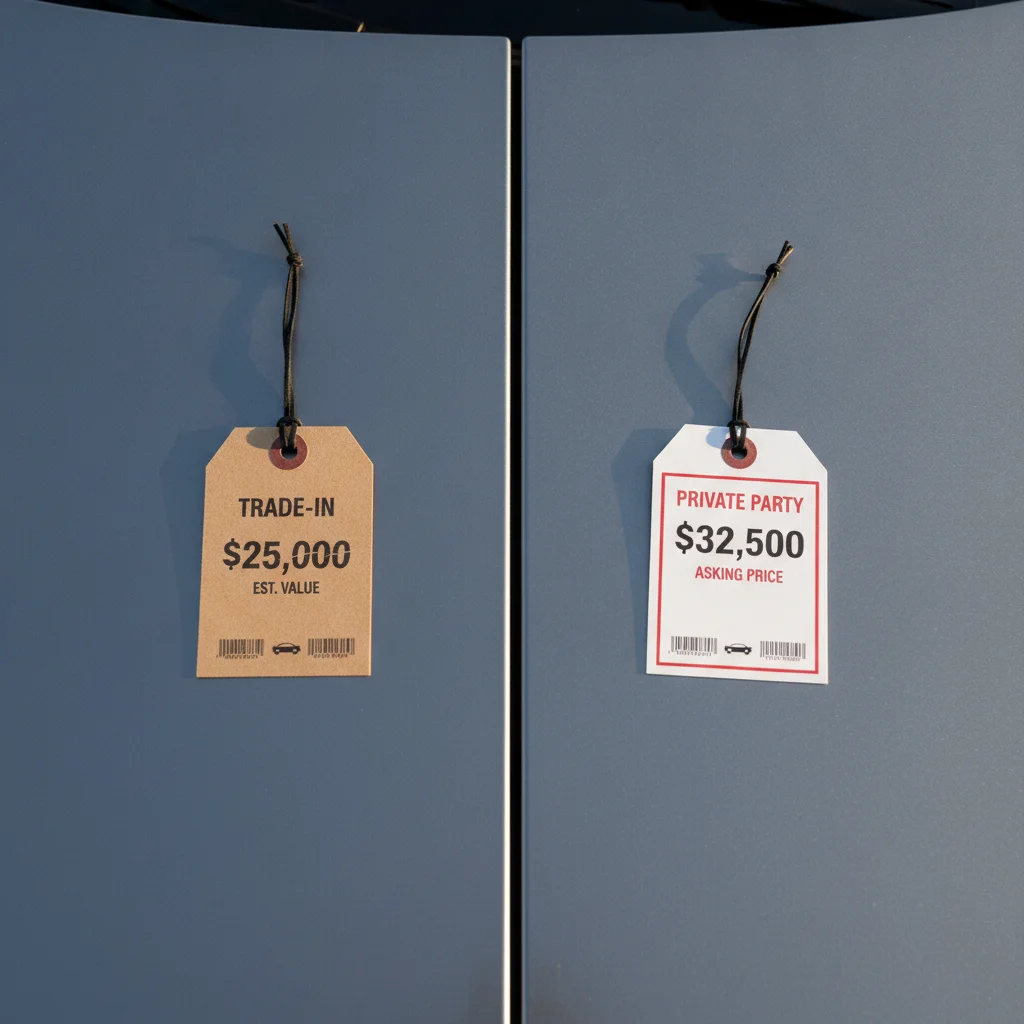
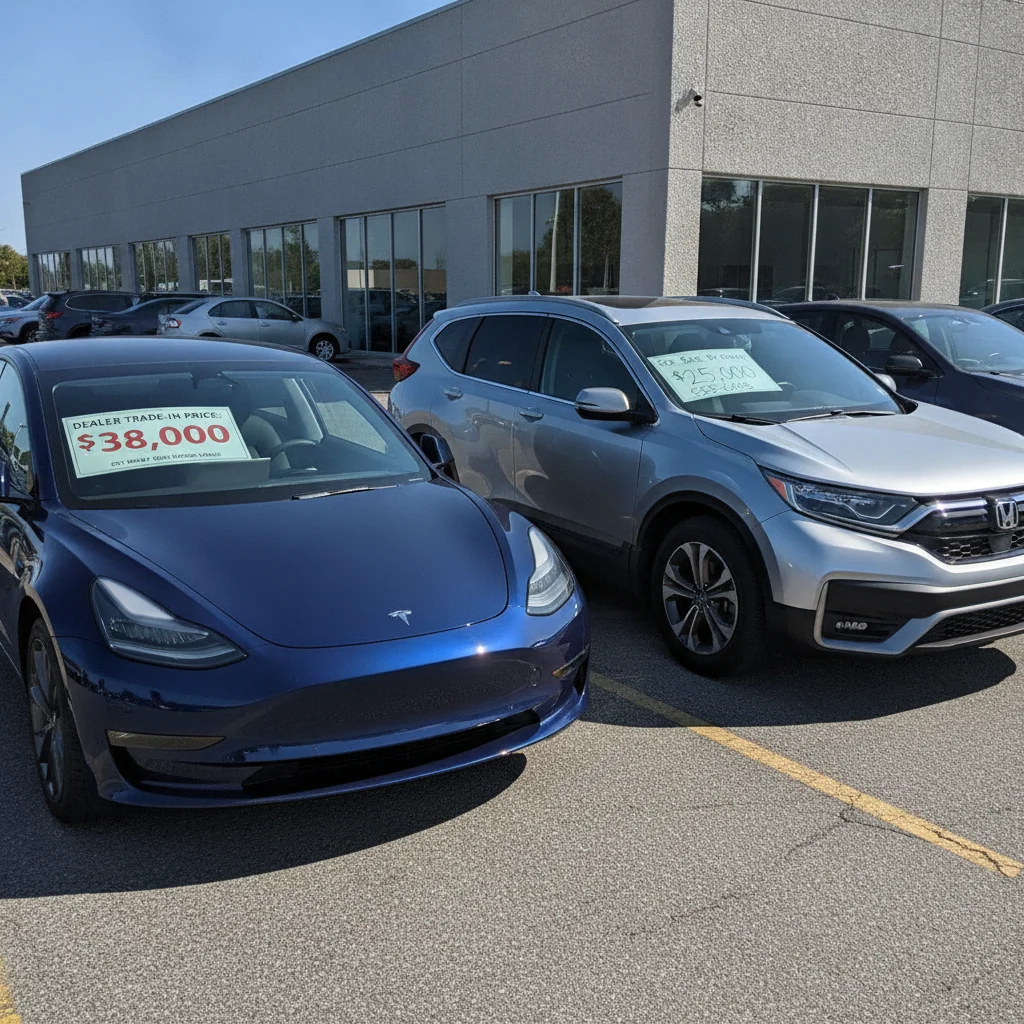
Trade-in value is what a dealer is willing to pay you for your car. Private sale price is what a private buyer in the open market will actually pay. The difference between the two — often $1,000 to $3,000 on a typical used vehicle, sometimes more on high-demand trucks and SUVs — represents the dealer's reconditioning budget, auction risk buffer, and profit margin baked into one lowball number.
This isn't a conspiracy. It's a business model. Dealers are wholesalers when they appraise your car. They need to buy it low enough to recondition it, list it on their used lot or send it to auction, and still make money. You are not their only option for inventory — they can buy from auctions, fleet returns, or off-lease vehicles any day of the week. That's leverage they hold, and most sellers hand it right back by not understanding the math.
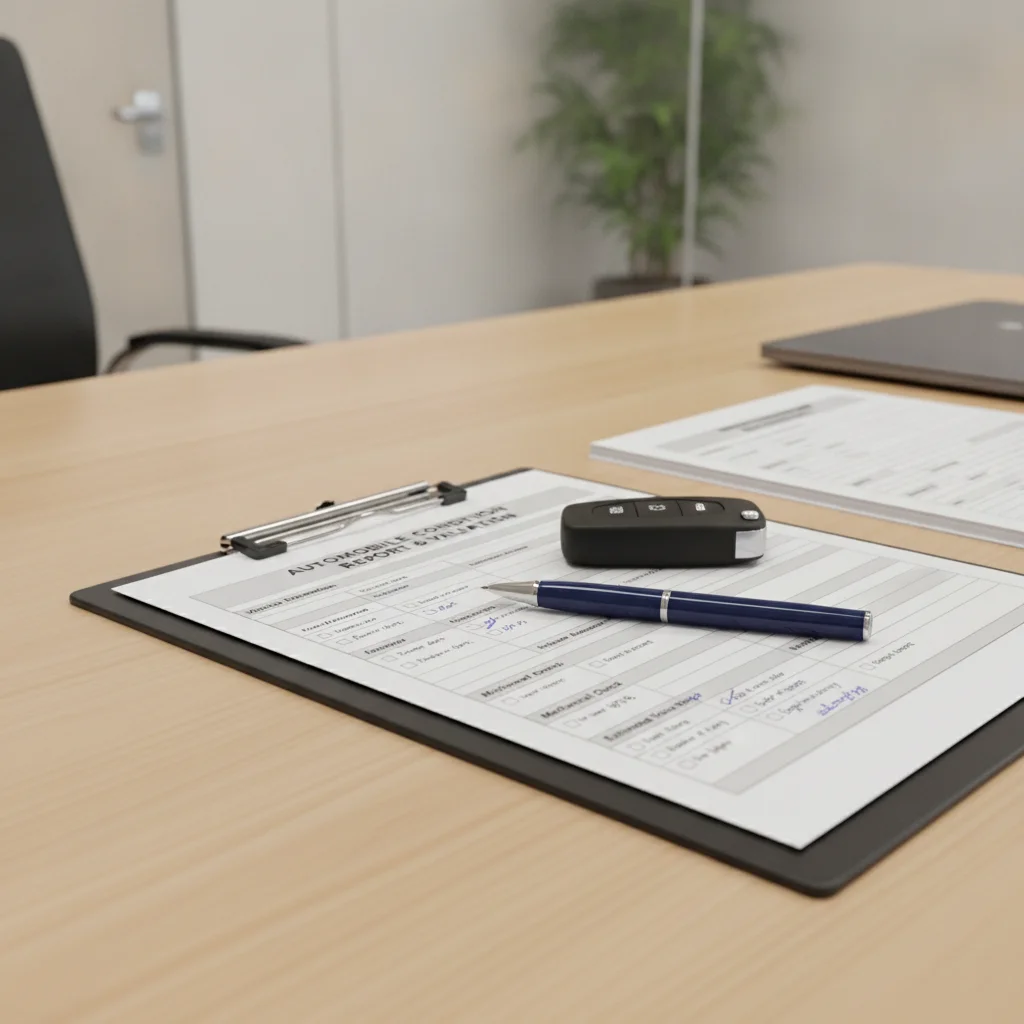
For a deeper breakdown of how valuation tools report these two figures differently, see Private Party Value vs. Trade-In Value: The Difference That Costs Sellers Thousands. Understanding the tool output is the first step to not getting played.
How Dealers Actually Calculate Your Trade-In Offer
Here's what happens behind the door when your car goes to the used car manager for appraisal. The appraiser runs your VIN through a wholesale auction platform — usually Manheim or ADESA — to see what similar vehicles are actually selling for at auction right now. That's their floor. They then subtract reconditioning estimates (detailing, mechanical inspection, minor repairs) and add a retail profit target on top. What you get offered is the number that leaves room for all of that.
This is why dealers rarely lead with their best offer. The initial appraisal is almost always on the conservative side. Appraisers know most sellers won't push back, and every hundred dollars left on the table is a hundred dollars in the dealer's pocket.
| Criterion | Trade-In Value | Private Sale Price |
|---|---|---|
| Typical price relative to market | 70–85% of private party value | Full retail private market value |
| Time to complete | Same day as new purchase | 2–6 weeks average |
| Who handles paperwork | Dealer handles title transfer | Seller manages DMV and title |
| Sales tax benefit | Reduces taxable purchase in most states | No tax offset on new purchase |
| Buyer screening required | None — dealer buys directly | Seller vets all inquiries |
| Negotiation complexity | One party (dealer) | Multiple buyer negotiations |
| Works well for problem vehicles | Yes — dealers factor in risk | No — buyers negotiate aggressively |
| Liability after sale | Minimal — dealer takes ownership | Seller remains contactable by buyer |
What can you do about it? Get competing offers before you walk into any dealership. Use CarMax, Carvana, and KBB Instant Cash Offer to establish a floor for your vehicle. These platforms give you a written offer — usually valid for seven days — that you can use as a negotiating chip at any franchise dealer. When a dealer knows you have a real competing bid in hand, the appraisal math changes quickly.
Dealer Trade-Ins: How Appraisals Work and How to Negotiate Better Offers covers the full negotiation playbook if you want to go deeper on the process.
Instant Cash Offers Are Not Trade-In Offers
Platforms like CarMax, Carvana, and KBB Instant Cash Offer give you a firm written bid for your car — independent of any new car purchase. These are distinct from dealer trade-in appraisals, which are often bundled with a new car negotiation and can be manipulated across both sides of the deal. Always treat an instant cash offer as your baseline before entering any trade-in conversation at a franchise dealership. Dealers are required to beat that number or lose the trade — and many will.
The Real Cost of Private Selling — and When It's Worth It
Private selling pays more. That's almost always true. But it's not free money — it costs time, effort, and carries real risks that dealers absorb for you when you trade in.
When you sell privately, you are the marketing department. You write the listing, take the photos, field calls and texts from tire-kickers, schedule test drives with strangers, and negotiate face-to-face with buyers who've done just as much research as you. Then you handle the title transfer and — depending on your state — notify the DMV. If something goes wrong after the sale, the buyer knows where to find you.
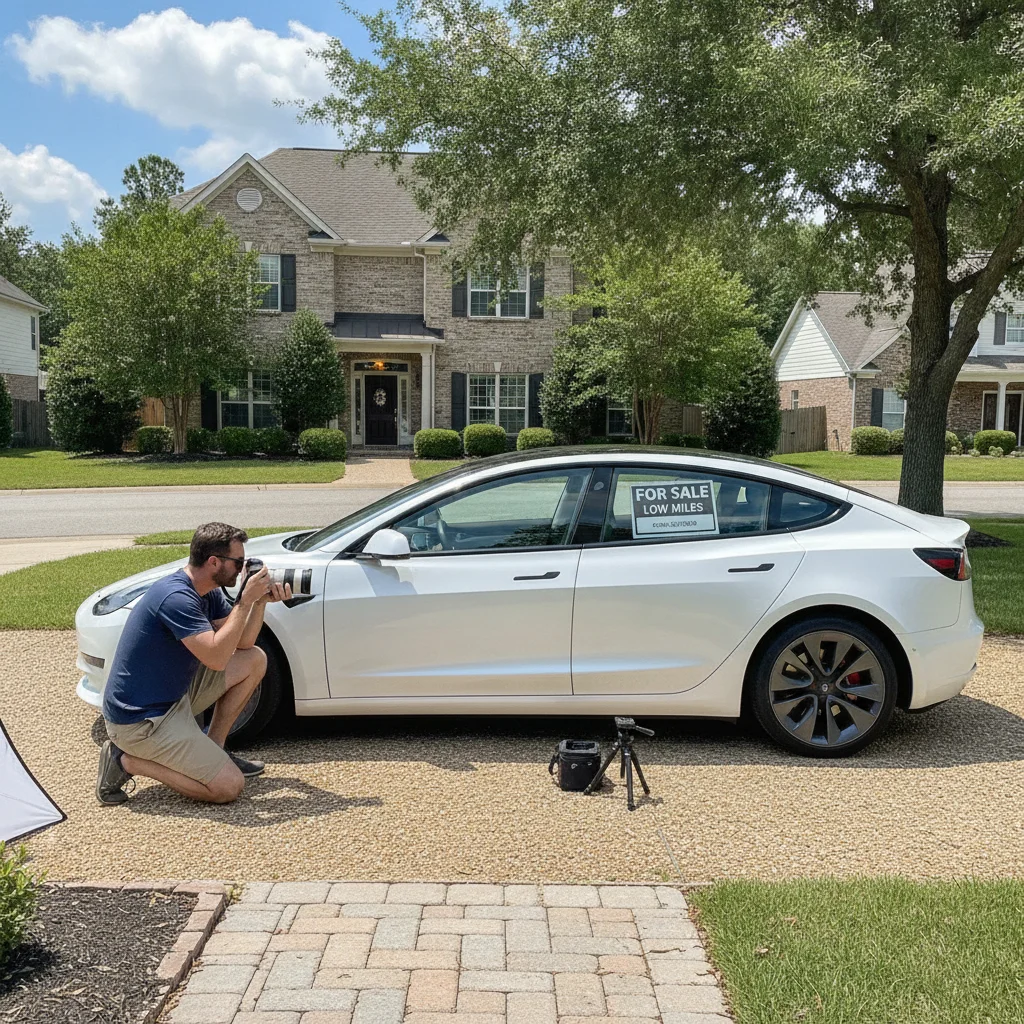
For most sellers, the process takes two to six weeks from listing to payment. For high-demand vehicles in good condition, it can be faster. For niche vehicles, older cars, or anything with deferred maintenance, it can drag on much longer — and every week you're not selling, you're still paying insurance and registration on that vehicle.
The math gets interesting when you run the actual numbers. If your car's private party value is $18,500 and your best trade-in offer is $16,200, that's $2,300 on the table. If you spend 15 hours managing the private sale over three weeks, you're effectively paying yourself roughly $153 per hour for that effort. For a lot of people, that's a very good use of time. For others — especially those trading into a new car at the same dealer — it's not.
$1,000–$3,000
Typical trade-in vs. private sale gap
Kelley Blue Book and Edmunds data consistently show private party values running $1,000–$3,000 above dealer trade-in offers for the same vehicle in similar condition.
2–6 weeks
Average time to complete a private sale
According to iSeeCars analysis of private listings, the median time from posting to sale varies by vehicle type, condition, and local market demand.
Up to $1,200+
Potential tax savings from trade-in credit
In states with 7–9% sales tax, trading in a $15,000 vehicle can reduce the buyer's tax bill by $900–$1,350 on a typical new car purchase.
3+
Competing offers needed to maximize trade-in
Consumer advocacy research shows that sellers who obtain three or more competing dealer appraisals receive meaningfully higher final trade-in offers than those with a single quote.
One scenario where private selling almost always wins: well-maintained vehicles with one owner, full service history, and no accidents. These cars are exactly what private buyers want and will pay a premium for. A dealer appraises condition mechanically; a private buyer buys emotionally. That emotional premium is real and it's yours to capture if you sell it right.
For a full comparison of the financial and logistical tradeoffs, Dealer Trade-In vs. Private Party Sale: Which Puts More Money in Your Pocket walks through real scenarios with actual numbers.
The Tax Angle Dealers Don't Always Mention
Here's a legitimate advantage of trading in that dealers rarely volunteer upfront — and one that can close the gap between trade-in value and private sale price more than most sellers expect.
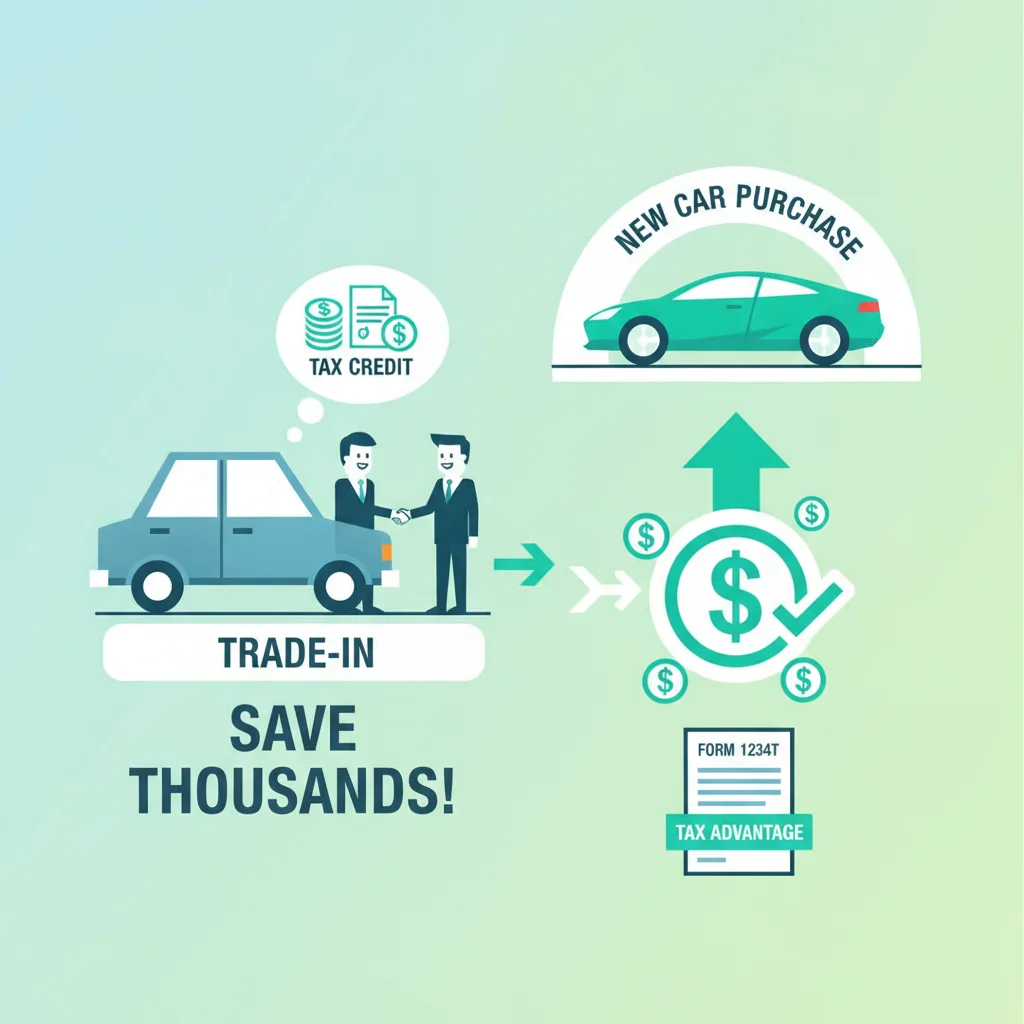
In most U.S. states, when you trade in a vehicle at a dealership and apply the trade-in credit toward a new car purchase, you only pay sales tax on the difference between the new car price and your trade-in value. This is called the trade-in tax credit, and it can be worth several hundred to over a thousand dollars depending on your state's tax rate and the size of your trade.
Example: You're buying a $35,000 vehicle in a state with 8% sales tax. With no trade-in, you owe $2,800 in tax. If you trade in a car worth $12,000, you only pay tax on $23,000 — saving you $960. If your private sale nets $13,500 instead of a $12,000 trade-in offer, you gained $1,500 but spent $960 more in tax. The net advantage of private selling just shrank to $540, not $1,500.
This math doesn't always favor trading in, but it shifts the calculation enough that you need to run it for your specific situation before deciding. The Hidden Tax Advantage of Trading In Your Car breaks down the state-by-state rules and the exact math for different scenarios.
Note: Not all states offer this credit. Oregon, Montana, New Hampshire, and Delaware have no sales tax, so the trade-in credit is irrelevant there. A handful of other states cap or limit the credit. Check your state's DMV or tax authority rules before you calculate.
Vehicles Where the Gap Is Biggest — and Smallest
Not every car has the same spread between trade-in and private sale value. The gap is widest for vehicles that have strong private-market demand but that dealers consider risky or slow-moving wholesale inventory.
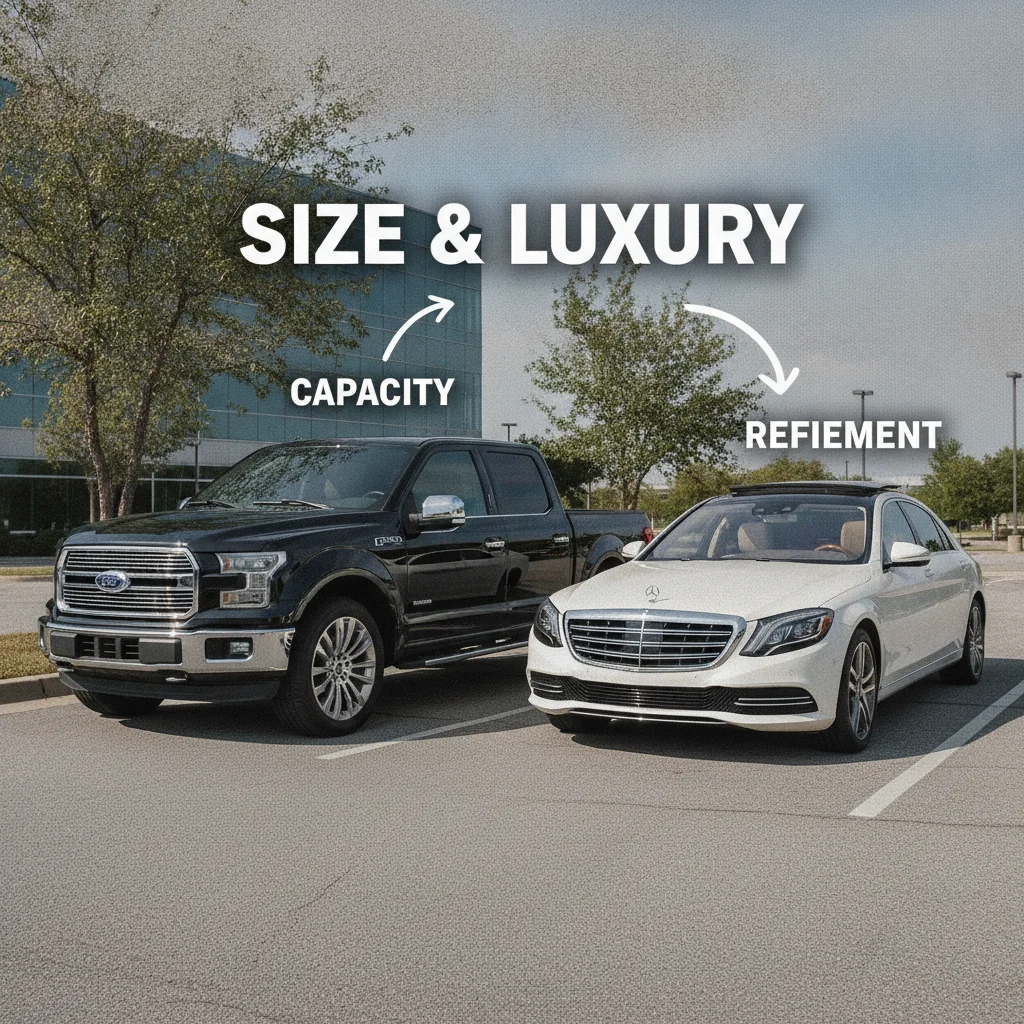
Trucks and SUVs — particularly domestic full-size pickups — consistently show the largest spreads. Private buyers in most markets will pay a significant premium over dealer appraisals for clean, well-optioned pickups. Dealers know this too, which is why their appraisals can still seem low relative to what you see on the private market: they're pricing in reconditioning and time on lot, not the emotional premium a private buyer might pay.
Luxury vehicles and high-mileage cars sit on the opposite end. Luxury cars depreciate hard, have expensive reconditioning costs, and attract a narrower pool of private buyers who are often very price-aware. High-mileage vehicles are similarly difficult private sales — buyers are cautious, want pre-purchase inspections, and negotiate aggressively. In these cases, the trade-in offer might be close to what you'd net privately after accounting for time and price concessions.
Modified vehicles, cars with accident history, and anything with deferred maintenance almost always trade better than they sell privately. Private buyers will research your car's history on Carfax or AutoCheck, ask pointed questions about the accident, and use every negative as a hammer in price negotiations. Dealers factor in those risks differently — they're in the business of reconditioning and remarketing, and they price your car accordingly.
Understanding how dealers decide whether your trade goes on their used lot versus straight to auction matters here. What Happens to Your Car After You Trade It In explains the pipeline and how it directly influences your appraisal number.
Making the Call: A Practical Framework
There's no universal right answer between trading in and selling privately. But there is a framework that makes the decision cleaner once you have the right numbers in front of you.
- Get your private party value estimate from KBB and Edmunds, using honest condition ratings. Valuation Tools: How KBB, Edmunds, and Others Estimate Your Car's Worth explains how to interpret what those tools actually tell you.
- Get at least three dealer trade-in offers — from CarMax, Carvana or Vroom, and one local franchise dealer. These are real bids, not estimates, and they establish your walk-away floor before you negotiate anything.
- Calculate the tax savings if you're buying a new or newer car at the same dealer. Run the math for your state's tax rate against the actual dollar gap between your best trade offer and your expected private sale price.
- Estimate the realistic time and effort of a private sale for your specific vehicle. High-demand vehicles in good condition sell fast; everything else takes longer than sellers expect.
- Decide what your time is worth. If the net financial advantage of going private — after taxes and transaction costs — is under $500, trading in is almost always the smarter play. If it's $1,500 or more and your car is easy to sell, the private route earns it.
For sellers still undecided, What 'Private Party Value' Actually Means — and Why It Differs From Trade-In is worth reading before you price your listing. And if timing is a factor in your decision, Timing Your Sale Around a Trade-In vs. Private Listing Decision covers when each channel tends to move fastest through the year.
The bottom line: trade-in value and private sale price represent two different transactions with different buyers, different risk profiles, and different financial outcomes. Knowing exactly where the gap goes — and running your own numbers before you commit — is how you stop leaving money on the table either way.

All claims are backed by peer-reviewed research. Sources on request.