Key Takeaways
Start here
How Auto Loan Interest Actually Works
Build context
What Early Payoff Means — and What It Doesn't
See the impact
Why Paying Early Saves You Real Money
Take action
The Simplest Strategies to Start Paying Ahead
Avoid mistakes
Watch Out: Prepayment Penalties and Other Traps
Move forward
Your Next Steps as a First-Time Borrower
How Auto Loan Interest Actually Works
Before you can make smart decisions about paying off your car loan early, you need to understand the basic mechanics of how interest is calculated. Most auto loans — the vast majority issued by banks, credit unions, and dealership lenders — use a method called simple interest.
Principal
The original amount you borrowed, not counting interest. As you make payments, your principal balance decreases.
Simple Interest
An interest calculation method where interest is charged only on the current outstanding balance. Reducing your balance faster means paying less total interest.
Amortization
The schedule that determines how each payment is split between interest and principal. Early payments are weighted toward interest; later payments cover more principal.
APR (Annual Percentage Rate)
The yearly cost of borrowing expressed as a percentage, including interest and certain fees. A higher APR means more interest paid over the life of the loan.
Prepayment Penalty
A fee some lenders charge if you pay off your loan before the scheduled end date. Not all loans have this — check your contract.
Payoff Quote
A figure from your lender showing the exact amount needed to fully pay off the loan on a specific date, including any accrued interest.
Precomputed Interest
An interest method where the total interest is calculated upfront and built into your payment schedule, meaning paying early may not reduce your interest as much as expected.
Principal-Only Payment
An extra payment designated to reduce only the loan balance, not counted toward a future monthly installment. Must be requested explicitly from most lenders.
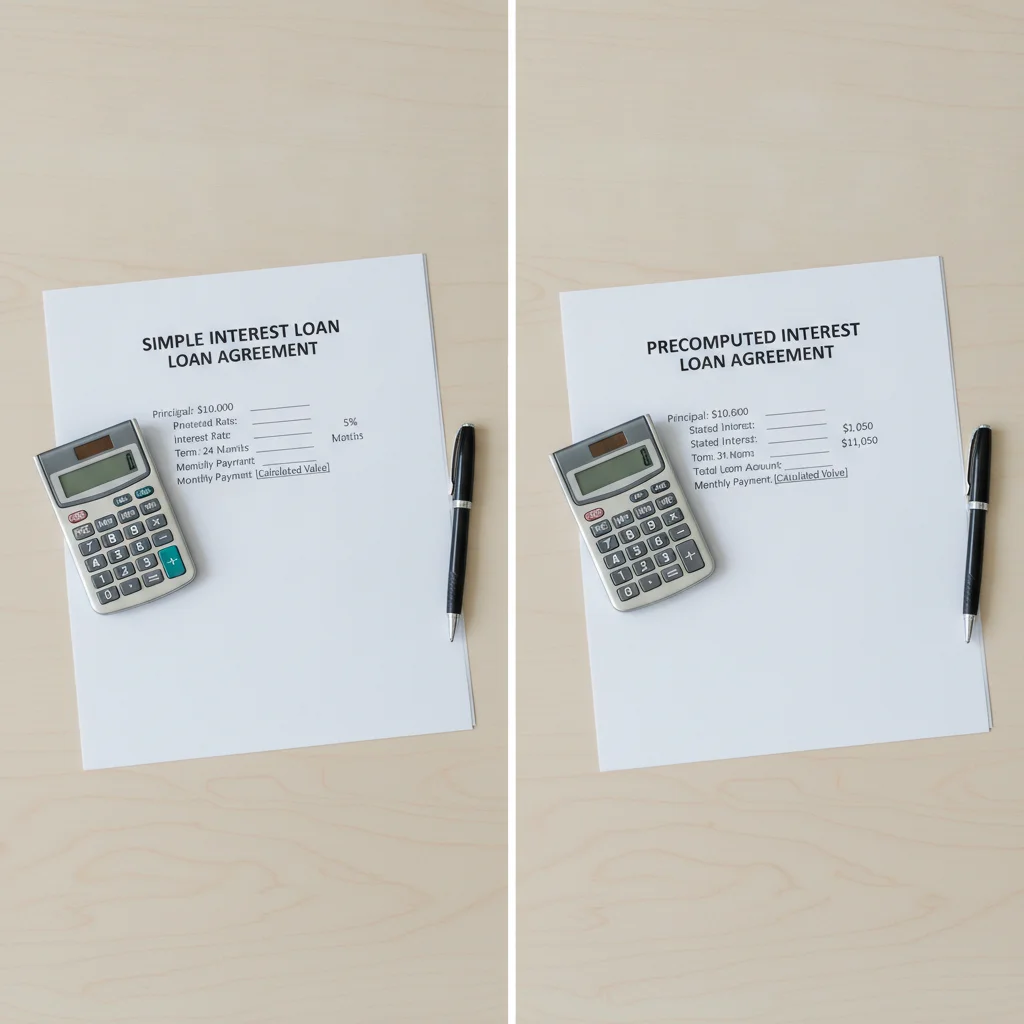
Here's what simple interest means in practice: each month, your lender calculates interest based on your current outstanding balance (called the principal). As that balance goes down, so does the amount of interest you owe. This is fundamentally different from a precomputed loan, where the total interest charge is fixed at the start regardless of when you pay. If you're unsure which type you have, learn the difference between simple and precomputed interest — because it changes how useful early payoff strategies are.
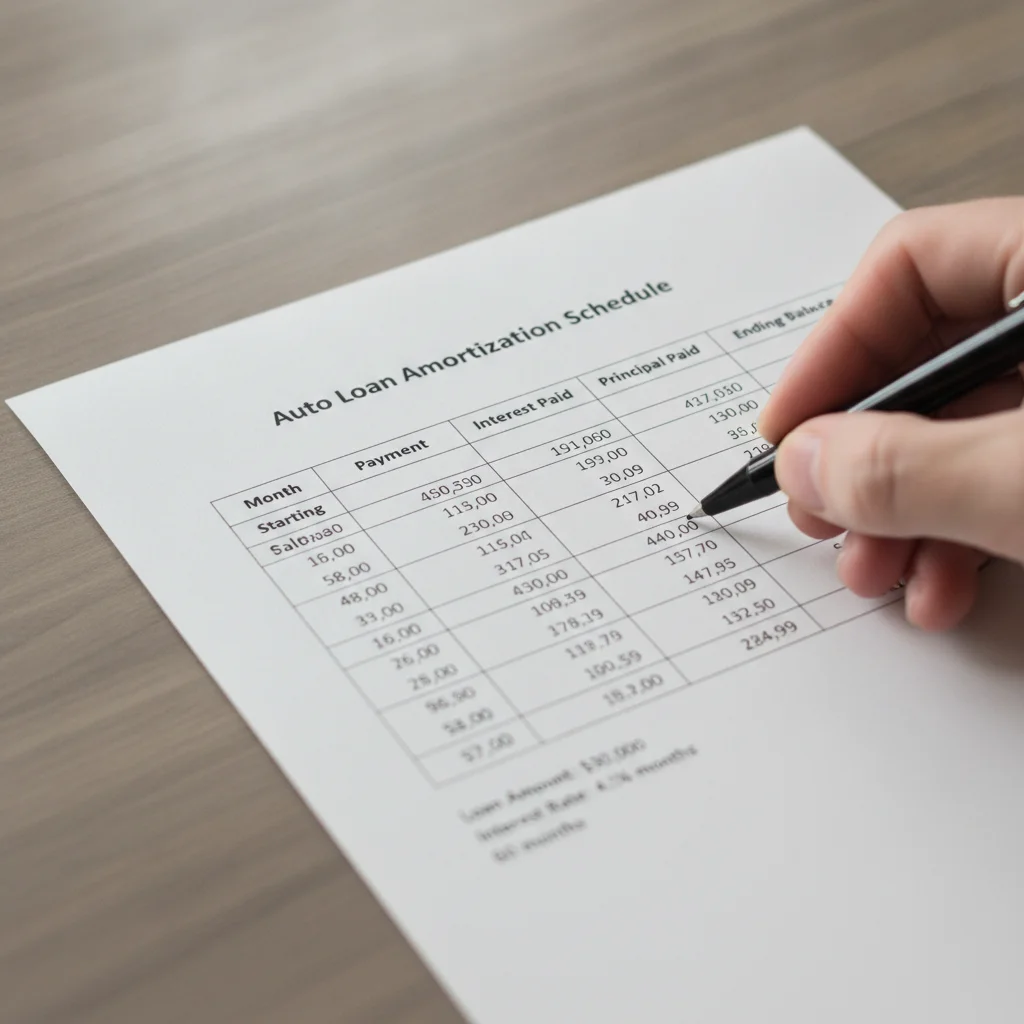
On a simple interest loan, your monthly payment covers two things: interest owed for that billing period and a portion of principal. The proportion of each shifts over the life of the loan through a process called amortization. Early payments are weighted heavily toward interest; later payments pay more principal. This is why acting sooner rather than later makes such a measurable difference.
For a concrete look at this, consider a $20,000 loan at 6.5% APR over 60 months. Your first payment might direct roughly $108 to interest and $247 to principal. By month 40, those numbers flip significantly — you're paying more principal per payment. But by then, you've already paid thousands in interest that earlier action could have reduced. Understanding how amortization works on an auto loan gives you the clearest picture of where your money goes each month.
What Early Payoff Means — and What It Doesn't
The phrase "early payoff" sounds straightforward, but lenders and borrowers often mean different things by it. Getting clear on the definition prevents surprises down the road.
Early payoff simply means reducing your loan balance faster than your original payment schedule requires. That can happen two ways:
- Extra payments over time: Adding $50, $100, or any amount on top of your regular monthly payment. Each extra dollar directly reduces your principal — which, in turn, reduces future interest charges.
- A lump-sum payoff: Paying the full remaining balance in one payment, effectively closing the loan immediately.
Early payoff does not mean skipping a payment and making it up later, or paying ahead so you can miss a future month. Those strategies don't reduce your balance the same way and can actually result in additional fees or interest charges.
It's also worth noting that "paying ahead" on your due date and "paying extra toward principal" are different things. Paying a month ahead on your due date keeps you current but doesn't necessarily shrink your loan balance faster — it depends entirely on how your lender applies the payment. Always specify that extra funds should go to principal reduction. What early payoff actually means on an auto loan breaks this distinction down further if you want to go deeper.
Your Loan Contract Is the Authoritative Source
Every auto loan is slightly different. Terms like prepayment penalties, how extra payments are applied, and whether biweekly payments are accepted all depend on your specific contract and lender. Before adopting any early payoff strategy, verify the relevant terms directly with your servicer. Keep a written record of any instructions you provide about payment application.
Why Paying Early Saves You Real Money
The financial case for paying off your auto loan early is direct and quantifiable. Because simple interest accrues daily on your remaining balance, every dollar you remove from that balance immediately reduces what you'll owe in the future. There's no ambiguity here — lower balance equals lower interest.
Let's walk through a realistic example:
| Scenario | Loan Amount | APR | Term | Monthly Extra | Total Interest Paid | Months Saved |
|---|---|---|---|---|---|---|
| Standard payments | $25,000 | 7% | 60 months | $0 | ~$4,653 | — |
| +$75/month extra | $25,000 | 7% | 60 months | $75 | ~$4,120 | ~5 |
| +$150/month extra | $25,000 | 7% | 60 months | $150 | ~$3,640 | ~9 |
Even a modest $75 per month in extra payments generates more than $500 in savings and eliminates nearly five months of payments. The benefit compounds as your rate increases — borrowers with above-average APRs have even more to gain. Payoff strategies for high-interest auto loans covers targeted approaches if your rate is on the higher end.
Beyond interest savings, early payoff has a second financial benefit: it shortens the period during which your car loan can become "upside down" — meaning you owe more than the car is worth. Vehicles depreciate quickly, especially in the first two to three years. Paying faster keeps your loan balance closer to (or below) the car's market value, which protects you if the vehicle is totaled or you need to sell.
Act Early — The Sooner the Better
The financial benefit of extra payments is largest in the first half of your loan term, when amortization is directing more of each payment toward interest. A $500 principal payment in month three saves significantly more than the same payment in month 45. If you can make even one extra payment in your first year, do it.
Always Confirm How Extra Payments Are Applied
Before sending any extra money to your lender, call or message them to confirm their process for principal-only payments. Ask for the specific steps — whether that means checking a box in the online portal, adding a note to your payment, or sending a separate check. Getting this right the first time ensures your extra payment actually accelerates your payoff.
The Simplest Strategies to Start Paying Ahead
You don't need a financial windfall to make early payoff work. The most effective strategies are repeatable and low-friction. Here are the approaches that work best for first-time borrowers:
1. Round Up Your Monthly Payment
If your payment is $387 per month, pay $400. If it's $432, pay $450. Rounding up costs very little but consistently chips away at your principal. Over a 60-month loan, this habit alone can save several hundred dollars.
2. Make One Extra Payment Per Year
A reliable method is to divide your monthly payment by 12, then add that amount to each monthly payment. This effectively funds one full extra payment annually without requiring a lump sum. On a $400/month payment, that's just $33 added per month — but it typically shortens a 5-year loan by three to four months.
3. Apply Windfalls Directly to Principal
Tax refunds, bonuses, and gift money are one-time opportunities to significantly dent your balance. A $1,000 principal payment early in your loan can eliminate hundreds of dollars in future interest. When you make this payment, contact your lender and confirm it's applied to principal — not held as a prepaid installment.
4. Switch to Biweekly Payments
Instead of one monthly payment, make half-payment every two weeks. Because there are 52 weeks in a year, this produces 26 half-payments — which equals 13 full monthly payments instead of 12. Check with your lender first to confirm they accept biweekly payments without fees or complications.

Whichever method you choose, the most important action is to specify in writing — through your lender's portal, by phone, or on a payment stub — that any amount above your required payment should be applied to principal only. Without that instruction, some servicers will process excess funds as an early payment for the following month, which does not accelerate payoff the same way. For a fuller picture of what can quietly slow your progress, see common traps that slow down auto loan payoff.
Watch Out: Prepayment Penalties and Other Traps
Early payoff is almost always beneficial — but there are a few situations where it can backfire or where you'll want to proceed with information first.
Prepayment Penalties
Some auto loan contracts include a clause that charges you a fee for paying off the loan before a certain date or below a certain remaining term. These penalties are less common than they used to be, but they do appear — particularly in subprime lending and some dealer-arranged financing. Before making any large extra payment, read your loan contract's prepayment or early termination clause. If you can't find it, call your lender and ask directly: "Does my loan carry a prepayment penalty?"
Check for Prepayment Penalties First
Making a large lump-sum payment on a loan that carries a prepayment penalty could trigger a fee that partially or fully offsets your interest savings. Read the early termination clause in your contract before sending any extra payment larger than your regular installment. If the language is unclear, ask your lender in writing.
Precomputed Interest Loans
If your loan uses precomputed interest rather than simple interest, paying early may save less than you expect — or nothing at all — because the total interest is calculated up front and built into your payment schedule. Precomputed vs. simple interest auto loans explains exactly how to identify which type you have and what early payoff means under each structure.
Payment Misapplication
As mentioned earlier, some lenders will treat extra payment funds as a prepayment for your next monthly installment — not as a principal reduction. This can push out your next due date while leaving your balance largely unchanged. Always confirm your lender's policy and request written confirmation when making a large extra payment.
Skipped-Payment Offers
Lenders occasionally offer "payment holiday" promotions, especially around the holidays, where you can defer one month's payment to the end of your loan. These sound helpful but typically mean interest continues to accrue on your full balance during that skipped month, effectively increasing your total cost. Accepting these offers while trying to pay off early works against your goal.
Your Next Steps as a First-Time Borrower
If you've read this far, you already understand more about your auto loan than most first-time borrowers do when they sign the contract. Here's how to convert that knowledge into action:
- Pull out your loan contract and locate your interest type (simple or precomputed), your APR, your loan term, and any prepayment penalty clause.
- Log into your lender's online portal (or call the servicer) and confirm how they process extra payments and whether a principal-only payment option exists.
- Pick one strategy from the methods above — rounding up, biweekly payments, or an annual extra payment — and implement it this month.
- Set a calendar reminder every six months to review your remaining balance and recalculate how much you've saved.
You don't need to commit to a dramatic payoff plan. Even a consistent, small extra payment made correctly will measurably reduce your interest cost and shorten your loan term. The key is starting before amortization has already shifted the bulk of interest out of your remaining payments.
When you're ready to go deeper, the auto loan early payoff terms and concepts every borrower should know is a useful reference — it covers payoff quotes, principal-interest breakdowns, and other language you'll encounter when talking to your lender. For the broader picture of how loan length and total cost interact, the Loan Terms Explained hub is a strong foundation.
Auto Loan Early Payoff Calculator
Enter your loan balance, rate, and extra monthly payment to instantly see how much interest you'll save and how many months you'll cut from your term.
Loan Terms Explained
A foundational hub covering loan length, monthly payment structure, and total cost — essential reading for any first-time borrower building their financial literacy.
Auto Loan Early Payoff: Terms and Concepts Every Borrower Should Know
A practical glossary of early payoff terminology including principal, amortization, payoff quotes, and prepayment penalties — useful to bookmark and return to as you talk with your lender.
Common Traps That Slow Down Auto Loan Payoff
Identifies specific lender practices and borrower habits — like payment misapplication and skipped-payment offers — that quietly undermine early payoff efforts.

All claims are backed by peer-reviewed research. Sources on request.