

| Average auto loan term in the U.S. | 72 months (6 years) (Experian State of the Automotive Finance Market, 2023) |
| Most common auto loan interest structure | Simple interest |
| Prepayment penalty legality | Banned on loans ≤60 months in some states; check your contract (Consumer Financial Protection Bureau guidance) |
| Payoff quote validity window | Typically 10–30 days |
| Time to receive lien release after payoff | 5–30 business days depending on lender |
| Interest front-loading on 72-month loans | ~55–60% of total interest paid in first half of term (Illustrative amortization calculation, simple interest basis) |
Why Terminology Matters When You're Paying Off a Loan Early
Paying off your car loan ahead of schedule sounds straightforward. You send money, the loan goes away, and you own your car free and clear. But the mechanics underneath that transaction involve terms that can meaningfully change the math — and the outcome — if you don't understand them.
Whether a lender charges a prepayment penalty, how interest accrues daily on your balance, or whether your loan uses simple or precomputed interest can each determine whether paying early saves you hundreds of dollars or barely saves you anything at all.
This reference is designed to be your lookup guide. Use it before you start a payoff strategy, while you're reading your loan contract, or when you're on the phone with your lender requesting a payoff quote. For a broader introduction to what early payoff actually involves, see what early payoff actually means on an auto loan.
| Average auto loan term in the U.S. | 72 months (6 years) (Experian State of the Automotive Finance Market, 2023) |
| Most common auto loan interest structure | Simple interest |
| Prepayment penalty legality | Banned on loans ≤60 months in some states; check your contract (Consumer Financial Protection Bureau guidance) |
| Payoff quote validity window | Typically 10–30 days |
| Time to receive lien release after payoff | 5–30 business days depending on lender |
| Interest front-loading on 72-month loans | ~55–60% of total interest paid in first half of term (Illustrative amortization calculation, simple interest basis) |
Core Loan Structure Terms
These are the building blocks of any auto loan. Understanding them is essential before you can evaluate the impact of paying early.
Principal
The original amount you borrowed, not counting interest or fees. Every payment you make reduces the principal balance, and the faster you bring it down, the less interest you'll owe overall.
Amortization
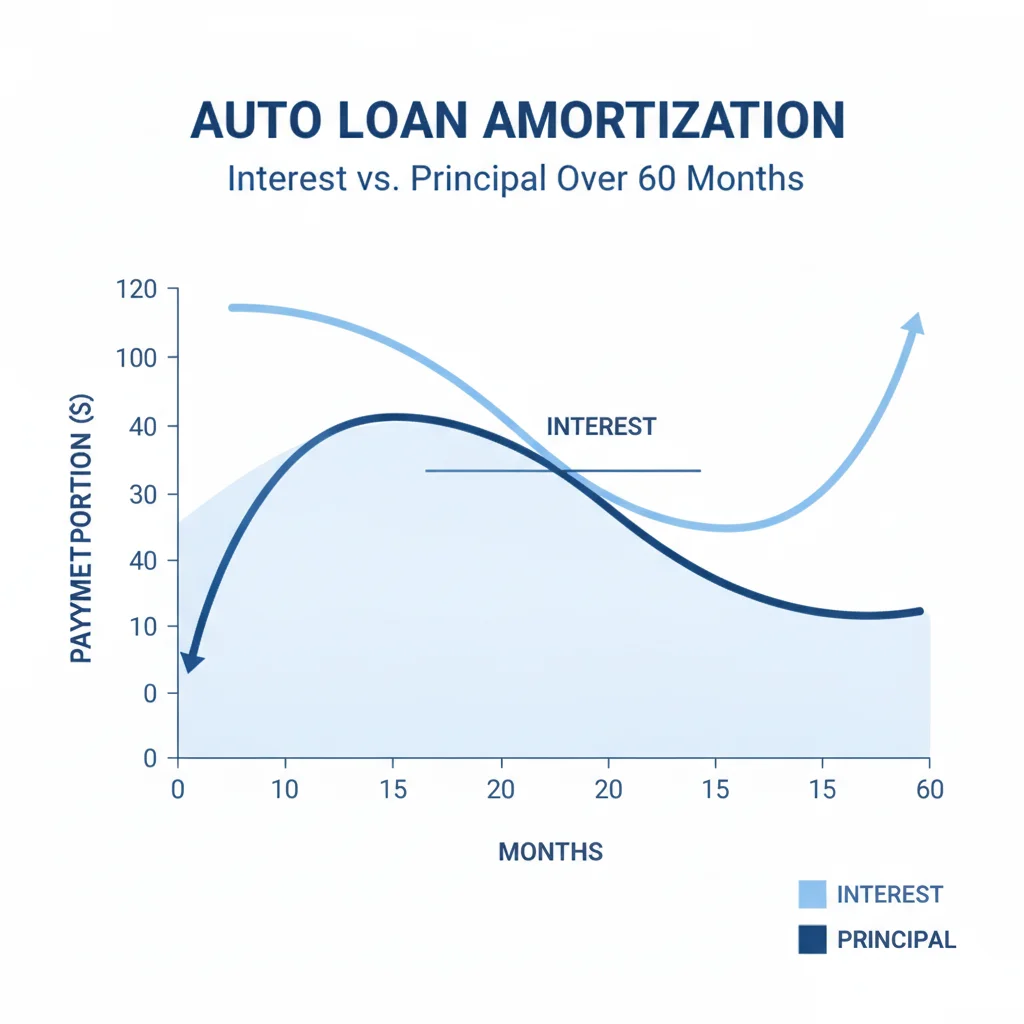
The schedule by which your monthly payments are divided between interest and principal over the life of the loan. In the early months, most of your payment goes toward interest; as the loan matures, more goes toward principal.
Prepayment Penalty
A fee some lenders charge if you pay off your loan before the scheduled end date. Not all auto loans include this clause, but it's critical to check your contract before making extra payments.
Payoff Quote
The exact dollar amount your lender says you owe to fully satisfy the loan on a specific date. It includes your remaining principal plus any accrued interest and applicable fees through that date.
Simple Interest
An interest calculation method where interest accrues daily on your outstanding principal balance. Paying early or making extra payments directly reduces the balance, so you accumulate less interest over time.
Precomputed Interest
An interest structure where the total interest for the loan is calculated upfront and added to the balance you owe. With precomputed loans, paying early may save you less than expected because some interest is already baked in.
Rule of 78s
A method some lenders use on precomputed loans to allocate more interest to the early months of the loan. If you pay off a Rule of 78s loan early, you may receive little or no interest rebate.
Outstanding Balance
The total amount you still owe on your loan at any given moment, including accrued but unpaid interest. This is distinct from your payoff quote, which locks in a figure for a specific date.
Accrued Interest
Interest that has built up on your loan since your last payment but hasn't yet been billed. Your payoff quote will include accrued interest to ensure the lender is fully compensated through the payoff date.
Loan Term
The agreed-upon length of time to repay your loan, typically expressed in months (e.g., 48, 60, or 72 months). Paying off a loan early means you're retiring the debt before the loan term expires.
Finance Charge
The total cost of borrowing, expressed in dollars. It includes all interest and any required fees over the full life of the loan. Paying early reduces the total finance charge you ultimately pay.
Lien Release
A document issued by your lender confirming the loan has been paid in full and they no longer have a legal claim on your vehicle. You'll need this to obtain a clear title in your name.
Principal vs. Balance: Not Always the Same Number
Your principal is the original amount you borrowed. Your outstanding balance is what you owe right now, which includes accrued interest that hasn't been billed yet. When you call your lender and ask what you owe, they'll typically give you your current balance — but that isn't the same as your payoff quote, which locks in a precise amount valid through a specific date.
Understanding this distinction matters because if you send a check for your current balance shown online, you may come up slightly short by the time it's processed. Always request a formal payoff quote before sending a final payment.
How Amortization Front-Loads Your Interest Cost
Amortization is the reason early payments are so powerful — and the reason waiting too long to pay extra diminishes the benefit. On a standard amortizing loan, each monthly payment is structured so that the lender collects its interest first, and whatever remains reduces your principal. Early in the loan, interest takes up the lion's share of your payment. By mid-loan, the balance begins to shift.
This is why making an extra principal payment in month six is far more valuable than making the same extra payment in month 54. The earlier payment lowers the balance that future interest is calculated on, compounding your savings across every remaining month. For a visual breakdown of how this works, see how amortization works on an auto loan.
72 months
Average new-car loan term in the U.S.
According to Experian's State of the Automotive Finance Market report (Q4 2023), the average new-vehicle loan term has stretched to six years.
$1,000+
Typical interest savings from one extra annual payment
On a $30,000, 72-month loan at 7% APR, making one extra principal payment of $500 per year can cut total interest costs by over $1,000.
~55%
Share of interest paid in first half of a 72-month loan
Amortization front-loads interest, so borrowers on long-term loans pay the majority of their total interest cost before the halfway mark.
3–5%
Typical prepayment penalty range
When prepayment penalties exist on auto loans, they commonly range from 1% to 5% of the remaining balance or a flat fee equivalent to 2–3 months of interest.
30 days
Maximum lien release window at most major lenders
Federal and state regulations generally require lenders to release a lien within 10 to 30 days of full loan satisfaction, though many act faster.
Interest Structures That Affect Early Payoff Savings
Not all auto loans reward early payoff equally. The interest structure written into your contract determines how much you actually save by paying ahead of schedule.
Simple Interest Loans
Simple interest is the most common structure for auto loans in the U.S. Interest accrues daily on your outstanding principal balance. The formula is straightforward: outstanding balance × daily interest rate × number of days since last payment. Because interest is recalculated constantly based on what you currently owe, any reduction to your principal immediately reduces how much interest accumulates going forward.
This is the ideal structure for early payoff. Every extra dollar you apply to principal starts saving you money the very next day.
Precomputed Interest Loans
With a precomputed interest loan, the lender calculates the total interest for the full loan term upfront and adds it to your total amount owed. Your monthly payments are then divided into equal installments that pay down this combined balance. Because interest isn't recalculating daily on your remaining principal, paying early doesn't automatically mean you avoid future interest — the lender uses a formula to determine how much of the precomputed interest you're entitled to as a rebate.
These loans are less common today but still exist, particularly through some buy-here-pay-here dealerships and credit unions. Always ask your lender directly which structure applies to your loan.
The Rule of 78s
Some older or higher-risk precomputed loans use the Rule of 78s (also called the sum-of-digits method) to calculate how interest is allocated across the loan term. Under this method, the lender assigns more interest to the early months of the loan. If you pay off early, you receive a rebate only on the interest assigned to future months — which may be very little by the time you decide to act.
The Rule of 78s is banned for loans over 61 months in many states and is prohibited on federally insured mortgages, but it can still appear on shorter auto loans. Check your contract for this language before assuming you'll save significantly by paying off early. For a complete look at loan structures that can reduce early payoff benefits, see signs your auto loan terms make early payoff less worthwhile.
Check Your Loan Type Before Making Extra Payments
Simple interest loans and precomputed interest loans respond very differently to early payments. On a simple interest loan, every extra dollar directly cuts the balance on which future interest accrues. On a precomputed loan — especially one using the Rule of 78s — your potential savings are front-loaded and may be minimal by the time you decide to pay ahead. Always confirm which structure applies to your loan before building a payoff strategy.
Payoff Quotes Expire — Request One Close to Your Payment Date
A payoff quote is only valid through a stated good-through date, typically 10 to 30 days out. Interest accrues daily on simple interest loans, so if you receive a quote on Monday but pay the following Friday, the amount may differ slightly. Request the quote close to when you plan to pay and confirm the exact wire or check instructions with your lender.
Extra Payments Must Be Applied to Principal
Some lenders automatically apply extra payments to your next scheduled monthly payment rather than to principal. To ensure your overpayment reduces your balance, explicitly instruct your lender in writing to apply the excess amount to principal. Many lenders have an online portal option or a notation field on the payment form specifically for this purpose.
Prepayment Penalties: What to Look For in Your Contract
A prepayment penalty is a fee a lender may charge if you pay off your loan before the scheduled end date. The logic behind it is simple: the lender was counting on receiving interest payments over the full loan term. Early payoff deprives them of that expected income, and the penalty partially compensates for the loss.
How Prepayment Penalties Are Typically Structured
- Flat fee: A fixed dollar amount, regardless of how early you pay off
- Percentage of remaining balance: Commonly 1%–5% of the outstanding principal at payoff
- Sliding scale: The penalty decreases the closer you get to the original end date
- Months of interest: The equivalent of two to three months of interest payments
Where to Find This Clause
Look in your loan contract under sections labeled "Prepayment," "Early Termination," or "Additional Charges." Federal law requires lenders to disclose prepayment penalties, but the language can be buried in dense legal text. Read it carefully before signing — and again before initiating a payoff.
If your lender says there's no prepayment penalty, ask them to point to the specific clause in the contract that confirms it. Get that confirmation in writing.
When Penalties Make Early Payoff Less Worthwhile
If you're six months into a 72-month loan with a 3% prepayment penalty on a $28,000 remaining balance, the penalty alone could be $840. You'd need to calculate whether the interest you'd save by paying now exceeds that fee. In many cases it still does — but the math is worth doing before you act.

Requesting and Using a Payoff Quote
A payoff quote is the official, binding figure from your lender that tells you exactly what it takes to close out your loan on a specific date. It's not the same as your account balance shown online. The payoff quote accounts for interest accrued since your last statement, any applicable fees, and possibly a small buffer to cover weekend or processing delays.
What a Payoff Quote Includes
- Remaining principal balance
- Accrued interest through the good-through date
- Any outstanding fees (late charges, administrative fees)
- A per diem (daily interest) figure in case your payment arrives after the stated date
How to Request One
- Call your lender's customer service line or log into your account portal
- Request a payoff quote and specify the date you plan to send payment
- Ask for the quote in writing — via email, mail, or downloadable PDF
- Confirm the exact payment method the lender accepts (wire transfer, certified check, ACH) and whether online payments are accepted for payoffs
Once you have the quote, act on it quickly. If your good-through date passes, you'll need a new quote. On a simple interest loan, a week's delay can add $10–$50 in additional accrued interest depending on your balance and rate.
After Your Final Payment: The Lien Release
Once your lender confirms receipt of the full payoff amount, they will issue a lien release — sometimes called a lien satisfaction letter or title release. This document proves the lender no longer has a legal claim on your vehicle. In states where the lender holds a paper title, they'll mail it to you. In electronic title states, they'll submit an electronic release directly to the DMV.
Expect this process to take anywhere from five to thirty business days. Follow up with your lender after two weeks if you haven't received confirmation. You'll need the lien release to obtain a clean title and to sell or refinance the vehicle in the future.
For the complete step-by-step process from first extra payment to final title, see paying off your car loan early: a complete roadmap.
Putting It All Together: Terms in Action
Here's a practical scenario that shows how these terms interact with each other in a real payoff situation.
Example: You took out a $25,000 simple interest auto loan at 6.9% APR for 60 months two years ago. Your current outstanding balance is $17,200. You call your lender and request a payoff quote good through the 15th of next month. The quote comes back at $17,392 — which includes $192 in accrued interest. Your contract has no prepayment penalty clause. You send a certified check for $17,392. Three weeks later, you receive your lien release.
In this scenario, every term covered in this guide played a direct role. The amortization schedule determined how much principal you'd paid down in those two years. The simple interest structure meant accrued interest was calculated daily, explaining why the payoff quote was higher than the balance on your app. The absence of a prepayment penalty meant your full savings went directly to you — roughly $4,200 in interest you'll never pay.
Common Mistakes to Avoid
- Sending a payment without requesting a payoff quote first — you may underpay and leave the loan open
- Assuming extra payments reduce your principal automatically — confirm this in writing with your lender
- Ignoring the loan type — on a precomputed loan, your savings calculation is completely different
- Not following up on the lien release — a missing lien release can delay future vehicle sales
For a broader grounding in auto loan language, the auto loan glossary covering 25 essential terms pairs well with this guide. And if you want to understand how APR, finance charges, and interest rates interact in a loan offer, see the plain-English glossary of auto loan interest terms.
Auto Loan Early Payoff Calculator
Enter your current balance, interest rate, and proposed extra payment amounts to see exactly how much interest you'd save and how many months you'd shave off your loan.
Auto Loan Glossary: 25 Terms Every Borrower Should Know
A broader plain-language reference covering every major term you'll encounter across any auto loan document, from APR to LTV to precomputed interest.
How Amortization Works on an Auto Loan
A deep dive into how your lender splits each monthly payment between interest and principal, and why the timing of extra payments matters so much.
Consumer Financial Protection Bureau: Auto Loans
The CFPB's official resource center for auto loan borrowers, including information on your rights, complaint filing, and prepayment penalty regulations.
Paying Off Your Car Loan Early: A Complete Roadmap
A step-by-step walkthrough from your first extra payment through your final payoff call, lien release, and title transfer.

All claims are backed by peer-reviewed research. Sources on request.