Key Takeaways
Auto Loan Amortization
Amortization is the process of paying off a loan through a fixed series of scheduled payments over time. On an auto loan, each monthly payment is split between two things: reducing the amount you borrowed (called the principal) and paying the cost of borrowing that money (called interest). In the early months, most of your payment goes toward interest. As the loan matures, that ratio flips, and more of each payment chips away at the principal.
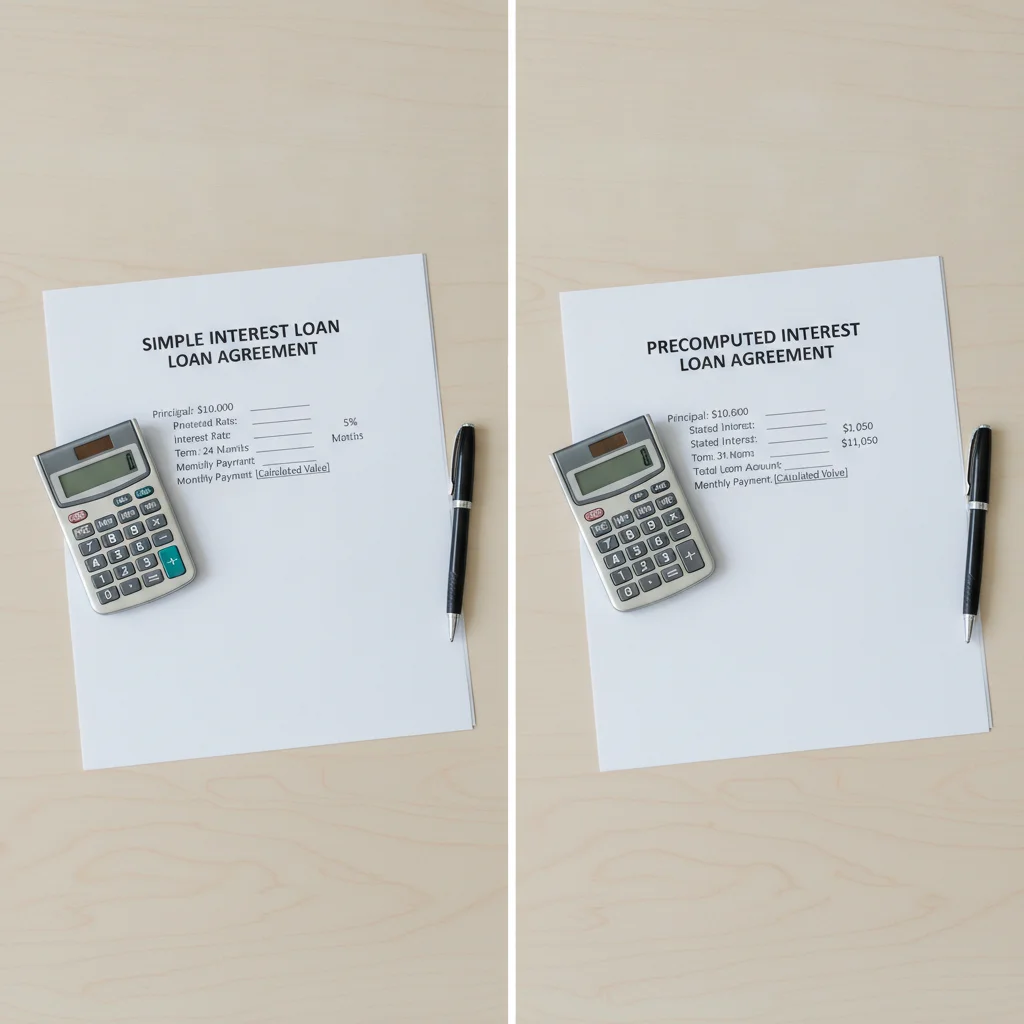
Auto loans almost universally use simple-interest amortization, meaning interest accrues daily on the outstanding principal balance rather than being precomputed on the original loan amount.
The Basic Mechanics of Loan Amortization
When you borrow money to buy a car, you don't repay the lender in one lump sum. Instead, you make a fixed monthly payment over the agreed loan term — 36 months, 60 months, 72 months, or some other duration. That steady payment schedule is called an amortizing loan, and the math that determines how each payment is divided is called amortization.
Here's the fundamental rule: interest is always calculated on the balance you currently owe, not the amount you originally borrowed. That single fact explains almost everything about how your payments behave over time.
At the start of your loan, your balance is at its highest point — whatever you financed. So the interest charge for month one is the largest it will ever be. After your payment is applied, some of it covers that interest, and whatever is left over reduces your principal. That reduced principal then generates a slightly smaller interest charge in month two. Month by month, the interest portion shrinks and the principal portion grows — even though your total payment amount never changes.
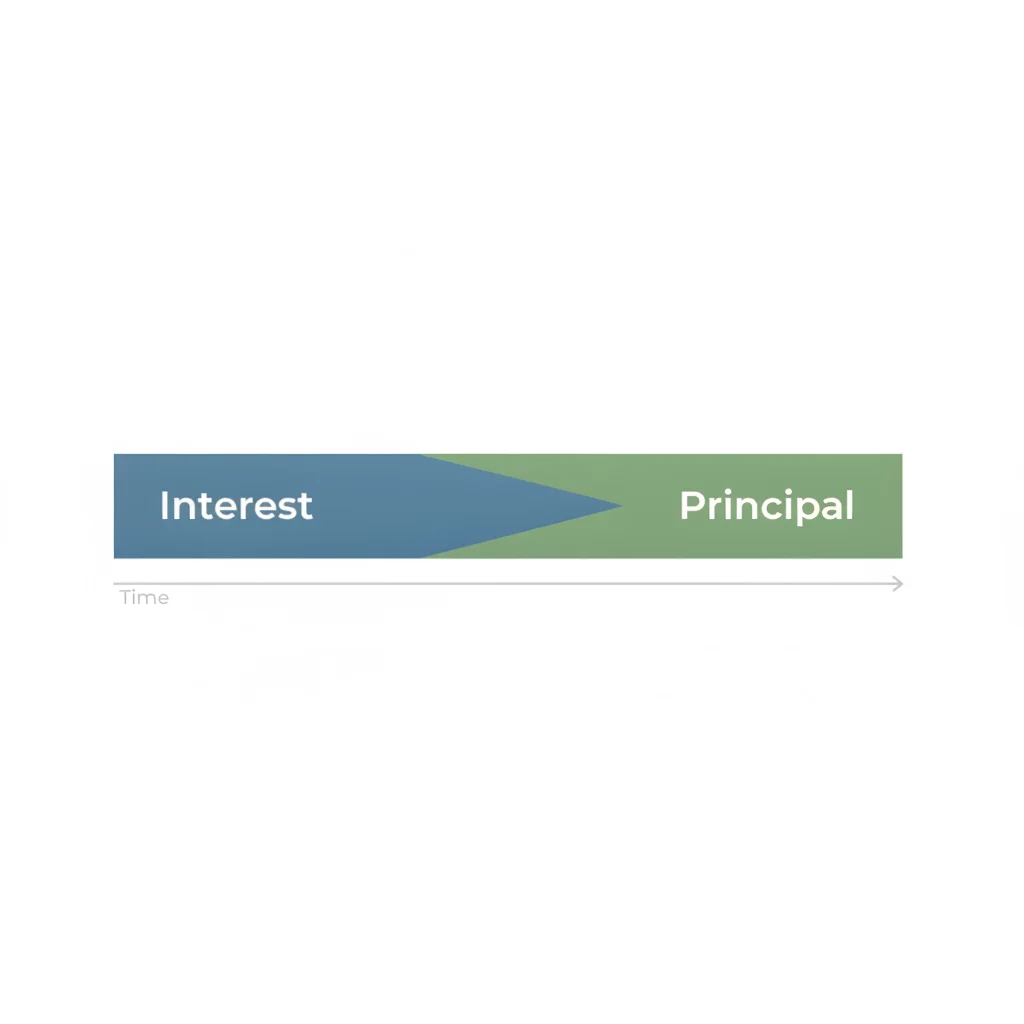
This gradual shift is the essence of amortization. It isn't random or unfair — it's simply math responding to a shrinking balance. But it has real consequences for when and how aggressively you should pay down your loan, which we'll explore in detail below.
How the Math Actually Works: A Step-by-Step Example
Let's walk through a concrete example so the numbers become intuitive rather than abstract.
Suppose you borrow $25,000 at an annual interest rate of 6% for 60 months. Your fixed monthly payment works out to approximately $483.32.
Here's how the first three payments break down:
| Payment # | Starting Balance | Interest Portion | Principal Portion | Ending Balance |
|---|---|---|---|---|
| 1 | $25,000.00 | $125.00 | $358.32 | $24,641.68 |
| 2 | $24,641.68 | $123.21 | $360.11 | $24,281.57 |
| 3 | $24,281.57 | $121.41 | $361.91 | $23,919.66 |
Notice that in payment #1, $125 goes to interest — that's 6% ÷ 12 months × $25,000. Only $358.32 actually reduces what you owe. By payment #60, those numbers have nearly reversed: almost the entire payment goes to principal because the balance is so small.
$4,999
Total interest on $25K at 6% for 60 months
Calculated using standard amortization formula on a $25,000 loan at 6% APR over 60 months.
~50%
Interest paid in first 30% of loan payments
On a typical 60-month simple-interest auto loan, roughly half of total interest is paid within the first 18 monthly payments.
$5,478
Extra interest cost of 72-month vs. 36-month loan
Comparison of total interest on a $25,000 loan at 6% APR illustrates how term length dramatically affects total cost.
85%
Share of new auto loans using simple interest
The vast majority of auto loans issued by banks, credit unions, and captive lenders use simple-interest amortization.
The interest calculation itself is straightforward: monthly interest = (annual rate ÷ 12) × current balance. On a simple-interest loan — which is what most auto loans use — this recalculates every month based on where your balance actually stands. If you've made extra payments and your balance is lower than scheduled, your interest charge drops accordingly. That's the mechanism that makes extra payments so effective. See our comparison of simple vs. precomputed interest to understand how your specific loan type affects this calculation.
How Loan Term Length Reshapes Everything
The single most powerful lever borrowers have when structuring an auto loan is the loan term. And amortization is the reason term length matters so much more than many buyers realize.
Lower Payment ≠ Lower Cost
It's easy to assume that a lower monthly payment is always the better deal — but amortization reveals the trade-off. Extending your term to reduce your payment means paying interest for more months on a larger balance. Always compare the total interest paid, not just the monthly obligation, before choosing a loan term.
Confirm Your Loan Uses Simple Interest
Most auto loans use simple interest, which means your extra payments immediately reduce the balance used to calculate future interest. A small number of loans — particularly some older dealership-arranged contracts — use precomputed interest, where the interest is locked in at origination regardless of when you pay. On precomputed loans, early payoff may not save you as much as you expect. Verify your loan type before planning extra payments.
Consider the same $25,000 loan at 6% APR across three different terms:
| Term | Monthly Payment | Total Interest Paid | Total Cost |
|---|---|---|---|
| 36 months | $760.55 | $1,379.80 | $26,379.80 |
| 60 months | $483.32 | $4,998.86 | $29,998.86 |
| 72 months | $414.69 | $6,857.68 | $31,857.68 |
Going from a 36-month to a 72-month loan cuts your monthly payment by roughly $346 per month — that feels significant. But it adds nearly $5,500 in total interest to the cost of the same vehicle. That's not a financing trick or a penalty. It's simply amortization doing its job: more months of borrowing means more months of interest accruing, even if each individual charge is smaller.
There's a secondary problem with longer terms: depreciation. Cars lose value fastest in their first few years. A 72-month loan stretches your payments across a period when the car's market value may drop faster than your balance shrinks. This is how buyers end up underwater — owing more on the loan than the car is worth. To understand how your down payment affects this dynamic from the start, see our hub on down payments.
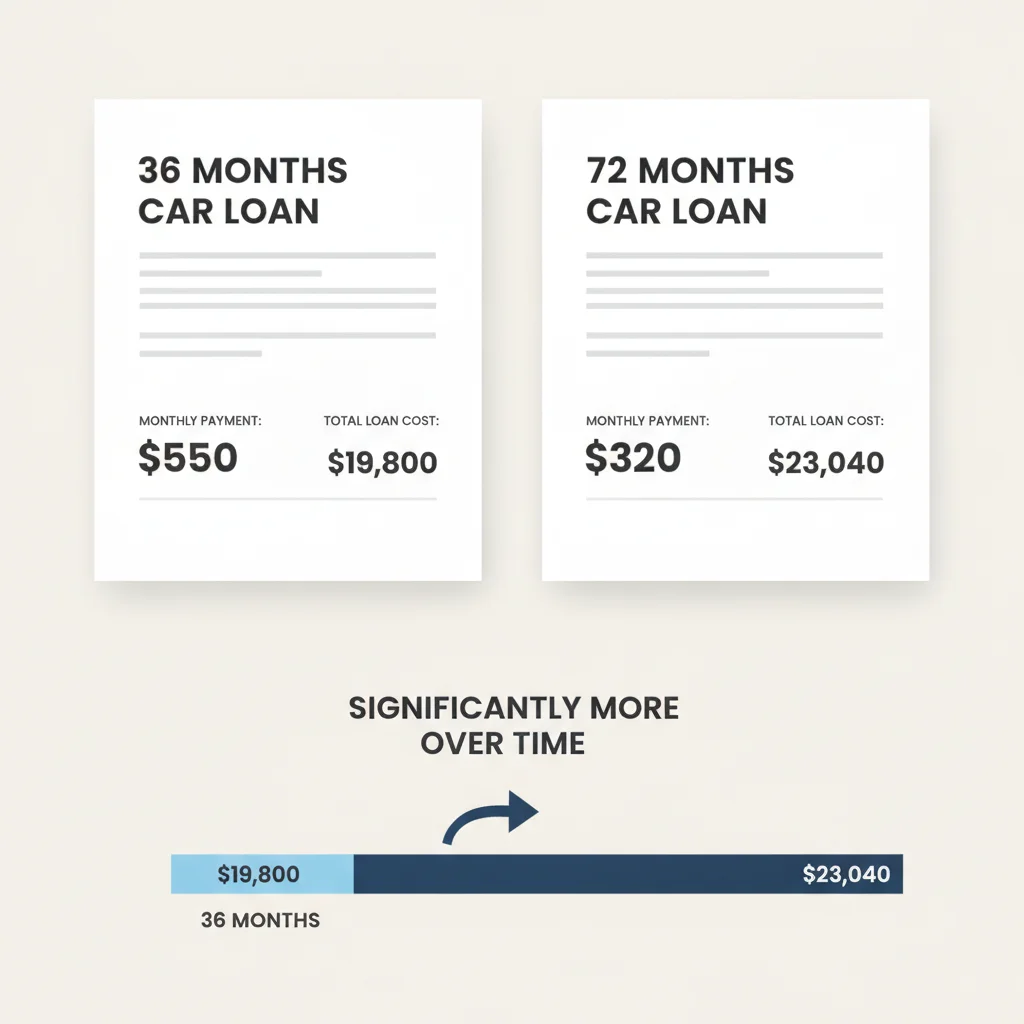
The practical takeaway: choose the shortest term whose monthly payment you can genuinely sustain in your budget. A lower monthly payment is only a benefit if you'd otherwise default — paying thousands more in interest to avoid a manageable extra $80 per month is rarely the better financial outcome.
The Front-Loading Effect: Why Early Payments Sting
Here's the aspect of amortization that surprises most first-time borrowers: you do most of your interest-paying upfront, even though the payments are spread evenly across the loan term.
On a 60-month loan at 6%, roughly half your total interest cost is paid in the first 18 months. You've made 30% of your payments but covered about 50% of your interest bill. This front-loading isn't a lender trick — it's a direct consequence of the balance being highest early in the loan when every dollar of interest is at its most expensive.
Make Extra Payments Early, Not Late
If you plan to pay extra on your auto loan, timing matters enormously. An additional $200 applied to principal in month three eliminates more total interest than the same $200 in month 40. That's because the earlier payment reduces a higher balance, which shrinks interest charges across a much longer remaining timeline. Front-load your extra payments whenever possible.
This is why financial advisors consistently recommend attacking principal early if you want to reduce total loan cost. Each extra dollar applied to principal in month three saves more than the same dollar applied in month 45, because it eliminates a larger compounding chain of future interest charges.
See our explanation of why early payments matter most for a deeper breakdown of the compounding math behind this effect.
“The single most underestimated factor in auto loan decisions is term length. Buyers focus on the monthly payment and forget to ask: 'How much will I actually pay for this car?' Amortization math answers that question precisely — if you know how to read it.”
— Greg McBride, Chief Financial Analyst, Bankrate
If you're evaluating your loan now and wondering what extra payments would actually do for your payoff timeline, the next step is to pull your amortization schedule. That document shows you exactly where you stand — payment by payment — and makes the early-payoff math tangible rather than theoretical.
Reading Your Amortization Schedule
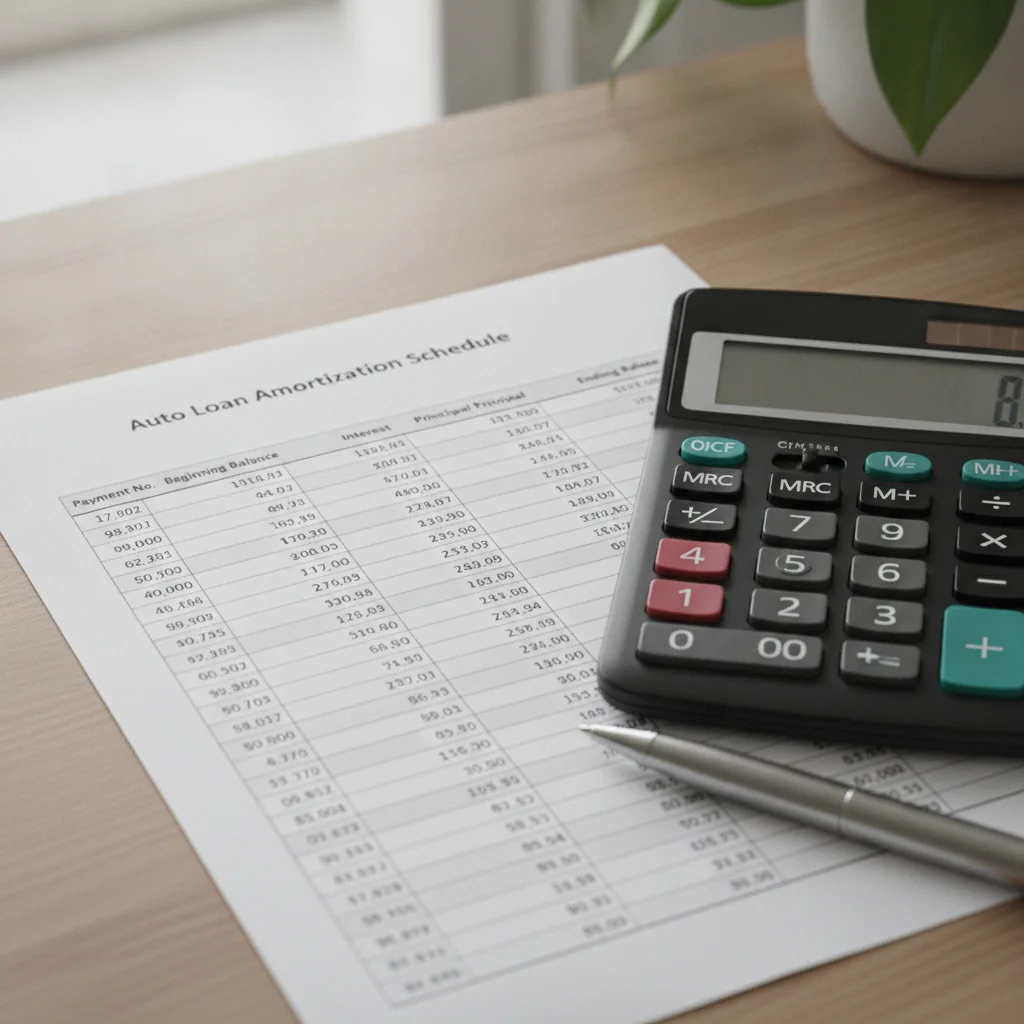
An amortization schedule is a table that maps out every single payment from the first to the last. For each payment, it shows:
- Payment number and due date
- Payment amount (fixed each month)
- Interest portion — how much goes to the lender's cost
- Principal portion — how much reduces your balance
- Remaining balance after that payment is applied
Your lender is required to provide this at loan closing. Most also make it available in their online account portal. If you can't locate yours, any free online amortization calculator can recreate it — you just need your loan amount, interest rate, and term.
The schedule is your most powerful tool for making payoff decisions. Want to know how much you'd save by paying an extra $100 per month? Compare your current schedule to a recalculated one with higher payments. Want to know your payoff quote before calling the lender? The schedule tells you your remaining balance on any given date, which is the starting point for that figure.
For a full walkthrough of how to interpret each column and use the schedule to guide your decisions, see reading an auto loan amortization schedule.
Using Amortization Knowledge to Make Better Loan Decisions
Understanding amortization isn't just an academic exercise — it changes the decisions you make when shopping for a loan and managing one you already have.
When shopping for a loan
Don't evaluate offers by monthly payment alone. Two loans can have identical monthly payments but wildly different total costs if the interest rates or terms differ. Ask lenders for the total interest paid figure, not just the monthly amount. The interest and APR hub explains how to compare the true cost of competing offers using APR rather than the stated rate alone.
When you're already in a loan
If you want to reduce what you'll ultimately pay, any extra money applied to principal ahead of schedule creates real savings through amortization. Even a one-time extra payment of $500 in the first year can save you more than $500 would in year four, because the earlier you reduce the balance, the fewer future months accumulate interest on it.
Lower Payment ≠ Lower Cost
It's easy to assume that a lower monthly payment is always the better deal — but amortization reveals the trade-off. Extending your term to reduce your payment means paying interest for more months on a larger balance. Always compare the total interest paid, not just the monthly obligation, before choosing a loan term.
Confirm Your Loan Uses Simple Interest
Most auto loans use simple interest, which means your extra payments immediately reduce the balance used to calculate future interest. A small number of loans — particularly some older dealership-arranged contracts — use precomputed interest, where the interest is locked in at origination regardless of when you pay. On precomputed loans, early payoff may not save you as much as you expect. Verify your loan type before planning extra payments.
Before making large extra payments, confirm your loan uses simple interest and has no prepayment penalty. Most auto loans have neither issue, but it's worth verifying — especially on loans originated through dealerships. Our glossary of early payoff terms covers prepayment penalties and payoff quotes in plain language.
For first-time borrowers
If this is your first auto loan, the single most actionable thing you can take from amortization math is this: borrow the smallest amount for the shortest term you can genuinely afford. Down payments help on both fronts — a larger down payment means a smaller loan balance from day one, which shrinks every interest charge across the entire schedule. First-time borrowers can also find a practical guide to early auto loan payoff strategies tailored to their situation.


All claims are backed by peer-reviewed research. Sources on request.