

Key Takeaways
Option A
Simple Interest Auto Loans
The flexible, borrower-friendly standard.
Best for: Borrowers who plan to make extra payments, pay off early, or want full control over their total interest cost.
Option B
Precomputed Interest Auto Loans
The fixed-cost, schedule-locked alternative.
Best for: Borrowers who intend to follow the exact payment schedule and will not pay off early or make extra principal payments.
If you plan to pay off the loan early or make lump-sum payments
Simple Interest Auto Loans
Every extra payment directly reduces the principal balance, which cuts the daily interest accrual immediately. You capture real savings instead of a partial rebate.
If you will make every payment exactly on schedule, never early or late
Precomputed Interest Auto Loans
If you follow the payment schedule perfectly, total cost is identical under both structures. The predictability of precomputed can work in this narrow scenario.
If you're concerned about the impact of occasional late payments
Simple Interest Auto Loans
Late payments do cause extra interest to accrue under simple interest, but the impact is transparent and proportional. Precomputed loans can obscure how falling behind affects your true balance.
If you're shopping at a buy-here-pay-here dealer with limited credit options
Simple Interest Auto Loans
Push back on precomputed terms if possible, or seek financing from a credit union first. The lack of early-payoff benefit on a precomputed loan is a significant disadvantage at high interest rates.
If you want maximum transparency on where every payment goes
Simple Interest Auto Loans
Simple interest amortization schedules clearly show the principal and interest split each month, giving you a real-time view of your payoff progress.
How Simple Interest Actually Works on an Auto Loan
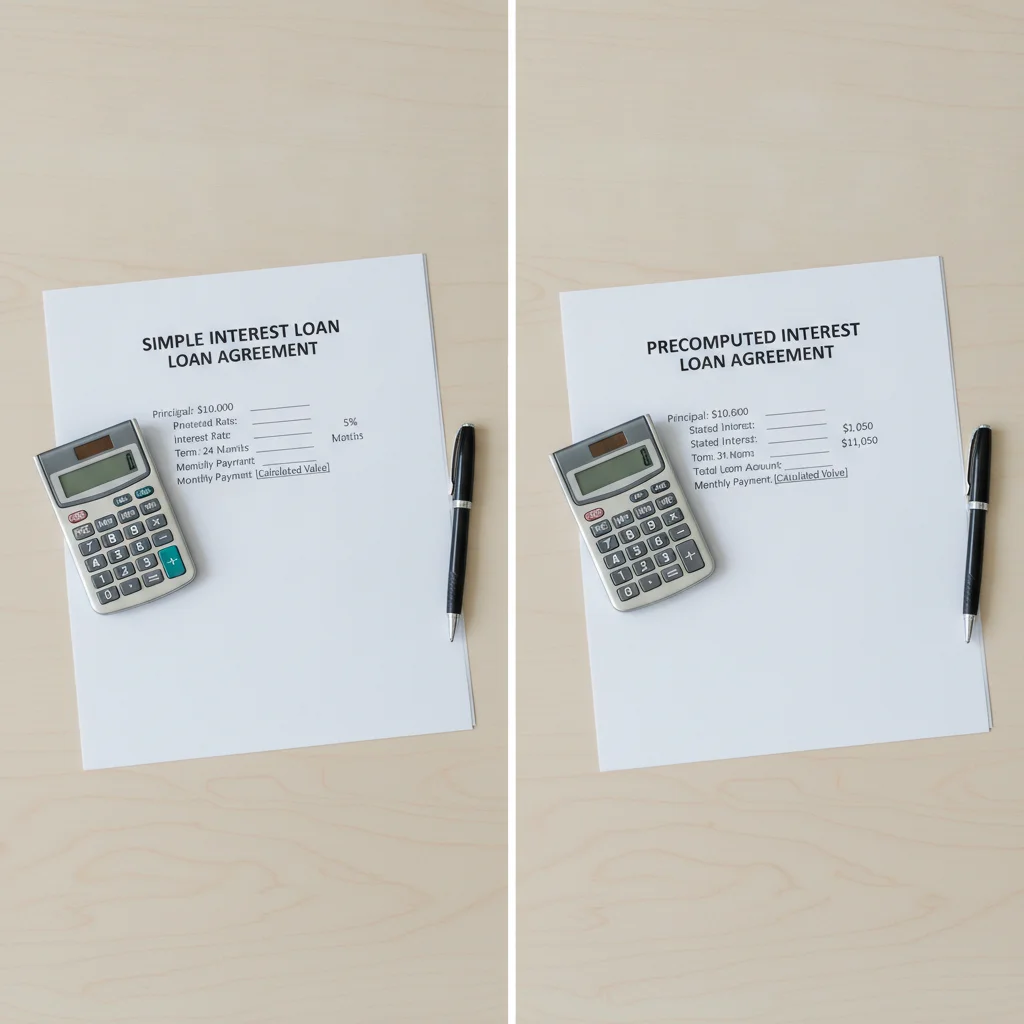
Simple interest is calculated on your current outstanding principal balance, and it resets every single day. The math is straightforward: take your annual interest rate, divide by 365, and multiply by the number of days since your last payment. Whatever you owe on that day — and only that — determines what interest accrues.
Here's what that looks like in practice. Say you borrow $25,000 at a 7% annual rate. Your daily interest rate is roughly 0.01918% (7% ÷ 365). If your balance is $20,000 at the time of your next payment, you owe $0.01918% × $20,000 = about $3.84 in interest that day. After 30 days since your last payment, the interest portion of that payment would be approximately $115.
The critical implication: any payment you make beyond the minimum immediately lowers the principal, which immediately reduces how much interest accrues tomorrow. This is why making one extra payment per year or rounding up to the nearest hundred dollars can shave months off a loan and save real money. It's not a trick — it's just arithmetic.

This structure also means payment timing matters. Pay two days early and you owe slightly less interest that month. Pay five days late and you owe slightly more. The lender doesn't pocket a windfall — you're just paying for the exact time you held the money. For a complete look at how principal and interest interact over a loan's life, see our guide to auto loan amortization.
Simple interest is the dominant structure at banks, credit unions, and manufacturer finance arms (like Ford Motor Credit or Toyota Financial Services). When you get preapproved for an auto loan through a traditional lender, simple interest is almost certainly what you're getting.
How Precomputed Interest Works — and Why It's Different
Precomputed interest takes a completely different approach. When you sign the loan, the lender calculates the total interest you would pay over the full loan term at that moment, adds it to your principal, and that combined number becomes your total obligation. Your monthly payment is simply that total divided by the number of payment periods.
The problem isn't the math — it's what happens when you try to leave early. Because the interest was calculated and committed at signing, paying off the loan ahead of schedule doesn't erase the interest you haven't yet reached on the schedule. Instead, lenders use a formula called the Rule of 78s (or a similar actuarial method) to determine how much of the precomputed interest you've already "used up." You receive a rebate for the unused portion — but that rebate is always less than the interest you would have paid under a simple interest loan for the same payoff date.
| Criterion | Simple Interest | Precomputed Interest |
|---|---|---|
| How interest is calculated | Daily, on current balance | Upfront, on full loan term |
| Early payoff savings | Full savings — interest stops accruing | Partial rebate only via Rule of 78s |
| Extra payments benefit | Yes — reduces principal and future interest | No — does not reduce total interest owed |
| Transparency of cost | High — amortization schedule shows split | Lower — total interest fixed at signing |
| Where it's most common | Banks, credit unions, captive lenders | Buy-here-pay-here dealers, some finance cos. |
| Impact of late payments | More interest accrues — proportional | Schedule disruption, complex effect on balance |
| Borrower flexibility | High | Low |
Here's a concrete example. On a $20,000 precomputed loan at 9% over 48 months, the total interest might be $3,870, built into a total obligation of $23,870. If you pay it off after 24 months, the Rule of 78s rebate might return roughly $930 — meaning you paid about $2,940 in interest for a 2-year loan. On a simple interest loan with the same terms and payoff date, you'd owe closer to $1,700 in total interest. The gap is real and it compounds at higher rates.
The Rule of 78s Is Declining But Not Gone
Many states have restricted or outright banned the Rule of 78s on consumer auto loans, particularly for longer loan terms. However, it still appears in some contracts — especially through smaller finance companies and buy-here-pay-here dealers operating in states with fewer restrictions. Always check the specific laws in your state and read the prepayment disclosure section of any loan agreement before signing.
Precomputed Loans Are Legal — Just Less Flexible
A precomputed loan is not inherently a scam or illegal product. For a borrower who genuinely intends to pay every installment on schedule and has no realistic path to early payoff, the cost structure is identical to simple interest. The problem arises when borrowers assume they'll benefit from paying ahead — and they won't, or won't fully. Disclosure requirements exist precisely to ensure borrowers understand this before signing.
Precomputed loans are most common through buy-here-pay-here dealers and some smaller finance companies that serve borrowers with thin or damaged credit. They're rarely offered by banks or credit unions, and they're prohibited for federally chartered banks in some loan categories. If you see the words "precomputed" or "Rule of 78s" in a loan contract, stop and do the payoff math before signing.
Head-to-Head Comparison: What the Numbers Reveal
The table below cuts through the definitions and shows exactly how these two structures differ across the criteria that matter most to a car buyer. Keep in mind that the differences are most pronounced when there's any chance of early payoff or extra payments.
Rule of 78s
Rebate method on precomputed loans
This front-loading formula means borrowers who pay off early in a 48-month loan may forfeit 15–20% more interest than under simple interest, according to consumer finance research.
~85%
Auto loans using simple interest
The vast majority of auto loans from traditional lenders use simple interest; precomputed structures are concentrated in subprime and buy-here-pay-here segments.
$1,200+
Potential extra cost of precomputed early payoff
On a $20,000 loan at 9% over 48 months paid off at 24 months, a precomputed borrower can pay over $1,200 more in interest than a simple interest borrower in the same scenario.
61 months
Max loan length for Rule of 78s in many states
Several U.S. states have banned the Rule of 78s on loans longer than 61 months due to its disproportionate impact on borrowers who pay early.
One area that surprises many borrowers is the treatment of late payments. On a simple interest loan, paying late causes a few extra dollars of interest to accrue — annoying, but proportional and transparent. On a precomputed loan, a late payment can trigger a different problem: because the payment schedule is locked in, consistently late payments can cause you to owe more than you expected at payoff even though the interest was supposedly fixed upfront.
If you want to stress-test the numbers for your specific loan amount, rate, and payoff timeline, our guide to calculating total interest paid walks through the exact formulas side by side.
The Rule of 78s: Why Early Payoff Saves Less Than You Expect
If a precomputed loan uses the Rule of 78s, you need to understand how the rebate calculation works — because it's systematically biased toward the lender in the early months of the loan.
The name comes from the sum of digits 1 through 12, which equals 78 (for a 12-month loan). For a 48-month loan, the sum of digits 1 through 48 equals 1,176. Under this method, the lender assigns more interest to the early payments and less to the later ones. In the first month of a 48-month loan, the lender considers 48/1,176 of the total interest "earned." In the last month, only 1/1,176 is earned.
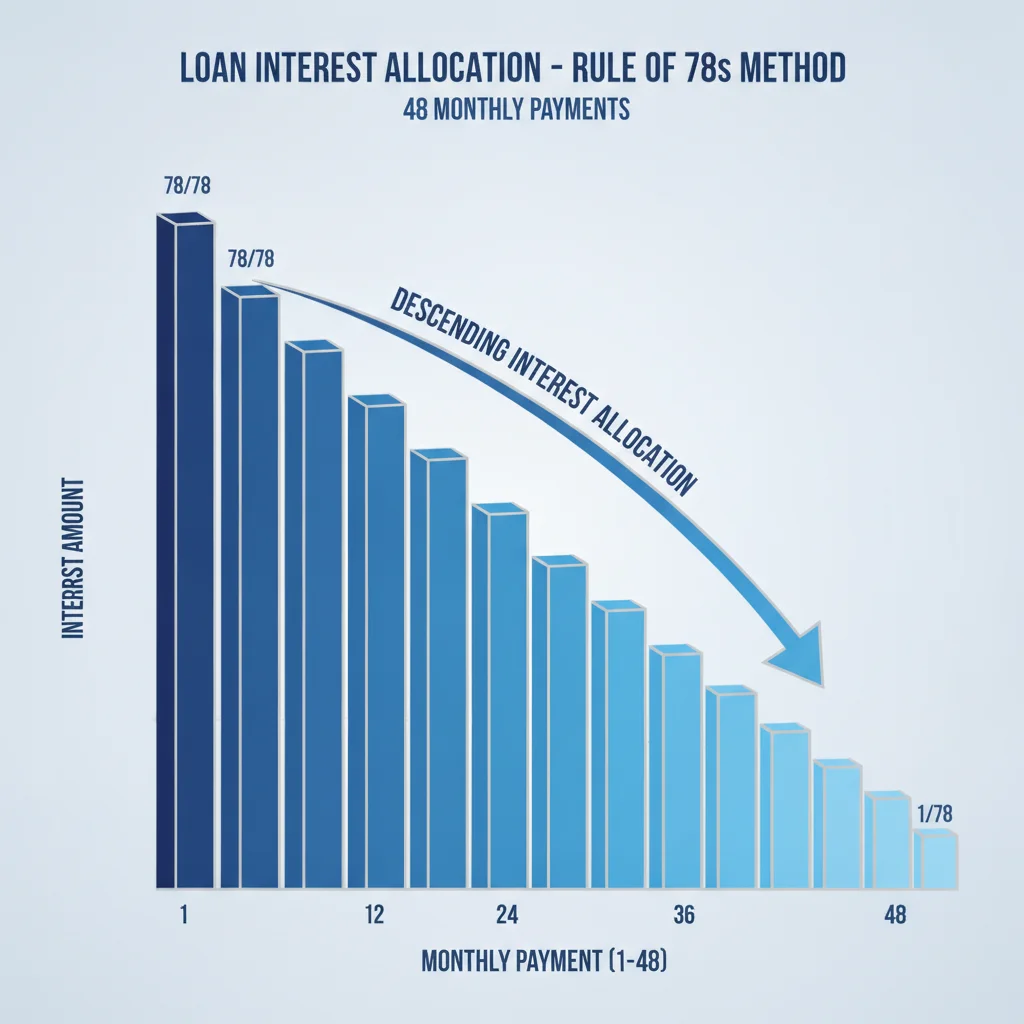
In practice, this means that if you pay off a 48-month precomputed loan after just 12 months, you might expect to have used roughly 25% of the interest — but the Rule of 78s says you've actually used closer to 40% or more. The lender earned that front-loaded interest the moment the loan was structured. Your rebate is real, but smaller than intuition suggests.
The Federal Trade Commission has flagged the Rule of 78s as potentially harmful to consumers, and several states have restricted or banned it for loans longer than 61 months. Some lenders now use actuarial methods for the rebate calculation, which are slightly more favorable to the borrower but still not equivalent to simple interest savings. Either way, the principle holds: early payoff on a precomputed loan returns less money than early payoff on a simple interest loan.
For first-time buyers especially, the implications of this structure can come as a shock when they go to trade in or refinance. Our early payoff guide for first-time borrowers explains how to plan around both loan types.
How to Identify Which Type of Loan You're Being Offered
Lenders aren't required to announce "this is a precomputed loan" in large print. Here's how to find out before you sign:
- Look at the contract's "Amount Financed" vs. "Total of Payments" section. On a simple interest loan, the gap between these numbers is the interest you'll pay if you follow the schedule exactly. On a precomputed loan, the interest is already baked into the "Total of Payments" and you'll also see it disclosed as part of a fixed finance charge.
- Search for "Rule of 78s" or "precomputed" anywhere in the loan agreement. If you find either phrase, you're looking at a precomputed structure. Ask the lender to explain the early payoff rebate formula.
- Ask directly: "If I pay this loan off six months early, what is my exact payoff amount that day?" A simple interest lender can calculate this precisely. A precomputed lender will give you the total minus a rebate — get that rebate formula in writing.
- Check the "prepayment penalty" disclosure. While precomputed loans don't always call the rebate shortfall a penalty, the economic effect is the same. Know what you're giving up.
If you're comparing loan offers across multiple lenders, the loan terms explained hub is a useful reference for decoding the language in each contract before you commit.
Also worth noting: the interest structure is completely separate from whether your rate is fixed or variable. You can have a fixed-rate precomputed loan or a fixed-rate simple interest loan. For a breakdown of the rate type question, see our comparison of fixed vs. variable interest rates on auto loans.
Which Structure Should You Choose?
The answer is almost always simple interest — not because precomputed loans are inherently predatory, but because simple interest gives you options that precomputed loans eliminate. The ability to pay ahead and directly reduce your interest burden is real economic value. Giving that up costs money.
The only scenario where a precomputed loan doesn't hurt you is if you make every payment on the exact due date, never pay extra, and never pay off early. That's a specific and rigid set of conditions. Life rarely cooperates: you get a bonus, you want to trade in, you refinance to a lower rate. Any of those moves on a precomputed loan results in a smaller benefit than you'd get from simple interest.
If a buy-here-pay-here dealer is your only financing option because of credit history, a precomputed loan may be unavoidable in the short term. In that case, focus on rebuilding credit quickly so you can refinance into a simple interest loan. Even moving from a 20% precomputed loan to a 15% simple interest loan saves significantly — not just because of the rate, but because you regain the payoff flexibility.
For buyers with decent credit, shop lenders before you shop cars. Get preapproved through a credit union or bank — both almost exclusively use simple interest structures — and walk into the dealership with financing already in hand. The dealer's finance office may offer a competitive rate on a simple interest loan, but you'll negotiate from a position of knowledge rather than necessity.
Bottom line: understand what type of loan is on the table before you sign anything. The monthly payment is not the whole story. The interest structure determines what happens to every dollar you pay and every dollar you might pay early. That's worth two minutes of due diligence at the contract table.
All claims are backed by peer-reviewed research. Sources on request.