Key Takeaways
Our Verdict
Neither a short-term nor a long-term refinance is universally better — the right choice depends entirely on your financial situation, current rate environment, and how much equity you hold in the vehicle. If your income is stable and you can handle higher payments, a shorter term almost always wins on total cost. If cash flow is tight or you're facing financial stress, a longer term buys breathing room, but go in with eyes open about what it will cost you over time.
| Best for | Recommended |
|---|---|
| Borrowers with stable income who want to minimize total interest | Short-Term Refinancing |
| Those facing monthly budget pressure or income disruption | Long-Term Refinancing |
| Borrowers early in their original loan with improved credit | Short-Term Refinancing |
| Borrowers deep into repayment looking to reduce payments temporarily | Long-Term Refinancing |
Why Loan Term Is the Most Overlooked Refinancing Decision
When most people think about refinancing their auto loan, the first question they ask is: Can I get a lower interest rate? That's the right instinct — but it's only half the equation. The other half is the loan term you select, and it can matter just as much as your new rate when it comes to what you actually pay.
Here's why: a lower rate on a longer term doesn't automatically save you money. In fact, you can refinance to a rate that's a full percentage point lower and still pay more in total interest if you tack on two extra years. The math doesn't lie, but it can mislead if you're only looking at the monthly payment number.
Understanding the fundamentals of loan terms — what they mean for your monthly payment, your total cost, and your equity position — is the foundation for making a smart refinancing call. This article walks through exactly how to think about that trade-off, with real numbers to back it up.
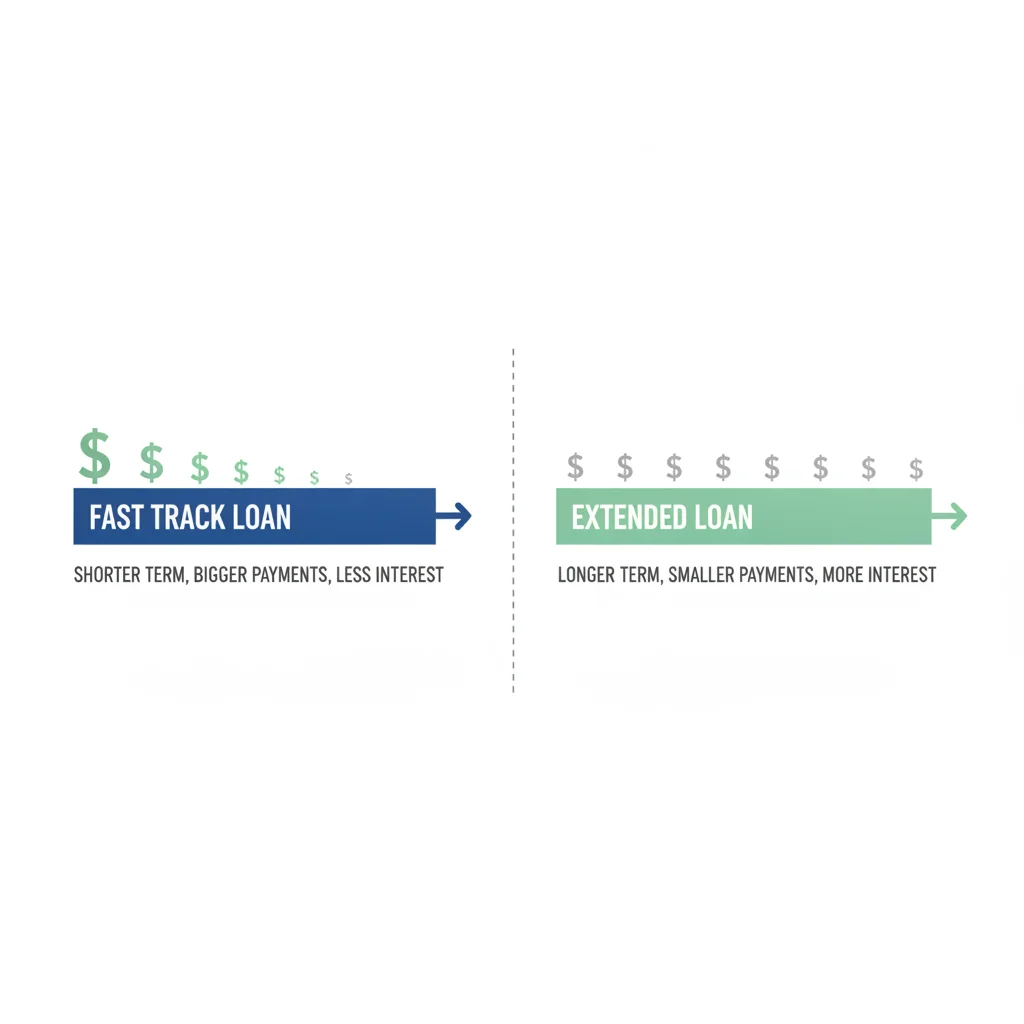
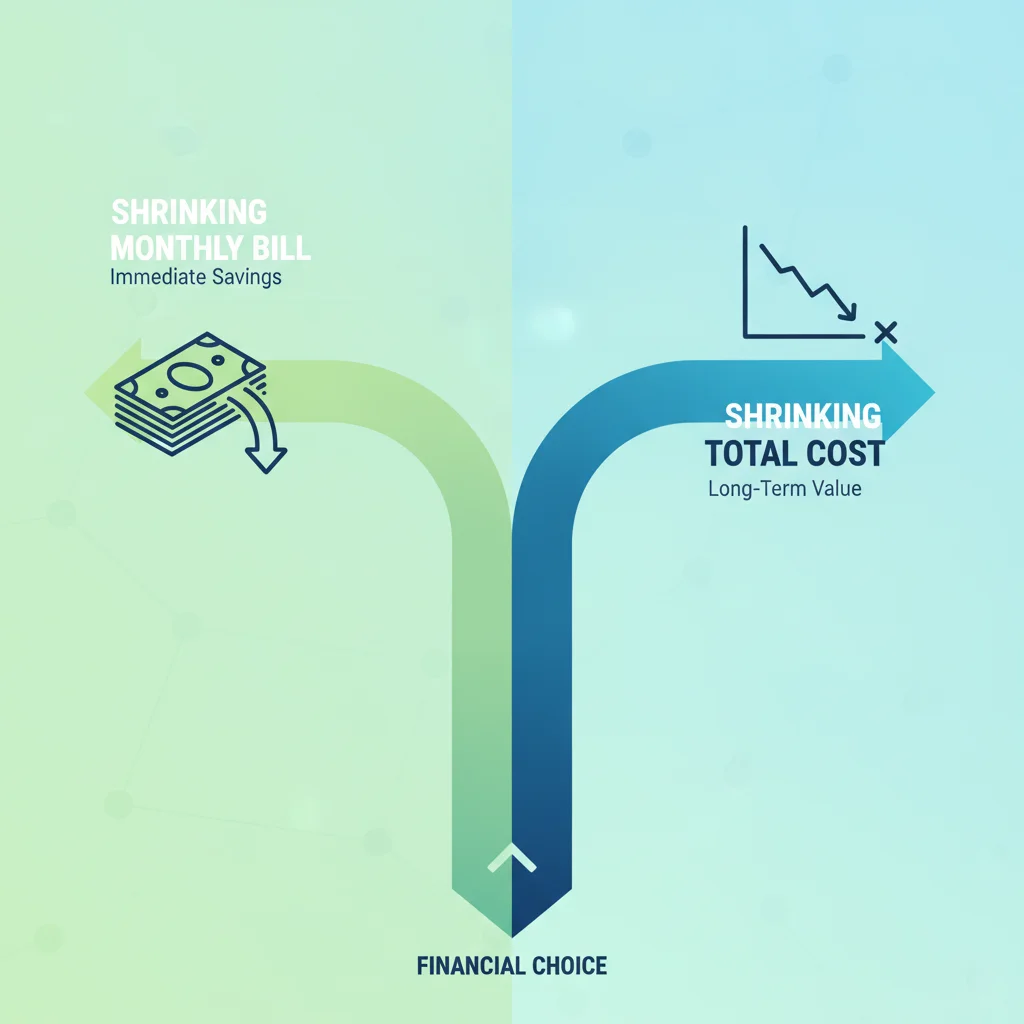
The core tension is simple: shorter terms mean higher monthly payments but less total interest. Longer terms reduce what you pay each month but cost more over time. Neither is categorically better. What matters is which one fits your real financial picture right now — and over the remaining life of the vehicle.
How Short-Term Refinancing Works
Refinancing into a shorter loan term means you're committing to pay off the remaining balance faster than your current schedule. If you have 54 months left on your original loan and refinance into a 36-month term, you're compressing the payoff window by a year and a half.
The immediate effect is a higher monthly payment. The long-term effect is less interest paid — sometimes dramatically less — because the lender has your money for a shorter period. Since auto loan interest is calculated on your outstanding balance, paying down that balance faster means interest accrues on a shrinking principal more quickly.
A Concrete Example
Let's say you owe $18,000 on your current loan with 60 months remaining at 8.5% APR. Your monthly payment is about $369, and you'd pay roughly $4,140 in interest over those five years.
Now you refinance to a 36-month term at 6.2% APR (reflecting improved credit or a better rate environment). Your new monthly payment rises to approximately $549 — that's $180 more per month. But your total interest drops to about $1,764. You save over $2,300 in interest and own the car free and clear two years sooner.
Run the Full Amortization Before Deciding
Before accepting any refinancing offer, ask your lender or use an online amortization calculator to see the total interest you'll pay over the life of each term option. A $50 difference in monthly payments can represent a $2,000+ difference in total interest — a number that's invisible if you only compare payment amounts. Make this calculation a non-negotiable step in your process.
Build Equity Faster with Short-Term Refinancing
If your car is less than four years old and you're planning to keep it, refinancing to a shorter term is one of the most reliable ways to build equity quickly. Faster principal paydown means the gap between what you owe and what the car is worth closes sooner, reducing your risk if circumstances change. Check the current market value of your vehicle before refinancing to understand your starting equity position.
Use the Hybrid Payment Strategy Strategically
Choosing a moderately longer term and voluntarily paying extra each month combines flexibility with interest savings — but only if you're genuinely disciplined about overpaying. Before adopting this approach, check that your new loan has no prepayment penalty and set up automatic extra payments rather than relying on willpower. Automating the extra payment removes the temptation to skip it when the month gets tight.
For borrowers who secured their original loan with poor credit and have since improved their score, a shorter refinance term can be especially powerful. You're compounding two advantages: a lower rate and a compressed repayment window. See how timing within your loan's life cycle affects these savings further.
When a Shorter Term Makes Sense
- Your income has increased since you took out the original loan
- You've improved your credit score and qualify for a meaningfully lower rate
- You want to build equity faster and avoid being underwater on the vehicle
- You plan to keep the car long-term and want it paid off sooner
- You're early in the original loan, so the interest savings are maximized
How Long-Term Refinancing Works
Refinancing into a longer term stretches your repayment period — and your monthly obligation shrinks accordingly. If you owe 42 months on your current loan and refinance into a 60-month term, you've just added 18 months to your payoff timeline.
The appeal is obvious: immediate cash flow relief. For someone dealing with a job change, a medical expense, or simply a budget that's gotten tighter, reducing a $450 payment to $310 can be the difference between making rent and not. That's a legitimate use of this tool — but it comes with a cost that's easy to underestimate.
The Same Example, Extended
Using the same scenario — $18,000 balance, 60 months remaining, current rate of 8.5% — suppose instead you refinance into a 72-month term at 7.1% APR (a modest rate improvement, but not dramatic). Your monthly payment falls to approximately $307. That's $62 less than what you're paying now.
But here's what happens on the back end: you now pay interest for six years instead of five, and your total interest paid over the new loan is roughly $4,104. You've barely reduced your interest burden despite getting a lower rate — because the longer term has eaten up most of the savings.
Long Terms Can Deepen Negative Equity
If you're already underwater on your vehicle — meaning you owe more than it's worth — refinancing into a longer term will make that problem worse, not better. You'll be slower to pay down principal while the car continues to depreciate. Before refinancing, look up your car's current market value and compare it to your payoff amount. If you're significantly underwater, consider whether refinancing makes sense at all right now.
Avoid Refinancing in the Final Months of Your Loan
Most of the interest on an auto loan is paid in the early months due to amortization. If you're in the last 12 to 18 months of your original term, you've already paid the bulk of the interest — and refinancing will reset that structure, costing you more interest on your remaining balance than you'd pay by simply finishing the original loan. Always calculate the break-even point before refinancing late in your loan term.
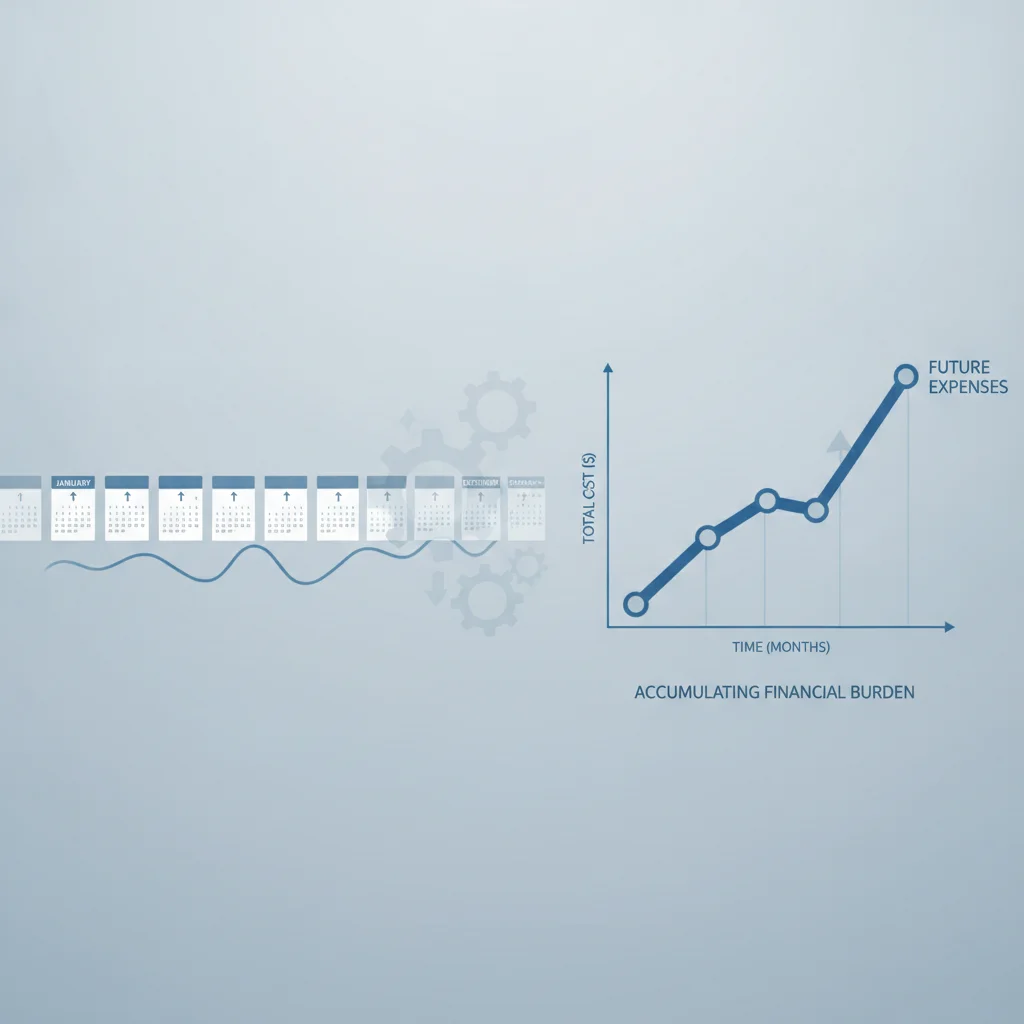
One of the most important things to understand about long-term refinancing is the trade-off between lower payments and total interest cost. Stretching your term also increases the risk of going underwater — owing more than the car is worth — which can create serious problems if you need to sell or your vehicle is totaled.
When a Longer Term May Make Sense
- You're experiencing genuine financial hardship and need immediate payment relief
- Your income is temporarily reduced but expected to recover
- The alternative is missing payments or defaulting
- You're getting a significantly lower interest rate that partially offsets the extended timeline
- You fully understand and accept the increased total cost
For a deeper look at the specific risks and benefits, the pros and cons of extending your loan term are worth working through before you commit.
Side-by-Side: Real Cost Comparison
Numbers make this clearer than words. The table below compares three refinancing scenarios starting from the same baseline: $18,000 remaining balance on an original loan at 8.5% APR with 60 months left. Each column shows a different refinancing path.
| Keep Original Loan | Refinance: 36-Month Term | Refinance: 48-Month Term | Refinance: 72-Month Term | |
|---|---|---|---|---|
| Starting Balance | $18,000 | $18,000 | $18,000 | $18,000 |
| Interest Rate (APR) | 8.5% | 6.2% | 6.7% | 7.1% |
| Monthly Payment | $369 | $549 | $431 | $307 |
| Total Interest Paid | $4,140 | $1,764 | $2,688 | $4,104 |
| Total Amount Paid | $22,140 | $19,764 | $20,688 | $22,104 |
| Months to Payoff | 60 | 36 | 48 | 72 |
| Interest Saved vs. Original | — | $2,376 | $1,452 | $36 |
What the table shows clearly: the monthly payment difference between a 36-month and a 72-month refinance is significant — but the total interest difference is even more striking. The 72-month path costs nearly $2,400 more in interest than the 36-month path, even though both carry lower rates than the original loan.
$2,376
Interest saved: 36-month vs. keeping original loan
Based on the $18,000 sample scenario above, refinancing to a 36-month term at 6.2% APR versus staying at 8.5% for 60 months.
84 months
Maximum auto loan term now offered by some lenders
According to Experian's State of the Automotive Finance Market, seven-year auto loans have become increasingly common, raising total interest exposure significantly.
38%
Share of new auto loan borrowers choosing 61–72 month terms
Experian's 2023 automotive finance data shows long-term loans dominate new vehicle financing, often prioritizing payment size over total cost.
$612
Average monthly new car payment in the U.S.
Experian reported the average new vehicle monthly payment reached $612 in Q4 2023, making payment-reduction refinancing a common goal.
The key insight is that interest rate and loan term work together. A great rate on a long term can produce a worse total outcome than a merely decent rate on a short term. This is why understanding how APR affects your true loan cost is essential before you sign anything.
The Equity Factor: Don't Ignore Where You Stand
Beyond monthly payments and total interest, there's a third dimension that many borrowers overlook: equity. Your equity is the difference between what the car is worth and what you still owe. It matters because a car with negative equity — where you owe more than the vehicle's market value — puts you in a vulnerable position.
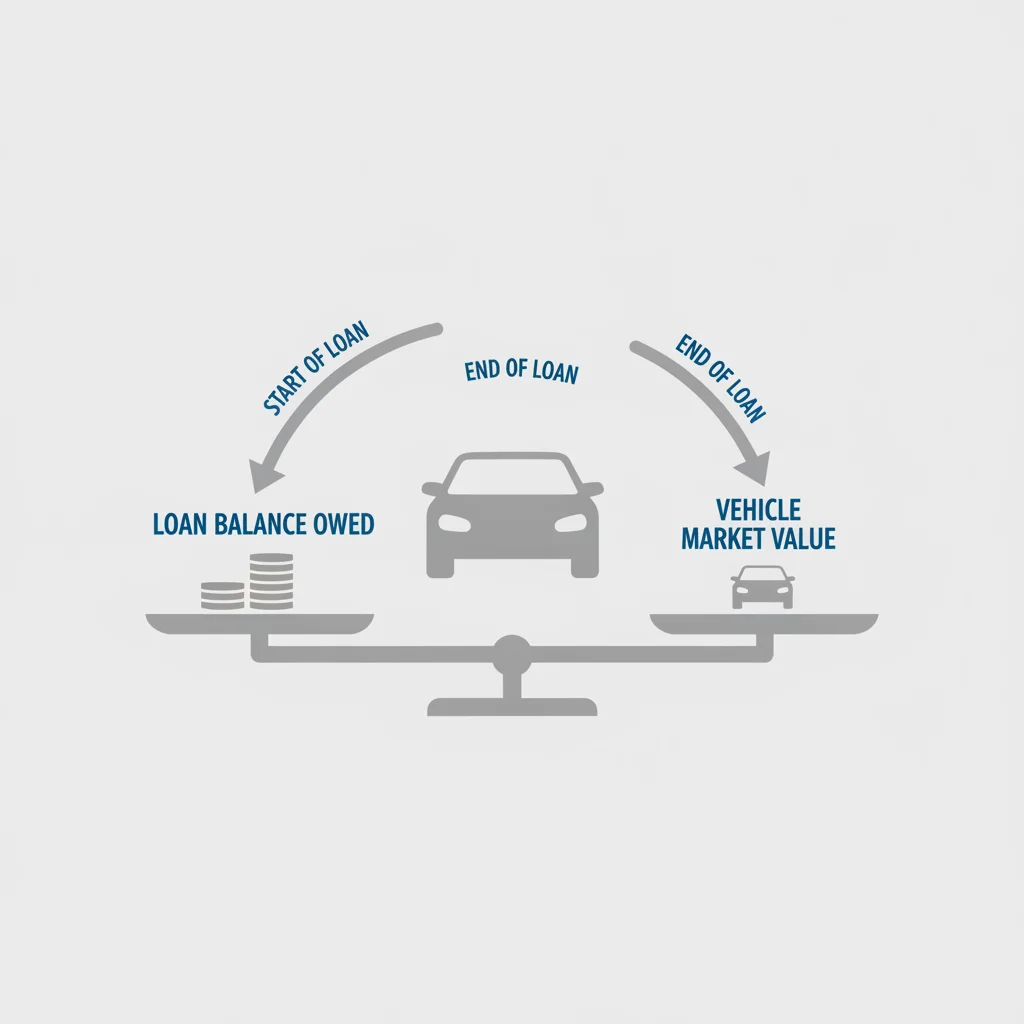
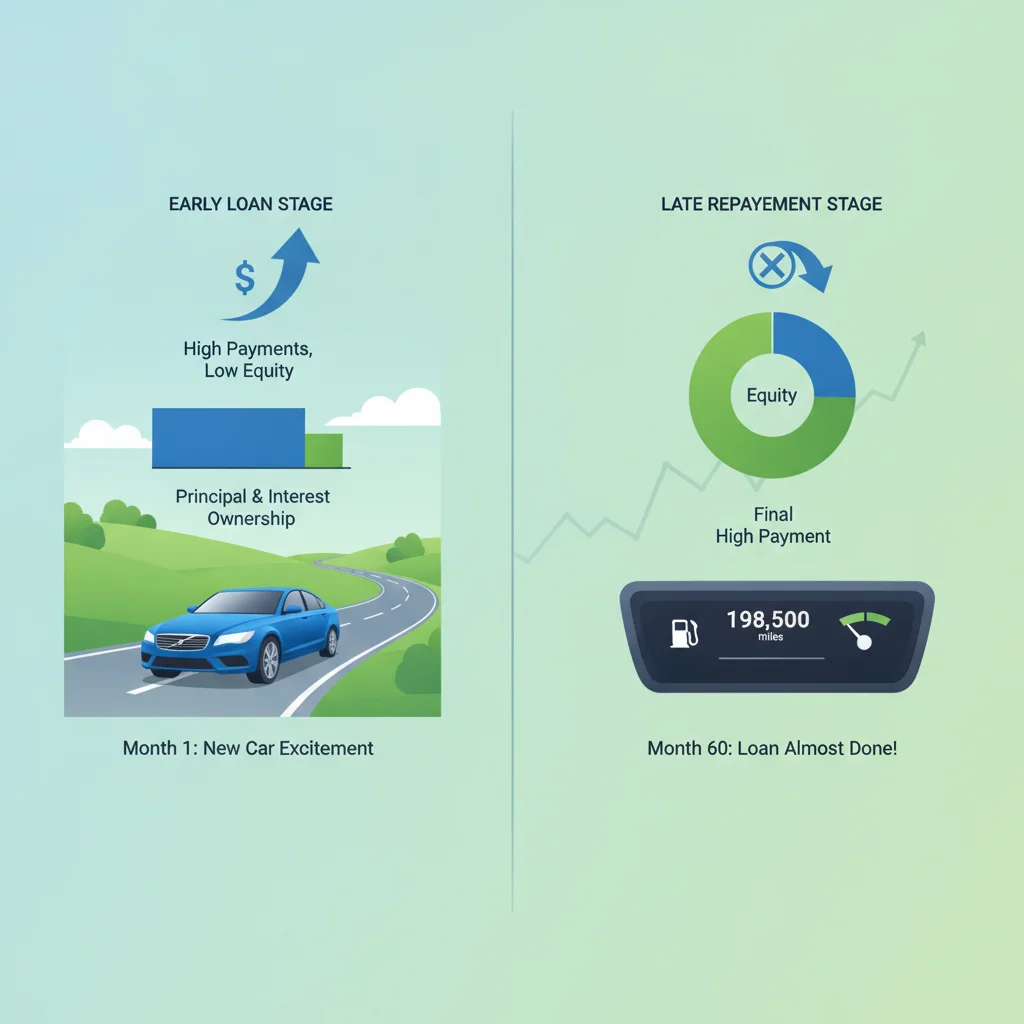
When you refinance into a longer term, you slow down the rate at which you build equity. Because auto loans are front-loaded with interest (a concept called amortization), you pay mostly interest in early months and more principal later. Extending your term resets this clock in part, meaning more of each new payment goes to interest initially rather than reducing what you owe.
A vehicle that depreciates faster than you're paying down your principal creates negative equity. If the car is then totaled, stolen, or you need to sell it, you could owe your lender money out of pocket even after the insurance settlement or sale proceeds.
Shorter-term refinancing, by contrast, accelerates your equity build. You're paying down principal faster, which means the gap between what you owe and what the car is worth closes sooner. This is particularly valuable for vehicles that depreciate quickly — which is most of them.
For a fuller picture of how your loan length should reflect your overall financial situation, picking a term that fits your circumstances covers the decision factors comprehensively.
Run the Full Amortization Before Deciding
Before accepting any refinancing offer, ask your lender or use an online amortization calculator to see the total interest you'll pay over the life of each term option. A $50 difference in monthly payments can represent a $2,000+ difference in total interest — a number that's invisible if you only compare payment amounts. Make this calculation a non-negotiable step in your process.
Build Equity Faster with Short-Term Refinancing
If your car is less than four years old and you're planning to keep it, refinancing to a shorter term is one of the most reliable ways to build equity quickly. Faster principal paydown means the gap between what you owe and what the car is worth closes sooner, reducing your risk if circumstances change. Check the current market value of your vehicle before refinancing to understand your starting equity position.
Use the Hybrid Payment Strategy Strategically
Choosing a moderately longer term and voluntarily paying extra each month combines flexibility with interest savings — but only if you're genuinely disciplined about overpaying. Before adopting this approach, check that your new loan has no prepayment penalty and set up automatic extra payments rather than relying on willpower. Automating the extra payment removes the temptation to skip it when the month gets tight.
Factors That Should Drive Your Decision
There's no formula that spits out the right loan term for everyone — but there are concrete factors you can evaluate to make a clear-headed decision. Work through each of these before you contact lenders.
1. Your Monthly Cash Flow
Start with your actual budget. Pull up your monthly income and fixed expenses. How much wiggle room do you genuinely have? If a shorter term would bring your payment to the point where an unexpected expense would derail you, that's a real risk worth weighing. Aim for a payment that's challenging but not precarious.
2. How Much You'll Save in Total Interest
Run the numbers for each scenario. Most lenders offer payment calculators online, or you can use any loan amortization calculator. Compare the total interest paid — not just the monthly payment — for each term option you're considering. The difference often surprises people.
3. Your Current Equity Position
Look up your car's current market value (Kelley Blue Book and Edmunds are solid references) and compare it to your payoff amount. If you're already underwater, a longer term digs the hole deeper. If you have positive equity, you have more flexibility.
4. How Long You Plan to Keep the Car
If you're planning to sell or trade in within two years, a longer term might cost you less overall than you'd expect — because you'd pay it off early anyway. If you're driving this car into the ground, a shorter term that gets you to zero faster gives you years of payment-free ownership.
5. Your Rate Improvement
The better the rate you can secure, the more a shorter term makes sense — because the payment increase from a shorter term is offset by lower interest. If your rate improvement is modest, a shorter term's higher payment may not produce enough total savings to justify the cash flow sacrifice. The short vs. long auto loan term trade-off framework can help you work through this calculation.
6. Income Stability
If your income is variable — freelance, commission-based, or subject to seasonal swings — a longer term gives you lower required payments and more room to make extra payments when income is strong. A shorter term locks you into a higher fixed obligation every month regardless of income variation.

A Strategy Most Borrowers Miss: The Hybrid Approach
Here's something worth knowing: your loan term sets your minimum payment — not your actual payment. If you refinance into a 48-month term, nothing stops you from paying extra each month when your budget allows. That extra payment goes directly to principal, which accelerates payoff and cuts total interest, effectively giving you the benefits of a shorter term without the rigid obligation.
This matters because life is unpredictable. You might refinance in January with a great job and strong cash flow, and by April your circumstances have changed. If you locked into a 36-month term with a $580 monthly payment, you're committed to that number. But if you took a 48-month term with a $460 payment and were voluntarily paying $580, you have the option to dial back to $460 when things get tight — without missing a payment or hurting your credit.
Run the Full Amortization Before Deciding
Before accepting any refinancing offer, ask your lender or use an online amortization calculator to see the total interest you'll pay over the life of each term option. A $50 difference in monthly payments can represent a $2,000+ difference in total interest — a number that's invisible if you only compare payment amounts. Make this calculation a non-negotiable step in your process.
Build Equity Faster with Short-Term Refinancing
If your car is less than four years old and you're planning to keep it, refinancing to a shorter term is one of the most reliable ways to build equity quickly. Faster principal paydown means the gap between what you owe and what the car is worth closes sooner, reducing your risk if circumstances change. Check the current market value of your vehicle before refinancing to understand your starting equity position.
Use the Hybrid Payment Strategy Strategically
Choosing a moderately longer term and voluntarily paying extra each month combines flexibility with interest savings — but only if you're genuinely disciplined about overpaying. Before adopting this approach, check that your new loan has no prepayment penalty and set up automatic extra payments rather than relying on willpower. Automating the extra payment removes the temptation to skip it when the month gets tight.
This hybrid strategy works best when your rate is low enough that the interest cost of the longer term is manageable, and when your discipline around extra payments is realistic. Be honest with yourself: will you actually pay extra? If the answer is genuinely yes, refinancing into a moderately longer term with a plan to overpay can give you both flexibility and interest savings.
The flip side: if you know you'll spend whatever's in your checking account, a shorter term with a higher required payment acts as forced savings — it builds equity whether you feel like it or not.
Common Mistakes to Avoid When Choosing a Term
Even well-intentioned borrowers make avoidable errors when picking a refinance term. Here are the ones I see most often.
Focusing Exclusively on Monthly Payment
The monthly payment is what you feel every month, so it naturally dominates attention. But it's a terrible sole criterion for a term decision. A $100 lower monthly payment over 24 extra months costs you $2,400 in additional payments minimum — before factoring in the additional interest. Always evaluate total cost alongside monthly payment.
Assuming a Lower Rate Automatically Means Savings
A lower rate on a longer term can cost more than a higher rate on a shorter term. This trips up a lot of borrowers. Run the full amortization comparison before you assume the refinance is a win.
Not Accounting for Depreciation
If you're refinancing a vehicle that's already a few years old, depreciation accelerates as the car ages. Choosing a 72-month term on a four-year-old car means you'll be making payments until the car is a decade old — and potentially still owing money on a vehicle worth very little. Match term length to a realistic expectation of the vehicle's value and lifespan.
Ignoring Prepayment Options
Some lenders charge prepayment penalties, though these are less common in auto lending than in mortgages. Before signing, confirm whether your new loan allows extra principal payments without penalty. This protects the hybrid strategy described above.
Refinancing Too Late in the Loan
The later you are in your original loan, the less interest is left to save — because you've already paid most of the front-loaded interest. If you're in month 50 of a 60-month loan, refinancing rarely makes financial sense regardless of the term you choose. Understanding when in the loan cycle refinancing pays off is critical context here.
Long Terms Can Deepen Negative Equity
If you're already underwater on your vehicle — meaning you owe more than it's worth — refinancing into a longer term will make that problem worse, not better. You'll be slower to pay down principal while the car continues to depreciate. Before refinancing, look up your car's current market value and compare it to your payoff amount. If you're significantly underwater, consider whether refinancing makes sense at all right now.
Avoid Refinancing in the Final Months of Your Loan
Most of the interest on an auto loan is paid in the early months due to amortization. If you're in the last 12 to 18 months of your original term, you've already paid the bulk of the interest — and refinancing will reset that structure, costing you more interest on your remaining balance than you'd pay by simply finishing the original loan. Always calculate the break-even point before refinancing late in your loan term.

All claims are backed by peer-reviewed research. Sources on request.