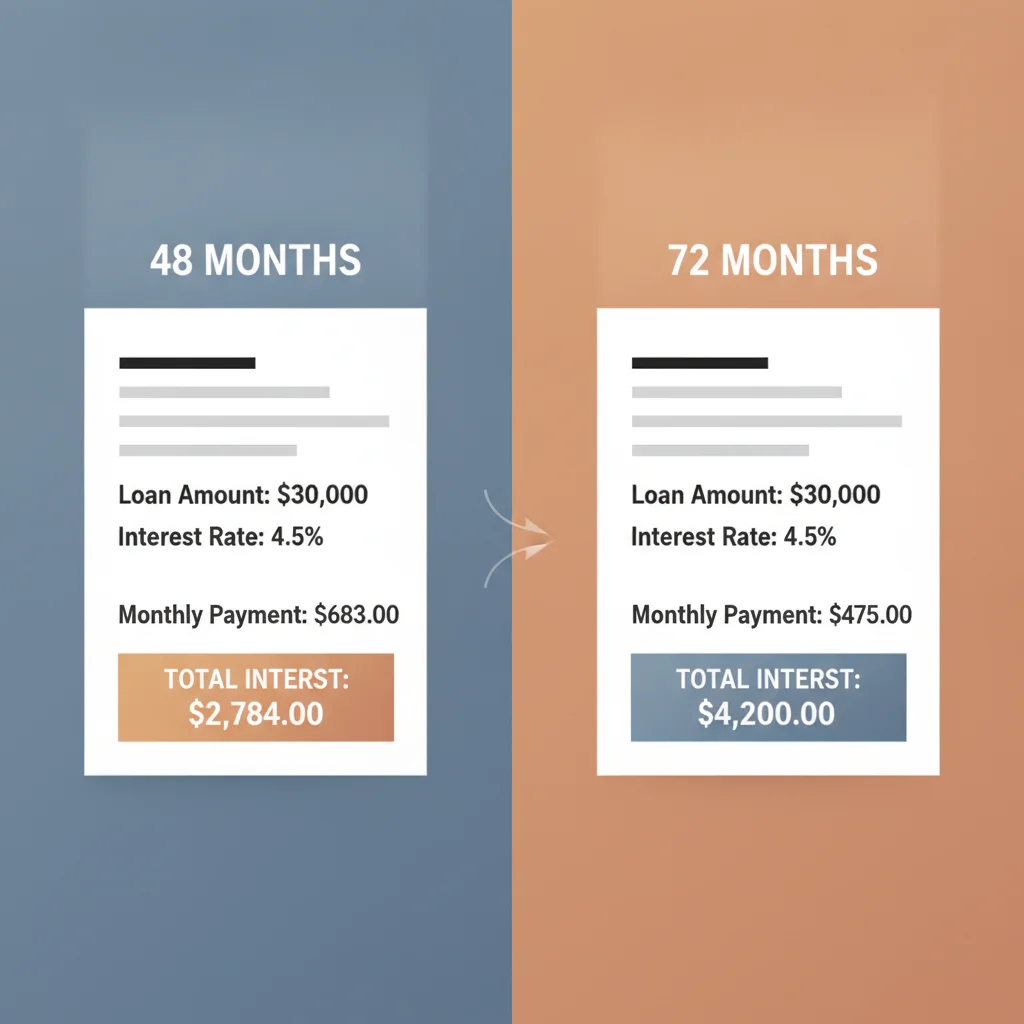
Key Takeaways
Why Loan Term Decisions Go Wrong
When you sit down at a dealership finance office, the conversation almost always gravitates toward one number: your monthly payment. It's human nature. Monthly payments feel manageable and concrete. A loan term — 48 months, 60 months, 72 months, 84 months — sounds like a technicality.
But the term you agree to is one of the most consequential decisions in the entire car-buying process. It determines how much interest you'll pay in total, how quickly you'll build equity in the vehicle, and how exposed you'll be if the car is totaled, stolen, or needs to be sold before the loan is paid off.
The mistakes borrowers tend to regret most aren't dramatic. They're quiet decisions made under pressure, without full information, that compound quietly for years. This article names them plainly — and tells you exactly how to avoid each one.
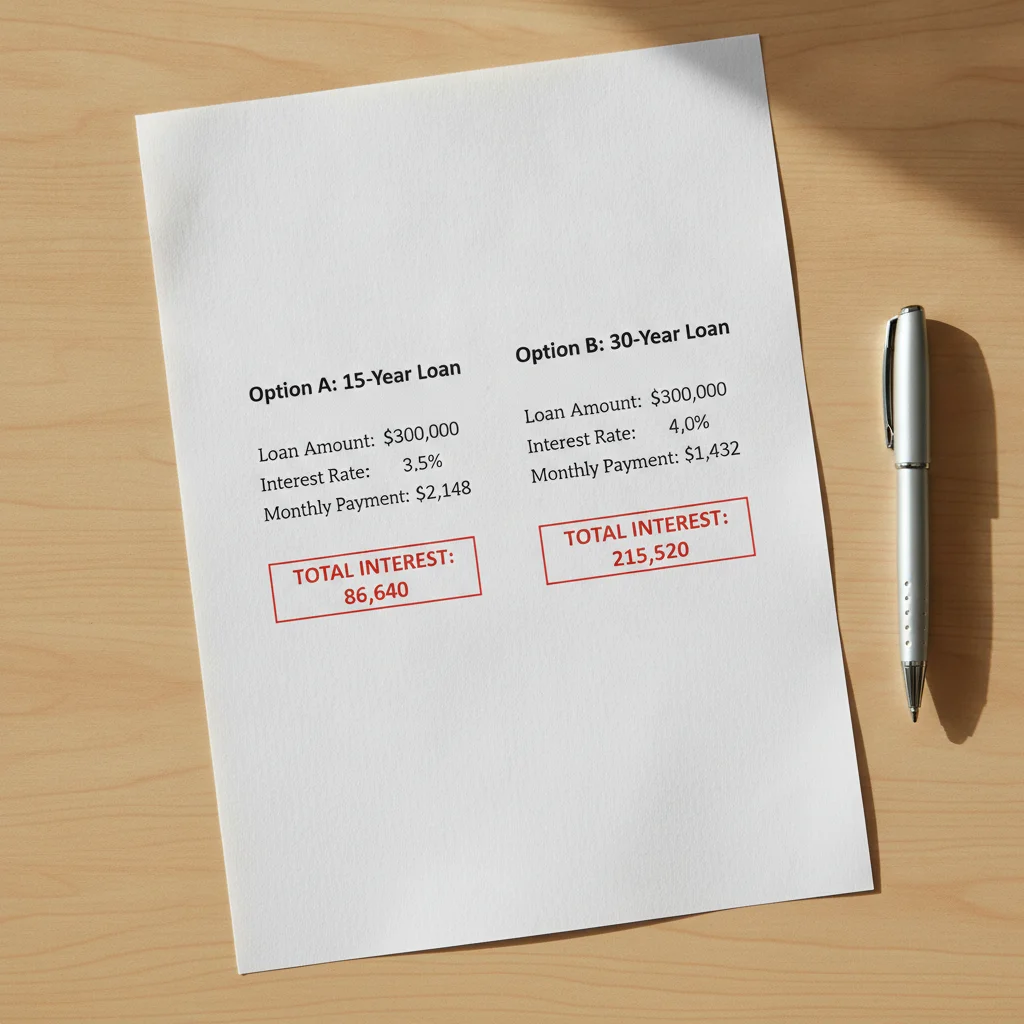
For a full framework on how to approach the term decision from the ground up, see the Auto Loan Term Strategy guide, which covers amortization, term selection, and goal-matching in depth.
The Mistakes That Haunt Borrowers Most
These aren't edge cases or rare scenarios. The following mistakes show up constantly among borrowers who financed a car and later wished they'd done something differently. Each one is preventable — but only if you know to look for it before you sign.
Choosing the longest available term solely to minimize the monthly payment, without calculating total interest paid.
Why it happens: Monthly payments are the most visible number in loan negotiations, and a lower payment feels like a win. Borrowers often don't see — or aren't shown — the total interest cost comparison across term options.
Stretching to an 84-month loan on a vehicle that will depreciate faster than the loan pays down.
Why it happens: The 84-month option lowers the payment enough to make an otherwise unaffordable vehicle seem within reach. Borrowers underestimate how long they'll carry negative equity at that term length.
Financing a vehicle with little or no down payment and then choosing a long term to compensate for the high payment.
Why it happens: Buyers want to preserve cash at purchase, and dealers can restructure the payment around a longer term to make it work on paper. The downstream equity risk rarely gets explained clearly.
Selecting a loan term that outlasts how long you plan to keep the vehicle.
Why it happens: Buyers focus on what they can afford today and don't fully account for the fact that they may want — or need — to sell or trade before the loan ends.
Ignoring the fact that lenders often charge higher APRs on longer loan terms.
Why it happens: Borrowers compare monthly payment amounts across terms without realizing the interest rate itself may also be higher on the 72- or 84-month option — compounding total cost further.
Not considering GAP coverage when taking a long-term loan on a fast-depreciating vehicle.
Why it happens: GAP insurance is treated as an optional add-on in the finance office, and buyers often skip it to reduce costs. But the protection it provides is directly tied to the negative equity risk they're accepting with a long term.
~32%
New-vehicle loans with terms over 72 months
According to Experian's State of the Automotive Finance Market report, loans of 73 months or longer represent nearly one-third of all new-vehicle financing.
$9,500+
Total interest on a $35K loan at 7% over 84 months
Compared to roughly $6,700 in interest on the same loan at 60 months — a difference of nearly $3,000 for choosing a longer term.
38%
Trade-in vehicles with negative equity
Edmunds data consistently shows that more than a third of trade-in vehicles carry negative equity, largely driven by long loan terms and low down payments.
$6,054
Average amount of negative equity rolled into new loans
Edmunds research found that buyers trading in underwater vehicles rolled an average of over $6,000 in negative equity into their next loan, repeating the cycle.
If you've already signed a long-term loan and feel locked in, you have more options than you might think. Strategies for exiting a long auto loan without refinancing can help you shorten your effective term and reduce total interest, even without starting a new loan from scratch.
The Monthly Payment Trap
The single most common cognitive error in auto financing is optimizing for the monthly payment number instead of the total cost of the loan. Dealership finance managers are trained to present loans this way — and it works, because a lower monthly figure feels like a better deal even when it isn't.
Low Monthly Payment ≠ Good Deal
A monthly payment that fits your budget is a necessary condition for a loan — but it's not sufficient evidence that the loan is a good deal. Two loans on the same vehicle with identical payments can have vastly different total costs depending on the term and APR. Always evaluate the total interest paid, not just what comes out of your account each month.
Skipping the Down Payment Creates Compounding Risk
Financing 100% of a vehicle's purchase price means you start the loan in negative equity before you leave the lot — the car depreciates the moment it's driven. Pairing zero down with a 72- or 84-month term means you could owe thousands more than the car is worth for several years. If anything disrupts the loan — job loss, accident, or the need to sell — you'll absorb that gap out of pocket.
Here's the math that gets glossed over: a $35,000 loan at 7% APR over 60 months costs roughly $6,700 in total interest. Stretch that same loan to 84 months and the total interest climbs past $9,500 — nearly $3,000 more — while the car simultaneously loses value faster than you're paying down the principal. That gap is where negative equity lives.
Understanding exactly how term length interacts with your rate is essential reading before you commit to any loan. The relationship between loan term length and APR is one of the most underestimated trade-offs in auto financing.

The fix is simple but requires discipline: always ask the lender or dealer for the total amount you'll pay over the life of the loan — not just the monthly figure. Federal law (the Truth in Lending Act) requires lenders to disclose this number. Find it, read it, and let it anchor your decision.
Stretching to 84 Months: A Closer Look at the Risks
Eighty-four month loans — seven years — have grown from a niche product to a mainstream option. According to Experian's State of the Automotive Finance Market data, loans of 73 months or longer now account for nearly a third of all new-vehicle financing. The appeal is obvious: lower monthly payments on vehicles that keep getting more expensive.
84-Month Loans and the Negative Equity Window
On most new vehicles, the loan balance exceeds the car's market value for at least the first 36 to 48 months of an 84-month loan. During that window, if your car is totaled, stolen, or needs to be sold, standard insurance pays market value — not what you owe. Without GAP coverage, the difference is your problem. This risk is real, common, and rarely explained clearly in the finance office.
Your Loan Term Decision Is Final at Signing
Unlike a mortgage, auto loans are not routinely renegotiated after closing. Once you sign, your term, rate, and total cost are set — unless you refinance later, which carries its own costs and complications. Take the time before you sign to fully understand what you're agreeing to. A rushed decision at the dealership can lock you into terms you'll live with for up to seven years.
But the risks are specific and worth understanding clearly. At 84 months, most vehicles depreciate faster than you pay down the loan balance for at least the first 36 to 48 months. That means you're carrying negative equity — often called being "underwater" — for a significant portion of the loan. If your car is totaled during that window, standard insurance pays you the car's current market value, not your remaining loan balance. The gap comes out of your pocket, unless you have GAP coverage.
There's also an interest-rate penalty. Lenders typically charge higher APRs on longer-term loans, compounding the cost further. A borrower who stretches from 60 to 84 months often gets hit with both a higher rate and more months of interest accrual — a double penalty that rarely shows up clearly in the payment comparison at the dealer.
For a thorough breakdown of why the longest term isn't always the smartest choice, even when it feels financially comfortable, see The Case Against Always Picking the Longest Loan Term Available.
Down Payment Mistakes That Amplify Every Term Risk
Loan term decisions don't happen in isolation. One of the biggest amplifiers of term-related risk is an insufficient — or nonexistent — down payment. When you put little or nothing down, you start the loan already at or near negative equity. A long term makes that hole deeper and slower to climb out of.

A meaningful down payment does several things at once: it reduces the total amount financed (which lowers both your payment and your total interest regardless of term), it builds immediate equity in the vehicle as a buffer against depreciation, and it gives you more flexibility if you need to sell or trade before the loan ends.
The down payment fundamentals hub covers how to size your down payment strategically and why it shapes your entire loan structure — not just your first month's bill.
Low Monthly Payment ≠ Good Deal
A monthly payment that fits your budget is a necessary condition for a loan — but it's not sufficient evidence that the loan is a good deal. Two loans on the same vehicle with identical payments can have vastly different total costs depending on the term and APR. Always evaluate the total interest paid, not just what comes out of your account each month.
Skipping the Down Payment Creates Compounding Risk
Financing 100% of a vehicle's purchase price means you start the loan in negative equity before you leave the lot — the car depreciates the moment it's driven. Pairing zero down with a 72- or 84-month term means you could owe thousands more than the car is worth for several years. If anything disrupts the loan — job loss, accident, or the need to sell — you'll absorb that gap out of pocket.
The general guidance of 10–20% down on a new vehicle exists for a reason: it keeps you above water during the depreciation-heaviest early months of ownership. Skipping or minimizing the down payment to preserve cash, then compensating with a longer term to keep the payment low, is a combination that routinely leads to regret.
How to Make a Loan Term Decision You Won't Regret
Avoiding these mistakes doesn't require advanced financial knowledge. It requires slowing down, asking the right questions, and refusing to let the monthly payment number be the only metric you evaluate.
Before finalizing any auto loan term, run through this checklist:
- Calculate total interest paid for every term option the lender offers — not just the monthly difference.
- Check the depreciation curve for the specific vehicle you're buying. Some vehicles hold value better than others, which affects your equity position at every point in the loan.
- Size your down payment to put at least 10% down on new vehicles, more if you're financing a luxury or fast-depreciating model.
- Match the term to how long you'll realistically keep the car. If you upgrade every three years, a 72-month loan means you'll almost certainly be trading out underwater.
- Compare the APR across terms. If the lender charges a higher rate for longer terms, factor that into your total cost calculation.
- Read the total amount financed disclosure on your loan documents — the Truth in Lending Act box shows you exactly what you'll pay from start to finish.

Every borrower's situation is different. Income stability, how much you drive, your plans for the vehicle, and your overall financial picture all matter. The guide to picking a loan term that matches your financial situation walks through all of these variables in detail.
And if you've encountered common assumptions about loan terms — that longer is always safer, or that any low payment means you got a good deal — Auto Loan Term Myths That Cost Borrowers Real Money addresses those head-on with the actual numbers behind each claim.
84-Month Loans and the Negative Equity Window
On most new vehicles, the loan balance exceeds the car's market value for at least the first 36 to 48 months of an 84-month loan. During that window, if your car is totaled, stolen, or needs to be sold, standard insurance pays market value — not what you owe. Without GAP coverage, the difference is your problem. This risk is real, common, and rarely explained clearly in the finance office.
Your Loan Term Decision Is Final at Signing
Unlike a mortgage, auto loans are not routinely renegotiated after closing. Once you sign, your term, rate, and total cost are set — unless you refinance later, which carries its own costs and complications. Take the time before you sign to fully understand what you're agreeing to. A rushed decision at the dealership can lock you into terms you'll live with for up to seven years.
The loan term decision is made once, at signing — but you live with it for years. Taking an extra hour to understand total cost, equity position, and how the term fits your real financial life is one of the highest-return uses of time in the entire car-buying process.

All claims are backed by peer-reviewed research. Sources on request.