Key Takeaways
Option A
Fixed Rate Auto Loan
The predictable, payment-stable choice for most buyers.
Best for: Buyers who want a consistent monthly payment from the first statement to the last, regardless of market conditions.
Option B
Variable Rate Auto Loan
The rate-sensitive option that can cut costs — or raise them.
Best for: Borrowers planning to pay off their loan quickly and comfortable accepting some payment uncertainty in exchange for a potentially lower starting rate.
If you need a predictable monthly budget with no surprises
Fixed Rate Auto Loan
Your rate is locked at signing and never changes, making it easy to budget and plan. Payment shock is simply not a risk with a fixed loan.
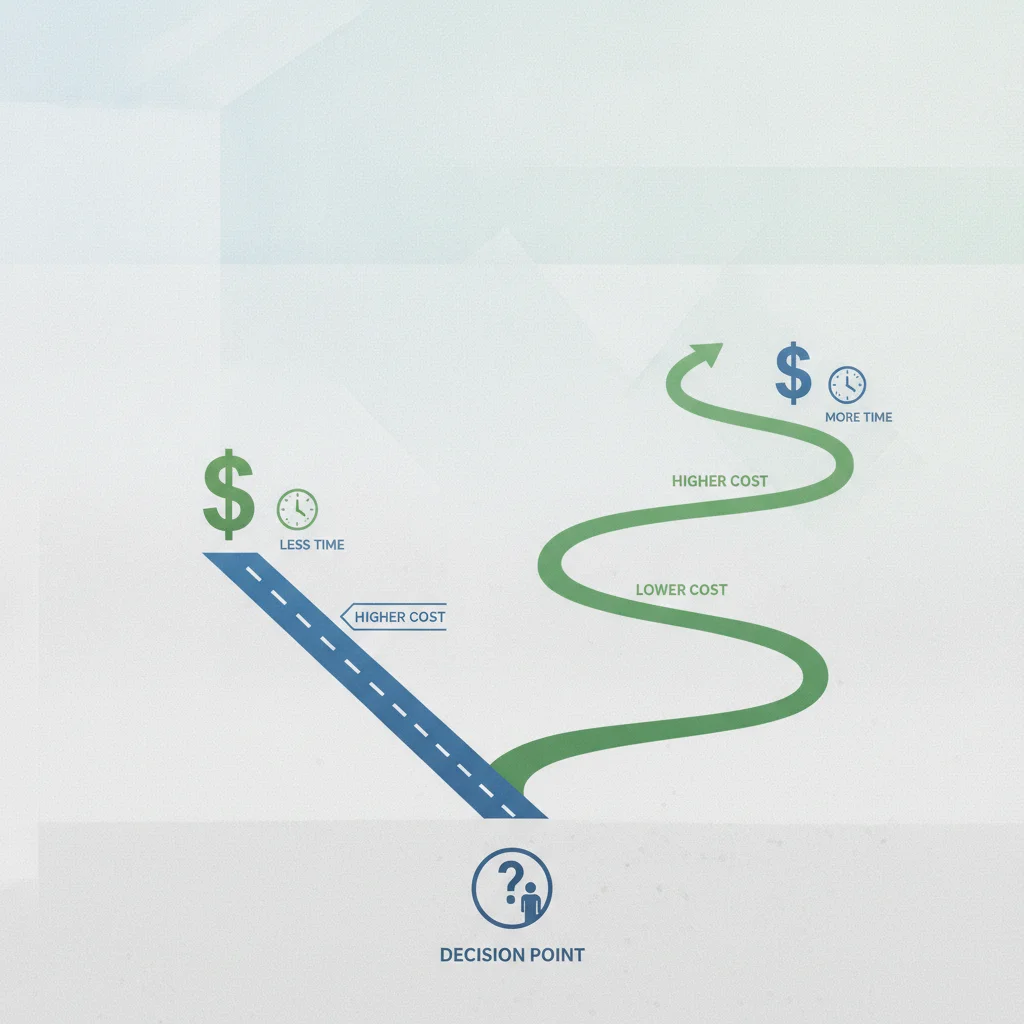
If you plan to pay the loan off within 24 months
Variable Rate Auto Loan
A shorter payoff window limits how much time the rate has to rise. If the starting rate is meaningfully lower, you could save on total interest paid.
If you're financing a used car over 48–72 months
Fixed Rate Auto Loan
Long loan terms and variable rates are a risky combination. Rate increases compound across dozens of extra payment cycles, potentially costing thousands more.
If you want flexibility and believe market rates will fall
Variable Rate Auto Loan
In a declining rate environment, a variable loan passes savings to you automatically. Just ensure you can absorb a higher payment if rates move the other direction.
If you're a first-time car buyer focused on simplicity
Fixed Rate Auto Loan
Fixed loans are easier to compare, understand, and budget for. One fewer variable to worry about during an already complex purchase process.
What Fixed and Variable Rates Actually Mean
Every auto loan comes with a cost of borrowing — an interest rate that determines how much you pay on top of the amount you financed. What varies is whether that rate stays the same throughout the loan or moves based on outside market conditions.
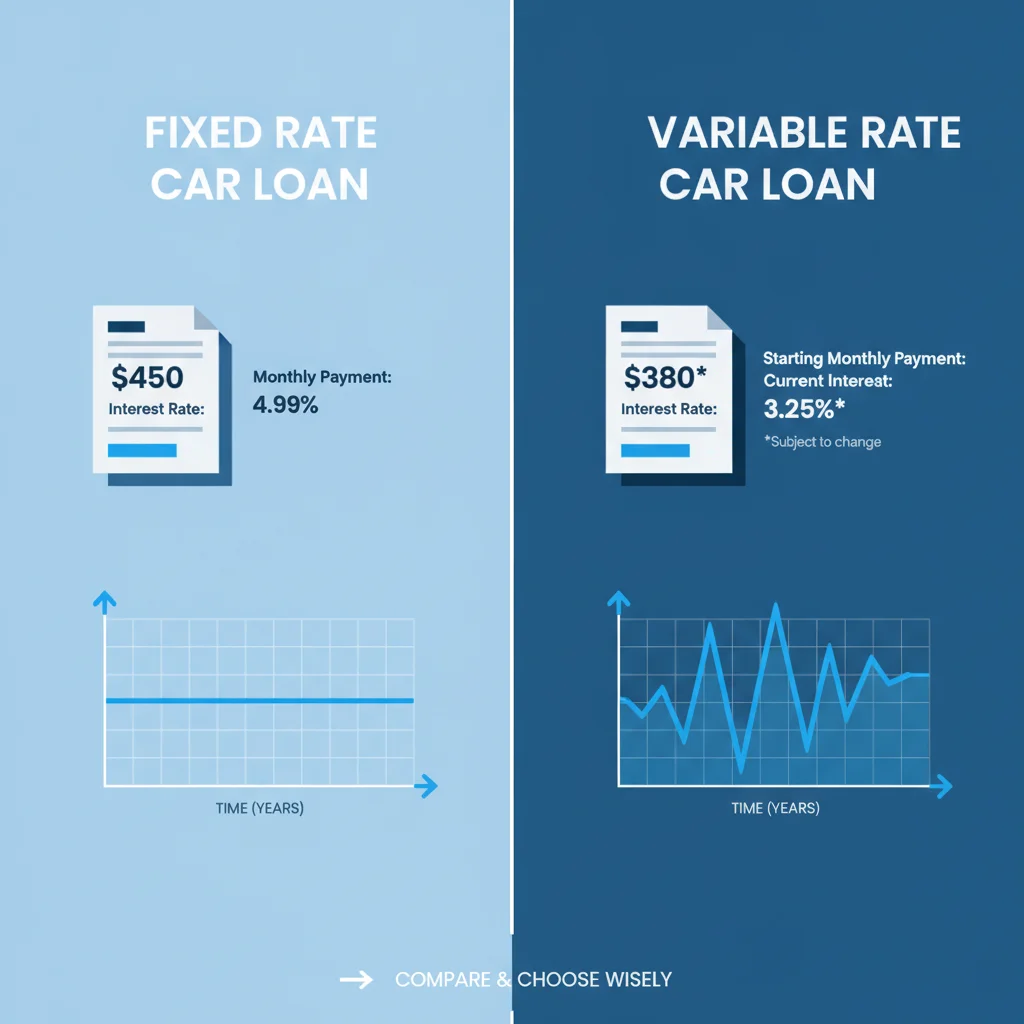
With a fixed rate auto loan, the interest rate is set when you sign the contract and stays exactly that rate until the loan is paid off. Your monthly payment is calculated once at origination and does not change. Whether you're on month three or month forty-three, you owe the same amount each period.
With a variable rate auto loan, the interest rate is tied to a financial index — commonly the prime rate or the SOFR. Lenders add a margin on top of this index to determine your rate. When the index moves, your rate moves with it, and so does your monthly payment. Some variable loans have periodic caps (limiting how much the rate can change per adjustment period) and lifetime caps (the maximum the rate can ever reach), but many do not.
It's worth noting that variable rate auto loans are not common in the U.S. market. Unlike mortgages, where adjustable-rate products are widely offered, most auto lenders — including banks, credit unions, and manufacturer finance arms — exclusively offer fixed rates. If you encounter a variable rate offer, it will most likely come from a credit union or a smaller regional bank.
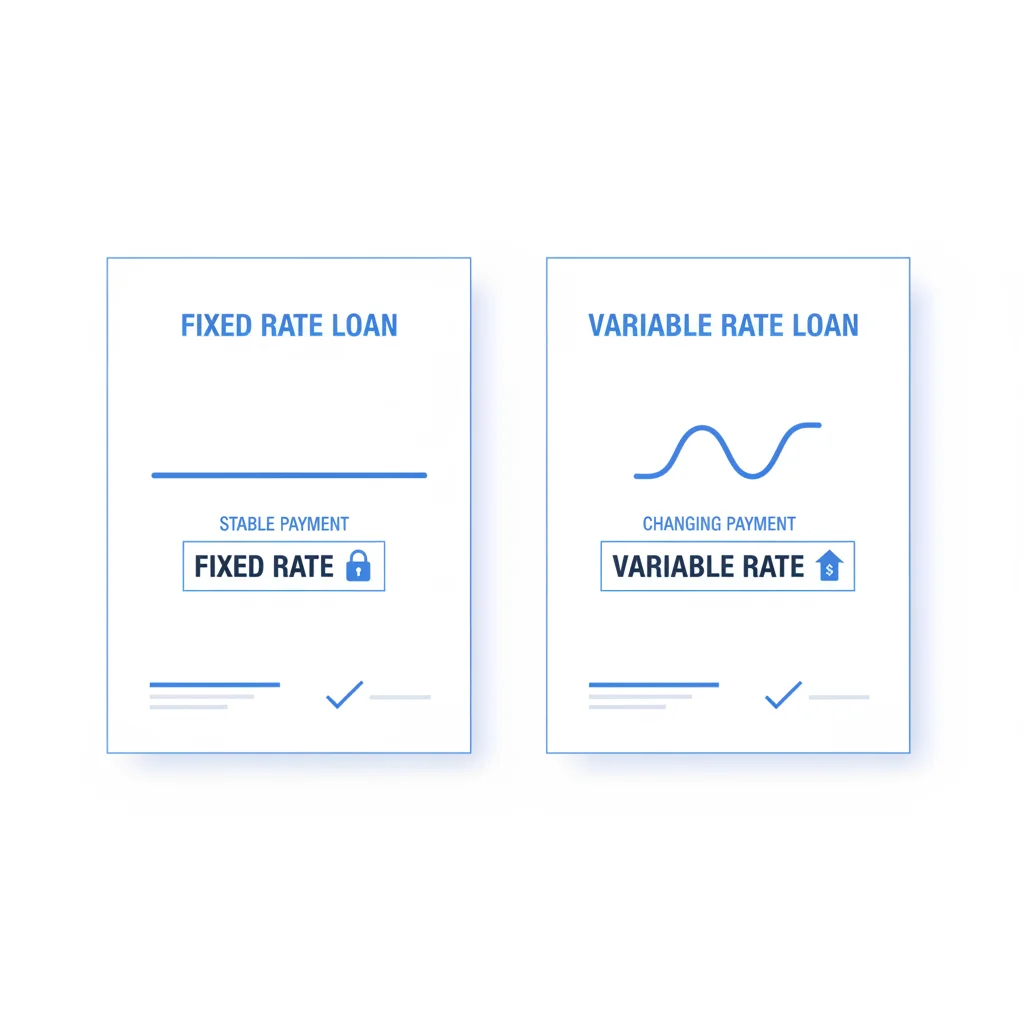
Understanding the difference matters because it shapes not just your payment amount, but your financial exposure over the entire life of the loan. For a deeper look at how rates interact with your credit profile and other loan factors, see everything that shapes your auto loan rate.
How Each Rate Type Affects Your Monthly Payment
The difference between fixed and variable rates becomes concrete when you look at actual payment behavior across a loan term.
Consider a $28,000 auto loan over 60 months at a fixed rate of 7.5%. Your payment is calculated once using the standard amortization formula and comes to approximately $561 every month for five years. No surprises, no recalculations. You can set an autopay and forget it.
Now take that same $28,000 at a variable rate that opens at 6.8% — attractively lower than the fixed option. At the outset, your payment is roughly $550. But if the underlying index rises by 1.5 percentage points in year two, your rate moves to 8.3% and your payment resets to around $574. A further rise of 1 point in year three pushes you to 9.3% and a payment near $590. Across 36 months at elevated rates, you could easily wipe out — and then exceed — any early savings from the lower starting rate.
| Criterion | Fixed Rate Auto Loan | Variable Rate Auto Loan |
|---|---|---|
| Rate stability | Locked at origination, never changes | Fluctuates with market index |
| Monthly payment | Same every month | Can rise or fall over time |
| Starting rate | Typically slightly higher | Often lower at origination |
| Budgeting ease | Very easy — fully predictable | Harder — requires payment cushion |
| Risk level | Low — no payment surprises | Moderate to high — depends on term |
| Best loan term pairing | Any term, especially 48–84 months | Short terms only (12–24 months) |
| Market availability | Widely available from all lenders | Rare; mainly credit unions and banks |
| Benefits if rates fall | None — must refinance to capture savings | Automatic rate and payment reduction |
| Ideal borrower profile | Most buyers; especially first-timers | Short-term payoff plan, financial cushion |
This dynamic is especially important when you consider loan term length. The longer your term, the more payment adjustment cycles a variable loan goes through, and the greater the cumulative exposure. That's why term selection and rate type are closely linked decisions. Our article on short vs. long auto loan terms explains how term length shapes both monthly burden and total interest paid — a key complement to the rate-type question.
~85%
Auto loans in the U.S. with fixed rates
Industry data consistently shows the overwhelming majority of U.S. auto loans are originated with fixed interest rates, reflecting lender and borrower preference for payment stability.
5.25%
Federal Reserve rate increase in 2022–2023 cycle
The Fed raised its benchmark rate by over 5 percentage points in roughly 18 months — illustrating how dramatically a variable rate's index can shift within a single loan term.
69 months
Average new car loan term (2024)
According to Experian's State of the Automotive Finance Market report, the average new vehicle loan term has extended to nearly six years — a length at which variable rate risk is especially significant.
$1,200+
Extra cost from a 2% rate increase on a 60-month loan
On a $30,000 loan, a 2-percentage-point rate increase applied mid-term adds over $1,200 in additional interest charges across remaining payments.
For buyers using a variable rate loan, budgeting requires a cushion. You need to be comfortable not just with your payment today, but with your payment if rates climb to their cap or to a realistic worst case. If that higher number strains your budget, a fixed rate is the more responsible choice.
The Role of Loan Term in Rate Risk
Loan term length is the multiplier that either amplifies or contains the risk of a variable rate. This is the part most borrowers underestimate.
A 24-month variable rate loan has 24 payment periods during which rates might change. Even in a rising rate environment, there's limited time for adjustments to cause serious damage. You pay off the balance quickly, limiting your exposure window.
A 72-month variable rate loan is a very different proposition. Six years of rate adjustments — in a market that can shift dramatically in that timeframe — creates real uncertainty. Interest rates in the U.S. have moved by several percentage points within individual 12-month windows in recent history. If you're in month 18 of a 72-month variable loan when rates spike, you face four and a half more years of elevated payments with no way out except refinancing, which carries its own costs.
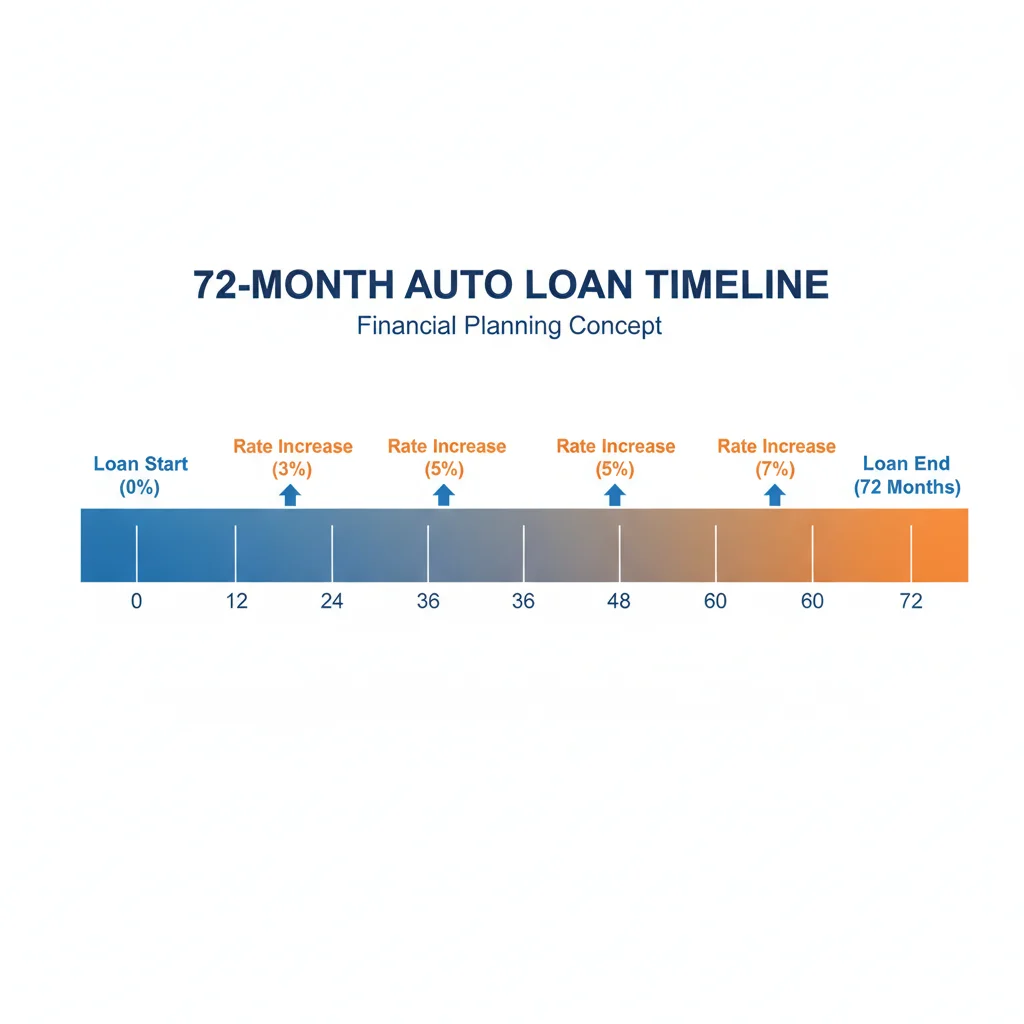
For most buyers, the right loan term is already a careful tradeoff between payment affordability and total interest cost. Adding rate variability on top of a long term compounds the complexity. If you're trying to match a loan term to your actual financial situation, this walkthrough on picking a term that fits your finances is a useful next step.
Variable Rate Caps: What to Always Ask For
Not all variable rate auto loans come with caps on how high the rate can go. Before signing any variable rate agreement, ask specifically about the periodic adjustment cap and the lifetime rate cap. Some lenders offer no cap at all, meaning there is theoretically no ceiling on your rate if the benchmark index continues to rise. Always model your payment at the lifetime cap before agreeing to any variable rate loan.
Refinancing Can Replicate Some Variable Rate Benefits
One reason borrowers consider variable rates is the possibility of capturing falling market rates without taking action. But fixed-rate borrowers can achieve a similar benefit by refinancing when rates drop meaningfully. Refinancing does involve paperwork, potential fees, and a new credit inquiry — but it's a deliberate choice made under favorable conditions, rather than an automatic adjustment that could move in either direction.
There's also the depreciation equation to consider. Cars lose value rapidly in the first few years. A longer-term variable loan creates a scenario where rising payments coincide with declining vehicle value — the worst of both worlds if you need to sell or trade in the car before the loan is paid off.
When Variable Rates Work — and When They Don't
Variable rate auto loans are not inherently bad financial products. They're simply the right tool for a narrow set of circumstances.
Situations where a variable rate can make sense
- Short payoff timeline: If you're planning to pay the loan off in 18–24 months by making extra payments, a lower starting rate saves real money before it has much chance to rise.
- Rate environment trending downward: In a declining rate cycle, a variable loan passes those savings to you automatically without requiring you to refinance.
- Strong financial cushion: If your budget comfortably absorbs a payment that's 15–20% higher than your starting amount, you can take on rate risk without jeopardizing your finances.
- Small loan balance: On a $10,000 loan, rate swings create smaller absolute dollar changes than on a $35,000 loan. The stakes are lower.
Situations where variable rates are the wrong call
- Long loan terms (48 months or more): Too many adjustment cycles, too much compounding risk.
- Tight monthly budget: If the difference between your current payment and a plausible higher payment would stress your finances, the predictability of a fixed rate is worth the potentially higher starting cost.
- Rising rate environment: If the Federal Reserve is actively hiking rates or signals further increases, a variable loan locks you into future pain.
- First-time buyers: Loan management is already complex enough. Fixed rates remove one variable from an already unfamiliar process.
It's also worth comparing how interest accrues within these loan types. Variable and fixed rates both typically work with simple interest in auto loans, but understanding the distinction between simple and precomputed interest is equally relevant. See simple interest vs. precomputed interest on car loans for a clear breakdown.
Comparing Rates in Practice: What to Look For
When you're evaluating loan offers, a few specific practices will help you make an honest comparison between fixed and variable options.
Look at the APR, not just the rate
The APR includes fees and other costs of borrowing in addition to the interest rate. A variable loan might advertise a lower rate but carry origination fees that erode the advantage. The APR gives you a more complete cost picture. For a full breakdown of how APR works in auto lending, explore the Interest & APR hub.
Ask for the rate cap structure on any variable offer
Before accepting a variable rate loan, insist on seeing the periodic cap (maximum rate increase per adjustment period) and the lifetime cap (maximum the rate can ever reach over the life of the loan). Calculate your payment at the lifetime cap. If that payment is unmanageable, decline the offer.
Run the numbers at multiple rate scenarios
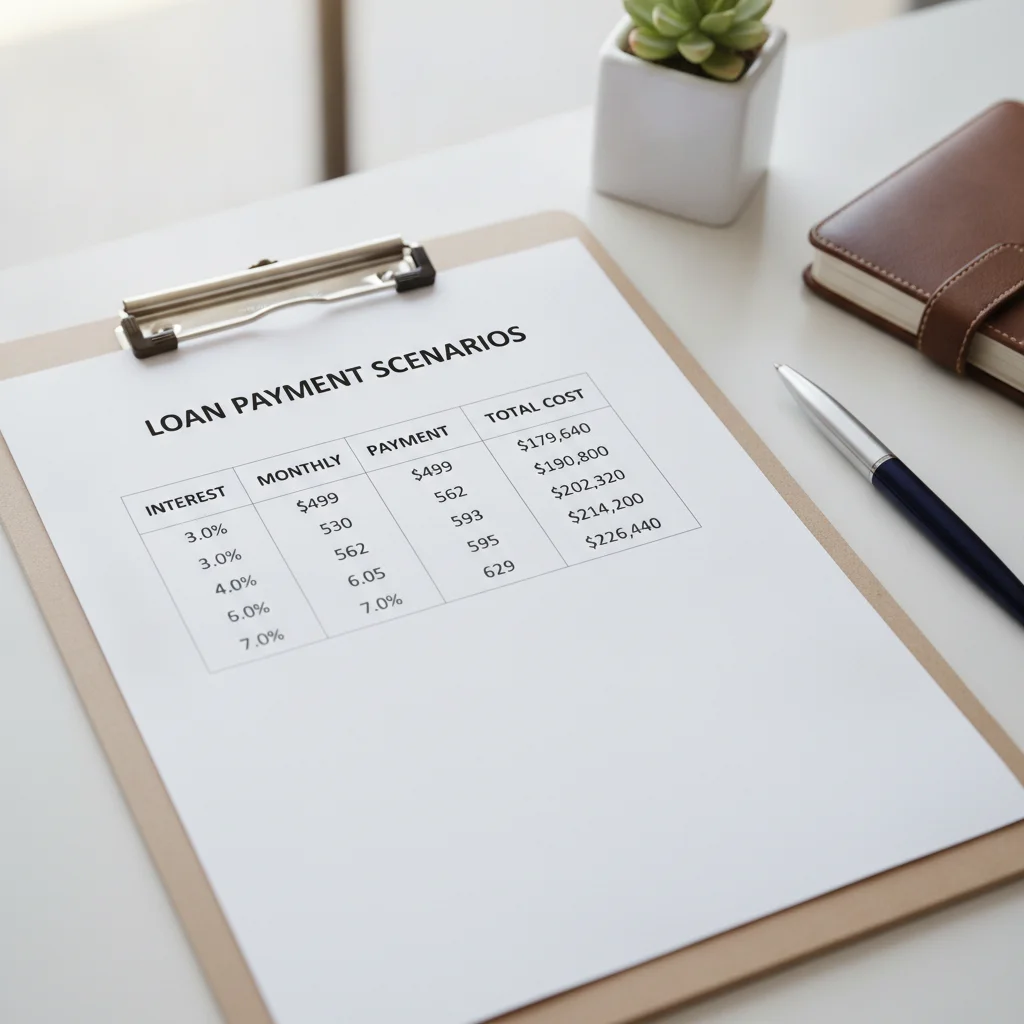
Don't just calculate what your payment is today. Use a loan calculator to model your payment if rates rise by 2%, 3%, and 5%. These aren't unlikely scenarios over a 48–72 month window. You need to know your worst-case monthly obligation before you agree to the loan.
Factor in refinancing as an alternative
One argument for accepting a variable rate — capturing future rate decreases — can also be achieved by starting with a fixed rate and refinancing if rates fall meaningfully. Refinancing does carry costs (title transfer fees, possible prepayment penalties on some loans), but it's a controlled action you take by choice rather than an automatic adjustment that happens regardless of your situation. The same logic applies if your credit improves significantly after loan origination. For a deeper look at how fixed vs. variable interest structures compare in auto lending, see our dedicated explainer on that topic.
The bottom line: when comparing offers, fixed and variable rates need to be evaluated not just at today's numbers but at what they could realistically become. The loan with the lower starting rate is not automatically the better loan.
Making Your Decision: A Practical Framework
Most car buyers in the U.S. will never be offered a variable rate loan — and for most, that's fine. But if you are presented with one, or if you're actively seeking the best rate structure for your situation, use the following framework to decide.
- Identify your loan term: If it's 48 months or longer, default to fixed unless you have compelling evidence to do otherwise.
- Check your budget flexibility: Calculate the payment at the variable loan's lifetime cap rate. Subtract your current payment. Can your budget comfortably absorb that difference every month? If not, choose fixed.
- Assess the rate environment: If rates are currently rising or at historic lows with nowhere to go but up, variable rate exposure is asymmetric and unfavorable. Fixed protects you.
- Calculate the break-even point: Determine how long the variable loan's lower starting rate would need to hold before the cumulative savings equal the cumulative savings of the fixed loan. If that break-even period is longer than you realistically expect rates to stay low, the variable loan is a losing bet.
- Consider your refinance tolerance: Are you willing and able to refinance if rates spike? If yes, a variable loan becomes slightly more manageable. If the idea of dealing with refinancing paperwork and costs mid-loan is unappealing, the simplicity of fixed is worth the trade-off.
Credit score also plays a major role in what rate you'll qualify for in either structure. A stronger credit profile doesn't just lower your rate — it widens the spread between what you're offered and the benchmark, giving you more room to negotiate. Understanding how your credit score affects the rates you're offered is foundational to any rate-type decision.
Ultimately, the fixed vs. variable choice is a risk management question as much as a math question. Crunching the numbers matters, but so does honest self-assessment about how much payment uncertainty you can absorb without financial stress.

All claims are backed by peer-reviewed research. Sources on request.