Key Takeaways
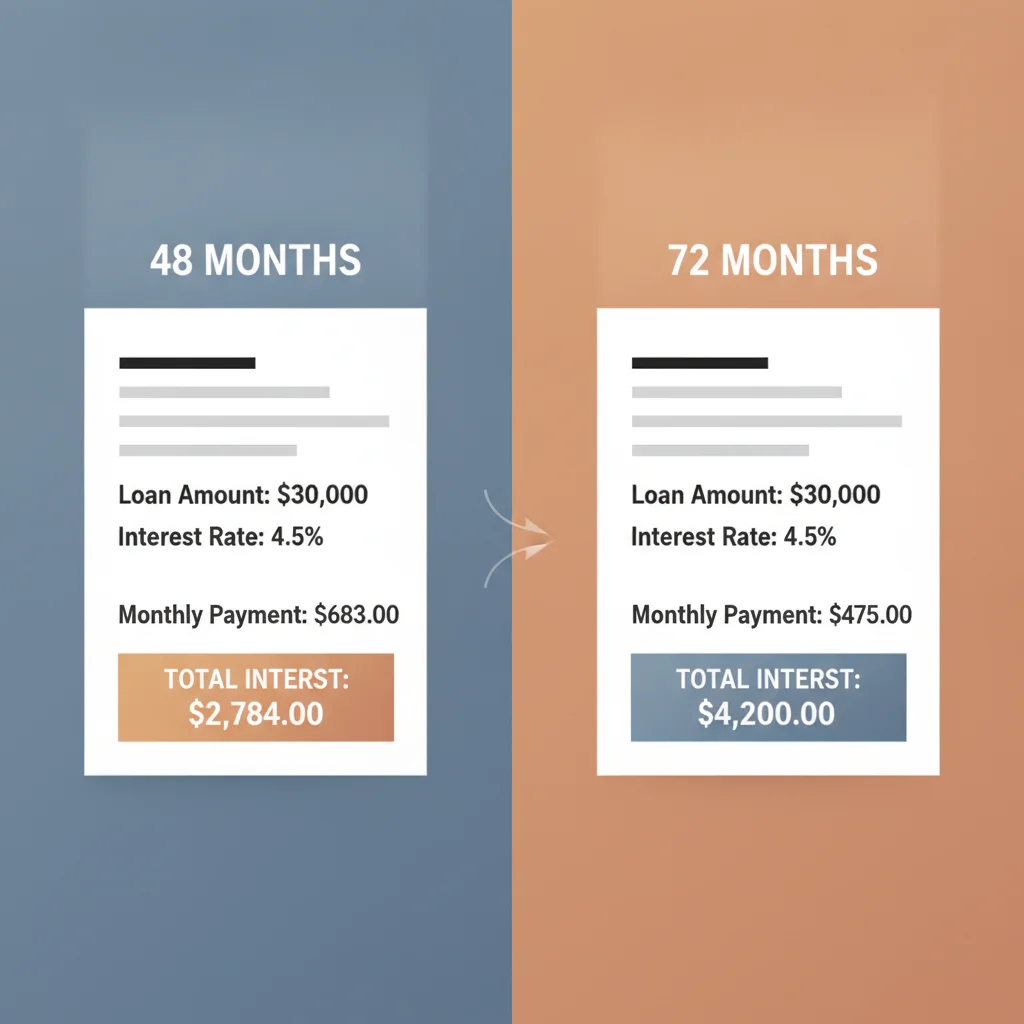
Run your loan calculation using the total interest paid — not just the monthly payment — before agreeing to any term. Most lenders are required to disclose this figure on the loan agreement.
Buyers who focus exclusively on monthly payments routinely accept thousands of dollars in avoidable interest costs. Total interest paid is the number that actually tells you what the loan costs.
If you're buying new, ask your lender or dealer to show you your equity position at the 12-, 24-, and 36-month marks so you can see exactly when — or if — you'll be above water.
Visualizing your equity trajectory helps you plan for potential trade-ins, total loss scenarios, and whether GAP insurance makes sense for your specific loan structure.
Never extend your loan term during a refinance purely to lower your monthly payment — this usually erases any interest savings from the lower rate and can leave you paying more in total.
The goal of refinancing should be to reduce total cost, not just monthly cost. Extending the term keeps more balance outstanding longer, which generates more interest even at a lower rate.
Why Loan Term Length Is the Pivot Point of Your Auto Loan
Every variable in an auto loan — interest rate, monthly payment, total cost, equity position — is downstream of one choice: how long you take to pay it back. Loan term length is the single lever that shapes everything else, yet most buyers treat it as an afterthought once the dealership finance manager starts filling in the paperwork.
That's a costly mistake. A $35,000 loan at 7% APR paid over 36 months costs you roughly $3,850 in interest. Stretch that same loan to 72 months, and you'll pay over $7,800 in interest — more than double — while also spending four extra years exposed to depreciation risk. The monthly payment looks friendlier, but the financial reality is not.
Understanding how term length works — mechanically, mathematically, and strategically — is the foundation of any smart auto loan decision. Before diving into the numbers, it helps to get comfortable with the vocabulary. Our Auto Loan Glossary walks through 25 essential terms, including amortization, APR, and principal balance, so you're not guessing at definitions when the stakes are high.
This guide builds a complete decision framework — from the mechanics of how payments are structured to a step-by-step process for choosing the term that fits your specific situation.
How Amortization Works — and Why It Changes Everything
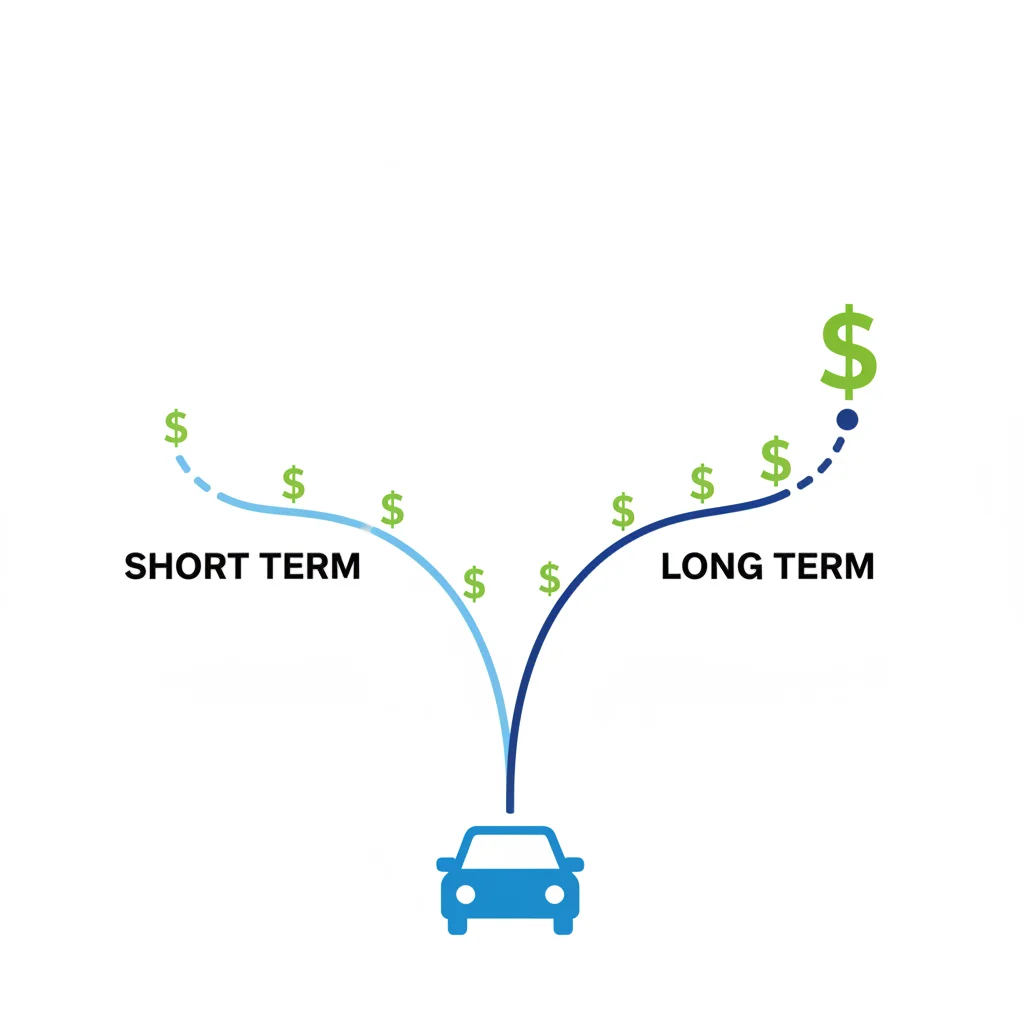
Amortization is the process of paying off a loan through scheduled, equal installments over time. Each payment you make is split between two buckets: interest (the lender's fee for lending you the money) and principal (the actual loan balance you owe). The proportion between them shifts with every payment.
In the early months of an auto loan, the vast majority of each payment goes toward interest. As the principal decreases, the interest portion shrinks and the principal portion grows. This is why the first two years of a long-term loan feel like you're barely making a dent in what you owe — because mathematically, you aren't.
A Concrete Example
Suppose you borrow $30,000 at 6.5% APR for 60 months. Your monthly payment is approximately $586. In month one, about $163 of that payment goes to interest and $423 goes toward principal. By month 30, the split is closer to $112 interest and $474 principal. By month 55, you're paying only $25 in interest per month.
Now extend that same loan to 84 months. Your monthly payment drops to around $450 — $136 less per month. But in month one, roughly the same $163 goes to interest. The difference is that you'll be paying that high-interest share for far longer before the principal shrinks enough to shift the curve. Total interest paid climbs from about $5,160 over 60 months to more than $7,800 over 84 months.
Don't Let Dealers Lead With Monthly Payments
A common dealership tactic is to ask what monthly payment you're comfortable with, then work backward to extend the loan term rather than reduce the price. This framing makes expensive vehicles seem affordable while dramatically increasing your total cost. Always negotiate the vehicle price and loan terms separately, and always ask for the total interest paid figure before agreeing to any financing.
Long Terms on Depreciating Assets Carry Real Risk
Accepting an 84-month loan on a new vehicle means you'll likely be underwater for the first 3–4 years of ownership. If the vehicle is totaled, stolen, or you need to sell during that period, you could face a significant financial shortfall. Consider GAP insurance coverage if you take a long-term loan with less than 20% down.
The key insight: amortization doesn't reward patience — it rewards speed. The faster you reduce your principal, the less total interest accumulates. Every month you extend the term, you're agreeing to keep a larger average balance outstanding for longer, which is exactly what lenders profit from.
For a deeper look at how term length interacts with your APR specifically, see our companion piece on term length and APR trade-offs.
Run your loan calculation using the total interest paid — not just the monthly payment — before agreeing to any term. Most lenders are required to disclose this figure on the loan agreement.
Buyers who focus exclusively on monthly payments routinely accept thousands of dollars in avoidable interest costs. Total interest paid is the number that actually tells you what the loan costs.
If you're buying new, ask your lender or dealer to show you your equity position at the 12-, 24-, and 36-month marks so you can see exactly when — or if — you'll be above water.
Visualizing your equity trajectory helps you plan for potential trade-ins, total loss scenarios, and whether GAP insurance makes sense for your specific loan structure.
Never extend your loan term during a refinance purely to lower your monthly payment — this usually erases any interest savings from the lower rate and can leave you paying more in total.
The goal of refinancing should be to reduce total cost, not just monthly cost. Extending the term keeps more balance outstanding longer, which generates more interest even at a lower rate.
The True Cost of Longer Terms: A Side-by-Side Breakdown
Numbers make the abstract concrete. The table below illustrates how the same loan — $32,000 at 7% APR — plays out across the five most common term lengths offered by lenders today.
| Term | Monthly Payment | Total Interest Paid | Total Cost |
|---|---|---|---|
| 36 months | $988 | $3,568 | $35,568 |
| 48 months | $765 | $4,720 | $36,720 |
| 60 months | $634 | $6,040 | $38,040 |
| 72 months | $545 | $7,240 | $39,240 |
| 84 months | $484 | $8,656 | $40,656 |
Notice what's happening: moving from a 36-month to an 84-month term saves you $504 per month — but costs you an additional $5,088 in interest over the life of the loan. You're essentially paying a $5,088 premium for the convenience of smaller monthly bills.
84 months
Most common max term offered by lenders
According to Experian's State of the Automotive Finance Market report, 84-month loans have become a mainstream offering from both banks and captive finance arms.
$7,800+
Estimated interest on a $32K 7% 84-month loan
Calculated using standard amortization on a $32,000 principal at 7% APR over 84 months, illustrating the total cost of extended financing.
20–30%
Average new car depreciation in year one
Industry research from Edmunds and Kelley Blue Book consistently shows new vehicles lose a significant portion of value within the first 12 months of ownership.
33%
Share of new auto loans with terms over 72 months
Experian's automotive finance data shows more than one-third of new vehicle loans now extend beyond six years — a record high as of recent quarters.
50 points
Credit score improvement that can trigger refinance savings
Lenders typically reassess risk tiers in 50-point credit score bands, meaning a 50-point improvement can qualify a borrower for a meaningfully lower APR tier.
This table also highlights why dealers often lead with monthly payment figures rather than total cost. A $484/month payment sounds far more approachable than a $988/month payment — but the monthly-payment framing obscures that you'll eventually spend $5,088 more for the same car.
Total Cost vs. Monthly Payment: Never Confuse the Two
Monthly payment is a cash flow number. Total cost is the financial reality. On a $32,000 loan at 7% APR, moving from a 36-month to an 84-month term saves you $504 per month — but costs you $5,088 more over the life of the loan. Before signing any loan agreement, obtain the total interest paid figure and add it to the vehicle price to understand what you're actually spending. This single habit prevents the most expensive mistakes buyers make.
Negative Equity Can Follow You Into Your Next Loan
If you trade in a vehicle while still underwater on your loan, most dealerships will offer to roll the remaining balance into your new loan — making your next loan start from a position of immediate negative equity. This cycle of rolled-over debt compounds over successive vehicle purchases and can leave buyers permanently overpaying. The only clean solution is to avoid negative equity in the first place by matching your term to your holding period and keeping down payments strong.
Short-Term vs. Long-Term Loans: Who Benefits from Each
Neither short nor long loan terms are universally better — they serve different buyer profiles. Understanding which profile fits your situation is essential before you commit.
Short-Term Loans (24–48 Months): Built for Equity and Efficiency
Short-term loans are well-suited for buyers who:
- Have sufficient monthly cash flow to handle higher payments comfortably
- Plan to keep the vehicle for many years and want to own it free and clear quickly
- Are buying a used vehicle that may have higher maintenance costs later — reducing debt before those costs arrive is strategic
- Want to minimize total interest expense and aren't willing to pay a premium for payment convenience
- Have strong credit and can qualify for the lowest available rates, making fast payoff even more rewarding
Long-Term Loans (60–84 Months): Built for Cash Flow Management
Longer terms make sense — or at least are less damaging — when:
- Monthly budget is genuinely constrained and a lower payment prevents financial strain
- The vehicle is a reliable model known for longevity (so the car will still be running well when the loan ends)
- The buyer plans to make additional principal payments when cash flow allows, effectively shortening the actual payoff timeline
- A larger down payment or significant trade-in equity has already reduced the principal, limiting depreciation risk
Term Options Vary by Lender and Vehicle Age
Not every lender offers every term length, and many lenders cap terms based on vehicle age. A used vehicle that's already 5 years old may only qualify for a 48- or 60-month term at most lenders, since they won't want a loan outlasting the expected useful life of the collateral. Always confirm available term options during the preapproval process.
Prepayment Is Almost Always Allowed
The vast majority of auto loans — particularly those from banks and credit unions — do not carry prepayment penalties. This means you can make extra principal payments at any time to accelerate your payoff without cost. If your original loan has a longer term but you make additional payments, you effectively create your own shorter payoff timeline while maintaining a lower minimum payment as a safety net.
Your Loan Term Affects More Than Payments
The term you accept also influences whether certain ancillary products make financial sense. GAP insurance, for example, is most valuable during the period when you're likely to be underwater — typically the first 24–36 months of a long-term loan on a new vehicle. Extended warranties tied to mileage rather than time may also be more or less relevant depending on how quickly you'll pay off and potentially sell the vehicle.
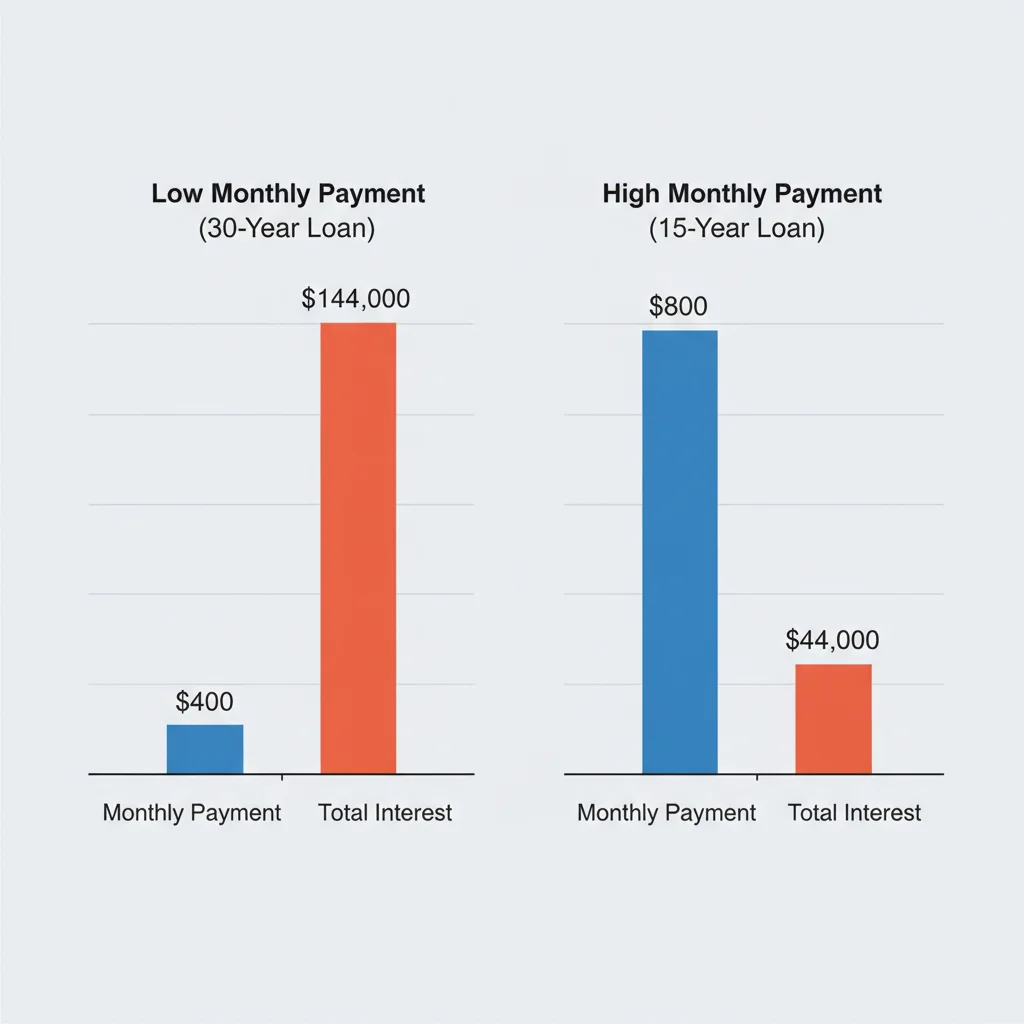
The critical caution with long-term loans isn't just the extra interest — it's the intersection with depreciation, which we'll examine in the next section.
How Depreciation and Equity Interact with Your Term
A car is a depreciating asset, which means its value declines over time regardless of what you paid for it or how well you maintain it. A new vehicle loses an estimated 20–30% of its value in the first year alone. By year five, a new car may be worth only 40–50% of its original purchase price.
This creates a dangerous mismatch on long-term loans: your vehicle can lose value faster than you're paying down your loan balance. When your outstanding loan balance exceeds the vehicle's current market value, you're described as being underwater or having negative equity.
Why Negative Equity Matters
Being underwater on your loan has real consequences:
- You can't sell or trade in easily: If your car is worth $18,000 but you owe $22,000, you'd need to bring $4,000 in cash to a transaction just to break even — or roll that debt into your next loan, compounding the problem.
- Insurance doesn't cover the gap: If your vehicle is totaled in an accident, your insurer pays market value — not your loan balance. Without GAP insurance, you could owe thousands after a total loss.
- It traps you in the vehicle: Negative equity removes flexibility. You may feel forced to keep a vehicle that no longer meets your needs simply because selling it would cost you money.
Total Cost vs. Monthly Payment: Never Confuse the Two
Monthly payment is a cash flow number. Total cost is the financial reality. On a $32,000 loan at 7% APR, moving from a 36-month to an 84-month term saves you $504 per month — but costs you $5,088 more over the life of the loan. Before signing any loan agreement, obtain the total interest paid figure and add it to the vehicle price to understand what you're actually spending. This single habit prevents the most expensive mistakes buyers make.
Negative Equity Can Follow You Into Your Next Loan
If you trade in a vehicle while still underwater on your loan, most dealerships will offer to roll the remaining balance into your new loan — making your next loan start from a position of immediate negative equity. This cycle of rolled-over debt compounds over successive vehicle purchases and can leave buyers permanently overpaying. The only clean solution is to avoid negative equity in the first place by matching your term to your holding period and keeping down payments strong.
New vehicles purchased with 72- or 84-month loans are especially susceptible to extended negative equity periods. The combination of front-loaded interest (slow principal paydown) and rapid early depreciation means buyers on these terms often spend the first 24–36 months significantly underwater.
Used vehicles depreciate more slowly in percentage terms — they've already absorbed the steepest initial drop — but they carry their own risks with long terms, including reliability concerns as the vehicle ages into the later years of an 84-month commitment.
Run your loan calculation using the total interest paid — not just the monthly payment — before agreeing to any term. Most lenders are required to disclose this figure on the loan agreement.
Buyers who focus exclusively on monthly payments routinely accept thousands of dollars in avoidable interest costs. Total interest paid is the number that actually tells you what the loan costs.
If you're buying new, ask your lender or dealer to show you your equity position at the 12-, 24-, and 36-month marks so you can see exactly when — or if — you'll be above water.
Visualizing your equity trajectory helps you plan for potential trade-ins, total loss scenarios, and whether GAP insurance makes sense for your specific loan structure.
Never extend your loan term during a refinance purely to lower your monthly payment — this usually erases any interest savings from the lower rate and can leave you paying more in total.
The goal of refinancing should be to reduce total cost, not just monthly cost. Extending the term keeps more balance outstanding longer, which generates more interest even at a lower rate.
Matching Loan Term to Your Financial Goals
The right loan term isn't just a math problem — it's a planning problem. Your term should align with how long you intend to keep the vehicle, your broader financial priorities, and how much risk you're willing to accept.
Goal: Minimize Total Lifetime Cost
If your primary goal is to spend as little money as possible on car ownership over time, shorter terms win decisively. Pay more per month, pay less overall. If a 36- or 48-month term is feasible given your income, it's almost always the financially superior choice.
Goal: Maximize Monthly Cash Flow
If you're in a period of financial transition — career change, new family expenses, building an emergency fund — monthly cash flow may legitimately take priority over total cost optimization. A longer term can be a rational short-term compromise, provided you understand the trade-off and plan to refinance or make extra payments as your situation improves.
Goal: Keep the Vehicle Long-Term
If you drive vehicles until they have 150,000+ miles and you're buying a reliable model, a 60-month term strikes a reasonable balance. You'll pay the car off well before it needs major repairs, and the additional interest cost compared to a 48-month term is manageable.
Goal: Upgrade Every 3–4 Years
If you prefer to trade in or sell every few years, longer terms are genuinely risky. You'll likely be underwater at the 3-year mark on a 72- or 84-month loan, meaning you'll either lose money on the trade or roll negative equity forward into your next loan. Shorter terms — 36 or 48 months — align your payoff timeline with your upgrade intention.
Use a Loan Term Calculator Before Negotiating
Before walking into any dealership or lender conversation, run your prospective loan through an auto loan amortization calculator at two or three different term lengths. Seeing the total interest figures side by side takes the abstraction out of the trade-off and gives you a concrete anchor for negotiation. Free calculators are widely available from credit unions, bank websites, and personal finance platforms.
Check Your Rate Before Choosing a Term
Your APR changes the entire term math. A 60-month loan at 4.5% costs dramatically less than the same loan at 9.5%. Always secure a preapproval — from a bank, credit union, or direct lender — before you decide on a term. If you walk in without a rate, you're making a term decision with an unknown variable.
“The monthly payment is a marketing tool. The total interest paid is the actual price of the loan. Buyers who confuse the two consistently pay more for the same car.”
— Greg McBride, Chief Financial Analyst, Bankrate
The Role of Down Payment and Credit Score in Your Term Decision
Two inputs significantly shape which loan terms are available to you and which ones are actually safe to accept: your down payment and your credit score.
Down Payment: Your Equity Cushion
A down payment reduces the principal you finance, which has cascading benefits. A larger down payment means:
- Lower monthly payments at any given term length
- Less total interest paid across the loan
- A smaller negative equity window — or no negative equity at all from day one
- More flexibility to choose a shorter term without the monthly payment becoming unmanageable
As a general rule, putting 20% down on a new vehicle and 10% on a used vehicle provides a meaningful equity buffer against initial depreciation. Our hub on down payments covers how to calculate the right down payment for your situation and why it's one of the most impactful variables in any loan structure.
Credit Score: Your Rate — and Your Term Options
Your credit score directly determines the APR a lender offers you, and APR dramatically changes the math on term length. A buyer with excellent credit (750+) might qualify for 4.5% APR, while a buyer with fair credit (620–659) might face 11% or higher on the same loan.
At 11% APR, the interest cost of a 72-month loan becomes almost punishing. Buyers with lower credit scores should be especially cautious about accepting long terms, since high rates amplify the interest cost of each additional month. If your credit score isn't where you'd like it, getting preapproved through a lender before visiting a dealership gives you a competitive baseline rate and lets you compare options without pressure.

Use a Loan Term Calculator Before Negotiating
Before walking into any dealership or lender conversation, run your prospective loan through an auto loan amortization calculator at two or three different term lengths. Seeing the total interest figures side by side takes the abstraction out of the trade-off and gives you a concrete anchor for negotiation. Free calculators are widely available from credit unions, bank websites, and personal finance platforms.
Check Your Rate Before Choosing a Term
Your APR changes the entire term math. A 60-month loan at 4.5% costs dramatically less than the same loan at 9.5%. Always secure a preapproval — from a bank, credit union, or direct lender — before you decide on a term. If you walk in without a rate, you're making a term decision with an unknown variable.
Refinancing as a Term Correction Strategy
What if you've already signed a loan with a term that doesn't serve your interests? Refinancing is a legitimate course correction — but it requires understanding when and how it works.
When Refinancing Makes Sense
- Your credit score has improved significantly since the original loan — even a 50-point improvement can reduce your APR enough to meaningfully lower your total cost.
- Market rates have dropped — if rates have fallen since you financed, refinancing at a lower rate and/or shorter term can save substantial interest.
- Your cash flow has improved — you originally took a 72-month term for budget reasons and now want to accelerate payoff without prepayment penalty risk.
- You're not yet significantly underwater — lenders generally won't refinance a loan where the balance substantially exceeds the vehicle's current value.
What to Watch For
Refinancing is not without risk. Extending the term during a refinance to lower your payment further compounds the original problem — you'll pay even more total interest. The goal of a term-correction refinance should be to either lower your rate at the same term, or shorten your term while keeping payments manageable.
Also check your original loan agreement for prepayment penalties before refinancing. Most auto loans don't include them, but some lenders — particularly those offering subprime financing — may charge a fee for early payoff. Our guide to reviewing your loan term agreement before signing covers exactly what to look for in that paperwork.
Term Options Vary by Lender and Vehicle Age
Not every lender offers every term length, and many lenders cap terms based on vehicle age. A used vehicle that's already 5 years old may only qualify for a 48- or 60-month term at most lenders, since they won't want a loan outlasting the expected useful life of the collateral. Always confirm available term options during the preapproval process.
Prepayment Is Almost Always Allowed
The vast majority of auto loans — particularly those from banks and credit unions — do not carry prepayment penalties. This means you can make extra principal payments at any time to accelerate your payoff without cost. If your original loan has a longer term but you make additional payments, you effectively create your own shorter payoff timeline while maintaining a lower minimum payment as a safety net.
Your Loan Term Affects More Than Payments
The term you accept also influences whether certain ancillary products make financial sense. GAP insurance, for example, is most valuable during the period when you're likely to be underwater — typically the first 24–36 months of a long-term loan on a new vehicle. Extended warranties tied to mileage rather than time may also be more or less relevant depending on how quickly you'll pay off and potentially sell the vehicle.
Your Decision Framework: Step-by-Step
Pulling everything together, here is a practical decision framework you can apply to any auto loan scenario before you commit to a term.
Step 1: Calculate Your True Monthly Capacity
Start with your net monthly income (after taxes). Most financial planners suggest keeping total vehicle expenses — loan payment, insurance, fuel, and maintenance — under 15–20% of net income. Calculate what that ceiling is, then back out estimated insurance and operating costs to find your realistic maximum loan payment.
Step 2: Set a Down Payment Target
Aim for at least 20% down on a new vehicle and 10% on used. If you're not there yet, consider delaying purchase or exploring a less expensive vehicle. A strong down payment makes every term safer and cheaper.
Step 3: Get Preapproved Before Choosing a Term
Your actual APR — which you won't know precisely until you're preapproved — changes the entire calculation. Get preapproved from a bank, credit union, or online lender before setting foot in a dealership. This gives you a real rate to plug into payment calculators rather than guessing.
Step 4: Model Multiple Terms at Your Real Rate
Using your actual APR and financed amount (purchase price minus down payment), calculate total interest paid at 36, 48, 60, and 72 months. Compare total cost — not just monthly payment. This one step prevents the most common and costly buyer mistake.
Step 5: Match Term to Holding Period
Commit to a term no longer than you plan to keep the vehicle. If you hold cars for 4 years, a 48-month term is your ceiling. If you hold them for 6+ years, a 60-month term may be reasonable. Never take a term that leaves you underwater at the point you expect to sell or trade.
Step 6: Build in a Prepayment Buffer
If budget constraints push you toward a longer term, commit to making at least one or two extra principal payments per year. Even one additional payment annually on a 72-month loan can shave months off the payoff timeline and reduce total interest substantially.
Step 7: Review the Entire Agreement Before Signing
Loan term is one of many variables in a loan agreement. Before you sign anything, verify the term, APR, prepayment terms, and total cost of financing are exactly what you negotiated. Our pre-signing checklist at Before You Sign: Reviewing Your Auto Loan Term Agreement walks through every line item to scrutinize.
Auto Loan Amortization Calculator
Enter your loan amount, APR, and term to see a full month-by-month breakdown of principal versus interest paid. Essential for comparing term options side by side before you commit.
Auto Loan Glossary: 25 Terms Every Borrower Should Know
A plain-language reference covering amortization, APR, LTV, GAP coverage, and 21 other terms you'll encounter in any loan agreement or dealership finance office.
Before You Sign: Reviewing Your Auto Loan Term Agreement
A pre-signing checklist covering loan length, rate type, prepayment terms, and total cost — so you catch every variable that matters before ink hits paper.
Loan Preapproval Hub
Learn what preapproval means, how to get it from multiple lender types, and why having a rate in hand before dealership negotiations strengthens your entire position.
Vehicle Depreciation Estimator
Estimate how quickly a specific make and model will lose value over time — essential context for determining whether your loan term and equity position are safely aligned.
Down Payments Hub
Understand exactly why down payment size matters, how to calculate the right amount for your loan structure, and how it interacts with term length and total cost.
Loan term strategy isn't glamorous, but it's one of the highest-leverage financial decisions most people make. The buyers who treat it seriously — who run the numbers, match their term to their goals, and resist the pull of the lowest monthly payment — consistently come out ahead, both financially and with far fewer surprises down the road.
Term Options Vary by Lender and Vehicle Age
Not every lender offers every term length, and many lenders cap terms based on vehicle age. A used vehicle that's already 5 years old may only qualify for a 48- or 60-month term at most lenders, since they won't want a loan outlasting the expected useful life of the collateral. Always confirm available term options during the preapproval process.
Prepayment Is Almost Always Allowed
The vast majority of auto loans — particularly those from banks and credit unions — do not carry prepayment penalties. This means you can make extra principal payments at any time to accelerate your payoff without cost. If your original loan has a longer term but you make additional payments, you effectively create your own shorter payoff timeline while maintaining a lower minimum payment as a safety net.
Your Loan Term Affects More Than Payments
The term you accept also influences whether certain ancillary products make financial sense. GAP insurance, for example, is most valuable during the period when you're likely to be underwater — typically the first 24–36 months of a long-term loan on a new vehicle. Extended warranties tied to mileage rather than time may also be more or less relevant depending on how quickly you'll pay off and potentially sell the vehicle.

All claims are backed by peer-reviewed research. Sources on request.