
Key Takeaways
Debt-to-Income Ratio (DTI)
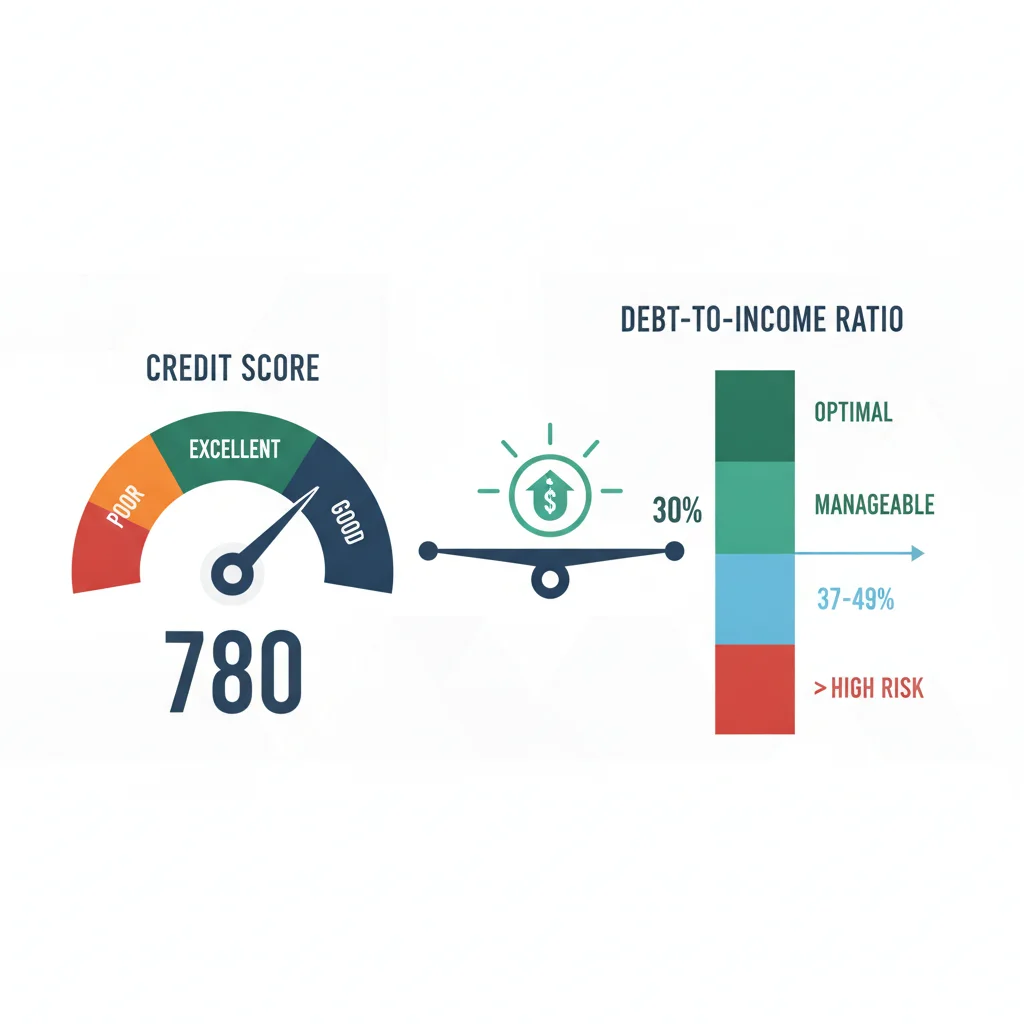
Your debt-to-income ratio is the percentage of your gross monthly income that goes toward paying existing debts. Lenders calculate it by dividing your total monthly debt payments — including rent or mortgage, car payments, credit cards, and student loans — by your gross monthly income. A lower DTI signals that you have room in your budget to take on new debt responsibly.
Most auto lenders use your front-end or back-end DTI depending on the product; back-end DTI (all debts combined) is the more commonly referenced figure in auto underwriting and typically must stay below 50% for prime lenders.
Why Two Numbers Tell the Full Story
When you walk into a dealership or submit an online application, lenders aren't just pulling your credit score and calling it a day. They're building a risk profile — and your credit score is only half the picture. The other half is your debt-to-income ratio (DTI), and the two signals work as a team.
Think of it this way: your credit score is your track record. It answers the question, "Has this person paid their debts on time in the past?" Your DTI is your capacity check. It answers the question, "Even if they have a perfect history, do they have the cash flow right now to handle one more payment?"
A borrower with a 780 credit score and a 58% DTI is a real problem for an underwriter. That score says they've been responsible. That DTI says there's almost no room left in their monthly budget. One unexpected expense — a car repair, a medical bill — could break the repayment cycle. Lenders have seen this pattern often enough that they've built hard rules around it.
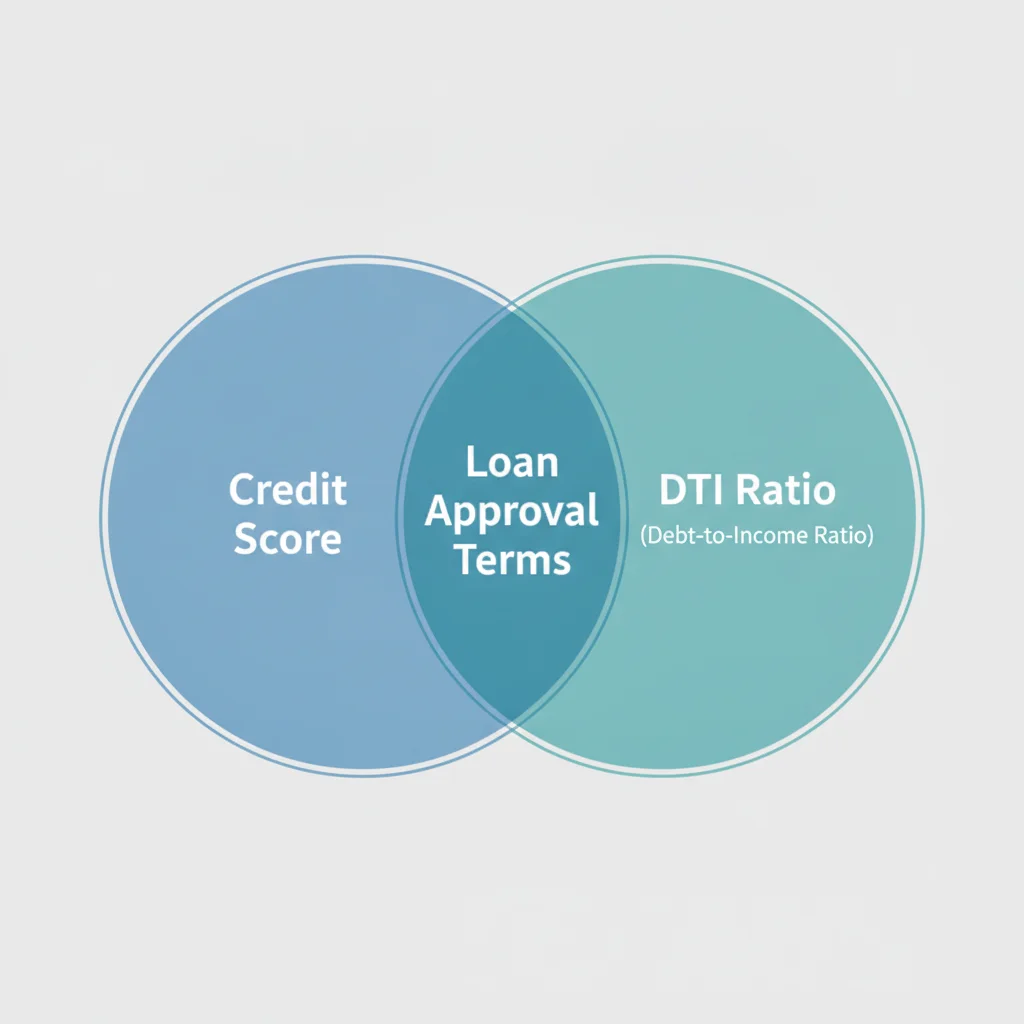
The relationship also works in the other direction. A borrower with a modest 650 score but a 28% DTI has solid breathing room each month. Some lenders will approve that application and offer reasonably competitive terms, because the cash-flow math is comfortable even if the credit history isn't spotless.
Understanding how these two factors interact — and how lenders weigh them against each other — is one of the most practical things you can do before you apply for an auto loan.
How Lenders Actually Calculate and Apply DTI
Lenders are not all using the same formula, but the logic is consistent. Back-end DTI — the figure that counts every monthly debt obligation — is the standard in auto lending. Here's what typically gets included:
- Rent or mortgage payment (or projected mortgage if you're buying)
- Existing auto loan payments
- Minimum monthly credit card payments
- Student loan payments
- Personal loan payments
- Any alimony or child support obligations
What they divide that total by is your gross monthly income — your earnings before taxes and deductions. If you earn $60,000 per year, that's $5,000 per month gross. If your existing debts total $2,000 per month and you're applying for a car loan that will add another $450, the lender calculates DTI as ($2,000 + $450) ÷ $5,000 = 49%.
43%
Maximum DTI for most qualified mortgages
The Consumer Financial Protection Bureau uses 43% as a benchmark for sustainable debt load — a figure auto lenders also reference when evaluating back-end DTI.
50%+
DTI threshold where prime auto approval becomes rare
Based on industry underwriting guidelines reported by the National Automobile Dealers Association, most bank and credit union auto lenders apply hard caps near 50% back-end DTI.
$1,400
Extra interest cost of a 2.5% rate increase
On a $35,000 loan at 60 months, moving from 7.2% to 9.8% APR — a shift attributable to a high DTI — adds approximately $1,400 in total interest paid.
28%
Average DTI of prime auto loan approvals
According to Experian's State of the Automotive Finance Market report, borrowers who receive the most competitive auto loan rates typically carry back-end DTIs well below 35%.
60%
DTI ceiling for most subprime auto lenders
Subprime auto lenders generally cap back-end DTI at 55–60%; applications above that threshold are typically declined regardless of compensating factors.
That 49% lands right at the edge of what many prime lenders will accept. At 50% or above, you're likely getting bumped to subprime options with higher rates — or declined outright. At 40% or below, you're in comfortable territory with most lenders. At 36% or below, you're near the sweet spot that unlocks the most competitive offers.
One thing many buyers don't realize: the lender runs this calculation including the new payment they're about to approve. So even if your current DTI is 38%, a high car payment could push you to 52% — and the lender sees that before they approve anything. This is why getting preapproved early lets you understand what payment range keeps your DTI in an acceptable range before you fall in love with a car that's priced out of your budget.
DTI Calculation Varies by Lender
Not every lender counts the same debts. Some lenders exclude certain lease payments or count proposed new payments differently. A few online lenders use net income rather than gross income for DTI calculations, which produces a different — often higher — percentage. Always ask which income figure and which debts a lender is using when they quote your DTI.
Preapproval Locks In Your Negotiating Position
When you arrive at a dealership with a preapproval letter from your own bank or credit union, the finance office must beat that offer to earn your business — or accept that you'll use your own financing. This shifts the dynamic considerably. Getting preapproved also forces you to calculate your own DTI before you shop, which keeps your payment expectations realistic.
The Interplay: When Score and DTI Work Against Each Other
The most common misconception I've seen across years in dealership finance offices is this: buyers assume their credit score is the master key. They worked hard to get to 720 or 740, and they expect that score to carry them across the finish line. When the finance manager tells them the rate is higher than expected, they're blindsided.
Here's what's happening behind the scenes. Most lenders use a risk matrix — a grid where credit score ranges run along one axis and DTI bands run along the other. The intersection of those two factors produces a rate tier. A borrower at 720 with a 35% DTI hits one rate. The same 720 borrower with a 55% DTI hits a significantly worse rate — or hits a hard wall entirely.
“Credit scores tell you about the past. Debt-to-income ratios tell you about the future. The smartest underwriters have always cared more about the future.”
— Melinda Forsythe, Former auto lending underwriting director, regional bank
This means your DTI can effectively demote your credit tier. You might qualify on paper for a 7.2% rate based on your score, but your DTI pushes the lender to price you at 9.8% to compensate for the cash-flow risk. That difference on a $35,000 loan over 60 months is roughly $1,400 more in total interest.
The same matrix logic works in your favor too. If your credit score is 640 — firmly in the fair range — but your DTI is 28%, some lenders will stretch to offer you terms reserved for borrowers with higher scores. They're comfortable with the math even if the history isn't perfect. This is especially true at credit unions and community banks that take a more holistic approach to underwriting.
For borrowers navigating bad credit loan options, DTI often becomes the deciding factor because the credit score alone already prices them into high-rate territory — their DTI determines whether they even get an approval offer.
Target 36% DTI Before You Apply
If you have time before your purchase, work to get your back-end DTI — including the projected new car payment — below 36%. That threshold unlocks the most competitive rate tiers at the widest range of lenders, giving you real negotiating leverage. Even getting from 48% to 42% can move you into a meaningfully better rate band.
Document Every Income Source Before Applying
DTI is only as favorable as your documented income. Gather two months of pay stubs, two years of tax returns if you're self-employed, and any written records of additional income sources like rental payments or consistent freelance contracts. Presenting complete documentation upfront prevents the underwriter from using a lower income figure than your actual earnings.
Real-World Rate Outcomes by Score and DTI Combination
Abstract percentages don't help you at the lot. Let's put numbers to paper. The following scenarios are based on a $32,000 new vehicle loan with a 60-month term, using rate bands representative of what a mix of banks and credit unions typically offer in a normal rate environment. Actual rates vary by lender and market conditions.
| Credit Score Range | DTI Below 40% | DTI 40–50% | DTI Above 50% |
|---|---|---|---|
| 760+ | ~6.5% APR | ~7.5% APR | Declined or 9%+ |
| 700–759 | ~7.9% APR | ~9.2% APR | Declined or 11%+ |
| 650–699 | ~11% APR | ~13.5% APR | Subprime only, 15%+ |
| Below 650 | ~14–16% APR | ~17–19% APR | Likely declined |
Look at what happens to a 760+ borrower when their DTI crosses 50%. They go from a rate well under 7% to potentially being declined by prime lenders entirely — and shopping with subprime lenders at rates approaching double digits. That's not a credit score problem. That's a DTI problem, and it costs them thousands.
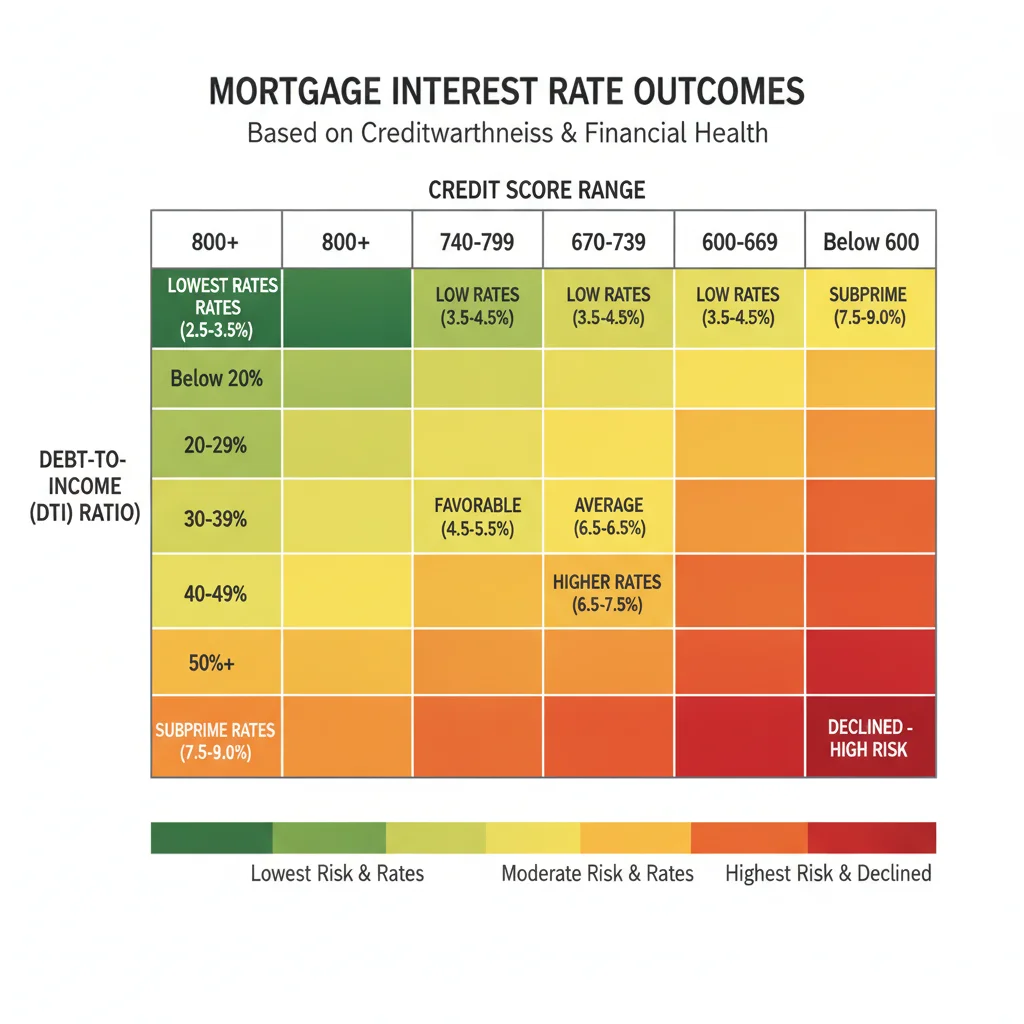
This is also why lenders evaluate factors beyond your credit score. A score in isolation doesn't capture whether you can actually handle the payment. The DTI fills that gap, and lenders weight it heavily precisely because it's a real-time snapshot of your financial obligations.
Note also the role of loan-to-value ratio in this picture. A larger down payment reduces the loan amount, which lowers the projected monthly payment, which in turn reduces your post-loan DTI. It's one of the fastest mechanical levers buyers can pull before they apply.
How to Improve Your Position Before Applying
If your DTI is running high, there are concrete moves that change the math before you sign anything. Some take weeks; a few can be done in the same month you plan to apply.
Pay Off or Pay Down Installment Debts
Eliminating a car payment, personal loan, or any installment debt that's nearly paid off can meaningfully reduce your monthly obligation total. If you have a loan with 8 months left and a $280 monthly payment, paying it off now drops your DTI by whatever that $280 represents relative to your income. On a $5,000 gross monthly income, that's 5.6 percentage points off your DTI — which could shift you from 48% to 42% and into a better rate tier.
Reduce Credit Card Minimum Payments
Minimum payments are calculated as a percentage of your balance — typically 1–2% per month. Paying down a $6,000 balance to $2,000 can cut your minimum from roughly $120 to $40. That $80 reduction lowers your DTI by 1.6% on a $5,000 income. It's not massive, but it stacks. It also improves your credit utilization, which lifts your score simultaneously.
Consider Loan Term Length Strategically
A longer loan term lowers your projected monthly payment, which reduces the DTI impact of the new loan. A $32,000 loan at 8% APR over 48 months carries a $782 payment. The same loan over 72 months drops to $563 per month — a difference that could move your post-loan DTI from 48% to 44%. As detailed in how loan term length affects DTI, this comes with a trade-off in total interest paid, so run the numbers both ways.
Document All Income Sources
DTI is calculated on documented income. If you have freelance income, rental income, or a side job, make sure you can verify it. Lenders often accept 1099 income with two years of tax returns. Adding $600 per month in documented side income to a $5,000 base income (bringing it to $5,600) improves your DTI on every dollar of debt you carry.
Target 36% DTI Before You Apply
If you have time before your purchase, work to get your back-end DTI — including the projected new car payment — below 36%. That threshold unlocks the most competitive rate tiers at the widest range of lenders, giving you real negotiating leverage. Even getting from 48% to 42% can move you into a meaningfully better rate band.
Document Every Income Source Before Applying
DTI is only as favorable as your documented income. Gather two months of pay stubs, two years of tax returns if you're self-employed, and any written records of additional income sources like rental payments or consistent freelance contracts. Presenting complete documentation upfront prevents the underwriter from using a lower income figure than your actual earnings.
There's also a threshold to know if you have credit challenges: the DTI ceiling that subprime lenders apply is tighter than many buyers expect, and hitting it means even high-rate lenders won't proceed. Understanding that line before you apply tells you exactly how much work you need to do.
What This Means at the Dealership Table
When you sit down with a finance manager, they already have your DTI calculated. They know whether you're over the line before they start talking numbers with you. That information asymmetry is real, and the way to close it is to know your own numbers before you walk in.
Calculate your current back-end DTI using only your existing debts — not the new payment. Then estimate the monthly payment on the car you're considering using any online auto loan calculator. Add that payment to your existing debt total and divide by your gross monthly income. If that number is above 45%, start shopping for a cheaper car, a larger down payment, or plan to reduce some existing debt first.
Also remember: the dealership's finance office doesn't just take one lender's offer. They submit your application to multiple lenders simultaneously and present the one that works (and often the one that maximizes dealer profit on the backend). If you know your DTI is solid, you're in a better position to ask to see competing offers — or to come in with a preapproval from your own bank or credit union that bypasses the dealership finance office entirely.
DTI Calculation Varies by Lender
Not every lender counts the same debts. Some lenders exclude certain lease payments or count proposed new payments differently. A few online lenders use net income rather than gross income for DTI calculations, which produces a different — often higher — percentage. Always ask which income figure and which debts a lender is using when they quote your DTI.
Preapproval Locks In Your Negotiating Position
When you arrive at a dealership with a preapproval letter from your own bank or credit union, the finance office must beat that offer to earn your business — or accept that you'll use your own financing. This shifts the dynamic considerably. Getting preapproved also forces you to calculate your own DTI before you shop, which keeps your payment expectations realistic.
Your credit score is important. Don't let anyone tell you otherwise. But after years of watching deals fall apart or go sideways for buyers who had great scores and no idea their DTI was killing their rate, I can tell you clearly: knowing both numbers — and what they mean together — is the real preparation that gets you a good deal.
All claims are backed by peer-reviewed research. Sources on request.