Key Takeaways
Debt-to-Income Ratio (DTI)
Your debt-to-income ratio is the percentage of your gross monthly income that goes toward paying all your monthly debt obligations. Lenders use it to measure how much additional debt you can realistically afford to carry. A lower DTI signals financial breathing room; a high DTI tells a lender you're already stretched thin.
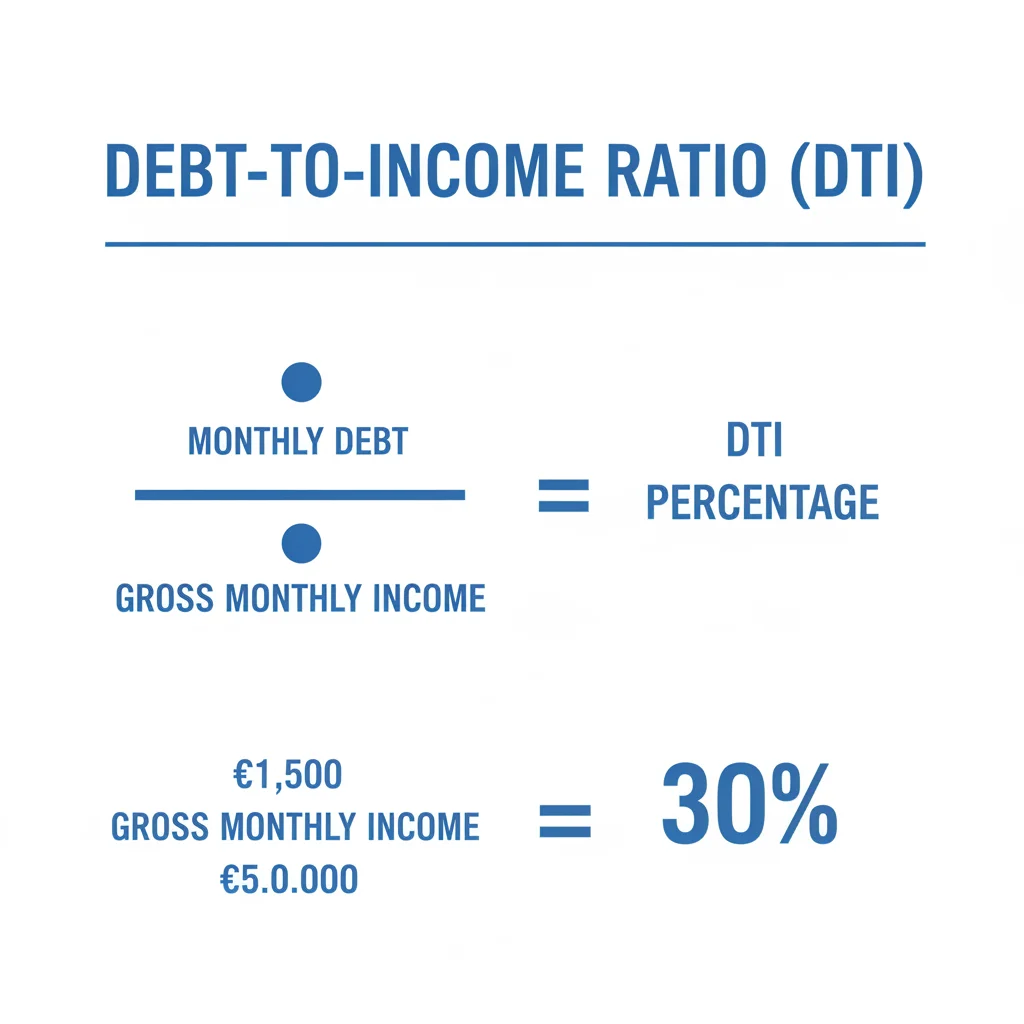
DTI is calculated as total monthly debt payments divided by gross monthly income, expressed as a percentage. Lenders may assess a "front-end" DTI (housing costs only) or a "back-end" DTI (all recurring debts), with auto lenders typically focused on the back-end figure.
Why Lenders Care More About DTI Than Most Buyers Realize
Walk into most dealerships without a preapproval and the finance manager will pull your credit score, smile or wince, and start building a deal around that number. What many buyers don't realize is that behind the scenes, the lender reviewing your application is running a second, arguably more important calculation: your debt-to-income ratio.
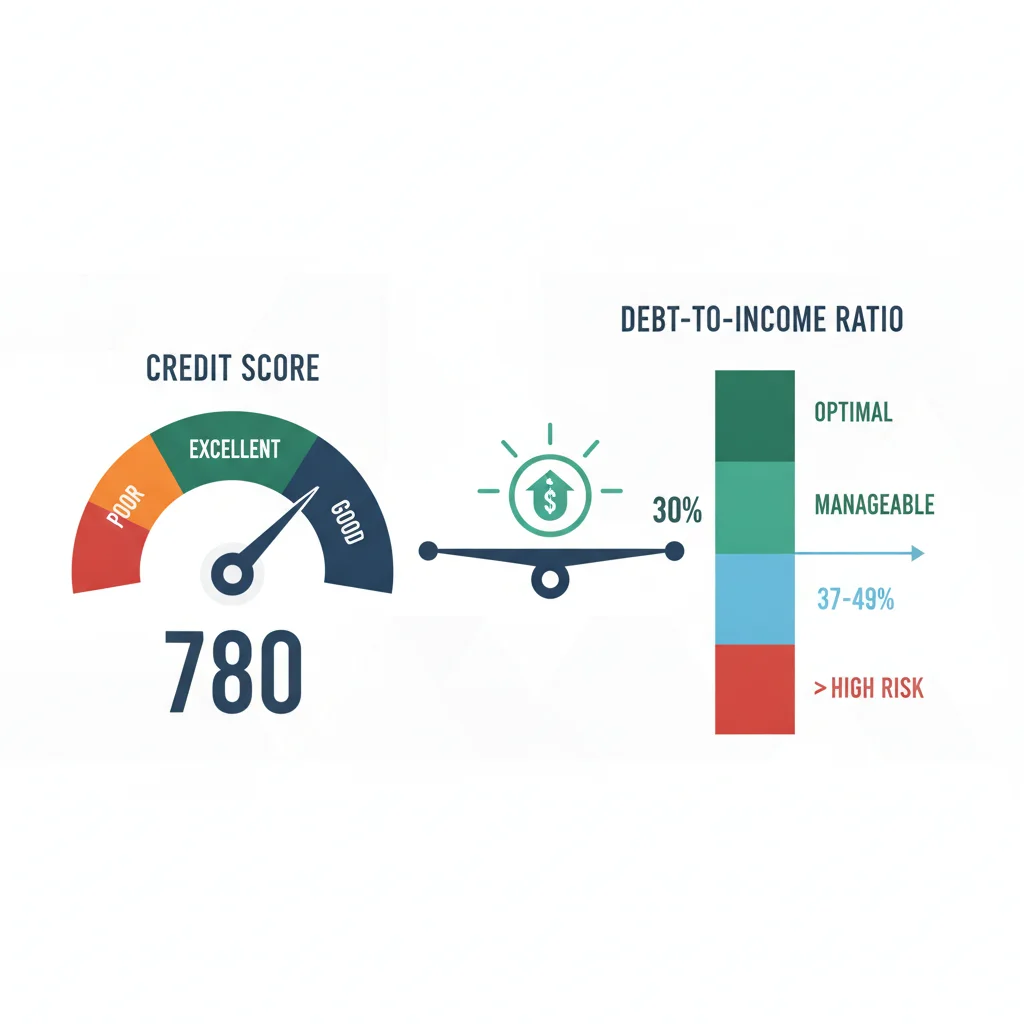
Your credit score is historical — it tells a lender what kind of borrower you've been. Your DTI is situational — it tells them whether you can actually service a new loan payment right now, given everything else you're obligated to pay each month. Lenders have learned, often painfully, that a borrower with a 720 credit score and a 55% DTI is a riskier bet than one with a 680 score and a 28% DTI.
This is especially true for auto loans, where the asset depreciates rapidly. Unlike a mortgage backed by appreciating real estate, an auto loan is secured by a vehicle that loses value from the moment you drive it off the lot. That makes income stability and debt capacity critical factors in the lender's risk model.
Rent vs. Mortgage: What Lenders Count
Some lenders include rent payments in the back-end DTI calculation; others do not, particularly if rent doesn't appear on your credit report. If you're renting, ask your prospective lender explicitly whether they include rent in the DTI formula — the answer affects how your ratio is calculated and what threshold you need to meet.
DTI Alone Won't Disqualify You Everywhere
Lenders have different risk appetites, and some specialize in approving borrowers with high DTI ratios or thin credit files. However, accepting a loan from a high-risk lender typically means paying a substantially higher interest rate. Before accepting unfavorable terms, consider whether adjusting the deal structure — down payment, vehicle price, or loan term — could move you into a more favorable approval tier with a better lender.
Understanding the full picture of what lenders evaluate is essential before you apply. Our guide on everything your lender looks at before issuing a preapproval covers credit score, income verification, and more in one place.
How to Calculate Your DTI — Before a Lender Does
Don't let a lender be the first to know your DTI. Run the numbers yourself so you walk in with eyes open. The formula is straightforward:
- Add up all monthly minimum debt payments. Include: car loans, student loans, credit card minimums, personal loans, child support or alimony, and your monthly mortgage or rent payment.
- Divide by your gross monthly income. Gross income is your earnings before taxes and deductions — use your base salary, not your take-home pay. If you're self-employed, lenders typically average two years of net income from tax returns.
- Multiply by 100. The result is your back-end DTI percentage.
Example: You earn $6,000 gross per month. You pay $400 on a student loan, $250 on credit cards, and $1,200 in rent. Your current monthly debt total is $1,850. Divide by $6,000: your DTI is approximately 30.8%. That's a solid number.
Now add in the prospective auto loan payment. If you're considering a vehicle with a $500/month payment, your new DTI would be ($1,850 + $500) / $6,000 = 39.2%. Still within most lenders' acceptable range — but close to the threshold where some lenders begin asking questions.
Run this calculation with the actual loan payment you're considering. Use an online auto loan calculator with your expected loan amount, term, and estimated interest rate to get a realistic monthly payment figure before you apply.
Get Preapproved Before You Calculate the Deal
Use an auto loan calculator to estimate the monthly payment on the vehicle you're targeting, then plug that number into your DTI formula. If the result is above 43%, adjust the purchase price, down payment, or term before submitting applications. This prevents unnecessary hard inquiries on your credit report from lenders likely to decline you.
Target Small Debts First for Fast DTI Relief
If your DTI is borderline, focus on eliminating accounts with small balances before applying. Paying off a $3,000 personal loan with a $150/month minimum removes that obligation entirely from your DTI calculation. Credit card minimums are often disproportionately high relative to the balance, making them high-impact targets for payoff.
The DTI Thresholds That Actually Drive Approval Decisions
There is no universal DTI cutoff hardcoded into every lender's system, but there are widely observed benchmarks that should guide your expectations:
| DTI Range | What Lenders Generally See | Typical Outcome |
|---|---|---|
| Below 36% | Strong financial health | Best rates, highest approval odds |
| 36%–43% | Acceptable, manageable debt load | Approved by most lenders; good rates |
| 43%–50% | Elevated risk; marginal cases | Approval possible; higher rates likely |
| Above 50% | High risk of payment stress | Declined by prime lenders; subprime territory |
Keep in mind that DTI doesn't operate in a vacuum. A 45% DTI paired with a 750 credit score and a 20% down payment will land very differently than a 45% DTI with a 590 credit score and no money down. Lenders layer these signals together. Learn how that interaction works in our explainer on how lenders use your DTI alongside your credit score.
If you're looking at non-prime financing, the threshold dynamics shift. Subprime lenders operate with different risk models, but they still have hard stops. See the DTI ratio most subprime lenders won't cross to understand where those limits fall.
43%
Maximum DTI most prime lenders accept
Industry-standard threshold cited by major auto lenders and credit unions as the upper boundary for prime loan approval.
36%
DTI associated with best auto loan rates
Borrowers with DTIs at or below 36% consistently qualify for the most competitive interest rate tiers from mainstream lenders.
~30%
Average American's back-end DTI
Federal Reserve consumer finance data indicates the median U.S. household carries debt obligations representing roughly 30% of gross income.
50%+
DTI floor for many subprime auto lenders
Lenders specializing in bad-credit auto loans frequently see applicant DTIs above 50%, but impose higher rates and stricter LTV requirements to offset risk.
14–45 days
Rate shopping window for credit inquiries
FICO and VantageScore both provide a rate-shopping window during which multiple auto loan inquiries are treated as a single hard pull.
How Preapproval Turns Your DTI Knowledge Into Negotiating Power
Here's the dealership dynamic that most buyers don't understand: when you walk onto a lot without financing, the finance manager controls the conversation. They can quote you a monthly payment, bury markup in the rate, extend your loan term without discussion, and you have no benchmark to push back against.
Preapproval changes this entirely. When you arrive with a lender's written offer — a specific loan amount at a specific interest rate — you've already separated the car deal from the financing deal. You know what monthly payment that loan produces. You know the rate. You know the term. The dealer's finance office has to beat that offer or lose the financing business.
More importantly, having been preapproved means a lender already reviewed your DTI and approved you anyway. That's leverage. You're not hoping a dealership's captive lender will say yes — you're a verified, preapproved buyer who can close today.

To get preapproved, you'll need to provide your gross income, employment history, Social Security number for a credit pull, and existing monthly debt obligations. The lender calculates your DTI from that information. If your DTI is borderline, some lenders may ask for documentation like recent pay stubs or two years of tax returns. See the full list of what lenders evaluate in our guide on what lenders look at beyond your credit score.
“A preapproved buyer is the dealership's best customer and their hardest negotiation. You've already been told yes by a lender — now they have to earn your business, not the other way around.”
— Desmond Kimathi, Former dealership finance insider and auto financing advocate
Practical Ways to Improve Your DTI Before Applying
If your DTI calculation came out higher than you'd like, you have two levers: reduce debt or increase income. Neither happens overnight, but even modest improvements can shift you into a more favorable approval tier.
Reduce Existing Debt Balances
The fastest impact comes from eliminating smaller debts entirely. Paying off a $150/month personal loan drops your monthly obligations by $150 — that's a direct, immediate improvement to your DTI. Focus on accounts with small balances and lower interest rates first if the goal is DTI reduction (not total interest savings). Credit card balances are particularly useful to target because the minimum payment is proportionally significant relative to the balance.
Avoid Taking on New Debt Before Applying
Don't finance furniture, open a new credit card, or take out any other loan in the 90 days before applying for an auto loan. Each new payment increases your DTI and may flag your file as someone actively accumulating debt.
Adjust the Loan Amount You're Targeting
A smaller loan means a smaller monthly payment, which means a lower projected DTI with the new loan included. This might mean targeting a less expensive vehicle, making a larger down payment, or both. Our resource on down payments explains how your upfront contribution affects loan structure and monthly payment math. A bigger down payment also affects your loan-to-value ratio — particularly important if your credit is less than perfect, as explained in our guide on LTV and why it matters more when credit is low.
Consider Loan Term Strategically
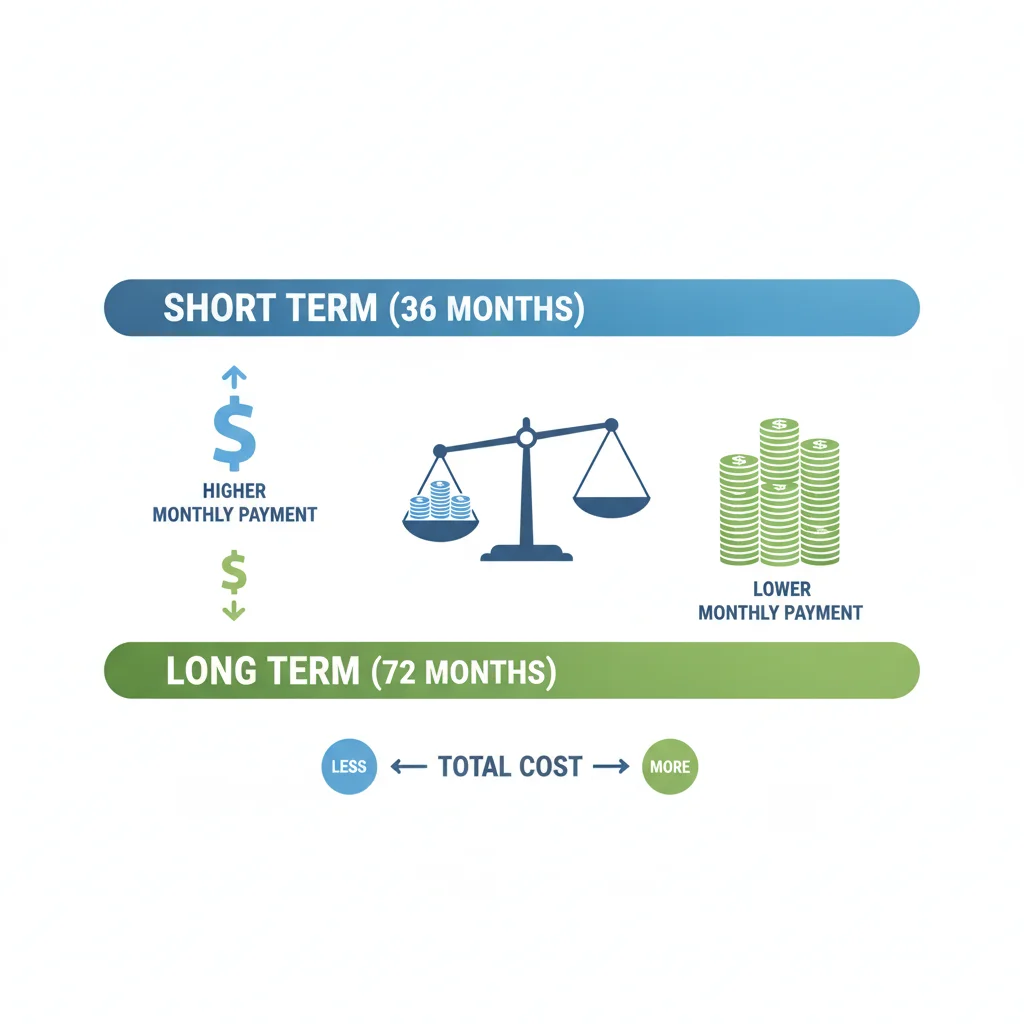
Extending your loan from 48 months to 60 or 72 months lowers your monthly payment and therefore the DTI impact of the new loan. But this comes at a cost — more total interest paid and a longer period of potential negative equity. It's a trade-off worth understanding fully. Our article on how loan term length affects your DTI walks through the math in detail.
Get Preapproved Before You Calculate the Deal
Use an auto loan calculator to estimate the monthly payment on the vehicle you're targeting, then plug that number into your DTI formula. If the result is above 43%, adjust the purchase price, down payment, or term before submitting applications. This prevents unnecessary hard inquiries on your credit report from lenders likely to decline you.
Target Small Debts First for Fast DTI Relief
If your DTI is borderline, focus on eliminating accounts with small balances before applying. Paying off a $3,000 personal loan with a $150/month minimum removes that obligation entirely from your DTI calculation. Credit card minimums are often disproportionately high relative to the balance, making them high-impact targets for payoff.
What a High DTI Tells You About the Deal You're Considering
If running the numbers reveals that a prospective auto loan would push your DTI above 43%, take that seriously — not just because lenders might decline you, but because the math is telling you something real about affordability. A high post-loan DTI means a significant portion of your take-home pay is locked into fixed obligations. One job disruption, unexpected medical expense, or rate adjustment on a variable debt could create a cascading problem.
I've seen buyers get approved for loans that pushed their DTI to 52%, only to return to the dealer six months later trying to voluntarily surrender the vehicle. The lender approved it. The payments were technically achievable in a best-case scenario. But there was no margin for error.
The right question isn't just "will a lender approve me?" It's "will I be able to sustain this payment without financial stress for the life of this loan?" Your DTI gives you a structured way to answer that question honestly before you sign anything.
If your DTI is borderline, revisit the vehicle price, down payment, and loan term before submitting applications. Applying and getting declined — or accepting unfavorable terms out of pressure — is a worse outcome than taking another 60 to 90 days to improve your financial position first. Your credit score factors into this picture too, and improving both simultaneously puts you in the strongest possible position.
Rent vs. Mortgage: What Lenders Count
Some lenders include rent payments in the back-end DTI calculation; others do not, particularly if rent doesn't appear on your credit report. If you're renting, ask your prospective lender explicitly whether they include rent in the DTI formula — the answer affects how your ratio is calculated and what threshold you need to meet.
DTI Alone Won't Disqualify You Everywhere
Lenders have different risk appetites, and some specialize in approving borrowers with high DTI ratios or thin credit files. However, accepting a loan from a high-risk lender typically means paying a substantially higher interest rate. Before accepting unfavorable terms, consider whether adjusting the deal structure — down payment, vehicle price, or loan term — could move you into a more favorable approval tier with a better lender.

All claims are backed by peer-reviewed research. Sources on request.