

Key Takeaways
Why the Monthly Payment Number Is Designed to Distract You
Walk into almost any dealership finance office and within 90 seconds someone will ask: "What payment are you comfortable with?" It sounds like a reasonable question. It isn't. It's a pivot — one of the most effective in the business — designed to shift your focus away from the two numbers that actually determine how much you'll pay: the sale price and the APR.
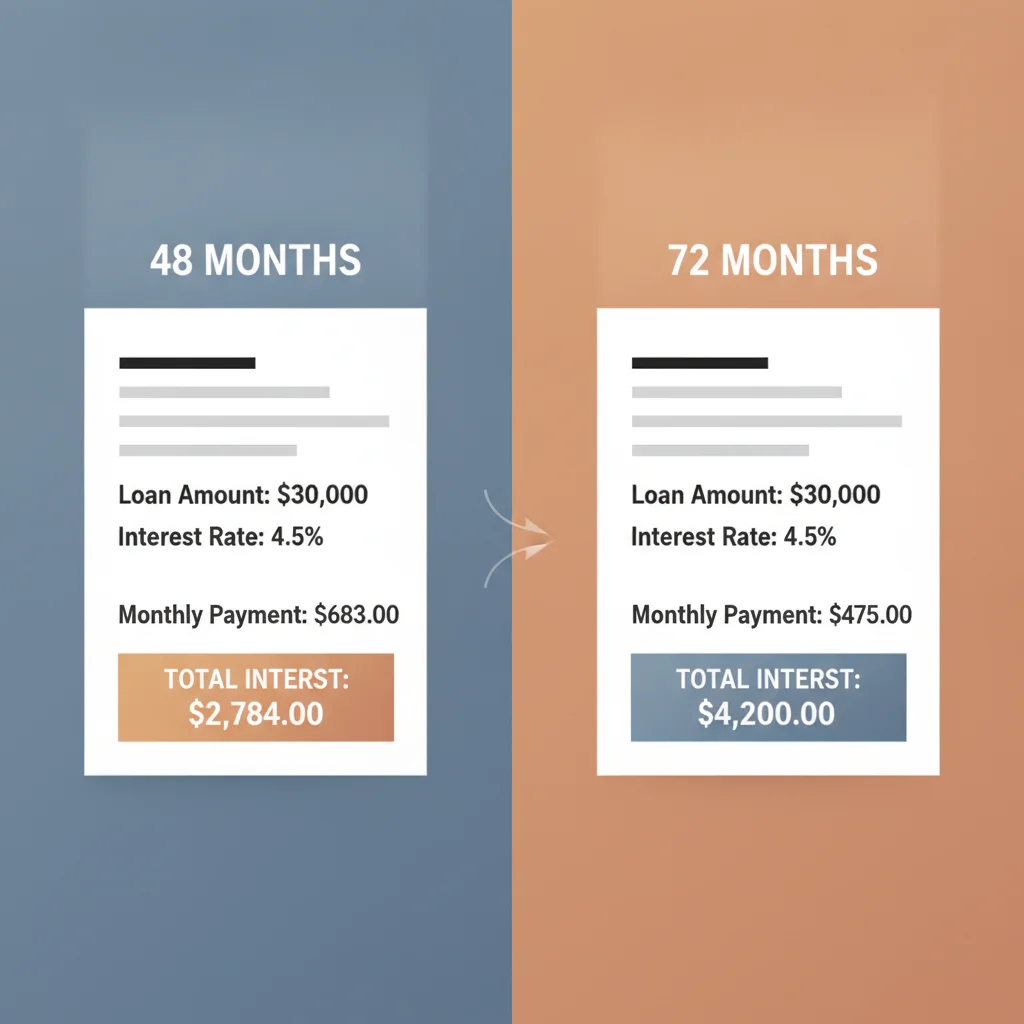
Here's the mechanic: a monthly payment is just the output of three variables — loan amount, interest rate, and loan term. Change any one of them and the payment changes. That gives a finance manager enormous flexibility to absorb a higher price or a worse rate by quietly stretching your loan term from 48 months to 72 or even 84. The payment stays in your comfort zone. The total cost balloons.
Consider a real example. You're financing $32,000:
| Scenario | APR | Term | Monthly Payment | Total Interest Paid |
|---|---|---|---|---|
| A (Credit union pre-approval) | 5.9% | 48 mo | $749 | $3,952 |
| B (Dealer counter) | 8.4% | 60 mo | $655 | $7,300 |
| C ("We can do $499/mo") | 9.1% | 84 mo | $499 | $9,916 |
Scenario C looks like the best deal at the table. You're paying $5,964 more in interest than Scenario A, and you're underwater on the vehicle for the majority of those seven years. The monthly payment framing made the worst loan look like the best offer.
Why dealers prefer to negotiate monthly payments is worth understanding in full — the short version is that monthly payment conversations give dealers more variables to work with, and more variables means more room to build margin.
APR vs. Interest Rate: The Distinction That Actually Matters
Many buyers treat APR and interest rate as interchangeable. They're not — and the gap between them can reveal fees you didn't know you were paying.
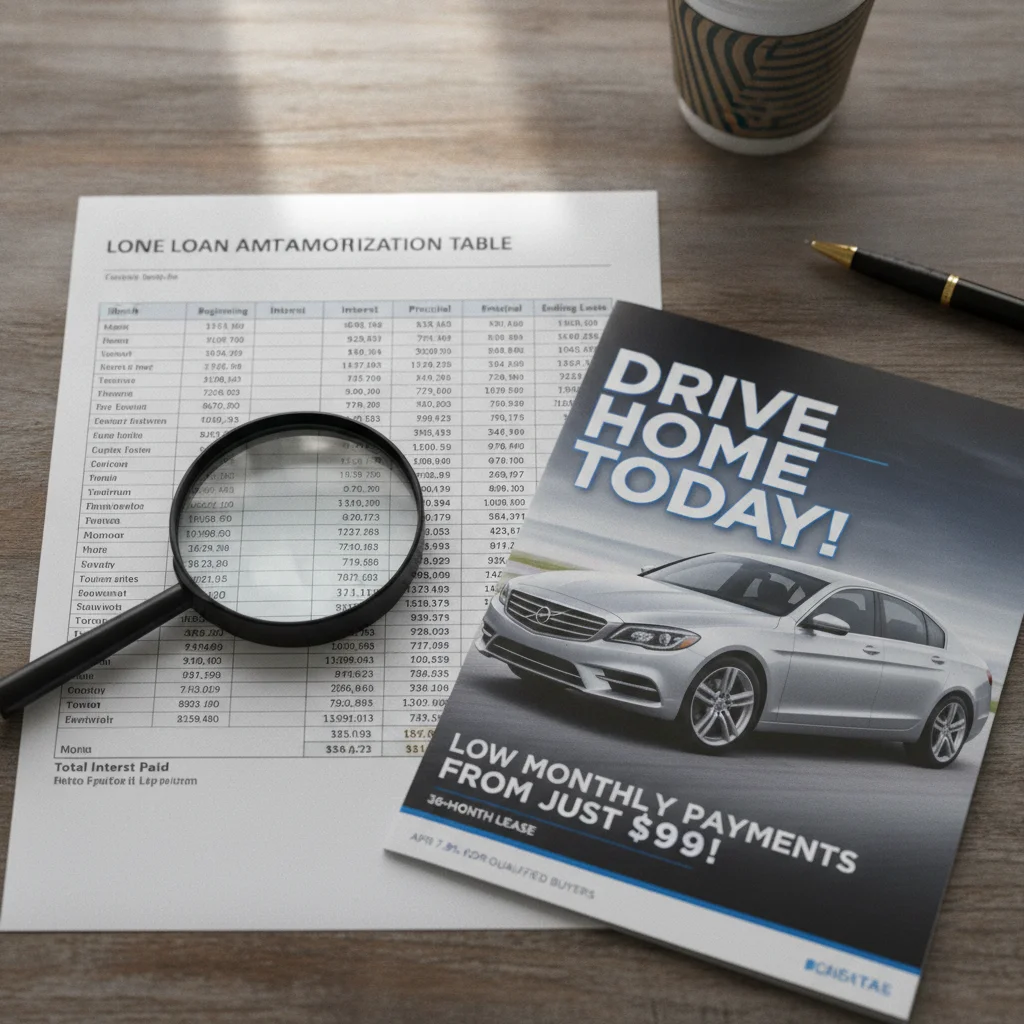
Your interest rate (also called the nominal rate) is simply the cost of borrowing expressed as a percentage, applied only to the principal balance. Your APR — Annual Percentage Rate — wraps in certain additional costs, such as loan origination fees, making it a fuller measure of what the loan actually costs per year.
In auto lending, the difference between APR and interest rate is often smaller than in mortgages, but it still matters. If a dealer quotes you a 7.5% interest rate but your loan documentation shows an APR of 8.2%, that gap represents fees being built into your financing — costs that might not have been clearly disclosed upfront.
APR Must Be Disclosed in Writing — Demand It
Under the federal Truth in Lending Act, lenders are required to provide a written disclosure of the APR before you sign. Do not finalize any financing agreement without reviewing this disclosure. If a dealer resists providing the APR in writing before signing, treat that as a serious red flag. You have a legal right to this information.
Your Pre-Approval Rate Is Your True Baseline
Any dealer financing offer should be evaluated against your pre-approved rate — not against a vague sense of what sounds reasonable. If the dealer's APR is higher than your pre-approval and they can't explain why or beat it, use your pre-approval. The dealer's financing only wins if it actually offers a lower APR for the same or shorter term.
Always ask for the APR in writing before you agree to anything. The Truth in Lending Act (TILA) requires lenders to disclose APR, but a dealer can quote you an interest rate verbally in negotiations while the APR quietly tells a different story on the contract.
The fees hidden inside your APR breaks down exactly which charges get folded into that number and which ones don't — because some costs, like dealer add-ons and extended warranties, are excluded from APR even when they're financed into the loan.
84 months
Most common extended auto loan term
According to Experian's State of the Automotive Finance Market report, loans with terms of 73–84 months now represent over 32% of all new vehicle financing.
$6,000+
Extra interest on a 7-year vs. 4-year loan
On a $32,000 loan at 8% APR, extending from 48 to 84 months lowers the monthly payment by roughly $170 but adds over $6,100 in total interest paid.
44%
Buyers who don't know their auto loan APR
A Consumer Financial Protection Bureau survey found nearly half of auto loan borrowers could not accurately recall their loan's APR within one percentage point.
2.4%
Average dealer markup above buy rate
Industry data indicates dealers routinely mark up the lender's offered rate — the "buy rate" — by 1–3 percentage points, pocketing the spread as dealer reserve.
The Most Costly Mistakes Buyers Make
These aren't hypothetical errors. Every one of these plays out in finance offices every day. Knowing them cold is the first step to avoiding them.
Telling the dealer your target monthly payment before agreeing on a price.
Why it happens: Buyers think they're being practical by anchoring to what they can afford each month. In reality, they've handed the finance manager a tool to obscure every other variable in the deal.
Accepting an extended loan term to hit a lower payment without calculating total interest.
Why it happens: A 72 or 84-month loan feels like financial flexibility. Nobody hands you a total interest comparison at the table — they just quote the payment.
Confusing the interest rate with the APR and assuming they're the same number.
Why it happens: Both are expressed as percentages and both relate to borrowing cost, so buyers treat them interchangeably. Salespeople sometimes exploit this by quoting only the interest rate.
Skipping pre-approval and treating the dealer as the only financing option.
Why it happens: Convenience and the dealer's pitch that "we can get you a great rate" lead buyers to assume dealer financing is competitive. It sometimes is — often it isn't.
Focusing on getting a payment lower without asking why the payment changed.
Why it happens: When a finance manager adjusts the payment downward, buyers feel like they won a concession. The adjustment may be a term extension or a rate increase buried elsewhere in the contract.
Signing the financing contract without verifying that the APR, term, and financed amount match what was agreed verbally.
Why it happens: Finance offices are fast-paced and paperwork-heavy. Buyers are often tired by the time they reach the signing stage and trust that the numbers were entered correctly.
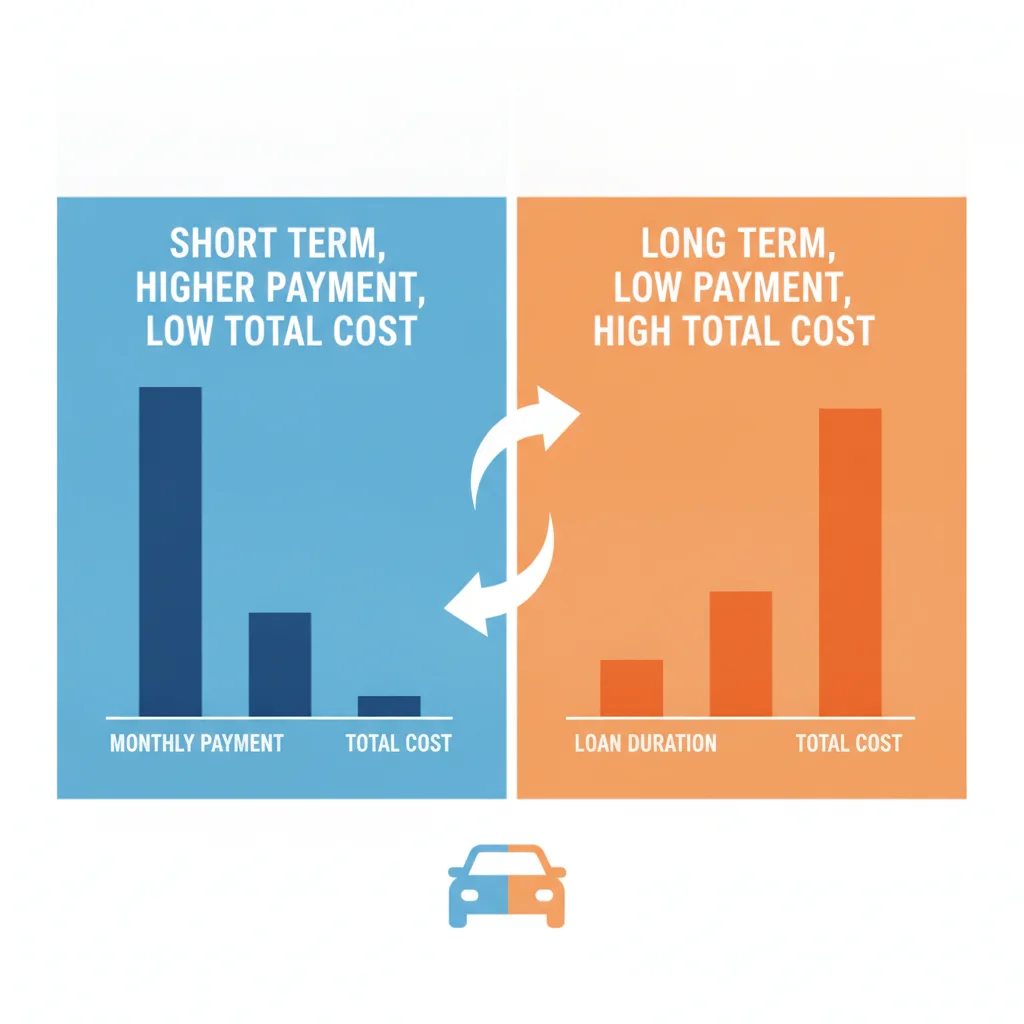
The loan term trap is especially worth calling out separately. When a buyer says "I need to keep it under $500 a month" on a $35,000 vehicle, a finance manager doesn't negotiate the price down — they extend the loan out. At 7% APR, the difference between a 48-month and 84-month loan on that amount is about $149/month in payment, but over $6,200 in total interest. You saved nothing. You spent considerably more.
Loan term length and APR examines this trade-off in detail with side-by-side calculations that show exactly where the money goes when you extend a term.
How to Negotiate the Right Way: Price First, Rate Second, Payment Last
There's a simple framework that eliminates most of the leverage a finance office has over you. It's not new, but most buyers don't actually follow it under pressure:
- Get pre-approved before you shop. Walk in with a rate from your bank or credit union. This is your benchmark. If the dealer can beat it legitimately, great. If not, you use yours.
- Negotiate the out-the-door price as if you're paying cash. Don't mention financing. Lock in the best possible purchase price before financing enters the conversation. Negotiating out-the-door price vs. monthly payment covers this in detail.
- Then negotiate the APR. Armed with your pre-approval rate, you can compare the dealer's offer on an apples-to-apples basis. Ask for the APR — not the interest rate, not the payment — and get it in writing.
- Calculate the payment yourself. Once you have price and APR locked, you know what the payment should be. Any deviation means something changed that you didn't agree to.
Watch for the "Payment Packing" Move
After you've agreed on a payment, some finance managers will add products — extended warranties, GAP insurance, paint protection — to the loan and present a new payment just slightly higher than before. Each add-on incrementally increases what you owe and earns the dealer additional margin. If your payment is higher than what your calculated APR and term should produce, something was added without your explicit sign-off. Ask for a complete itemization before proceeding.
Rate Quotes Over the Phone Are Not Guarantees
A dealer may quote you an attractive rate to get you in the door. Until that rate is on a signed contract with a disclosed APR, it isn't real. Always confirm the rate in the actual loan documentation — not a verbal quote, not a printed estimate, not a phone number from a salesperson.
One practical tool: bring a loan amortization calculator on your phone. Enter the financed amount, the APR, and the term. The resulting payment is what you should see on the contract. If the numbers don't match, ask why before you sign anything.
It's also worth understanding the myths that keep buyers from doing this. Auto loan APR myths that cost buyers real money covers the belief that "dealer financing is always competitive" — which is sometimes true but often isn't, especially if your credit score isn't exceptional.

What to Do If You Already Have a Monthly-Payment Loan
If you're reading this after already signing a loan that was negotiated on payment terms, you're not without options. The first step is to find out what you actually agreed to. Pull your loan documents and locate the APR, the total amount financed, and the total of all payments. Multiply the monthly payment by the number of months — the difference between that number and the amount financed is your total interest cost.
If your APR is higher than what you could qualify for today, refinancing is worth investigating. Even dropping your rate by 1.5 to 2 percentage points on a $25,000 balance with 36 months remaining can save $700–$1,200 in interest, depending on your term. Early payoff strategies outlines how making extra principal payments can also compress your total interest significantly without the cost of refinancing.
The key qualifier: refinancing makes sense when your credit score has improved since origination, market rates have dropped, or you discover your original rate was inflated above what your credit profile warranted. If any of those apply, shop refinance offers from at least three sources — your current lender is rarely the most competitive option.
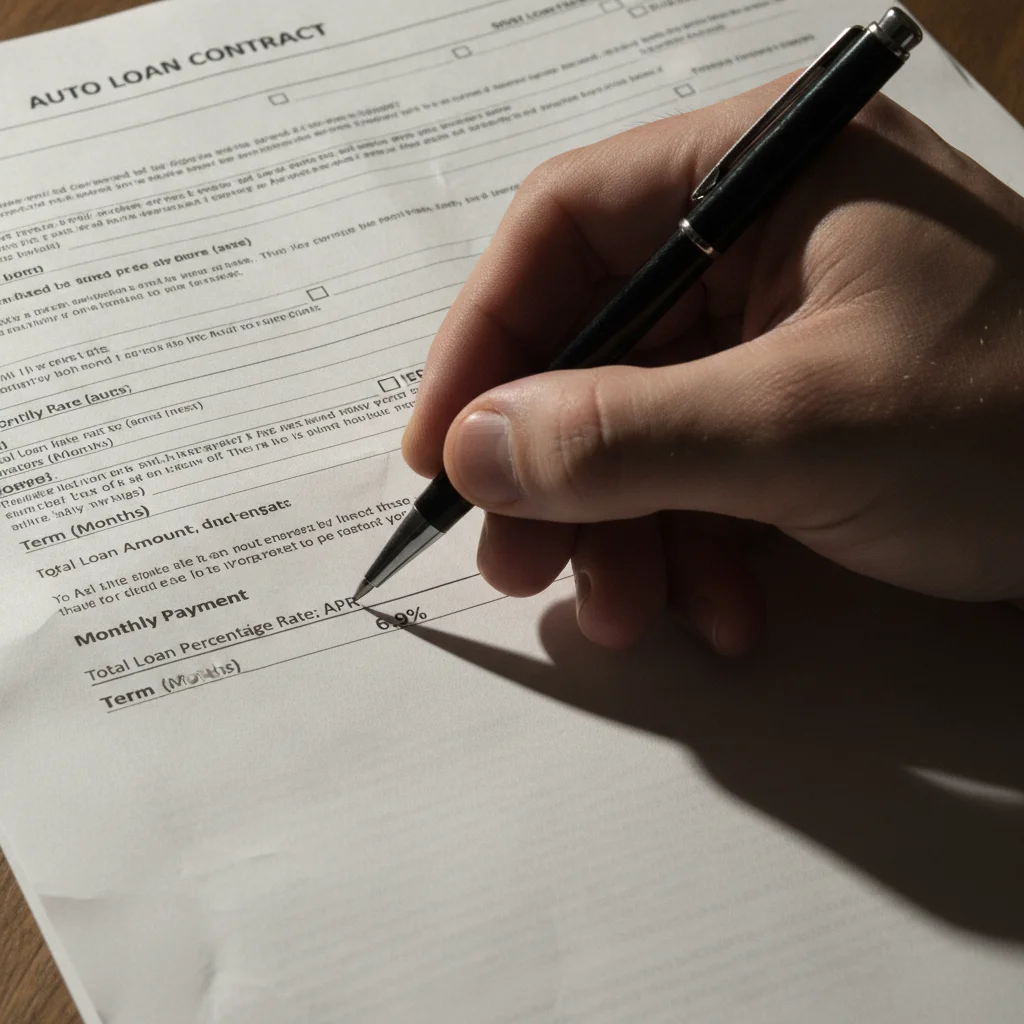
For a deeper foundation on what loan length really costs you over time, loan terms explained is worth bookmarking — it covers the full picture of what monthly payment, loan length, and total cost mean in practical terms.
The One Number to Walk In With
If there's a single habit that protects buyers more than anything else, it's this: know your APR before you sit down. Not a range. Not a rough idea. A specific rate from a specific lender, in writing, that you can use as a live comparison at the table.
Credit unions typically offer the most competitive auto loan rates for buyers with solid credit. Many allow you to apply online and receive approval within a business day. Online lenders like LightStream, PenFed, and others have made this process straightforward even for buyers who don't already have a banking relationship.
When you walk in with pre-approval documentation showing, say, 5.4% APR for a 48-month term, the conversation changes entirely. The dealer knows you have a real exit ramp. They either compete on rate — which benefits you — or they can't, and you use your pre-approval. Either outcome is better than negotiating blind against someone who does this every day.
APR Must Be Disclosed in Writing — Demand It
Under the federal Truth in Lending Act, lenders are required to provide a written disclosure of the APR before you sign. Do not finalize any financing agreement without reviewing this disclosure. If a dealer resists providing the APR in writing before signing, treat that as a serious red flag. You have a legal right to this information.
Your Pre-Approval Rate Is Your True Baseline
Any dealer financing offer should be evaluated against your pre-approved rate — not against a vague sense of what sounds reasonable. If the dealer's APR is higher than your pre-approval and they can't explain why or beat it, use your pre-approval. The dealer's financing only wins if it actually offers a lower APR for the same or shorter term.
Monthly payments are the output. Price and APR are the inputs. Control the inputs and the output takes care of itself. Let the dealer control the framing, and you're handing them the controls to a machine specifically designed to maximize their margin at your expense.
All claims are backed by peer-reviewed research. Sources on request.