
Key Takeaways
APR and Loan Term Interaction
APR (Annual Percentage Rate) is the yearly cost of borrowing money, expressed as a percentage. But the total interest you actually pay is determined by both the APR and how many months you're borrowing — extend the term, and the same rate generates more total interest dollars, even though the rate itself hasn't changed.
Because auto loans use simple interest calculated on the declining principal balance, each additional month of a longer term adds another period over which interest accrues — compounding the total cost without touching the stated APR.
The Rate Is the Same — So Why Is the Bill Different?
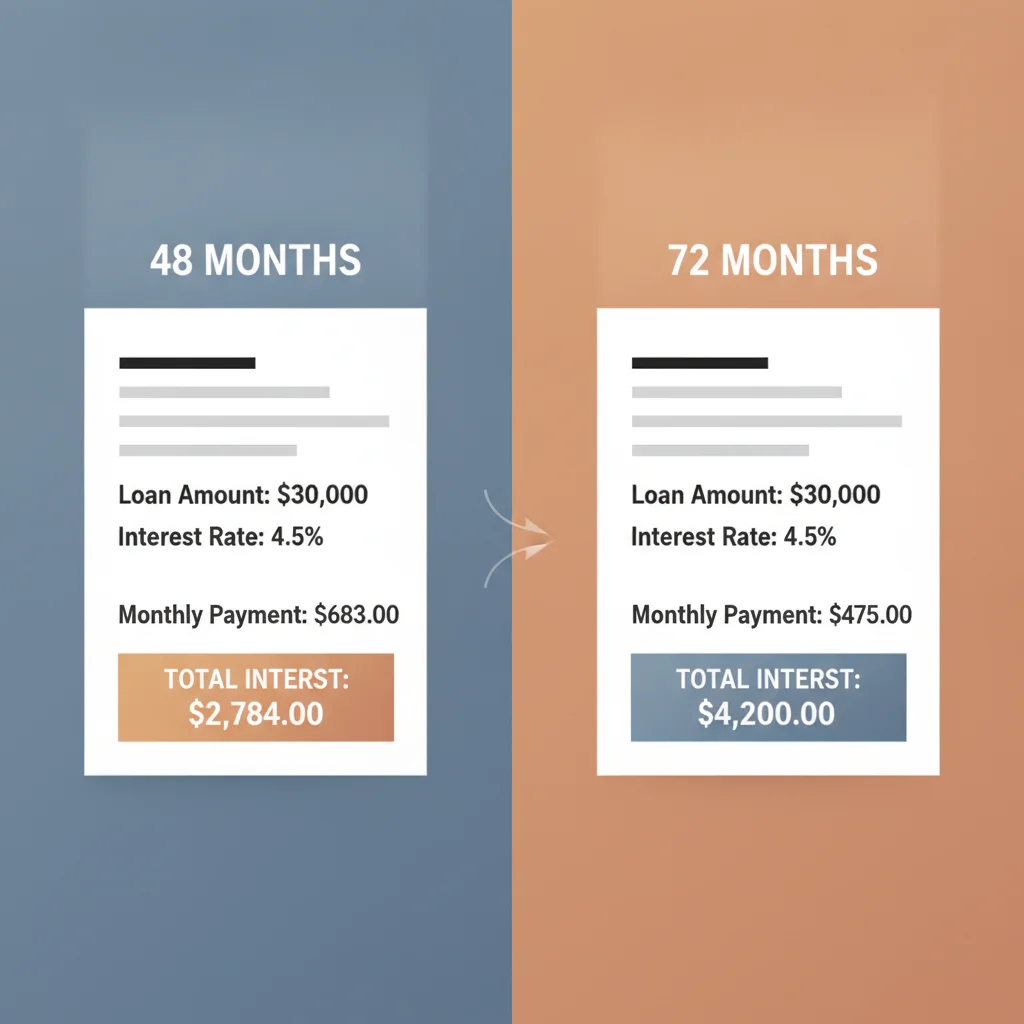
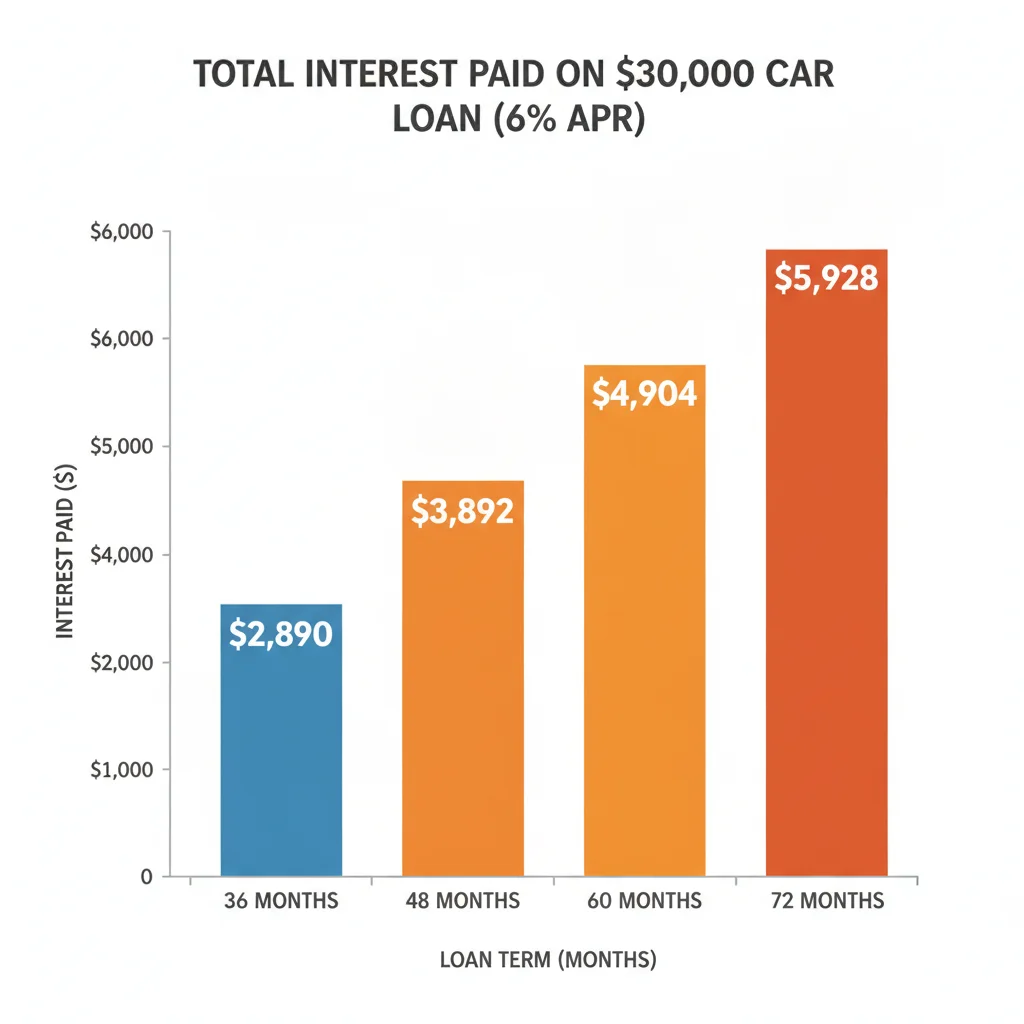
Walk into two dealerships and finance the same $30,000 vehicle at 6% APR. At the first, you take a 48-month loan. At the second, you take a 72-month loan. Same purchase price. Same rate. But your total cost is not the same — not even close.
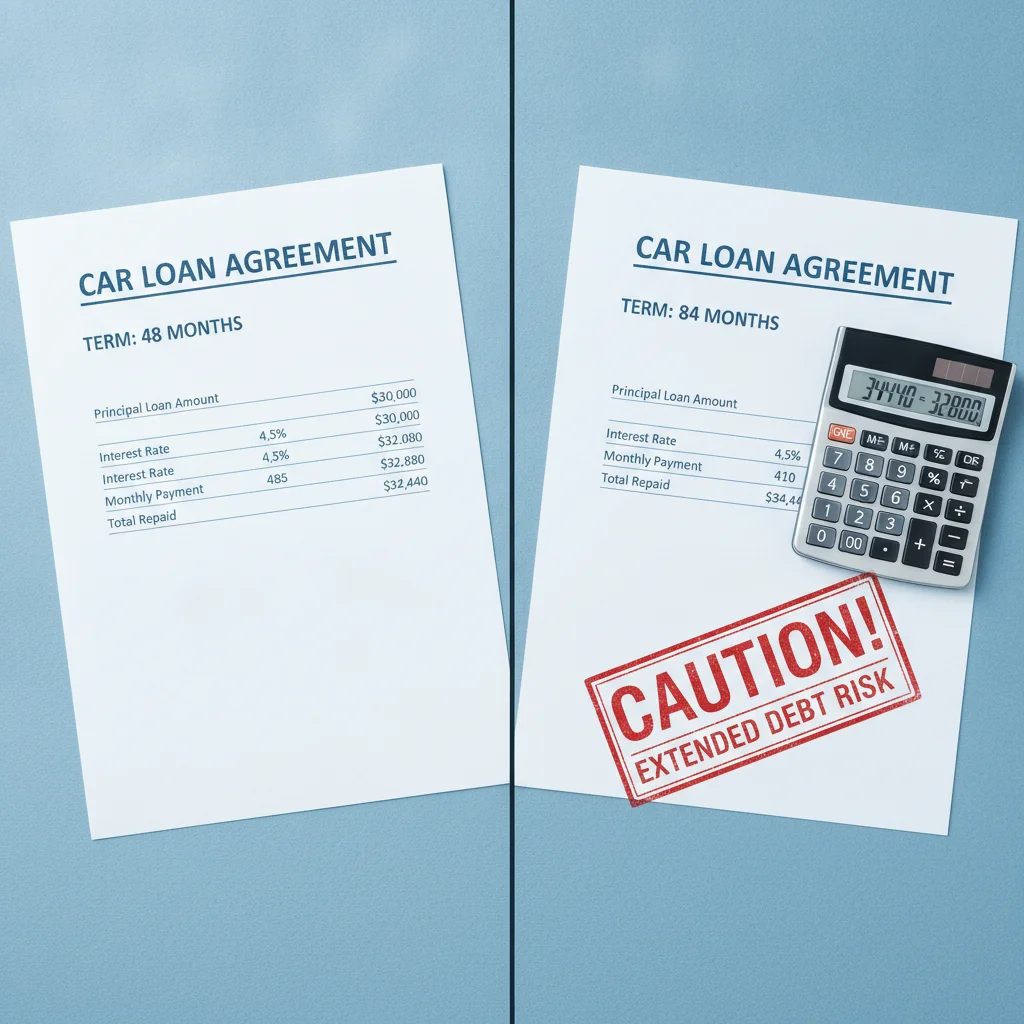
On the 48-month loan, your monthly payment is roughly $705 and you pay about $3,840 in total interest. On the 72-month loan, your monthly payment drops to around $498 — and your total interest climbs to about $5,856. That's $2,016 more out of your pocket for the exact same APR, the exact same vehicle, and the exact same lender.
This is the part most buyers miss entirely: APR is a rate, not a dollar amount. It tells you the speed at which interest accumulates each year. Time tells you how long that meter runs. Extend the term, and you're running the meter longer — even if the speed stays constant.
Understanding this relationship doesn't require a finance degree. But it does require shifting your focus from monthly payment to total repayment. Those are two completely different numbers, and dealerships know exactly which one to show you.
How Interest Actually Accumulates on an Auto Loan
Auto loans use simple interest, calculated on the remaining principal balance each month. Here's the mechanics in plain English:
- At the start of month 1, you owe the full loan amount. The lender calculates your interest for that month as:
principal × (APR ÷ 12). - Your monthly payment covers that month's interest first. Whatever is left reduces the principal.
- In month 2, interest is calculated on the now-slightly-smaller principal. And so on.
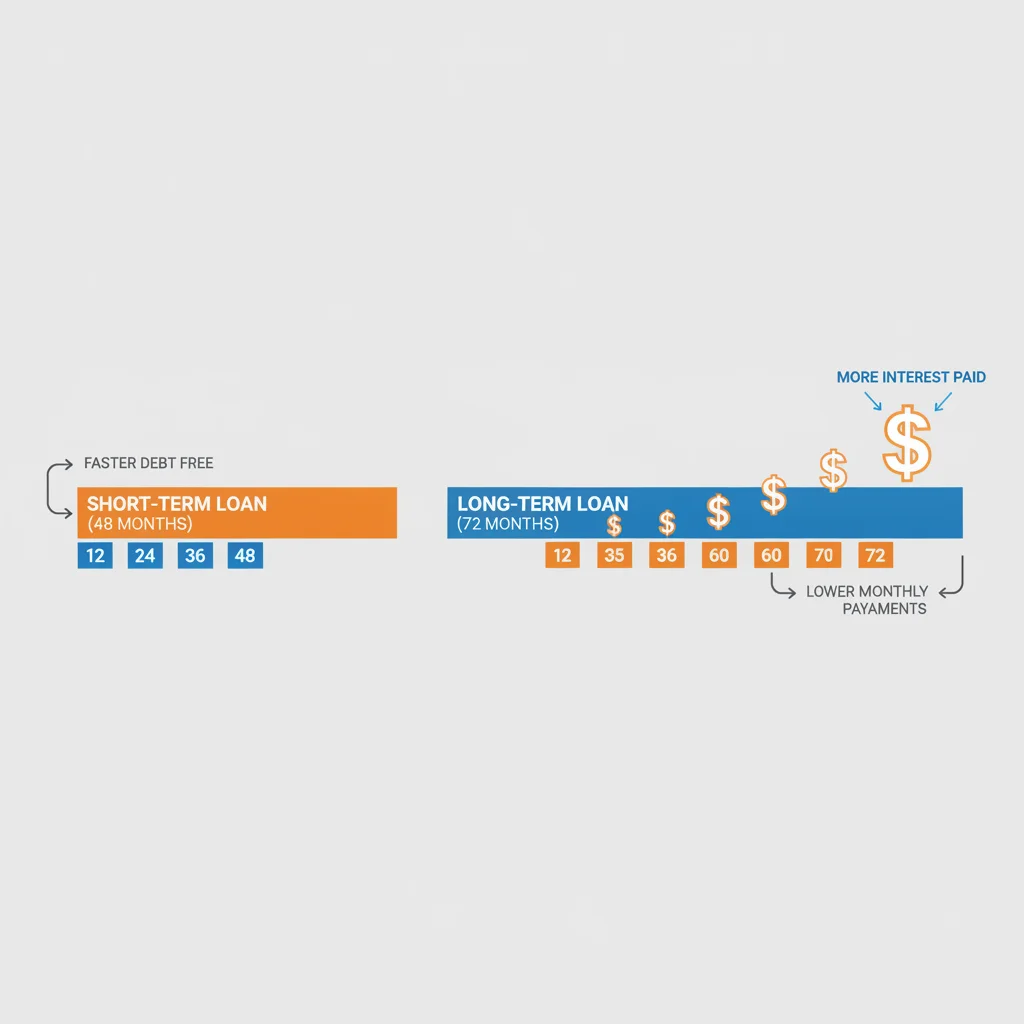
This is why early payments are mostly interest and later payments are mostly principal — the classic amortization curve. It's also why loan term length matters so much: a longer term slows down your principal payoff, keeping your balance higher for longer, which means each monthly interest calculation hits a bigger number.
How Simple Interest Differs from Compound Interest
Auto loans use simple interest, meaning interest is calculated only on the remaining principal — not on accumulated interest. This is more favorable to borrowers than compound interest. However, it still means that slower principal paydown (caused by a longer term) results in more total interest paid, even without compounding effects.
APR Disclosures Are Required by Law
Under the Truth in Lending Act (TILA), lenders must disclose the APR in writing before you sign. This federal requirement exists specifically so borrowers can make apples-to-apples comparisons across offers. If a dealer quotes you only a monthly payment without revealing the APR and term, ask directly — they are legally required to tell you.
Same APR Doesn't Always Mean Same Loan Cost
Two loans with identical APRs can still differ in total cost if one carries fees that the other doesn't, or if fee structures differ by lender type. APR is standardized enough to be a reliable comparison tool in most cases, but always verify what's included. For a detailed breakdown, see our guide to <a href="/auto-loans/loan-basics/interest-and-apr/interest-rate-vs-apr-on-a-car-loan-why-the-gap-between-them-matters">why the gap between interest rate and APR matters</a>.
Let's run the numbers on that $30,000, 6% APR example in more detail:
| Term | Monthly Payment | Total Paid | Total Interest |
|---|---|---|---|
| 36 months | $913 | $32,868 | $2,868 |
| 48 months | $705 | $33,840 | $3,840 |
| 60 months | $580 | $34,800 | $4,800 |
| 72 months | $498 | $35,856 | $5,856 |
| 84 months | $438 | $36,792 | $6,792 |
Every 12 months of additional term adds roughly $1,000 in total interest in this scenario. The monthly savings feel meaningful — $207 less per month going from 36 to 72 months — but you've paid almost $3,000 more for the privilege.
$2,016
Extra interest on 72-month vs. 48-month loan
Based on a $30,000 vehicle financed at 6% APR — same rate, same purchase price, different term.
70%
New car buyers choosing 60+ month loans
According to Experian's State of the Automotive Finance Market, the majority of new vehicle loans in recent years have terms of 60 months or longer.
$6,792
Total interest on an 84-month, 6% APR loan
Compared to $2,868 on a 36-month loan for the same $30,000 vehicle — a nearly $4,000 difference at an identical rate.
~3–5%
APR premium lenders charge for longer terms
Many lenders charge a higher APR for 72- and 84-month loans compared to 48- or 60-month terms due to elevated default risk over longer periods.
$1,000
Approximate interest added per 12 extra months
On a $30,000 loan at 6% APR, each additional year of loan term adds roughly $1,000 in total interest cost.
The Monthly Payment Illusion
Finance managers at dealerships are trained in a technique called payment selling. The idea is simple: anchor the buyer on a monthly number they're comfortable with, then adjust the term — not the price — to hit that number. The APR may never move. The sticker may never move. But the term stretches out until the payment fits.
A buyer who says "I need to keep it under $500 a month" on a $30,000 vehicle is essentially volunteering to take the longest possible loan. At 6% APR, a $498 payment requires exactly 72 months. The finance manager nods, the paperwork gets written, and the buyer leaves thinking they got what they wanted.
“Buyers get so fixated on the monthly payment that they forget the monthly payment is just a slice of a much larger pie. The question is never 'Can I afford this payment?' — it's 'Can I afford this loan?'”
— Jack Nerad, Former Executive Editorial Director, Kelley Blue Book
This isn't illegal. But it is a known pressure point, and buyers who walk in focused exclusively on monthly payment are the most vulnerable to it. The fix is straightforward: calculate the total repayment before agreeing to any term. Multiply the monthly payment by the number of months. Compare that number — not the monthly figure — across offers.
For a broader look at how term length and APR interact across different scenarios, see our analysis of loan term and APR trade-offs.
Always Ask for the Total Repayment Amount
Before signing any loan, ask the finance manager to show you the total of all payments — that's monthly payment multiplied by the number of months. This single number lets you compare any two loan offers on equal footing, regardless of how the monthly payments are framed. Write it down and take it home if needed.
Make Extra Principal Payments Early
On a simple-interest auto loan, extra payments applied to principal reduce your balance immediately, which shrinks every future interest calculation. Even $50–$100 extra per month in the first year of a long loan can save hundreds in total interest and shave several months off your payoff date. Always confirm there's no prepayment penalty first.
Real-World Examples That Show the Difference
These examples show a consistent pattern: the interest premium for a longer loan compounds with the purchase price. A $15,000 used car financed 24 months longer costs you an extra $1,000. A $45,000 SUV financed 24 months longer costs you an extra $3,000. The rate never changed.
When a Longer Loan Can Make Sense — and When It Traps You
Longer terms aren't always the wrong move. If you're choosing between not buying a vehicle and stretching to a 72-month loan to preserve monthly cash flow, the math changes. Sometimes you need the car, and the longer term is the realistic option.
But there are two specific risks to understand before going long:
1. Negative Equity (Being Underwater)
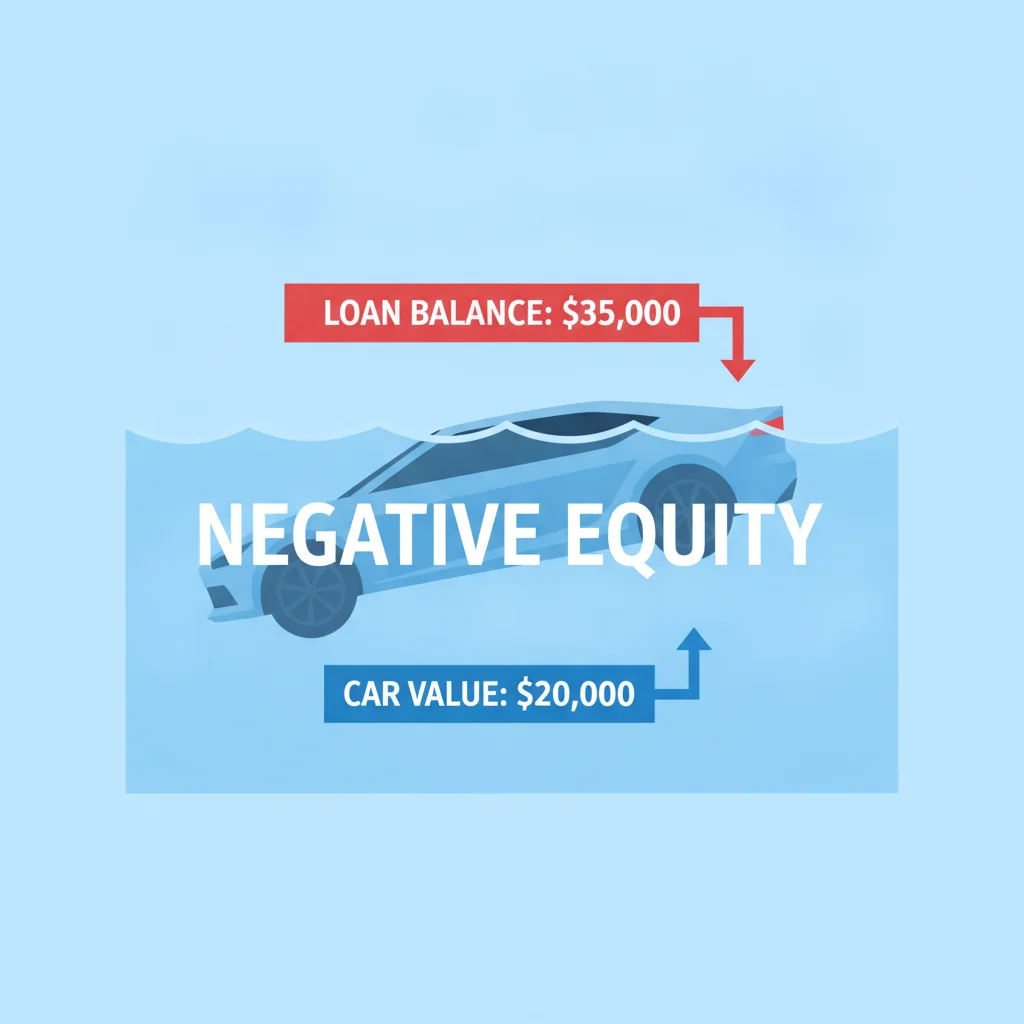
Cars depreciate fastest in the first two to three years. On a long loan, your principal payoff is slow — meaning for the first couple of years, your car's value drops faster than your balance does. If you need to sell, trade in, or total the vehicle during that window, you owe more than the car is worth. That gap becomes your problem immediately.
2. Higher Rates on Longer Terms
Not every lender offers the same APR across all term lengths. Many charge a higher rate for 72- or 84-month loans compared to 48- or 60-month loans, because longer loans carry more default risk. If that's the case, you're hit by both factors simultaneously: more months and a higher rate. The total interest cost can become punishing. This risk is especially pronounced for buyers with challenged credit — see our article on loan term length and bad credit.
If a longer term is unavoidable, there's one move that helps significantly: make extra principal payments whenever possible. Because auto loans use simple interest, every dollar applied directly to principal reduces future interest calculations immediately. Even an extra $50 a month on a 72-month loan can trim months off the term and save hundreds in interest.
Always Ask for the Total Repayment Amount
Before signing any loan, ask the finance manager to show you the total of all payments — that's monthly payment multiplied by the number of months. This single number lets you compare any two loan offers on equal footing, regardless of how the monthly payments are framed. Write it down and take it home if needed.
Make Extra Principal Payments Early
On a simple-interest auto loan, extra payments applied to principal reduce your balance immediately, which shrinks every future interest calculation. Even $50–$100 extra per month in the first year of a long loan can save hundreds in total interest and shave several months off your payoff date. Always confirm there's no prepayment penalty first.
APR vs. Interest Rate: Don't Confuse the Two
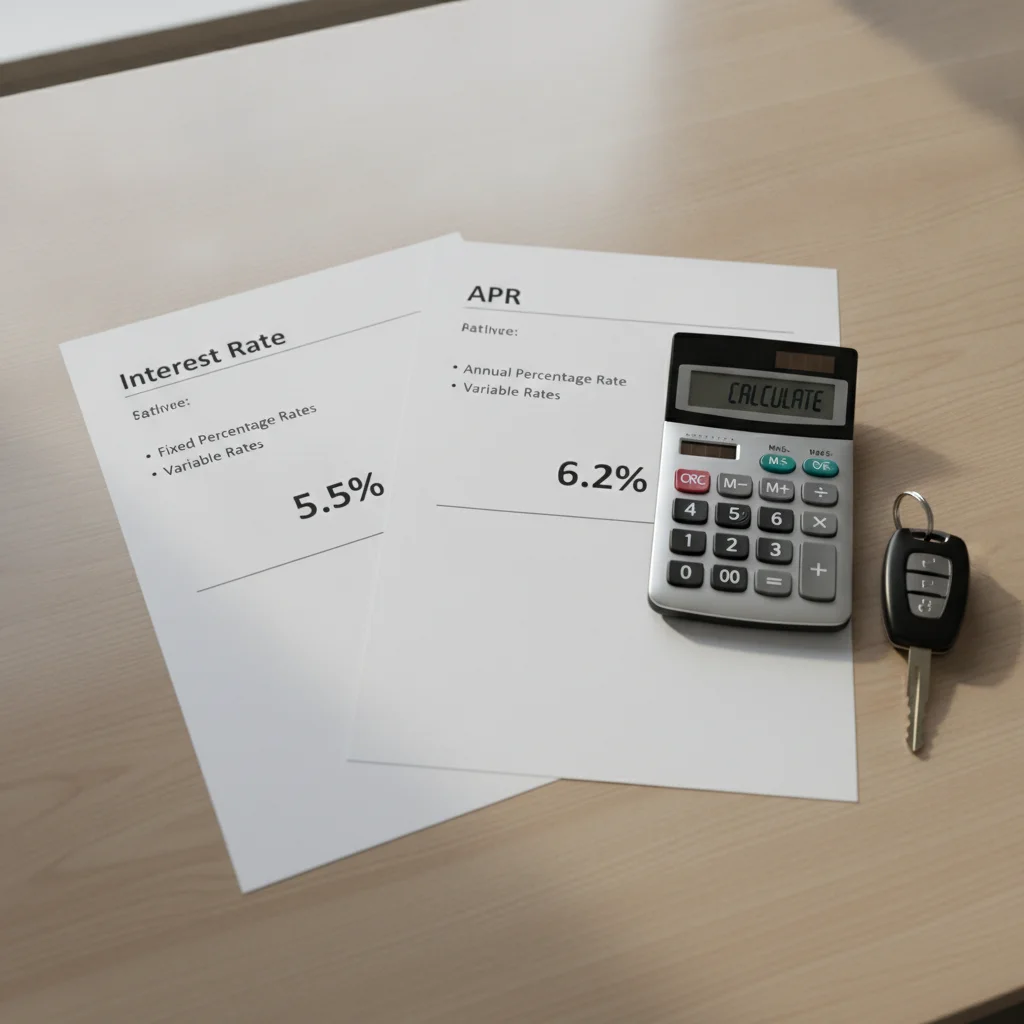
One more thing that trips buyers up: APR and interest rate are related but not identical. The interest rate is the base cost of borrowing. APR includes the interest rate plus lender fees, origination charges, and certain other costs — rolled into one annualized percentage. APR is always the more accurate measure of what a loan actually costs per year.
When comparing offers from different lenders, always use APR, not the raw interest rate. A loan with a lower interest rate but higher fees can have a higher APR than a loan with a slightly higher interest rate and no fees. For a full breakdown of these two numbers and why both matter, see APR vs. interest rate on a car loan.
And to understand exactly how much a small APR difference — say half a percentage point — translates into real dollars over common loan amounts, see how a half-point APR difference can cost you hundreds.
How Simple Interest Differs from Compound Interest
Auto loans use simple interest, meaning interest is calculated only on the remaining principal — not on accumulated interest. This is more favorable to borrowers than compound interest. However, it still means that slower principal paydown (caused by a longer term) results in more total interest paid, even without compounding effects.
APR Disclosures Are Required by Law
Under the Truth in Lending Act (TILA), lenders must disclose the APR in writing before you sign. This federal requirement exists specifically so borrowers can make apples-to-apples comparisons across offers. If a dealer quotes you only a monthly payment without revealing the APR and term, ask directly — they are legally required to tell you.
Same APR Doesn't Always Mean Same Loan Cost
Two loans with identical APRs can still differ in total cost if one carries fees that the other doesn't, or if fee structures differ by lender type. APR is standardized enough to be a reliable comparison tool in most cases, but always verify what's included. For a detailed breakdown, see our guide to <a href="/auto-loans/loan-basics/interest-and-apr/interest-rate-vs-apr-on-a-car-loan-why-the-gap-between-them-matters">why the gap between interest rate and APR matters</a>.
Your credit score is one of the biggest levers you have on APR. A score in the mid-700s vs. the mid-600s can mean a 3–5 percentage point difference in rate, which translates directly into hundreds or thousands of dollars of total interest. Understanding how your credit score affects your loan rate is covered in depth in our credit score impact hub.
What to Do Before You Sign
Armed with this understanding, here's a practical checklist for any loan offer you're evaluating:
- Calculate total repayment. Monthly payment × number of months. This is your real cost comparison number.
- Ask for the APR, not just the interest rate. If a dealer quotes you "6% financing," confirm whether that's the APR or the base rate. These can differ, especially if fees are involved.
- Compare the same term across lenders. Don't compare a 48-month offer from one lender against a 72-month offer from another. Standardize the term to isolate the APR difference.
- Run the numbers on a shorter term. Even if you ultimately choose a longer term, see what the 48-month version costs. If the monthly payment is manageable, the shorter term is almost always the better financial decision.
- Check for prepayment penalties. If you plan to pay ahead, confirm the loan doesn't penalize early payoff. Most auto loans don't, but some do.
For more foundational context on how these loan mechanics work, the Loan Terms Explained hub covers everything from amortization to total cost in one place.
The bottom line: APR is just the speed. Term length is how long you drive at that speed. Both determine where you end up — and right now, most buyers are only looking at the speedometer.
All claims are backed by peer-reviewed research. Sources on request.