Key Takeaways
Our Verdict
Dealers and lenders are aligned on wanting a down payment but diverge sharply on why. For you as the buyer, the lender's view matters more to your long-term cost — a bigger upfront contribution lowers your interest rate, shrinks the loan balance, and protects you from being upside-down. Use that knowledge to approach the dealership with preapproval in hand and let the numbers do the talking.
| Best for | Recommended |
|---|---|
| Buyers focused on getting the lowest interest rate | Maximizing down payment to satisfy lender risk thresholds |
| Buyers negotiating at the dealership | Arriving with lender preapproval before discussing down payment |
| Buyers with limited cash who still want approval | Strategic minimum down payment targeting lender LTV requirements |
| Buyers trading in a vehicle with equity | Applying trade-in value as down payment to satisfy both dealer and lender simultaneously |
Two Parties, Two Motivations
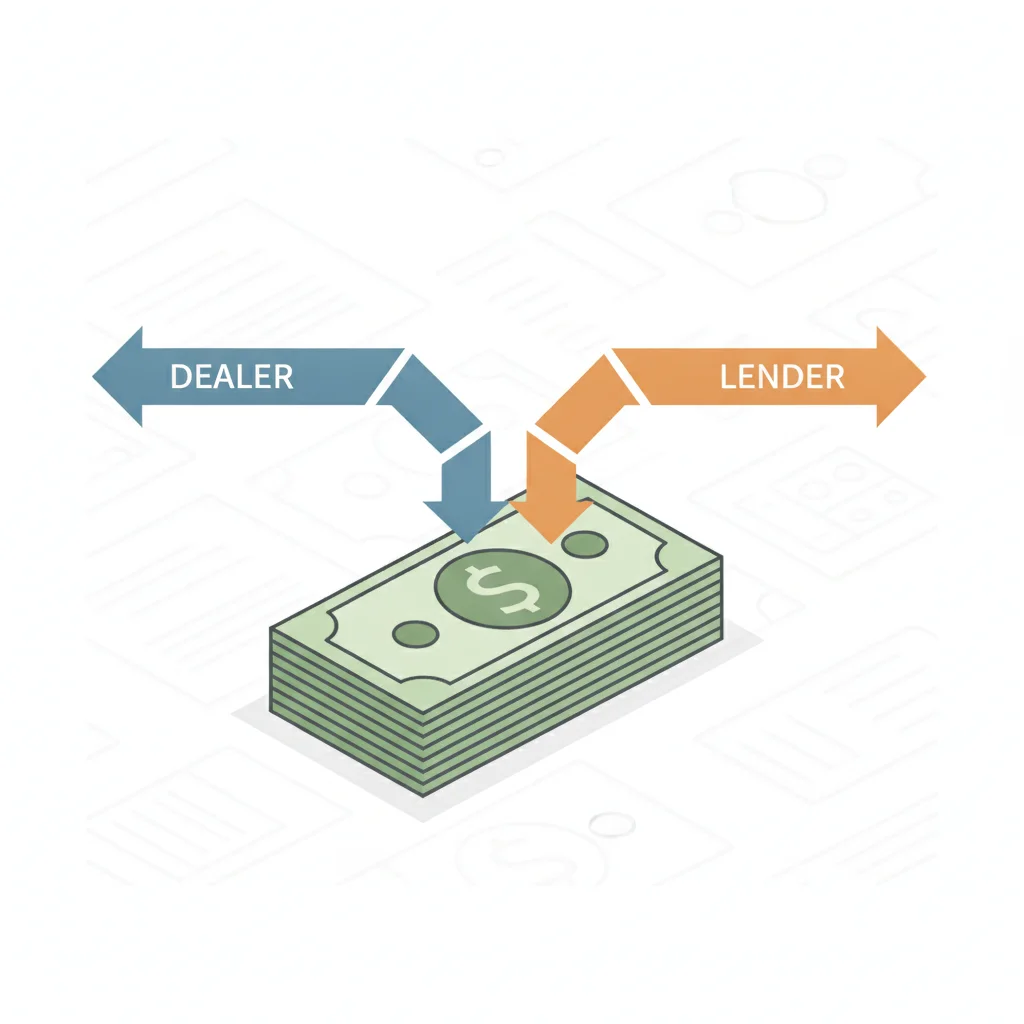
When you sit down to buy a car, there are really two separate financial relationships happening at the same time — one with the dealership and one with the lender. Both of them care about how much money you put down upfront, but for reasons that have almost nothing to do with each other.
The dealer is running a retail business. Their goal is to sell a car today, collect their margin, and move on to the next customer. The lender — whether it's a bank, credit union, or the automaker's own financing arm — is running a lending business. Their goal is to issue a loan that gets paid back in full, with interest, over the next four to six years.
Because their goals differ, they evaluate your down payment through completely different lenses. Once you understand both lenses, you can use that knowledge to structure your deal more strategically. See our full breakdown of what a down payment does to your loan for the foundational mechanics behind this.
How the Dealer Thinks About Your Down Payment
From a dealer's perspective, a down payment is primarily a deal-closing tool. Here's what's actually running through the finance manager's mind when you offer a lump sum upfront:
It Reduces Financing Fallthrough Risk
Dealers don't fund loans themselves. They arrange financing through a lender and get paid once the loan is approved and funded. If a lender declines your application — or comes back with terms so bad you walk — the dealer loses the sale. A larger down payment makes your application more likely to get approved, which makes the dealer more likely to get paid. It's that simple.
It Can Affect the Dealer's Financing Profit
Dealers often earn what's called a "dealer reserve" — a markup on the interest rate the lender quotes. For example, if the lender approves you at 6%, the dealer might quote you 7.5% and pocket the difference over the life of the loan. A bigger down payment reduces the loan principal, which reduces how much of that markup the dealer collects over time. In other words, the dealer's profit from financing is slightly smaller when your down payment is bigger — though they'll rarely tell you that.
It Helps Move Slower-Selling Inventory
If you're buying a vehicle that has been sitting on the lot, the dealer is carrying what's called a flooring cost — essentially interest on the money they borrowed to stock that car. A deal that closes quickly with a solid down payment ends that cost immediately. Dealers will sometimes negotiate more aggressively on price or add-ons when they see a buyer with real money ready to go.
Separate the price negotiation from financing
Always agree on the vehicle's out-the-door price before discussing your down payment amount or monthly payment target. Once price is locked, your down payment's role shifts to purely optimizing your loan terms with the lender — not subsidizing the dealer's margin. This one discipline prevents the most common car-buying negotiation mistakes.
Know your LTV before you walk in
Calculate the loan you'll need at different down payment levels and divide by the car's market value — not the sticker price. If a $32,000 car has a $30,000 market value and you're putting $6,000 down, your LTV is 87%, not 81%. Use independent valuation tools so you're working from the same numbers the lender will use.
The key takeaway here: the dealer wants your down payment to make the deal happen. They're less focused on protecting your long-term financial health and more focused on clearing inventory and getting the loan funded today.
How the Lender Thinks About Your Down Payment
The lender's view is more analytical and, for your purposes, more important to understand. Lenders use your down payment to answer one core question: if this borrower stops paying, will we get our money back?
Loan-to-Value Ratio Is the North Star
Every lender calculates a loan-to-value ratio, or LTV, for your deal. This is simply the loan amount divided by the vehicle's value. If you're buying a $32,000 car and putting $6,400 down (20%), your loan is $25,600 — an LTV of 80%. If you're putting nothing down, your LTV is 100%, and if you're rolling in taxes and fees, it can exceed 100%.
Lenders assign risk categories based on LTV thresholds. An LTV below 80% is typically considered low risk. An LTV between 80% and 100% is moderate risk. Anything above 100% — meaning the loan is larger than the car is worth from day one — is high risk, and many lenders will either decline or significantly increase the interest rate to compensate.
80%
LTV threshold for low-risk classification
Most prime auto lenders classify loans at or below 80% LTV as low risk, qualifying for their best available rate tiers.
15–25%
Average new car depreciation in year one
According to industry valuation data from sources such as Edmunds and Kelley Blue Book, new vehicles typically lose 15–25% of their value within the first 12 months.
2x
Higher default rate for zero-down auto loans
Consumer finance studies consistently show that borrowers with no down payment default at approximately twice the rate of those who put 10% or more down.
Equity Cushion Protects the Lender at Repossession
Cars depreciate. A new vehicle can lose 15% to 25% of its value in the first year alone. If you default and the lender repossesses the car, they sell it at auction — usually for wholesale value, which is below what even a private buyer would pay. Without a down payment, the lender is almost guaranteed to lose money at that auction. Your down payment is essentially an equity cushion that absorbs depreciation risk on their behalf.
This is why lenders care so much about your down payment — it's not about trust, it's about collateral mathematics.
It Functions as a Creditworthiness Signal
Beyond the math, lenders read a meaningful down payment as a behavioral signal. Saving up a large chunk of cash and choosing to apply it to a depreciating asset requires both discipline and willingness to take on real financial commitment. Research consistently shows that borrowers who put more down have lower default rates — not just because they owe less, but because the type of person who saves for a down payment is the type of person who takes loan obligations seriously.
This matters even if your credit score is strong. And if your credit score is weak, a larger down payment can partially offset that weakness by reducing the lender's actual exposure. The interaction between down payments and credit scores is one of the most underappreciated dynamics in auto lending.

Side-by-Side: What Each Party Actually Prioritizes
To make the contrast concrete, here's a direct comparison of how the dealer and the lender evaluate the same down payment decision:
| Criterion | Dealer's View | Lender's View | |
|---|---|---|---|
| Primary goal | Close the sale today | Issue a loan that gets repaid in full | |
| Down payment purpose | Makes financing approval more likely | Reduces loan-to-value ratio and default exposure | |
| LTV ratio importance | Low — rarely a concern for the dealer | High — central to pricing the loan's risk | |
| Depreciation concern | None after the sale is complete | Critical — collateral must cover the balance | |
| Impact on interest rate | Indirect — through lender approval odds | Direct — higher equity often means lower rate tier | |
| Behavioral signal interpretation | Signals buyer is serious and ready | Signals financial discipline and lower default risk | |
| Preferred minimum amount | Whatever gets the loan approved | 20% or enough to keep LTV below 80% | |
| Add-ons rolled into loan | Profitable — increases total financed amount | Risky — raises LTV above acceptable thresholds |
Notice that several criteria that matter enormously to the lender — LTV ratio, default probability, collateral coverage — don't appear on the dealer's radar at all. The dealer's checklist ends when the financing is approved. The lender's checklist is what determines whether it gets approved and at what rate.
The 20% Guideline: Why It Satisfies Both Parties
You've probably heard the advice to put 20% down on a car. It's not arbitrary. That number sits at the intersection of dealer and lender needs in a way that smaller amounts don't.
For the lender, 20% down on a new vehicle roughly matches the first-year depreciation curve. If a $35,000 car drops to $28,000 in value after 12 months, a buyer who put $7,000 down (20%) and made 12 payments still has a loan balance close to the car's market value. The lender's collateral position remains solid. With no money down, that same buyer is already $5,000 to $7,000 underwater before they've made a single extra payment.
For the dealer, 20% is typically enough to satisfy even conservative lenders, which means faster funding and fewer approval complications.
For you as the buyer, 20% down on a new car keeps you from carrying negative equity — the financially dangerous position of owing more than the car is worth. If you need to sell or trade in before the loan is paid off, negative equity follows you into your next deal. The dynamics differ somewhat between new and used vehicles, which is why it's worth reviewing how the down payment rule changes between new and used cars.
Negative equity can follow you for years
If you put little or nothing down on a new car, you're likely to owe more than the car is worth for the first two to three years of the loan. If you need to sell or trade in during that window — due to a job change, a growing family, or financial hardship — you'll have to either pay cash to cover the gap or roll that negative equity into your next loan, compounding the problem. Going in with at least 10–20% down is the most straightforward way to avoid this trap.
When the Two Perspectives Create Tension for the Buyer
Understanding that dealers and lenders have different motivations can actually reveal some traps that buyers fall into.
The Monthly Payment Negotiation Trap
Dealers are very skilled at steering conversations toward monthly payments rather than total purchase price or loan terms. If you walk in saying "I can afford $450 a month," the finance manager will find a way to hit that number — often by extending the loan term to 72 or 84 months rather than reducing the price. In this scenario, the size of your down payment gets absorbed into a payment structure that still leaves you with a massive total interest bill.
The better approach: know your loan terms before you walk in. Getting preapproved for a loan from a bank or credit union before visiting the dealer gives you a baseline rate to compare against whatever the dealer offers. It also shifts the negotiation back to price rather than monthly payments.
The Add-On Financing Inflation Trap
Extended warranties, GAP insurance, paint protection packages — dealers routinely roll these into the financed amount. Each dollar added to the loan reduces the effective impact of your down payment. If you put $5,000 down on a $30,000 car but then finance $4,000 in add-ons, your actual loan is $29,000 — almost back where you started. The lender sees an LTV that's barely improved, and you've negated much of your down payment's risk-reduction benefit.
GAP insurance specifically is worth noting: it's a product that pays the difference between what you owe and what the car is worth if it's totaled. If you've put 20% or more down, you may not need GAP coverage at all, since you're unlikely to be underwater. But dealers will often sell it anyway as a standard offering.

Trade-In Value and How It Satisfies Both Parties
If you have a vehicle to trade in, that equity can serve as your down payment and often satisfies both the dealer and the lender simultaneously. The dealer applies the trade-in value to reduce your purchase price, and the lender sees a lower loan amount relative to the new vehicle's value. Just make sure you know your trade-in's market value before you walk in — services like Kelley Blue Book or dealer wholesale quotes will give you a realistic range. Dealers sometimes undervalue trade-ins to recapture margin lost elsewhere in the deal.
Practical Strategy: Using Both Perspectives to Your Advantage
Now that you can see the deal from both sides of the table, here's how to use that knowledge in a concrete negotiation sequence:
- Get preapproved first. Approach a bank or credit union before visiting any dealership. This tells you exactly what rate and LTV the lender is willing to accept at your credit level. See what your credit score means for your loan rate before you apply so there are no surprises.
- Determine your target LTV. Look up the car's market value using independent sources. Calculate the loan you'd need at various down payment levels and determine which puts you below 80% LTV — the threshold most lenders treat as low risk.
- Negotiate the vehicle price before mentioning financing. Pin down the out-the-door price first. Only then discuss how you're financing. This prevents the dealer from adjusting the price or trade-in value to compensate for a lower monthly payment.
- Evaluate add-ons separately. If the dealer presents GAP insurance or an extended warranty, price them independently. Often, your own insurance provider or a third party offers these products at a lower cost. Never assume they're mandatory.
- Present your preapproval as a benchmark. If the dealer's financing arm offers a rate lower than your preapproval, accept it. If not, use your preapproval and save the dealer's financing pitch for another day.
Separate the price negotiation from financing
Always agree on the vehicle's out-the-door price before discussing your down payment amount or monthly payment target. Once price is locked, your down payment's role shifts to purely optimizing your loan terms with the lender — not subsidizing the dealer's margin. This one discipline prevents the most common car-buying negotiation mistakes.
Know your LTV before you walk in
Calculate the loan you'll need at different down payment levels and divide by the car's market value — not the sticker price. If a $32,000 car has a $30,000 market value and you're putting $6,000 down, your LTV is 87%, not 81%. Use independent valuation tools so you're working from the same numbers the lender will use.
One final note on leased vehicles: the mechanics of upfront money shift significantly in a lease structure. If you're comparing buying versus leasing, the down payment strategy for leased versus financed vehicles explains why a large upfront payment on a lease carries very different risks than it does on a purchase loan.

All claims are backed by peer-reviewed research. Sources on request.