Key Takeaways
Loan-to-Value Ratio (LTV)
Loan-to-value ratio, or LTV, is a simple percentage that compares how much you're borrowing to how much the car is actually worth. If a car is worth $30,000 and you borrow $24,000, your LTV is 80%. The higher that number, the more of the car's value is covered by debt — and the more risk a lender takes on. Your down payment is what shrinks that number before you ever sign a contract.
Lenders calculate LTV using the vehicle's purchase price or its appraised/book value (whichever is lower), not the sticker price. Trade-in equity applied to the purchase functions the same as cash down for LTV purposes.
What LTV Actually Measures — and Why It Matters
When you apply for an auto loan, the lender isn't just evaluating you — they're evaluating the deal. Specifically, they want to know: if you stop making payments tomorrow, could they recover their money by repossessing and selling the car? That question is exactly what the loan-to-value ratio answers.
LTV is a single number that compares two things: how much you're borrowing versus how much the collateral (the car) is currently worth. The formula is straightforward:
LTV = (Loan Amount ÷ Vehicle Value) × 100
Say you want to buy a used SUV priced at $28,000. You put $4,000 down, which means you're financing $24,000. Divide $24,000 by $28,000 and multiply by 100, and you get an LTV of approximately 85.7%.
That number tells the lender that their loan covers 85.7 cents of every dollar of the car's current value. If you default on day one and they repossess and auction the vehicle, they might net $23,000 after fees — just barely enough to break even. That's tight. The lender is exposed.
Now imagine you put $8,000 down instead. You're financing $20,000 on a $28,000 car — an LTV of 71.4%. The lender has a much bigger cushion. Even if the car loses some value or the auction price comes in lower than expected, they're still likely to recover the full loan balance. That reduced risk is why they'll offer you a better interest rate.
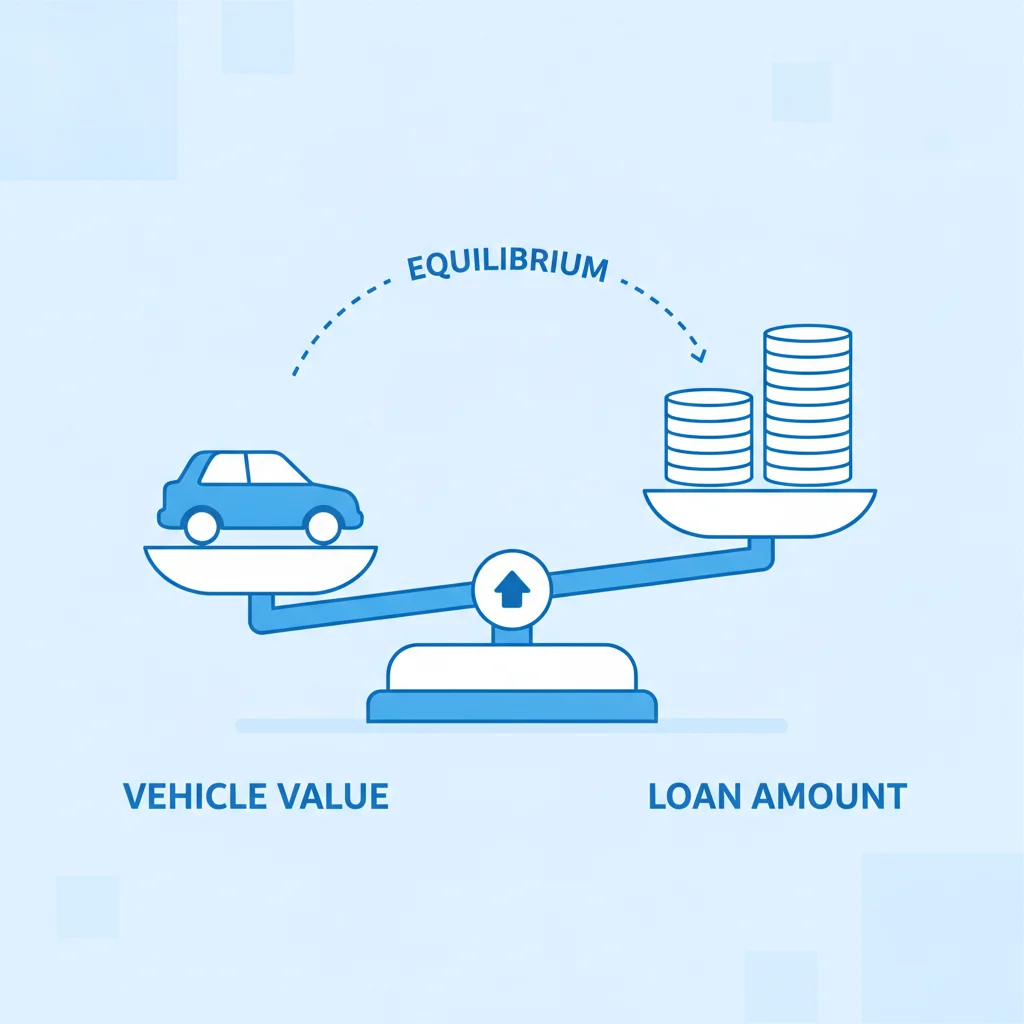
This is the core trade-off in auto financing: your down payment is the most direct tool you have to control LTV, and LTV is the most direct lever on your loan terms. Understanding this relationship is the foundation for making smarter financing decisions — whether you're buying new, used, or working with challenged credit.
How Your Down Payment Moves the LTV Number
There's a clean, mechanical relationship between your down payment and your LTV. Every dollar you put down is a dollar you don't borrow — and since the car's value stays fixed, the only thing changing in the LTV formula is your loan amount. Put simply: more down equals lower LTV, always.
Let's walk through a concrete example using a $32,000 new car:
| Down Payment | Loan Amount | LTV | Risk Category |
|---|---|---|---|
| $0 (0%) | $32,000 | 100% | High risk — no equity cushion |
| $3,200 (10%) | $28,800 | 90% | Elevated — tight margin |
| $6,400 (20%) | $25,600 | 80% | Standard — most lenders' comfort zone |
| $9,600 (30%) | $22,400 | 70% | Strong — typically earns best rates |
The table illustrates why 20% down is so commonly recommended: it lands your LTV right at 80%, which is the threshold where most lenders stop charging a risk premium on the rate. Below 80%, you're in their preferred zone. Above 80%, you're increasingly paying for their uncertainty.
15–20%
New car value lost in year one
According to Carfax and Edmunds depreciation data, most new vehicles lose this share of their value within the first 12 months of ownership.
80%
LTV threshold for best auto loan rates
Industry data from Experian and lender guidelines consistently cite 80% as the LTV level where most borrowers access the most competitive interest rate tiers.
2–3%
APR penalty for high-LTV loans
Borrowers with LTVs above 100% can face APRs 2 to 3 percentage points higher than borrowers at 80% LTV with equivalent credit scores, based on lender rate sheet comparisons.
$2,100+
Extra interest on a high-LTV loan
On a $28,000, 60-month loan, the difference between a 5.5% and 8.0% APR — a spread typical between low and high LTV borrowers — results in approximately $2,100 in additional interest paid.
Trade-in equity works the same way. If you're trading in a car with $5,000 of equity and applying it to your purchase, that $5,000 reduces your loan amount just like cash. A $32,000 car with a $5,000 trade-in and $2,000 cash down means you're financing $25,000 — an LTV of about 78%. You've hit that 80% target without writing a large check.
For a deeper dive into the exact dollar-by-dollar math, see how down payment size changes your total financing cost.
Book Value vs. Purchase Price: Which One Lenders Use
Lenders don't always use the purchase price to calculate LTV. Many use the vehicle's book value — typically from sources like Kelley Blue Book, Black Book, or NADA Guides — and apply whichever figure is lower. If you negotiate a purchase price above book value, your loan may still be capped at the book-value LTV, meaning you'd need to cover the difference in cash. Always check the book value of the vehicle you're considering before finalizing a down payment target.
What Happens When LTV Climbs Too High
Most people focus on what a lower LTV earns them — better rates, easier approval. But it's equally important to understand what a high LTV costs you, because the risks go beyond just a higher monthly payment.
Higher Interest Rates
Lenders price risk into your APR. An LTV of 100% or higher can add one, two, or even three percentage points to your interest rate compared to an 80% LTV loan. On a $28,000 loan over 60 months, the difference between 5.5% and 8% APR is roughly $2,100 in additional interest. That's money out of your pocket that could have been your down payment in the first place.
Being Underwater on the Loan
A new car loses roughly 15–20% of its value in the first year. If you financed 100% of the purchase price with no money down, you're likely underwater almost immediately. After 12 months, you could owe $28,000 on a car that's now worth $24,000. That gap — called negative equity — becomes a serious problem if you need to sell, trade in, or if the car is totaled.
Gap in Insurance Coverage
Standard auto insurance pays out the car's current market value if it's totaled — not what you owe on the loan. If you're underwater, that gap (what you owe minus what insurance pays) comes out of your pocket unless you have GAP insurance. Ironically, the people most likely to need GAP coverage are those who started with a high LTV and little or no down payment.
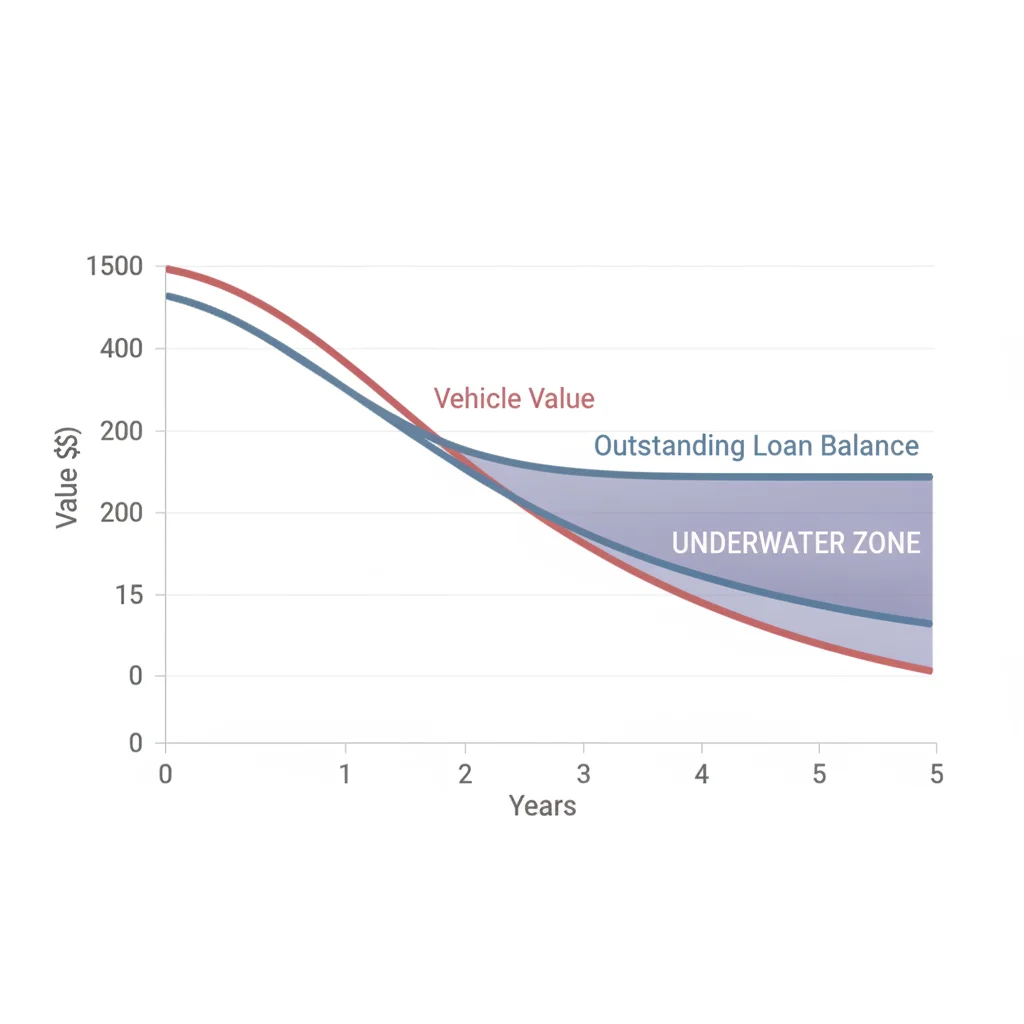
These risks compound each other. A high LTV means a higher rate, which means more of your payment goes to interest rather than principal, which means you build equity more slowly, which means you stay underwater longer. That's why getting LTV right from the start isn't just about saving a few dollars — it's about avoiding a years-long financial trap.
See how LTV affects your approval odds and available loan term lengths for the full picture of what lenders are looking at.
LTV vs. Other Lender Metrics: How It Fits In
LTV doesn't work in isolation. When a lender evaluates your application, they're looking at several signals simultaneously. It helps to understand where LTV sits in that picture.
“The loan-to-value ratio is one of the most powerful risk indicators in consumer lending. A borrower who puts meaningful money down demonstrates both commitment and a financial cushion — and lenders price that confidence directly into the interest rate they offer.”
— Greg McBride, Chief Financial Analyst, Bankrate
LTV vs. Credit Score
Your credit score tells a lender how reliably you've repaid debt in the past. LTV tells them how much cushion they have if you don't repay this loan. They're complementary signals. A borrower with excellent credit and a high LTV may still get approved — but they'll pay a higher rate than a borrower with the same credit score and a lower LTV. The LTV risk adds a layer the credit score alone can't erase.
Learn more about how your credit score directly affects loan rates lenders offer.
LTV vs. Debt-to-Income Ratio (DTI)
DTI measures whether your income is sufficient to handle your total monthly debt load. LTV measures the security of the specific loan. A lender might see a borrower with a healthy DTI but a sky-high LTV as someone with adequate income but a dangerously undercollateralized loan. Conversely, a low LTV might make a lender more comfortable extending credit to someone whose DTI is slightly elevated. Both ratios matter, but they measure different types of risk. See how lenders balance DTI and credit score when setting your terms.
LTV vs. Loan Term
Longer loan terms — 72 or 84 months — are particularly dangerous when combined with high LTV. Because you're paying more interest and less principal early in the loan, the balance drops slowly. Meanwhile, the car continues depreciating. Stretch a 100% LTV loan over 84 months, and you could remain underwater for four or five years. That's why many lenders cap the terms they'll offer based on LTV, not just creditworthiness.
Match Your Loan Term to Your LTV
If your LTV is above 80%, keep your loan term as short as you can comfortably afford — ideally 48 to 60 months. Longer terms reduce your monthly payment but slow how quickly you build equity, keeping you underwater longer. Pairing a short term with a reasonable down payment is the fastest path to positive equity.
Get Preapproved Before Visiting the Dealer
Knowing your preapproved rate before you shop tells you exactly what LTV the lender expects. If a preapproval letter specifies a maximum loan amount against the vehicle's value, you can calculate the minimum down payment you need before stepping on the lot — and avoid being pressured into a deal that puts your LTV in a costly range.
Practical Steps to Improve Your LTV Before You Buy
The good news is that LTV is one of the most controllable factors in your auto loan. Unlike your credit score, which takes months to move, LTV can be improved immediately — before you step into a dealership.
Save a Larger Down Payment
Even an extra $1,000 down makes a measurable difference. On a $25,000 car, going from $3,000 to $4,000 down moves your LTV from 88% to 84%. That alone may not be enough to change your rate tier, but if you can push to $5,000 (80% LTV), you've crossed a meaningful threshold. Set a savings target based on the specific car you want, and calculate the down payment needed to hit 80% LTV before you start shopping.
Maximize Your Trade-In Value
Get competing offers from at least three sources — your current dealer, other dealerships, and online buyers like CarMax or Carvana — before you negotiate. A trade-in that pays $500 more means $500 less borrowed, which improves LTV and reduces your total interest paid. Bring that offer to the table as leverage.
Avoid Rolling Fees Into the Loan
Extended warranties, GAP insurance, dealer add-ons, and documentation fees can add $2,000–$5,000 to a loan if you let them. Every dollar you roll in raises your LTV above 100% before the car even leaves the lot. Pay these costs upfront or negotiate them out of the deal entirely. If you need GAP coverage, buying it separately through your insurance company is almost always cheaper than financing it through the dealer.
Shop for a Lower-Priced Vehicle
If your budget limits how much you can put down, consider targeting a car priced lower than your original target. A $22,000 car with a $4,000 down payment yields an LTV of 81.8%. The same $4,000 on a $28,000 car gives you 85.7%. Sometimes the smartest move is narrowing your vehicle selection to what your down payment can reasonably cover.
Once you know your target LTV, the logical next step is getting preapproved for a loan so you walk into the dealership knowing exactly what terms you qualify for — and what you don't need to accept.
For borrowers with lower credit scores, LTV becomes even more critical. Understand how LTV shapes approval and rate when credit is subprime so you can prepare accordingly.

All claims are backed by peer-reviewed research. Sources on request.