Key Takeaways
Why the Down Payment Amount You Choose Matters More Than You Think
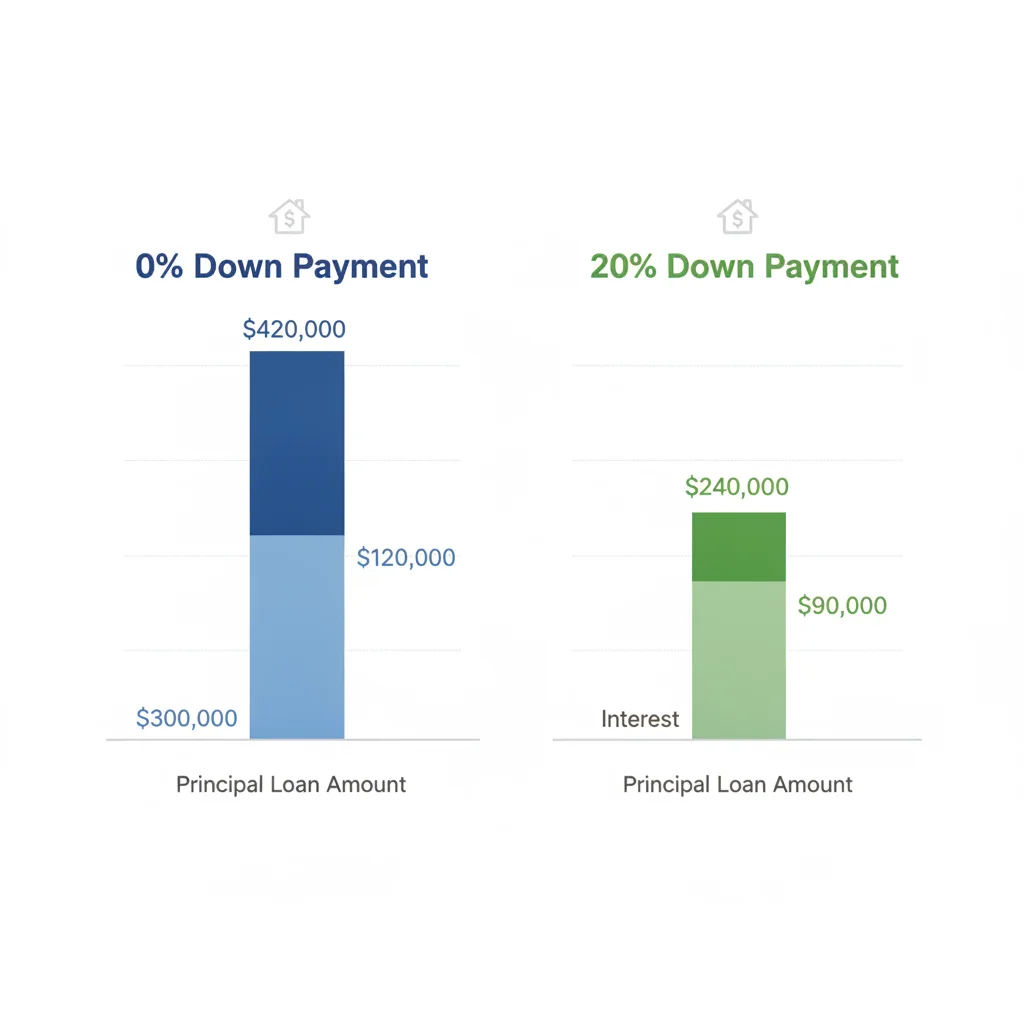
Most car buyers focus on the monthly payment, but the down payment is actually the lever that controls your total cost of ownership. Here's the core math: every dollar you put down is a dollar you don't finance. And every dollar you don't finance saves you interest — sometimes several times over, depending on your loan term and rate.
Consider two buyers purchasing the same $32,000 SUV at 7.5% APR for 60 months:
| Down Payment | Amount Financed | Monthly Payment | Total Interest Paid |
|---|---|---|---|
| $0 (0%) | $32,000 | $640 | $6,406 |
| $3,200 (10%) | $28,800 | $576 | $5,765 |
| $6,400 (20%) | $25,600 | $512 | $5,124 |
The buyer with 20% down saves $128/month and $1,282 in total interest compared to the buyer with nothing down — on the exact same car, at the exact same rate. That's real money that stays in your pocket.
Beyond interest savings, a meaningful down payment also protects you against being upside-down on the loan — owing more than the car is worth. New vehicles lose 15–25% of their value in the first year. If you finance 100% of a $32,000 purchase and the car is worth $26,000 twelve months later, you're already $6,000 underwater. A 20% down payment creates a buffer that keeps you above water even through the steepest part of the depreciation curve.
To understand all the financial dimensions behind the right down payment amount, see the complete breakdown of auto loan down payments.
What You'll Need Before You Start Saving
Before diving into the step-by-step saving plan, gather a few inputs. Having these ready makes every subsequent step faster and more accurate.
What you will need
High-Yield Savings Account (HYSA)
Stores your down payment fund separately from everyday checking and earns interest while you accumulate the balance.
Budget Spreadsheet or App
Tracks income, fixed expenses, and discretionary spending so you can identify the exact amount to redirect each month.
Automatic Transfer Feature
Schedules a recurring transfer from checking to your HYSA on payday so saving happens before you can spend the money.
Vehicle Valuation Tool (e.g., Kelley Blue Book, Edmunds)
Estimates your current car's trade-in or private-party value so you can factor existing equity into your down payment plan.
Loan Amortization Calculator
Shows how different down payment amounts change your monthly payment and total interest paid, helping you set a motivating savings target.
If you're still deciding exactly how much to target, a structured calculation approach can help. See how to calculate the right down payment for any car purchase for a method that factors in vehicle price, loan term, and your personal financial goals.
Also worth understanding upfront: not every source of funds is accepted by lenders as a down payment. Cash savings and trade-in equity are universally accepted, but other sources have restrictions. See which down payment sources lenders will and won't accept before you finalize your plan.
Your Step-by-Step Plan to Save
The following eight steps walk you through setting a target, finding the money in your existing budget, storing it correctly, and accelerating your timeline with every available opportunity. Follow them in order — each step builds on the last.
Set a concrete down payment target
Vague goals like "save more" tend to stall. You need a specific dollar figure tied to the car you plan to buy. A common benchmark is 10% down on a used vehicle and 20% down on a new vehicle — the higher target on new cars compensates for rapid first-year depreciation.
Here's a practical example: if you're eyeing a $28,000 new sedan, a 20% down payment is $5,600. On a used $16,000 crossover, 10% is $1,600 — a much more achievable near-term target. Use a loan amortization calculator to see exactly how each extra thousand dollars down reduces your monthly payment and total interest. That real number becomes your motivational anchor.
For a data-driven starting point, see down payment benchmarks by vehicle price range to find recommended amounts for budget, midrange, and luxury purchases.
Audit your budget and find your monthly saving capacity
Pull up three months of bank and credit card statements. Categorize every expense into three buckets: fixed obligations (rent, utilities, existing loan payments), variable necessities (groceries, gas, prescriptions), and discretionary spending (dining out, subscriptions, entertainment, impulse purchases).
Add up the discretionary column. Most households find 15–30% of that total can be redirected without real hardship. On a $3,200 take-home monthly income, even $200/month of redirected spending reaches a $2,400 down payment in one year — enough to put 15% down on a $16,000 used car.
[in_content_images:0]Once you have your monthly saving capacity, divide your target down payment by that number to get your savings timeline in months. If the timeline is too long, you'll know you either need to increase savings, choose a less expensive vehicle, or accept a smaller percentage down.
Open a dedicated high-yield savings account
Keep your down payment money physically separate from your everyday checking account. When funds share the same account, they tend to get absorbed into routine spending. A dedicated account — ideally labeled something like "Car Fund" — creates a psychological barrier that makes you think twice before dipping in.
Choose a high-yield savings account (HYSA) at an online bank. As of mid-2024, many HYSAs offer APYs in the 4.5–5.0% range, compared to the national average of around 0.45% at traditional banks. On a $4,000 balance held for 12 months, that difference is roughly $180 in extra interest — free money that trims your required savings contributions.
Avoid certificates of deposit (CDs) unless your purchase timeline is fixed. CDs lock your money for a set term and charge early withdrawal penalties that can erase the rate advantage if your plans shift.
Automate a recurring transfer on payday
Manual saving relies on willpower, which is unreliable. Automation removes the decision entirely. Set up a recurring transfer from your checking account to your car fund HYSA to trigger within 24 hours of every paycheck hitting. This "pay yourself first" mechanic ensures the money is moved before grocery runs, nights out, or any other spending opportunity arises.
Start with a comfortable amount — say, $175/month — and schedule it. After 30 days, review whether you felt the pinch. If you didn't, increase it by $25–$50. Most people discover they can save meaningfully more than their initial estimate once the habit is established and the money is out of sight.
Funnel windfalls directly into the car fund
Regular monthly transfers are the foundation, but windfalls are the accelerant. Commit in advance — before the money arrives — to routing a set percentage of each windfall to your car fund. Suggested allocations:
- Tax refund: 50–100% (average federal refund is around $3,000 — enough to dramatically shorten your timeline)
- Work bonus: 50% to car fund, 50% to your emergency fund or other goals
- Cash gifts: 75% to car fund
- Side-hustle earnings: 80–100% to car fund until the goal is hit
The reason to decide percentages in advance is simple: once money lands in your checking account, competing spending priorities appear immediately. A pre-committed allocation eliminates that temptation entirely.
For ideas on other ways to accelerate your contributions, see ways to increase your down payment before buying — including strategies like selling assets and timing your purchase around bonuses.
Value your current car and factor in trade-in equity
If you own a vehicle, its equity is a form of down payment you may already have. Trade-in equity is the difference between what your car is worth and what you still owe on it. For example, if your car is worth $9,000 and you owe $3,500, you have $5,500 in equity that a dealer will apply directly toward your next purchase — no cash required.
Run your car's details through Kelley Blue Book and Edmunds to get both trade-in and private-party valuations. Private-party sales typically yield 10–15% more than dealer trade-ins, but they require more time and effort. If you're on a tight savings timeline, a private-party sale can close the gap faster than months of additional deposits.
[in_content_images:1]Combine whatever cash you've saved with your trade-in equity to calculate your total effective down payment. This composite number is what matters to the lender and what determines how much you need to finance.
Protect your emergency fund — never raid it
One of the most common budgeting mistakes is treating the emergency fund as a flexible source of down payment cash. Your emergency fund is a different financial instrument — it exists to cover job loss, medical bills, or major car repairs. If you drain it for a down payment and then face an unexpected expense, you'll end up putting that expense on a credit card at 20%+ interest, completely undermining the financial benefit of the down payment you worked to build.
Keep your car fund and your emergency fund in separate accounts and treat the dividing line as non-negotiable. If your emergency fund is currently underfunded (most advisors recommend three to six months of expenses), split your monthly savings contributions between the two goals until both are adequately funded.
For a full discussion of how your emergency fund should factor into your down payment decision, see things to know before deciding how much to put down.
Pick your purchase timing strategically
The month and even the day you buy can affect how far your down payment goes. Dealers are under the most pressure to move inventory at the end of each month, the end of each quarter (March, June, September, December), and during model-year clearance events in late summer and early fall. During these windows, negotiated discounts and manufacturer incentives are highest — meaning a fixed down payment covers a larger percentage of the final price.
If your savings timeline puts you close to one of these peak discount windows, consider waiting a few extra weeks rather than buying mid-month at full price. A $1,000 dealer discount is financially equivalent to an extra $1,000 in down payment cash — with zero additional saving required.
For a deeper look at how to time your purchase for maximum negotiating leverage, see timing your car purchase.
Common Pitfalls That Derail Down Payment Plans
Even well-intentioned savers run into predictable traps. Knowing them in advance keeps your plan on track.
Don't Let a "Good Deal" Rush Your Timeline
Dealers and salespeople are trained to create urgency — "this price is only good today" or "someone else is coming to look at it tomorrow." In most cases, a comparable vehicle at a comparable price will be available in a few weeks. Buying before your down payment is ready typically adds thousands of dollars in total interest cost — far more than any expiring deal is worth. Stick to your savings timeline.
Avoid Down Payment Loans and Credit Advances
Some buyers consider taking out a personal loan or credit card cash advance to fund a down payment. Most lenders explicitly prohibit borrowed down payments, and even when they don't, you're compounding debt — paying interest on the personal loan on top of interest on the auto loan. This strategy almost always costs more than simply waiting a few additional months to save the cash organically.
Never Deplete Your Emergency Fund for a Down Payment
Your emergency fund is not a savings pool — it is financial insurance. Draining it to accelerate a car purchase leaves you one unexpected expense away from high-interest credit card debt. If you face a $2,000 car repair or medical bill with an empty emergency fund, you'll likely put it on a card at 20%+ APR, which wipes out the interest savings from your larger down payment almost immediately. Keep the two funds completely separate and replenish your emergency fund first if it ever drops below three months of expenses.
Lifestyle inflation after a raise
When income goes up, spending instinctively rises to match it — a phenomenon behavioral economists call lifestyle inflation. If you get a raise, route the entire net increase to your car fund for the first three months before allowing any of it to flow into discretionary spending. By then, the habit of not having that money is established.
Moving the savings target downward mid-plan
After a few months of disciplined saving, some buyers convince themselves that "a little less down is fine" and redirect savings to other purchases. Run the amortization numbers again with the reduced amount — seeing the concrete dollar cost of that decision usually reverses it.
Confusing pre-approval with readiness to buy
Getting a loan pre-approval is useful for budgeting, but it is not a signal to buy immediately. A pre-approval tells you what you can borrow — not what you should borrow, or whether your down payment is sufficient. Wait until your car fund reaches your target before visiting a dealership.
If you're weighing whether to push further with savings or accept a larger loan now, the trade-off analysis in tapping savings vs. financing more walks through the math in detail.
Use a Savings Progress Chart as a Visual Motivator
Print or draw a simple bar chart with your down payment target at the top and color in each segment as your balance grows. Behavioral research consistently shows that visual progress indicators improve follow-through on savings goals. Tape it somewhere visible — the refrigerator, your desk, or your bathroom mirror — so the goal stays top of mind every day.
Negotiate the Vehicle Price Before Revealing Your Down Payment
At the dealership, always agree on the out-the-door vehicle price before disclosing how much you plan to put down. Dealers sometimes use knowledge of a large down payment to resist negotiating the price, reasoning that your monthly payment is already comfortable. Lock in the best price first, then discuss financing and down payment structure.
Review Your Insurance Cost Before Finalizing Your Budget
First-time buyers frequently forget that a more expensive vehicle or a longer loan term (which lenders may require comprehensive and collision coverage on) significantly increases monthly insurance costs. Get insurance quotes for your target vehicle before you finalize how much monthly budget you can redirect to savings — the true monthly ownership cost may shift your target vehicle choice.
After You Buy: Making the Down Payment Work Long-Term
The financial discipline you built while saving for a down payment has a natural extension once you own the car: paying the loan off ahead of schedule. Even small extra principal payments each month can shave months off a 60- or 72-month loan term and save hundreds in interest.
For structured strategies on accelerating payoff after purchase, see early payoff tips for auto loans. The same mindset that helped you save — directing extra money toward a financial goal rather than letting it diffuse into spending — applies directly.
One more consideration: if a family member has offered to contribute to your down payment, understand the documentation lenders may require before you count on that money. See using gift funds for a car down payment for lender rules around gifted funds.
The bottom line is straightforward: saving a meaningful down payment before you buy costs you time but saves you money, flexibility, and stress for the entire life of the loan. The steps above give you the framework — the rest is consistency.

All claims are backed by peer-reviewed research. Sources on request.