Key Takeaways
Before you negotiate the car's price, negotiate the out-the-door price separately from your trade-in value. Dealers sometimes inflate the trade-in offer while quietly increasing the sale price — keeping them separate prevents this shell game.
Experienced auto finance analysts consistently find that bundling trade-in and purchase negotiations gives dealerships room to offset concessions, leaving buyers thinking they got a deal when the numbers cancel each other out.
If your credit score is below 660, try to put down at least 15% — even if it means waiting another 60 to 90 days to save more. The interest rate reduction you may unlock will often save more than what you'd spend on a lower-priced vehicle with a high rate.
Subprime borrowers can face APRs of 12–18%; a modest improvement in LTV or credit-risk perception can move the rate meaningfully, saving thousands over a five-year term.
Get your trade-in appraised at two or three independent sources (CarMax, Carvana, and a local dealer) before setting foot in a showroom. The highest offer becomes your floor in the dealership negotiation.
Trade-in equity is often the most undervalued asset a buyer brings to the table; independent competing offers prevent dealers from low-balling a vehicle that represents real down payment capital.
Ask your lender specifically whether the manufacturer rebate is being applied to reduce the capitalized cost (sale price) or treated as a cash down payment — the tax treatment and financing math can differ by state.
In some states, sales tax is calculated on the pre-rebate price, in others on the post-rebate price; knowing which applies to you prevents a surprise at the closing table.
When comparing loan offers, calculate the total amount you'll repay (monthly payment × number of payments + down payment) rather than just comparing APR. Two loans at the same APR but different terms can have dramatically different total costs.
A 72-month loan at 6.5% APR results in far more total interest than a 48-month loan at the same rate; the down payment's value must be evaluated in the context of the full repayment timeline.
What a Down Payment Actually Does
A down payment is the portion of the vehicle's purchase price you pay upfront, out of pocket, before financing covers the rest. It sounds simple, but its effects ripple through every dimension of your loan — the amount you borrow, the interest you pay over time, the rate your lender offers, and how quickly you build equity in the vehicle.
Here is the core mechanic: if a car costs $35,000 and you put $5,000 down, you are financing $30,000. Put $7,000 down and you are financing $28,000. That $2,000 difference in principal means less interest accrues each month, and because interest compounds on the remaining balance, the savings grow larger over the life of the loan than most people expect.
Beyond the math, a down payment sends a signal to your lender. It demonstrates financial discipline and reduces the lender's exposure if you default. A car that's been partially paid for is easier for a lender to recover value from at auction than one with no equity in it at all. That reduced risk often translates into a better interest rate offer for you.
For a deeper look at every way the upfront payment reshapes your loan structure, see what a car down payment actually does to your loan.
Before you negotiate the car's price, negotiate the out-the-door price separately from your trade-in value. Dealers sometimes inflate the trade-in offer while quietly increasing the sale price — keeping them separate prevents this shell game.
Experienced auto finance analysts consistently find that bundling trade-in and purchase negotiations gives dealerships room to offset concessions, leaving buyers thinking they got a deal when the numbers cancel each other out.
If your credit score is below 660, try to put down at least 15% — even if it means waiting another 60 to 90 days to save more. The interest rate reduction you may unlock will often save more than what you'd spend on a lower-priced vehicle with a high rate.
Subprime borrowers can face APRs of 12–18%; a modest improvement in LTV or credit-risk perception can move the rate meaningfully, saving thousands over a five-year term.
Get your trade-in appraised at two or three independent sources (CarMax, Carvana, and a local dealer) before setting foot in a showroom. The highest offer becomes your floor in the dealership negotiation.
Trade-in equity is often the most undervalued asset a buyer brings to the table; independent competing offers prevent dealers from low-balling a vehicle that represents real down payment capital.
Ask your lender specifically whether the manufacturer rebate is being applied to reduce the capitalized cost (sale price) or treated as a cash down payment — the tax treatment and financing math can differ by state.
In some states, sales tax is calculated on the pre-rebate price, in others on the post-rebate price; knowing which applies to you prevents a surprise at the closing table.
When comparing loan offers, calculate the total amount you'll repay (monthly payment × number of payments + down payment) rather than just comparing APR. Two loans at the same APR but different terms can have dramatically different total costs.
A 72-month loan at 6.5% APR results in far more total interest than a 48-month loan at the same rate; the down payment's value must be evaluated in the context of the full repayment timeline.
How Much Should You Put Down?
The auto finance industry has long cited 20% down on a new car and 10% on a used car as the standard benchmarks. Those numbers are not arbitrary — they are calibrated to keep you ahead of depreciation and give the lender adequate collateral coverage. But the right number for you depends on several personal factors.
The 20/10 Starting Point
On a $35,000 new car, 20% means $7,000 upfront. That's a meaningful savings goal, but it accomplishes a lot: it keeps your loan-to-value (LTV) ratio at 80% at signing, which most mainstream lenders consider safe. It also means you start building equity immediately rather than spending the first year simply catching up to depreciation.
Adjusting Based on Your Situation
- Credit score below 640: A larger down payment — 20% or more — can compensate for a weak credit profile and may help you qualify for financing at all.
- Long loan term (72–84 months): The longer you stretch the loan, the slower you pay down principal, so a bigger down payment protects you from going underwater longer.
- High-depreciation vehicle: Trucks and SUVs hold value better than many sedans or luxury cars. If your vehicle depreciates faster, front-load more equity.
- Tight monthly budget: If you need to hit a specific monthly payment number, increasing the down payment is the cleanest way to get there without extending the loan term.
If you want a systematic method for calculating the exact number that fits your vehicle price, term, and goals, how to calculate the right down payment for any car purchase walks through each step.
20%
Recommended minimum down payment on a new car
Industry benchmark cited by Edmunds and most major lenders to keep buyers ahead of first-year depreciation.
~$20B
Average new vehicle transaction price in the US
Kelley Blue Book reported the average new car transaction price exceeded $48,000 in late 2024, making adequate down payments more important than ever.
30%
Share of auto loan borrowers currently underwater
According to Edmunds Q4 2023 data, nearly 1 in 3 trade-in customers owed more on their vehicle than it was worth.
15–20%
Typical first-year new car depreciation
Automotive valuation data from iSeeCars and CarEdge consistently shows new vehicles lose 15–20% of value in their first 12 months.
$1,316
Interest savings from 20% vs. 0% down at 7% APR
Calculated on a $35,000 vehicle over a 60-month term, illustrating the direct financial benefit of a substantial down payment.
The Math: Down Payment vs. Total Loan Cost
Numbers make this concrete. Consider two buyers purchasing the same $35,000 vehicle at a 7% APR on a 60-month loan.
| Scenario | Down Payment | Amount Financed | Monthly Payment | Total Interest Paid |
|---|---|---|---|---|
| Buyer A | $0 | $35,000 | $693 | $6,580 |
| Buyer B | $3,500 (10%) | $31,500 | $624 | $5,922 |
| Buyer C | $7,000 (20%) | $28,000 | $554 | $5,264 |
Buyer C puts down $7,000 more than Buyer A, but saves $1,316 in interest and pays $139 less per month. Over 60 months, those monthly savings total $8,340 — more than the down payment itself. The key insight: the down payment does not just disappear. It comes back to you through reduced financing costs.
The Interest Rate Effect
The table above holds the rate constant at 7% for simplicity. In reality, a larger down payment often unlocks a lower rate. If Buyer C's 20% down secures a 6% APR instead of 7%, total interest drops further to roughly $4,508 — saving $2,072 more compared to Buyer A's scenario. The down payment does double duty: it shrinks the balance and can reduce the rate applied to that balance.
Understanding how loan length amplifies or dampens these effects is covered in full at Loan Terms Explained.
Don't Roll Negative Equity Into a New Loan
If you owe more on your current vehicle than it's worth, rolling that balance into a new loan means you are financing debt from a car you no longer own. This inflates your new loan's principal, raises your LTV from day one, and could leave you $5,000–$10,000 underwater immediately after signing. Always exhaust other options — including waiting to buy — before accepting negative equity rollover.
Monthly Payment Framing Can Be Misleading
A dealership finance manager who says 'we can get you into this car for $450 a month' may be stretching your term to 84 months to make that number work. Always ask for the total amount financed, the APR, and the total interest paid — not just the monthly figure. Low monthly payments on long terms often cost thousands more than higher payments on shorter terms.
Financing Your Down Payment Is a Red Flag
Taking out a personal loan to fund your vehicle down payment defeats the purpose — you are simply moving debt around rather than reducing it. Most lenders prohibit this and will catch it when the personal loan appears on a credit check. Bring only funds you actually own, not borrowed capital.
How Lenders Use Your Down Payment
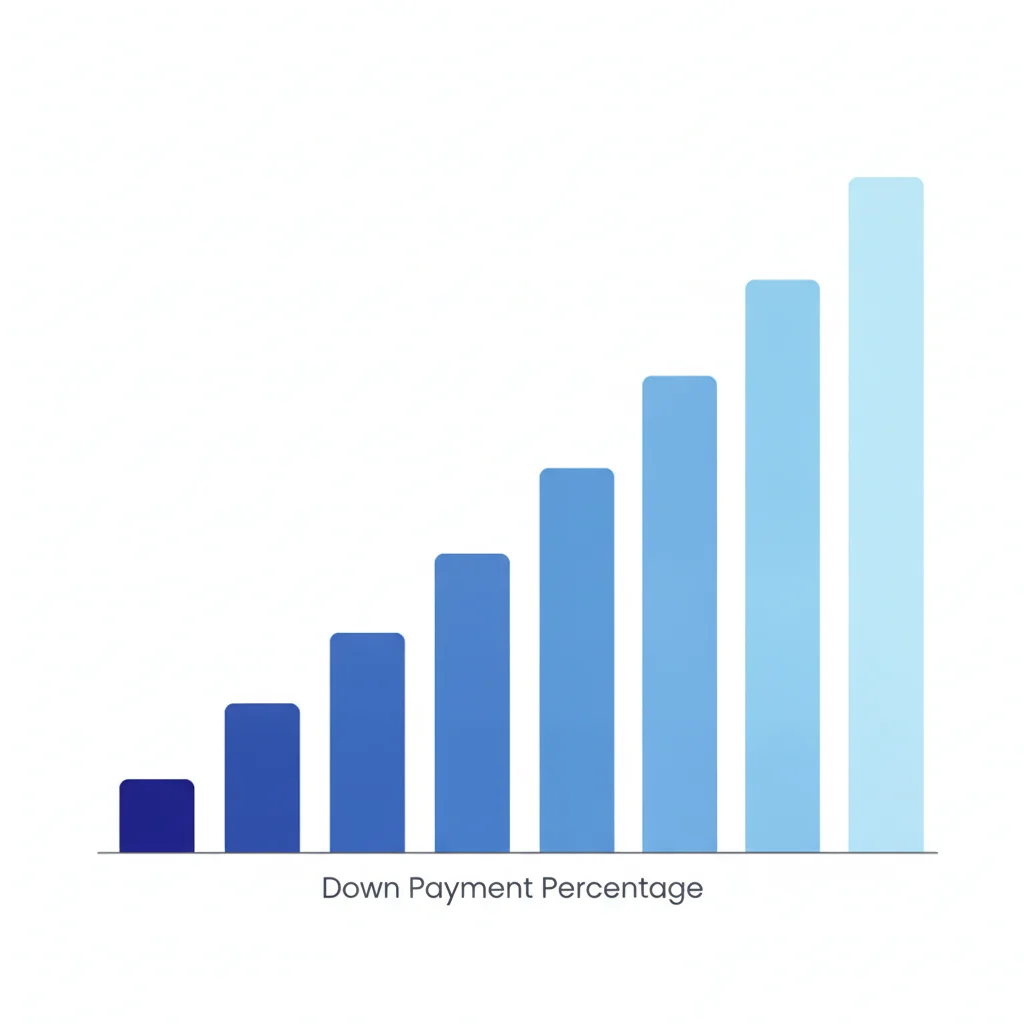
When a lender evaluates your auto loan application, one of the most important metrics they calculate is the loan-to-value (LTV) ratio. LTV is simply the loan amount divided by the vehicle's value, expressed as a percentage.
Example: You want to borrow $28,000 on a car valued at $35,000. LTV = $28,000 ÷ $35,000 = 80%.
Lenders maintain internal LTV thresholds that dictate what rates and terms they'll offer — or whether they'll approve the loan at all. Most banks and credit unions prefer LTVs at or below 100%, though some will go up to 110–120% for borrowers with strong credit. At higher LTVs, lenders compensate for added risk by charging higher rates.
What Happens at High LTV
When you finance 100% or more of a vehicle's value, the lender has no equity cushion. If you miss payments and the car has to be repossessed, the lender may not recover the full loan balance at auction. That risk gets priced into your interest rate. A down payment directly lowers your LTV and removes some of that risk premium from your rate.
Lender-Specific Requirements
Some lenders — particularly those serving borrowers with poor credit — require minimum down payments as a condition of approval. Subprime auto lenders commonly require $1,000 or 10% down, whichever is greater, precisely because the borrower's credit profile creates higher default risk. Getting preapproved for your loan before you shop lets you see each lender's requirements upfront so there are no surprises at the dealership.
Dealer Financing vs. Direct Lending
When you finance through a dealership, the dealer often marks up the lender's base rate by 1–2 percentage points as their compensation. This is legal and common. Comparing a preapproval from your bank or credit union gives you a benchmark to assess whether the dealer's offer is competitive. You are not obligated to use dealer financing.
GAP Insurance and Down Payments
GAP (Guaranteed Asset Protection) insurance covers the difference between what you owe and what your insurer pays if your car is totaled. It's most valuable when you have little or no down payment. If you put 20% down and drive a vehicle with average depreciation, you may never need it — and skipping the premium represents additional savings.
Rebates and Down Payments: State Tax Nuances
How manufacturer rebates interact with sales tax calculation varies by state. Some states tax the full purchase price before the rebate; others tax only the post-rebate amount. In a state that taxes the full price, a $2,500 rebate saves you less net money than it appears. Check your state's DMV or Department of Revenue for the specific rule that applies to your purchase.
Down Payments and Credit Scores
Your credit score and your down payment are not independent variables — they interact in ways that can work for or against you depending on how you play them.
A Down Payment Can Offset a Weak Score
Lenders assess risk using a combination of signals. A borrower with a 620 credit score putting 25% down may receive similar loan terms to a borrower with a 680 score putting 10% down — because the large down payment substantially reduces the lender's collateral exposure. This is one of the most underused levers available to buyers rebuilding credit after a setback.
A Strong Score Doesn't Mean You Should Skip the Down Payment
On the flip side, buyers with excellent credit (740+) sometimes assume they can skip the down payment entirely because they'll qualify easily. That thinking is financially costly. Even if the lender approves a zero-down loan at a competitive rate, you still bear the risk of going underwater if the car depreciates faster than you pay it down.
The relationship between credit scores and down payment strategy is explored in detail at how down payments interact with your credit score on an auto loan.
Before you negotiate the car's price, negotiate the out-the-door price separately from your trade-in value. Dealers sometimes inflate the trade-in offer while quietly increasing the sale price — keeping them separate prevents this shell game.
Experienced auto finance analysts consistently find that bundling trade-in and purchase negotiations gives dealerships room to offset concessions, leaving buyers thinking they got a deal when the numbers cancel each other out.
If your credit score is below 660, try to put down at least 15% — even if it means waiting another 60 to 90 days to save more. The interest rate reduction you may unlock will often save more than what you'd spend on a lower-priced vehicle with a high rate.
Subprime borrowers can face APRs of 12–18%; a modest improvement in LTV or credit-risk perception can move the rate meaningfully, saving thousands over a five-year term.
Get your trade-in appraised at two or three independent sources (CarMax, Carvana, and a local dealer) before setting foot in a showroom. The highest offer becomes your floor in the dealership negotiation.
Trade-in equity is often the most undervalued asset a buyer brings to the table; independent competing offers prevent dealers from low-balling a vehicle that represents real down payment capital.
Ask your lender specifically whether the manufacturer rebate is being applied to reduce the capitalized cost (sale price) or treated as a cash down payment — the tax treatment and financing math can differ by state.
In some states, sales tax is calculated on the pre-rebate price, in others on the post-rebate price; knowing which applies to you prevents a surprise at the closing table.
When comparing loan offers, calculate the total amount you'll repay (monthly payment × number of payments + down payment) rather than just comparing APR. Two loans at the same APR but different terms can have dramatically different total costs.
A 72-month loan at 6.5% APR results in far more total interest than a 48-month loan at the same rate; the down payment's value must be evaluated in the context of the full repayment timeline.
“A down payment is not just an entry fee to get a loan — it's the single fastest way a buyer can change both the cost of borrowing and their long-term financial position relative to the vehicle they're buying.”
— Melinda Zabritski, Senior Director of Automotive Financial Solutions, Experian
Depreciation and the Case for Putting More Down
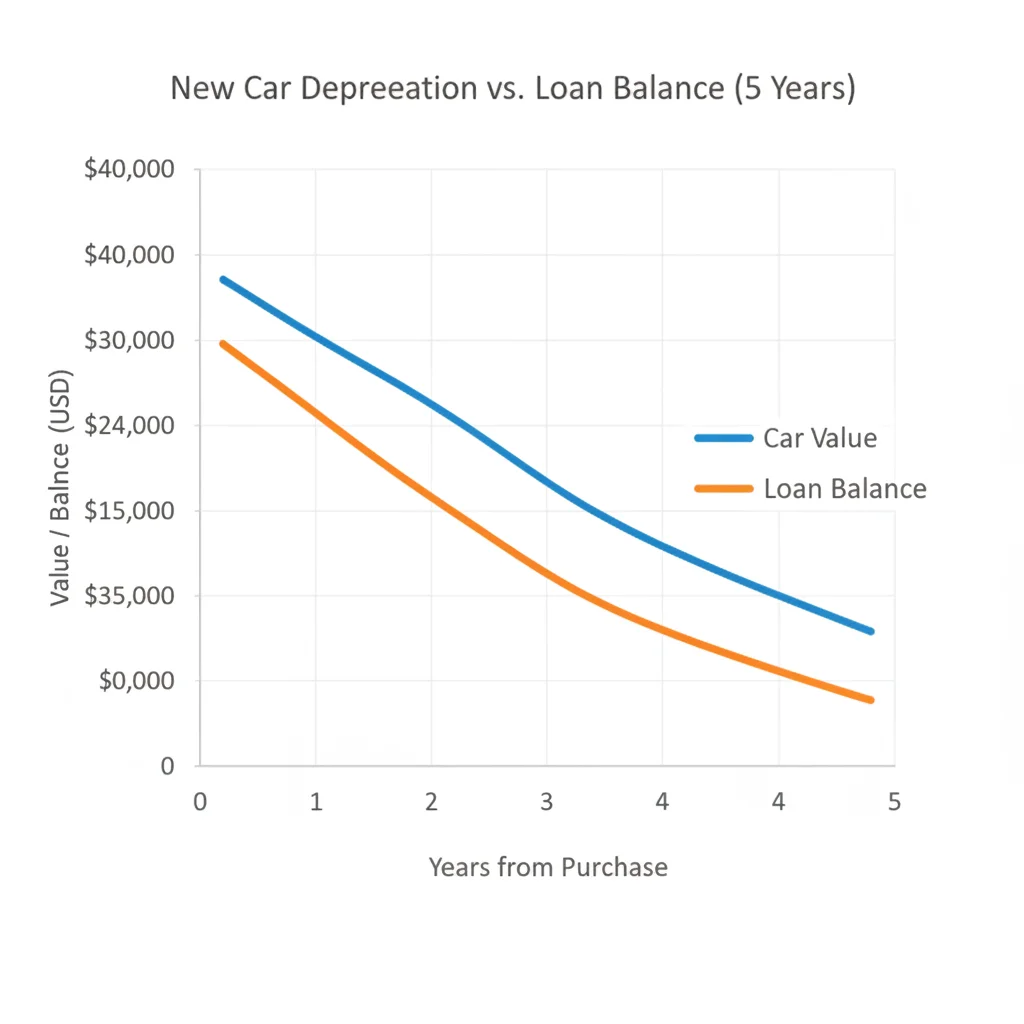
Depreciation is the silent opponent in every car purchase. A new vehicle loses approximately 15–20% of its value the moment it's driven off the lot, and another 10–15% each year for the first several years of ownership. This isn't opinion — it's a documented pattern tracked by automotive valuation firms.
The Underwater Problem
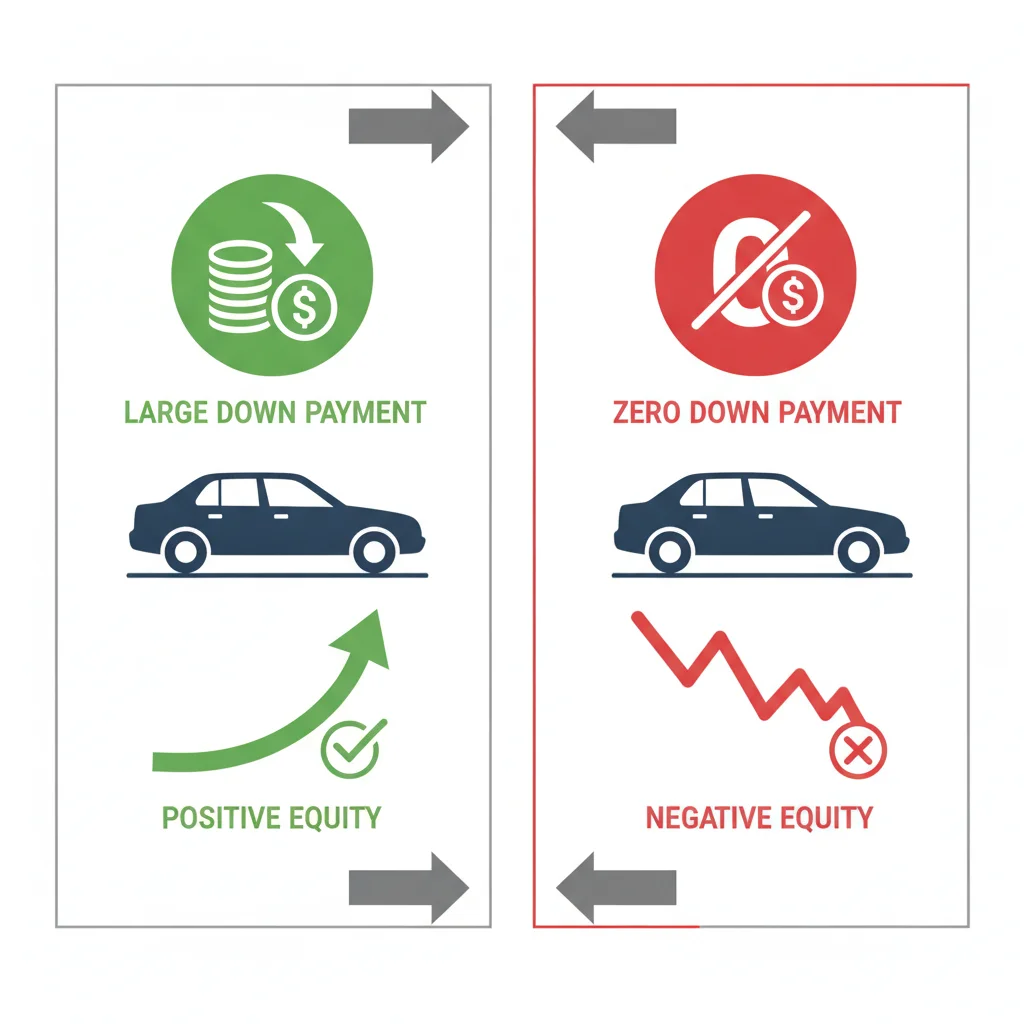
When your loan balance exceeds the car's current market value, you are "underwater" or "upside down" on the loan. This creates several serious problems:
- You can't sell or trade without bringing cash to the table. If you owe $24,000 and the car is worth $19,000, you need $5,000 to cover the gap before any new transaction can happen cleanly.
- Insurance doesn't cover the gap. If the car is totaled and your insurer pays $19,000 but you owe $24,000, you still owe the lender $5,000. GAP insurance exists specifically to cover this — but you're paying a premium to insure against a problem a larger down payment would have prevented or minimized.
- Refinancing becomes difficult. Lenders won't refinance a loan where the balance exceeds the vehicle's value — they have no adequate collateral.
A down payment of 20% on a new vehicle essentially matches the first-year depreciation hit, meaning you start Year 2 approximately at break-even between what you owe and what the car is worth. This is the core financial logic behind that 20% benchmark.
For first-time buyers especially, understanding this depreciation-equity dynamic is foundational. Auto loan down payments: a complete guide for first-time buyers covers this in an accessible format.
Going Underwater Is a Serious Financial Risk
Being underwater on your auto loan — owing more than the car is worth — is not just an abstract concern. It eliminates your ability to sell or trade without paying cash out of pocket, leaves you exposed if the car is totaled, and traps you in a loan you may outgrow financially before you can exit it. The primary defense against this outcome is a sufficient down payment at the start. If you cannot put down at least 10% on a new vehicle, seriously consider purchasing a lower-priced car or waiting until you've saved more.
Don't Sacrifice Your Emergency Fund for a Bigger Down Payment
Exhausting your liquid savings to maximize your down payment creates a different kind of financial fragility. If you have no cash reserves and face an unexpected expense within the first year of ownership — a job disruption, medical bill, or major repair — you may be forced into high-interest debt that costs more than the interest savings your larger down payment achieved. Maintain at least three months of essential expenses in liquid form before committing any surplus to a vehicle down payment.
What You Can Use as a Down Payment
Most buyers think of a down payment as a wire transfer or a stack of bills — but the definition is broader than cash alone. Here are all the accepted forms, and the fine print on each.
Cash or Check
The simplest form. Most dealerships accept personal checks for down payments, though some may hold the vehicle for a few days until the check clears. Large cash payments may trigger reporting requirements under federal banking regulations.
Trade-In Equity
If you own a vehicle worth more than you owe on it, the difference (equity) can be applied directly to your down payment. Example: Your trade-in is worth $12,000 and you owe $7,000 on it — you have $5,000 of equity that reduces your financed amount. If you owe more than the car is worth, that negative equity typically rolls into the new loan, which is a red flag to be cautious about.
Manufacturer Rebates
When a car manufacturer offers a cash rebate (e.g., "$2,500 cash back"), that amount is usually applied at point of sale and reduces the price before financing. In practice this acts like a down payment because it reduces what you finance — but confirm with your dealer how they're applying it.
Gifted Funds
Funds given to you by a family member are generally acceptable, though some lenders may ask for a gift letter confirming the money does not need to be repaid.
Get Multiple Trade-In Offers Before Visiting a Dealer
Online appraisal tools from CarMax, Carvana, and Kelley Blue Book Instant Cash Offer take less than 10 minutes and provide written offers valid for several days. Bring those offers to the dealership as your negotiating floor. A dealer who knows you have competing offers is far more likely to give you fair value on your trade-in.
Target 10% Down as a Minimum Starting Point
If 20% feels out of reach right now, aim for at least 10% before you shop. Even that threshold meaningfully changes your LTV, may influence your rate, and significantly reduces the period during which you're underwater on the loan. Some equity from day one is always better than none.
Automate Your Car Savings Like a Bill
Set up an automatic transfer into a dedicated savings account to fire the moment your paycheck hits. Treating your car down payment savings as a non-negotiable expense — just like rent or utilities — dramatically increases follow-through and compresses the time to reach your target.
What Doesn't Count
A personal loan taken out to fund your down payment generally won't count — and lenders often catch this because the new debt shows up on a credit inquiry. The purpose of a down payment is to demonstrate that you have skin in the game from your own resources, not leveraged capital.
Common Down Payment Mistakes to Avoid
After working through auto loan scenarios with many buyers, the same mistakes surface repeatedly. These are the ones with real financial consequences.
Mistake 1: Draining Your Emergency Fund
Maximizing your down payment by emptying your savings account leaves you exposed. If you put $8,000 down and have nothing left in reserve, a single unexpected car repair or medical bill forces you toward high-interest credit card debt. A good rule: maintain at least 3 months of living expenses in liquid savings before applying any surplus to a vehicle down payment.
Mistake 2: Accepting Negative Equity as a Down Payment Substitute
Dealers sometimes present rolling your old loan's negative equity into the new loan as a zero-friction solution. It isn't. You are simply carrying forward a debt and making it larger. That practice starts the new loan already underwater and compounds interest on a balance that includes money you owe for a car you no longer own.
Mistake 3: Letting the Monthly Payment Drive the Conversation
Dealers are trained to anchor your attention on the monthly payment rather than the total cost. A low monthly payment achieved through a long term with no down payment is not a good deal — it's a mechanism that extracts more total money from you over time. Focus on the total financed amount and total interest paid, not just what hits your account each month. Everything you need to know before signing an auto loan breaks down every term to watch for.
Mistake 4: Not Shopping the Loan Before the Car
If you walk into a dealership without a preapproval, the dealer controls the financing conversation. Getting approved through your bank or credit union first gives you a rate benchmark and eliminates the pressure to accept whatever the dealership's finance office offers.
Don't Roll Negative Equity Into a New Loan
If you owe more on your current vehicle than it's worth, rolling that balance into a new loan means you are financing debt from a car you no longer own. This inflates your new loan's principal, raises your LTV from day one, and could leave you $5,000–$10,000 underwater immediately after signing. Always exhaust other options — including waiting to buy — before accepting negative equity rollover.
Monthly Payment Framing Can Be Misleading
A dealership finance manager who says 'we can get you into this car for $450 a month' may be stretching your term to 84 months to make that number work. Always ask for the total amount financed, the APR, and the total interest paid — not just the monthly figure. Low monthly payments on long terms often cost thousands more than higher payments on shorter terms.
Financing Your Down Payment Is a Red Flag
Taking out a personal loan to fund your vehicle down payment defeats the purpose — you are simply moving debt around rather than reducing it. Most lenders prohibit this and will catch it when the personal loan appears on a credit check. Bring only funds you actually own, not borrowed capital.
Zero-Down Financing: When It Works and When It Doesn't
Zero-down auto loans exist, and in specific circumstances they are a rational choice. In most circumstances, they are an expensive convenience that you'll pay for gradually over years.
When Zero-Down Makes Sense
- 0% APR manufacturer promotions: If you qualify for a 0% interest offer, you are not paying to finance the full vehicle price — so keeping cash invested elsewhere is mathematically sound.
- Strong liquidity strategy: A buyer with substantial liquid assets who is making a calculated decision to preserve cash for higher-return investments is making a different choice than a buyer who simply can't afford a down payment.
- Short loan terms: On a 24- or 36-month loan on a vehicle with strong residual value, the depreciation risk from no down payment is more contained.
When Zero-Down Hurts You
- Long loan terms (60–84 months) with no down payment almost guarantee an extended period of being underwater.
- Buyers with subprime credit who accept zero-down offers often pay 12–18% APR, meaning a large portion of each payment goes to interest rather than principal.
- Any situation where you might need to sell or trade before the loan is paid off becomes financially painful when there's no equity cushion.
For a complete, balanced analysis of no-down-payment financing, zero-down auto loans: what you're actually agreeing to covers both sides without sugarcoating the tradeoffs.
Building Your Down Payment Savings Plan
Knowing you need 20% down on a $35,000 car means saving $7,000. That's a specific target, and specific targets are achievable with a plan.
Step 1: Set Your Vehicle Budget First
Before you can save a down payment, you need to know what vehicle you are targeting. A rough guide: total vehicle cost (including insurance, fuel, and maintenance) should not exceed 15–20% of your monthly take-home pay. Establish that ceiling first, then calculate 20% of the purchase price as your savings target.
Step 2: Open a Dedicated Savings Account
Commingling your car savings with your regular checking account invites spending. Open a dedicated high-yield savings account and automate a fixed monthly transfer into it the day after your paycheck arrives.
Step 3: Accelerate With Windfalls
Tax refunds, bonuses, and overtime pay deposited directly into the car savings account can compress your savings timeline significantly. A $3,000 tax refund applied to a $7,000 goal cuts your remaining savings time nearly in half.
Step 4: Evaluate Your Trade-In Early
Get a trade-in appraisal before you start shopping — not after. Knowing your current car's equity (or lack thereof) tells you how much cash you actually need to bring in addition to the trade. Use resources like Kelley Blue Book or CarMax's online appraisal tool to establish a baseline.
Step 5: Don't Wait for the Perfect Number
Saving from 0% to 10% down is far better than buying at 0% while waiting to reach 20%. The key threshold is having something in — because it changes your LTV, may change your rate, and begins your equity-building journey from day one.
Get Multiple Trade-In Offers Before Visiting a Dealer
Online appraisal tools from CarMax, Carvana, and Kelley Blue Book Instant Cash Offer take less than 10 minutes and provide written offers valid for several days. Bring those offers to the dealership as your negotiating floor. A dealer who knows you have competing offers is far more likely to give you fair value on your trade-in.
Target 10% Down as a Minimum Starting Point
If 20% feels out of reach right now, aim for at least 10% before you shop. Even that threshold meaningfully changes your LTV, may influence your rate, and significantly reduces the period during which you're underwater on the loan. Some equity from day one is always better than none.
Automate Your Car Savings Like a Bill
Set up an automatic transfer into a dedicated savings account to fire the moment your paycheck hits. Treating your car down payment savings as a non-negotiable expense — just like rent or utilities — dramatically increases follow-through and compresses the time to reach your target.
Kelley Blue Book Trade-In Value Tool
Enter your current vehicle's details to get an estimated trade-in range. Use it to calculate how much equity you can apply toward your next down payment.
Auto Loan Payment Calculator
Plug in different down payment amounts, loan terms, and interest rates to see exactly how each variable affects your monthly payment and total interest paid.
Consumer Financial Protection Bureau: Auto Loans
The CFPB's official auto loan resource explains your rights as a borrower, how financing actually works, and what dealerships are legally required to disclose.
Experian State of the Automotive Finance Market
Quarterly report tracking average down payments, loan amounts, terms, and credit tiers — useful context for understanding where your situation stands relative to other buyers.
Loan Preapproval Checklist
A structured list of documents and information you need to gather before applying for preapproval, helping you approach lenders efficiently and professionally.
iSeeCars Depreciation Tool
Search any vehicle make and model to see its historical depreciation curve — essential data for deciding how much to put down relative to expected value loss.
Going Underwater Is a Serious Financial Risk
Being underwater on your auto loan — owing more than the car is worth — is not just an abstract concern. It eliminates your ability to sell or trade without paying cash out of pocket, leaves you exposed if the car is totaled, and traps you in a loan you may outgrow financially before you can exit it. The primary defense against this outcome is a sufficient down payment at the start. If you cannot put down at least 10% on a new vehicle, seriously consider purchasing a lower-priced car or waiting until you've saved more.
Don't Sacrifice Your Emergency Fund for a Bigger Down Payment
Exhausting your liquid savings to maximize your down payment creates a different kind of financial fragility. If you have no cash reserves and face an unexpected expense within the first year of ownership — a job disruption, medical bill, or major repair — you may be forced into high-interest debt that costs more than the interest savings your larger down payment achieved. Maintain at least three months of essential expenses in liquid form before committing any surplus to a vehicle down payment.

All claims are backed by peer-reviewed research. Sources on request.