
Key Takeaways
Start here
What Is a Down Payment and Why Does It Matter?
Understand the math
How Down Payments Affect Your Loan Math
Set your target
How Much Should You Put Down?
Know the risks
The Risk of Putting Too Little Down
Build your savings
How to Save for Your Down Payment
Move forward
Next Steps After Your Down Payment
What Is a Down Payment and Why Does It Matter?
A down payment is the portion of a car's purchase price you pay upfront—in cash, trade-in equity, or a combination of both—before your loan covers the rest. If a car costs $30,000 and you put $6,000 down, you're financing $24,000. That gap between the price and what you bring to the table is called the loan amount or principal.
For a first-time buyer, the down payment is one of the most important levers you control. It directly affects:
- How much you borrow (and therefore how much interest you pay)
- What your monthly payment looks like
- Whether a lender approves you, and at what rate
- How quickly you build equity in the vehicle
Lenders care about down payments because they tell a story about risk. When you put meaningful money down, you've demonstrated financial discipline and reduced the lender's exposure if you default. That's why borrowers who put more down often get better loan terms.
Down Payment
The amount of money you pay upfront toward a car's purchase price before your loan covers the rest. It reduces how much you need to borrow.
Loan-to-Value Ratio (LTV)
A percentage comparing your loan amount to the car's value. A $20,000 loan on a $25,000 car is an 80% LTV. Lower LTV generally means less risk for the lender.
Negative Equity
When you owe more on your car loan than the vehicle is currently worth. Also called being 'underwater' on your loan.
Principal
The original amount you borrow, not counting interest. Payments reduce your principal over time as the loan is paid down.
Depreciation
The decline in a car's market value over time. New cars typically lose the most value in the first year, which is why a solid down payment helps protect against negative equity early on.
Trade-In Equity
The money left over after you subtract what you still owe on your current vehicle from its trade-in value. Positive equity can be applied toward your new car's down payment.
Gap Insurance
Optional coverage that pays the difference between your car's market value and your remaining loan balance if the car is totaled. Most useful when you have little or no down payment.
Think of it this way: the car starts losing value the moment you drive off the lot. A down payment creates a financial cushion so your loan balance doesn't immediately outpace what the car is worth—a situation known as being underwater on your loan.
How Down Payments Affect Your Loan Math
Numbers make this concept much clearer. Let's walk through a real example using a $28,000 vehicle financed over 60 months at a 7% APR.
| Down Payment | Loan Amount | Monthly Payment | Total Interest Paid |
|---|---|---|---|
| $0 (0%) | $28,000 | $554 | $5,240 |
| $2,800 (10%) | $25,200 | $499 | $4,716 |
| $5,600 (20%) | $22,400 | $443 | $4,192 |
| $8,400 (30%) | $19,600 | $387 | $3,668 |
Going from 0% to 20% down saves you $111 per month and over $1,000 in total interest. That's real money—and it doesn't require perfect credit to achieve.
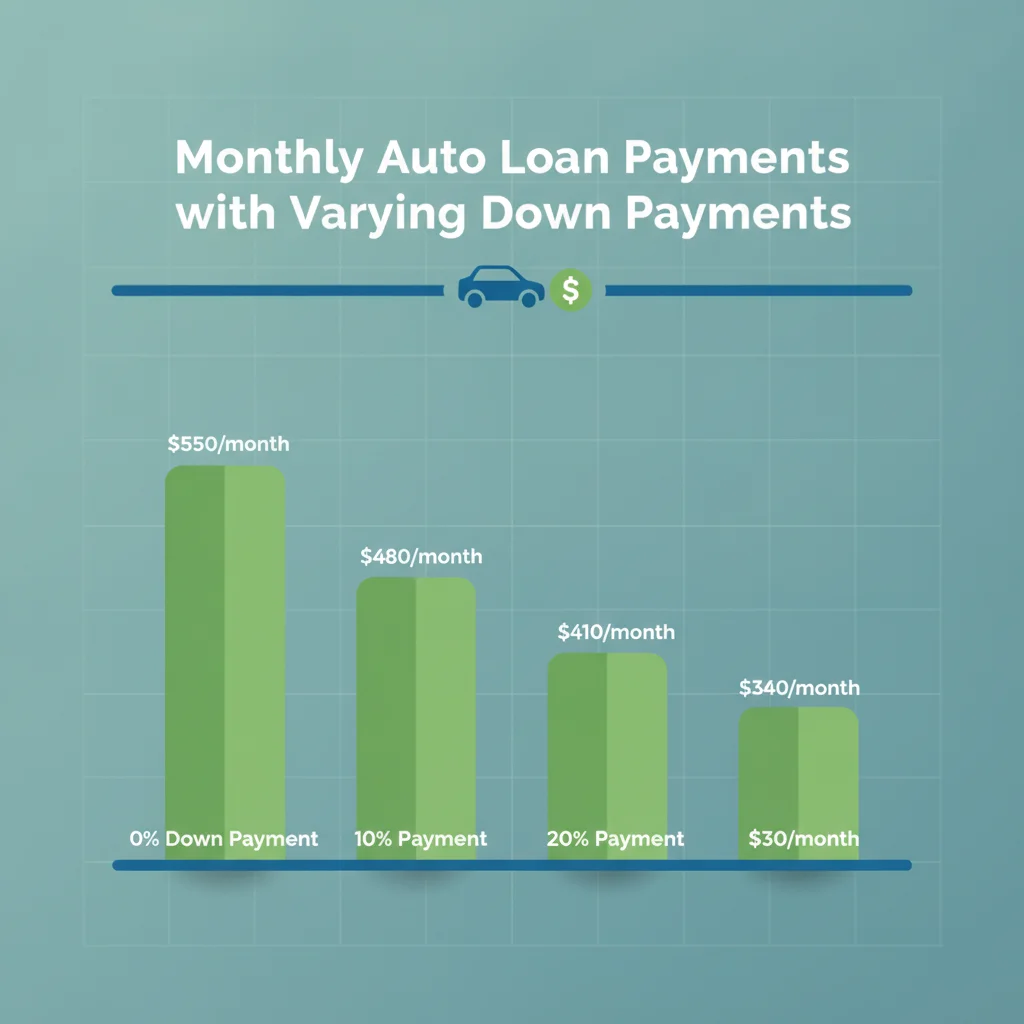
The relationship between your down payment and loan is also expressed as a loan-to-value ratio (LTV). If the car is worth $28,000 and you borrow $22,400, your LTV is 80%. Lenders generally prefer LTVs of 80% or lower—meaning a 20% down payment. Higher LTVs signal more risk to the lender.
To understand how the interest portion of your payment is calculated month by month, see our guide to auto loan interest and APR—it walks through exactly how lenders compute what you owe.
Use a Loan Calculator Before You Shop
Before visiting any dealership, plug different down payment amounts into an online auto loan calculator. Seeing the monthly payment and total interest side by side makes the tradeoffs immediate and concrete. Aim to test at least three scenarios: 0%, 10%, and 20% down on your target vehicle price.
Negotiate the Vehicle Price Before Applying Down Payment
Always agree on the out-the-door price of the vehicle before revealing your down payment amount. Some dealers will adjust their offer based on how much cash you're bringing. Settling on the price first ensures your down payment actually reduces your loan balance rather than simply replacing a discount.
How Much Should You Put Down?
The right down payment depends on your specific situation, but standard benchmarks exist for good reasons.
New Cars: Aim for 20%
New vehicles depreciate fastest in the first year—often losing 15–25% of their value within 12 months. A 20% down payment helps ensure your loan balance doesn't overtake the car's market value during that steep early drop. On a $35,000 new car, that's $7,000 upfront.
Used Cars: 10% Is a Reasonable Floor
Used vehicles have already absorbed the steepest portion of depreciation. A 10% down payment on a $20,000 used car—$2,000—is generally enough to establish positive equity quickly. Lenders are often more flexible here.
If Your Credit Is Poor, Consider Going Higher
When your credit score is below 620, lenders view you as a higher-risk borrower. A larger down payment—15–25%—can be the deciding factor in whether you're approved, and it may reduce the interest rate offered. Our guide for first-time buyers with bad credit explains how to navigate this situation in detail.
Balance Down Payment Against Your Emergency Fund
Don't drain your savings to make a larger down payment. Financial emergencies happen—job loss, medical bills, car repairs. Keeping at least two to three months of expenses in reserve is more important than hitting a round-number percentage. For a deeper look at how your overall financial picture should shape this decision, see things to know before deciding how much to put down.
Your Down Payment Doesn't Affect Every Lender the Same Way
Some lenders set firm minimum LTV requirements, while others weigh down payment as just one factor alongside credit score, income, and loan term. Credit unions in particular may have more flexibility than traditional banks or dealer-arranged financing. Shopping multiple lenders—ideally with preapproval in hand—lets you compare how each institution responds to your specific down payment amount.
Down Payment Sources: What Lenders Accept
Not all down payment sources are treated equally. Here's a breakdown of the most common options:
- Personal savings (cash)
- The most straightforward source. Funds from a checking or savings account are universally accepted. The lender may ask for bank statements to verify the funds are yours.
- Trade-in equity
- If you're selling your current vehicle to the dealer, any equity—the trade-in value minus what you still owe on it—is applied directly to your down payment. This is one of the most common ways buyers piece together a down payment without cash on hand.
- Manufacturer rebates or incentives
- On new cars, automakers often offer cash-back rebates that can be applied to the purchase price, effectively functioning as part of your down payment. These vary by make, model, and month.
- Gift funds from family
- Some lenders accept financial gifts toward a down payment, but documentation requirements vary. Learn exactly what's involved in our article on using gift funds for an auto loan down payment.
Several sources are typically not accepted, including personal loans, credit card cash advances, and borrowed money from a 401(k). These create additional debt rather than reducing your financial risk—the opposite of what a down payment is supposed to accomplish. For a full breakdown of accepted and ineligible sources, see down payment sources lenders will and won't accept.
Don't Borrow Your Down Payment
Using a personal loan, credit card cash advance, or borrowed funds as a down payment defeats the purpose. Lenders want to see that you have real financial stake in the vehicle. Borrowed down payments increase your total debt load, may be flagged during underwriting, and often violate lender terms—potentially leading to loan denial or cancellation.
Longer Loan Terms Amplify the Risk of Low Down Payments
A 72- or 84-month loan term combined with a small down payment is one of the fastest ways to end up deeply underwater. Depreciation outpaces your slow payoff during the early years of a long loan. If you can't put much down, shorten the loan term to build equity faster—even if it means a higher monthly payment.
The Risk of Putting Too Little Down
The biggest risk of skipping or minimizing your down payment is becoming underwater on your loan—also called having negative equity. This happens when you owe more on the car than it's currently worth.
Here's a concrete example: You buy a $28,000 car with no money down on a 72-month loan at 7% APR. After one year of payments, your loan balance is approximately $24,500. But the car has depreciated to around $21,000. You're $3,500 underwater—meaning if you needed to sell or trade the car right now, you'd still owe $3,500 to the lender after the sale.
Being underwater becomes a serious problem if:
- The car is totaled in an accident (insurance pays market value, not what you owe)
- You need to sell the car to cover a financial emergency
- You want to trade in before the loan is paid off
Gap insurance can protect you in a total-loss scenario, but it doesn't help with the other situations—and it costs money. The better solution is starting with enough equity that you're never significantly underwater. For a frank assessment of what zero-down financing actually means for your risk exposure, read zero-down auto loans: what you're actually agreeing to.
Don't Borrow Your Down Payment
Using a personal loan, credit card cash advance, or borrowed funds as a down payment defeats the purpose. Lenders want to see that you have real financial stake in the vehicle. Borrowed down payments increase your total debt load, may be flagged during underwriting, and often violate lender terms—potentially leading to loan denial or cancellation.
Longer Loan Terms Amplify the Risk of Low Down Payments
A 72- or 84-month loan term combined with a small down payment is one of the fastest ways to end up deeply underwater. Depreciation outpaces your slow payoff during the early years of a long loan. If you can't put much down, shorten the loan term to build equity faster—even if it means a higher monthly payment.
How to Save for Your Down Payment
If you're not ready to buy today, a structured savings plan makes the goal reachable. Here's a practical approach:
Step 1: Set a Specific Target
Decide on the car's approximate price range first. If you're targeting a $20,000 used car, your 10% goal is $2,000; a 20% goal is $4,000. Having a number makes saving feel concrete.
Step 2: Open a Dedicated Savings Account
Keep your car fund separate from everyday spending. A high-yield savings account earns a bit of interest while you accumulate funds and removes the temptation to spend the money on something else.
Step 3: Automate Monthly Contributions
Set a recurring transfer on payday—even $200/month reaches $2,400 in a year with zero effort. Automation removes the decision from your routine.
Step 4: Accelerate With Windfalls
Tax refunds, bonuses, and cash gifts can meaningfully shorten your timeline. Consider directing a large portion of any windfall directly to your car savings account before lifestyle spending claims it.
Step 5: Monitor Loan Terms as You Save
As your savings grow, start exploring how different loan lengths and amounts interact. Our hub on loan terms explained is a useful reference for understanding how term length affects your monthly payment and total cost.
Auto Loan Down Payments: The Complete Breakdown
A deeper dive into down payment strategy, lender expectations, and loan math for buyers who want the full picture beyond the basics.
Loan Terms Explained
Understand how loan length affects your monthly payment and total cost—essential reading before you choose how much to put down.
First-Time Car Buyer's Introduction to Loan Preapproval
Step-by-step walkthrough of the preapproval process so you know your budget and rate before negotiating at the dealership.
Auto Loan Interest and APR: A Complete Guide
Learn exactly how lenders calculate interest on your loan so you can see in real numbers what a lower principal—thanks to a bigger down payment—saves you.
Next Steps After Your Down Payment
Once you have a down payment target in mind—or the funds already saved—a few important steps come next.
Get Preapproved Before You Shop
Preapproval lets you know exactly how much a lender will finance, at what rate, and on what terms—before you set foot in a dealership. It puts you in control of the negotiation because you already know your numbers. Our guide on loan preapproval for first-time buyers walks through the full process. You can also explore the broader loan preapproval hub for lender comparison tips.
Factor In All the Upfront Costs
Your down payment isn't the only cash you'll need at signing. Sales tax, registration fees, dealer documentation fees, and any first-month insurance premium are typically due at or before delivery. Budget for these separately so your down payment stays intact.
Think About Payoff Strategy Early
Once your loan is active, the down payment work is done—but the financial strategy isn't. Paying extra toward principal each month, or eventually refinancing to a lower rate, can save you hundreds. Our guide to early auto loan payoff explains exactly how this works for first-time borrowers. If your situation changes down the road, auto loan refinancing for first-timers covers when and how to revisit your rate.

A down payment is where smart car buying begins. It's the single decision that affects everything downstream—your rate, your monthly budget, your equity position, and your financial flexibility. Starting with a clear understanding of why it matters gives you a meaningful edge as a first-time buyer.

All claims are backed by peer-reviewed research. Sources on request.