
Key Takeaways
Start here
How an Auto Loan Actually Works
Next
Loan Term Length: The Decision That Changes Everything
Then
Interest Rates Explained: APR, Credit Score, and What Moves the Number
Watch out for
Fees, Add-Ons, and Hidden Costs to Watch For
Plan ahead
Down Payments and Their Role in Your Loan
Before you sign
What to Check Before You Sign
How an Auto Loan Actually Works
An auto loan is a secured installment loan — "secured" because the vehicle itself serves as collateral, and "installment" because you repay it in fixed monthly payments over a set period. If you stop making payments, the lender has the legal right to repossess the car. That's the fundamental deal on the table.
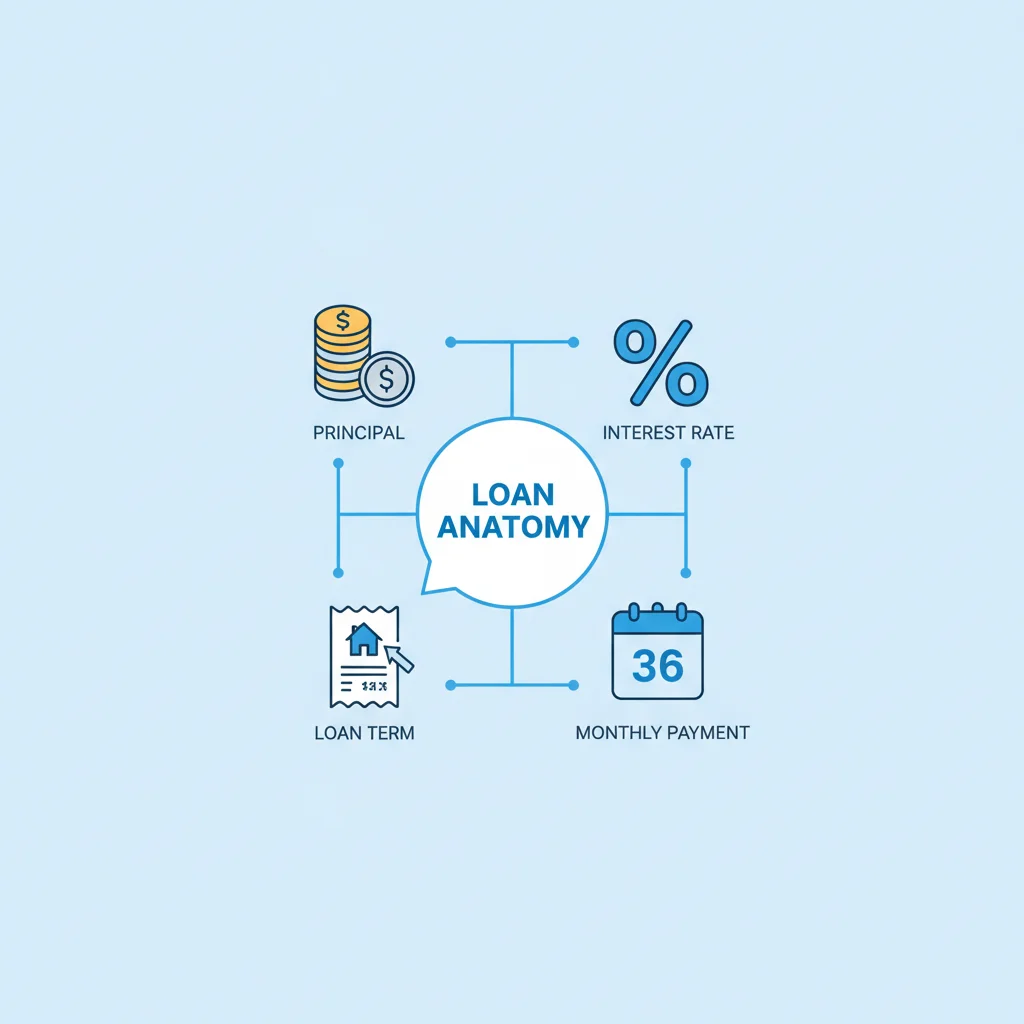
Here's the basic anatomy of every auto loan:
- Principal: The amount you borrow — typically the vehicle price minus your down payment, plus any rolled-in fees.
- Interest: The lender's charge for lending you the money, expressed as an annual percentage rate (APR).
- Term: The length of the loan in months — most commonly 36, 48, 60, 72, or 84 months.
- Monthly payment: A fixed amount due each month, covering both principal and interest.
What most first-time borrowers don't immediately grasp is how these four elements interact. Your monthly payment is determined by all three variables — principal, rate, and term — simultaneously. Change any one of them and the others shift in response.
Principal
The amount of money you actually borrow, not counting interest. Your monthly payments gradually reduce the principal until the loan is paid off.
APR (Annual Percentage Rate)
The true annual cost of borrowing, expressed as a percentage. APR includes the interest rate plus certain fees, making it more useful than the interest rate alone when comparing loan offers.
Amortization
The process by which each loan payment is split between interest and principal repayment. Early payments are mostly interest; later payments are mostly principal.
Loan Term
The length of time you have to repay the loan, usually expressed in months (e.g., 60 months = 5 years). Longer terms mean lower monthly payments but more total interest paid.
Negative Equity (Upside-Down)
When you owe more on the loan than the vehicle is currently worth. This typically happens with long loan terms and small down payments, since cars depreciate quickly.
GAP Insurance
An optional insurance product that covers the gap between your loan balance and the car's actual cash value if the vehicle is totaled or stolen. Most valuable when you have a long loan term or small down payment.
Buy Rate
The minimum interest rate a lender will accept for a given borrower. Dealers can mark this rate up above the buy rate and keep the difference as profit.
Retail Installment Sales Contract (RISC)
The primary legal document you sign when buying a car on credit. It spells out the loan amount, rate, term, payment schedule, and all agreed terms. Verbal promises not in this document are not legally binding.
Lenders use a process called amortization to calculate your payment schedule. In the early months of your loan, the majority of each payment goes toward interest rather than principal. As the loan matures, that ratio gradually flips. This is why paying extra toward principal early in the loan — even by a small amount — can meaningfully reduce the total interest you pay. For a deeper look at how early payoff works in practice, see our article on early auto loan payoff for first-time borrowers.
Your lender will also run a credit check before approving your loan. This inquiry is used to assess your creditworthiness and set your interest rate. The better your credit profile, the lower the rate you'll be offered — and over a five-year loan, even a 2-percentage-point difference in rate can add up to hundreds or thousands of dollars.
Loan Term Length: The Decision That Changes Everything
Of all the variables in an auto loan, term length is the one that catches the most buyers off guard. On the surface, longer terms look appealing — they make the monthly payment smaller and easier to fit into a budget. But they come at a steep hidden cost: more total interest paid, and a longer period during which you can owe more than the car is worth.
Let's make this concrete. Suppose you're borrowing $30,000 at a 7% APR:
| Loan Term | Monthly Payment | Total Interest Paid | Total Cost |
|---|---|---|---|
| 36 months | $927 | $3,371 | $33,371 |
| 48 months | $718 | $4,451 | $34,451 |
| 60 months | $594 | $5,640 | $35,640 |
| 72 months | $513 | $6,947 | $36,947 |
| 84 months | $455 | $8,230 | $38,230 |
Moving from a 36-month to an 84-month term cuts your monthly payment nearly in half — but you pay $4,859 more in interest for the privilege. That's money leaving your pocket that provides zero additional value.
Use the 60-Month Rule as Your Guide
If you can't comfortably afford the monthly payment on a 60-month loan, that's a strong signal the vehicle is outside your budget — not a reason to stretch to 72 or 84 months. Use the shorter term as a budget reality check, not just a payoff target. Driving a less expensive car for a few years beats being financially stressed for seven.
Get Pre-Approved Before You Shop
Arriving at a dealership with a pre-approval letter from your bank or credit union puts you in control of the financing conversation. You know your rate, you know your ceiling, and you're negotiating from a position of strength rather than dependence. Many buyers skip this step and end up paying more for financing than necessary.
20% Down Is the Starting Target
Putting down at least 20% on a new car helps you stay ahead of depreciation from day one. If 20% isn't feasible right now, even 10% provides meaningful protection against negative equity. Consider delaying the purchase by a few months to save a larger down payment — it will pay off throughout the loan's life.
There's a second risk with long terms: negative equity, also called being "upside-down." Cars depreciate fastest in their first two to three years. On a 72- or 84-month loan with a small down payment, the vehicle's market value can fall below your outstanding loan balance within the first year or two. If the car is totaled or you need to sell it, you may owe the lender more than the car fetches — meaning you'd pay off a vehicle you no longer own.
The practical guideline most consumer finance advisors use: keep your loan term at 60 months or fewer whenever your budget allows. If the payment on a 60-month loan feels unmanageable, that's often a signal that the vehicle itself is priced above what you can comfortably afford — a useful reality check before you commit.
Long Terms Can Cost More Than You Realize
The jump from 60 to 84 months might save you $139 per month on a $30,000 loan — but it costs you nearly $2,600 more in interest over the life of the loan. Dealers sometimes default to offering the longest term available to make payments feel affordable while maximizing their profit from financing. Always ask what the loan costs in total dollars, not just monthly.
Add-Ons Are Quoted in Payments, Not Total Cost
Finance managers are trained to present optional products in terms of their monthly payment impact. A $2,000 extended warranty becomes "just $28 per month" on a 72-month loan — which sounds trivial but isn't. Always ask what the total price of any add-on is, not just how it affects your payment. That reframing often makes it easier to decide whether the product is genuinely worth it.
For more on how auto loan terminology like amortization and LTV affects your total borrowing cost, our glossary covers every term you'll encounter on a real loan document.
Interest Rates Explained: APR, Credit Score, and What Moves the Number
Your interest rate is the price you pay to borrow money. But there are two versions of that price — the interest rate and the APR (Annual Percentage Rate) — and understanding the difference matters.
The raw interest rate reflects only the cost of borrowing the principal. APR folds in certain fees (like loan origination fees) to give a more complete picture of what the loan actually costs you annually. When comparing loan offers from different lenders, always compare APRs, not raw interest rates. A loan with a slightly higher interest rate but no fees can easily be cheaper than one with a lower rate but significant upfront costs.
What determines your rate?
Several factors influence the rate a lender will offer you:
- Credit score
- This is the biggest lever. Lenders use your credit score to assess how likely you are to repay. Borrowers with scores above 720 typically receive the best rates. Scores below 580 often result in subprime rates that can significantly inflate the total cost of the loan.
- Loan term
- Longer terms often carry slightly higher rates because the lender is exposed to more risk over a longer period.
- New vs. used vehicle
- New car loans typically carry lower rates than used car loans. Lenders view new vehicles as lower-risk collateral.
- Lender type
- Credit unions generally offer lower rates than banks or dealer-arranged financing. Shopping multiple lenders before you commit is one of the simplest ways to save money.
- Down payment size
- A larger down payment reduces the lender's risk, which can improve the rate you're offered.
Hard vs. Soft Credit Inquiries
When lenders check your credit during the loan approval process, it creates a "hard inquiry" that can temporarily lower your credit score by a few points. However, credit bureaus treat multiple auto loan inquiries within a 14–45 day window as a single inquiry — so shopping around with multiple lenders in a short period won't stack up repeated damage to your score. Use that window strategically.
You Can Walk Away Before Signing
No matter how far along the process feels, you are not legally obligated to proceed until you have signed the Retail Installment Sales Contract. If something in the paperwork doesn't match what was discussed, or if you feel pressured to accept terms you didn't agree to, you have every right to stop, ask questions, or leave and return another day. The car will almost certainly still be available.
The dealer markup trap
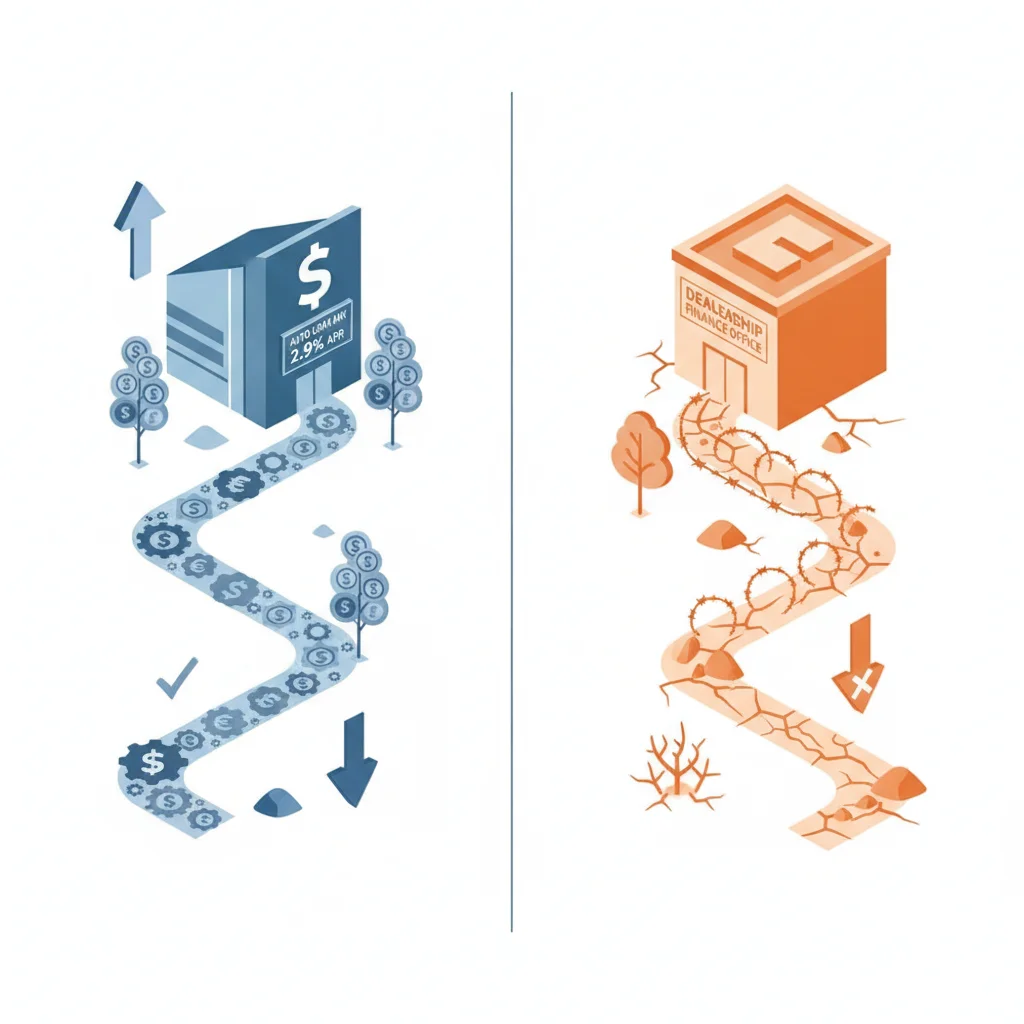
When you finance through a dealership, the dealer acts as an intermediary between you and a bank or finance company. The lender sets a buy rate — the minimum rate they require — and the dealer is often allowed to mark it up and pocket the difference as profit. This is legal and common. The best defense is arriving at the dealership with a pre-approval from your own bank or credit union. That offer becomes your floor, and the dealer must beat it to earn your financing business.
Fees, Add-Ons, and Hidden Costs to Watch For
The sticker price of a car is just the beginning. By the time you reach the finance office, a variety of fees and optional products will be introduced — some legitimate, some inflated, and some that you may not need at all. Knowing what each one is before you sit down gives you the ability to question, negotiate, or decline.
Standard fees you'll likely see
- Documentation fee ("doc fee"): A dealer charge for processing paperwork. Amounts vary widely by state — from under $100 to over $800. Some states cap this fee; others don't.
- Title and registration fees: State-mandated costs to transfer the title and register the vehicle. These are legitimate and generally non-negotiable.
- Sales tax: Calculated on the purchase price and collected by the dealer on behalf of your state. Not negotiable.
- Dealer prep or destination fees: Sometimes legitimate (transport from manufacturer), sometimes inflated. Ask for an itemized breakdown.
Finance office add-ons to evaluate carefully
- GAP insurance: Covers the difference between your loan balance and the car's actual cash value if it's totaled or stolen. This can be genuinely valuable — especially with a long loan term or small down payment — but it's almost always cheaper through your auto insurance provider than through the dealer.
- Extended warranty / vehicle service contract: Can provide peace of mind but often carries significant markup at the dealership. Compare coverage and pricing with third-party providers before accepting the dealer's offer.
- Credit life/disability insurance: Pays off or covers your loan if you die or become disabled. Typically overpriced relative to standalone life or disability insurance policies.
- Paint/fabric protection packages: Usually provide little value beyond what a basic wax and upholstery spray would achieve. Generally safe to decline.
Long Terms Can Cost More Than You Realize
The jump from 60 to 84 months might save you $139 per month on a $30,000 loan — but it costs you nearly $2,600 more in interest over the life of the loan. Dealers sometimes default to offering the longest term available to make payments feel affordable while maximizing their profit from financing. Always ask what the loan costs in total dollars, not just monthly.
Add-Ons Are Quoted in Payments, Not Total Cost
Finance managers are trained to present optional products in terms of their monthly payment impact. A $2,000 extended warranty becomes "just $28 per month" on a 72-month loan — which sounds trivial but isn't. Always ask what the total price of any add-on is, not just how it affects your payment. That reframing often makes it easier to decide whether the product is genuinely worth it.
A key tactic in the finance office is bundling add-ons into your monthly payment rather than quoting their full price. "It's only $18 more per month" sounds minor — but over 72 months, that's $1,296 for a single add-on. Always ask for the total cost of every product, not just its payment impact.
Auto Loan Glossary: 25 Terms Every Borrower Should Know
A plain-language reference covering every term you'll encounter on a car loan — from amortization to LTV to precomputed interest. Essential reading before you sit down in the finance office.
Auto Loan Down Payments: The Complete Breakdown
An end-to-end resource covering down payment strategy, the math behind how it affects your loan, lender expectations, and common pitfalls — including how trade-in equity factors in.
Auto Loan Payoff Calculator
Enter your loan amount, rate, and term to see a full amortization schedule — including exactly how much of each payment goes to interest versus principal every month.
CFPB Auto Loan Resources
The Consumer Financial Protection Bureau offers free, unbiased tools and guides for auto loan borrowers, including what your rights are and how to file a complaint against a lender.
Down Payments and Their Role in Your Loan
A down payment is the portion of the vehicle's purchase price you pay upfront in cash (or trade-in equity). It directly reduces the amount you need to borrow — and its effects ripple through your entire loan.
Consider two scenarios on a $32,000 vehicle at 7% APR over 60 months:
| Down Payment | Loan Amount | Monthly Payment | Total Interest |
|---|---|---|---|
| $0 (0%) | $32,000 | $634 | $6,020 |
| $3,200 (10%) | $28,800 | $570 | $5,418 |
| $6,400 (20%) | $25,600 | $507 | $4,816 |
A 20% down payment saves over $1,200 in interest alone — and reduces your monthly obligation by $127. But the benefits go beyond the math. A meaningful down payment:
- Immediately creates equity in the vehicle, reducing upside-down risk
- Can improve the interest rate a lender offers
- Makes it easier to sell or trade the car later without owing money at closing
Use the 60-Month Rule as Your Guide
If you can't comfortably afford the monthly payment on a 60-month loan, that's a strong signal the vehicle is outside your budget — not a reason to stretch to 72 or 84 months. Use the shorter term as a budget reality check, not just a payoff target. Driving a less expensive car for a few years beats being financially stressed for seven.
Get Pre-Approved Before You Shop
Arriving at a dealership with a pre-approval letter from your bank or credit union puts you in control of the financing conversation. You know your rate, you know your ceiling, and you're negotiating from a position of strength rather than dependence. Many buyers skip this step and end up paying more for financing than necessary.
20% Down Is the Starting Target
Putting down at least 20% on a new car helps you stay ahead of depreciation from day one. If 20% isn't feasible right now, even 10% provides meaningful protection against negative equity. Consider delaying the purchase by a few months to save a larger down payment — it will pay off throughout the loan's life.
The traditional guideline is to put down at least 20% on a new vehicle and 10% on a used one. That said, these thresholds aren't rigid rules — they're starting points for your planning. Our full guide to auto loan down payments walks through how to calculate the right amount for your specific loan structure and how trade-in equity fits into the calculation.
If you're rolling a trade-in into the deal, understand that negative equity from a previous loan can carry forward — meaning you'd be borrowing more than the new car's value from day one. That's a significant risk worth understanding before you agree to any numbers. For more context on how down payment strategy connects to the broader loan basics around down payments, that hub covers it thoroughly.
What to Check Before You Sign
The finance office at a dealership moves quickly — and that pace is not accidental. A slow review of every document is your right, and exercising it is one of the most financially protective things you can do. Here's a practical checklist of what to verify before your pen touches paper.
Verify the loan terms match what was discussed
- Confirm the APR exactly matches what you were quoted or pre-approved for
- Check the loan term in months — make sure it wasn't quietly extended to lower your payment
- Confirm the principal amount matches the vehicle price plus agreed fees, minus your down payment
- Check the monthly payment amount and confirm you can locate where it comes from in the contract math
Review every add-on that appears in the contract
- List out every product included in the financing and confirm you agreed to each one
- For any add-on you don't recognize, ask for a plain-language explanation of what it covers and what it costs in total dollars
- Know that you can decline any optional product — no dealer can legally require you to buy an extended warranty or GAP policy as a condition of financing
Understand the paperwork you're signing
The main loan document you'll sign is called a Retail Installment Sales Contract (RISC). It is the legally binding record of your loan. Every verbal promise a salesperson made — about rate, payment, included features, or anything else — is only enforceable if it appears in writing in this document. If something was agreed verbally but isn't in the contract, ask to have it added before you sign.
The paperwork and contracts involved in a car purchase extend beyond just the loan — there are also title transfer documents, odometer disclosures, and potentially arbitration clauses to review. Understanding what each piece of paper does helps you catch errors and negotiate from a position of knowledge.
Hard vs. Soft Credit Inquiries
When lenders check your credit during the loan approval process, it creates a "hard inquiry" that can temporarily lower your credit score by a few points. However, credit bureaus treat multiple auto loan inquiries within a 14–45 day window as a single inquiry — so shopping around with multiple lenders in a short period won't stack up repeated damage to your score. Use that window strategically.
You Can Walk Away Before Signing
No matter how far along the process feels, you are not legally obligated to proceed until you have signed the Retail Installment Sales Contract. If something in the paperwork doesn't match what was discussed, or if you feel pressured to accept terms you didn't agree to, you have every right to stop, ask questions, or leave and return another day. The car will almost certainly still be available.
Take your time — and take copies
Request copies of every document you sign before you leave the dealership. You are legally entitled to them. File them somewhere accessible. If a dispute arises later about what you agreed to, your signed copies are your primary evidence. Don't leave the lot without a complete paper trail in hand.

All claims are backed by peer-reviewed research. Sources on request.