
Key Takeaways
Why 'Final Offer' Is Almost Never Final
Walk into any dealership to trade in your vehicle and you'll eventually hear some version of it: "That's the best we can do." Sometimes it comes after a single appraisal. Sometimes the sales manager delivers it on a yellow sticky note. Either way, it's designed to feel like a wall — a hard stop that ends the conversation on the dealer's terms.
Here's the reality: in the vast majority of cases, it isn't final at all. Dealers set their initial appraisal low because the upside is asymmetric. If you accept, they pocket the margin. If you push back, they still have room to move. The "final offer" phrasing is part of the same pressure toolkit described in our piece on dealer tactics that eat into your trade-in value.
That doesn't mean there's unlimited room. Dealers need to cover reconditioning costs, auction fees if the car won't sell on the lot, and a retail margin. But the gap between their opening offer and their actual floor is usually $500–$2,500 on a typical used vehicle — and can be significantly higher on late-model, low-mileage cars that are genuinely in demand.
The steps below give you a structured way to reopen that conversation, back it with evidence, and extract a better number — even after a salesperson has told you the door is closed.
What You Need Before You Walk In
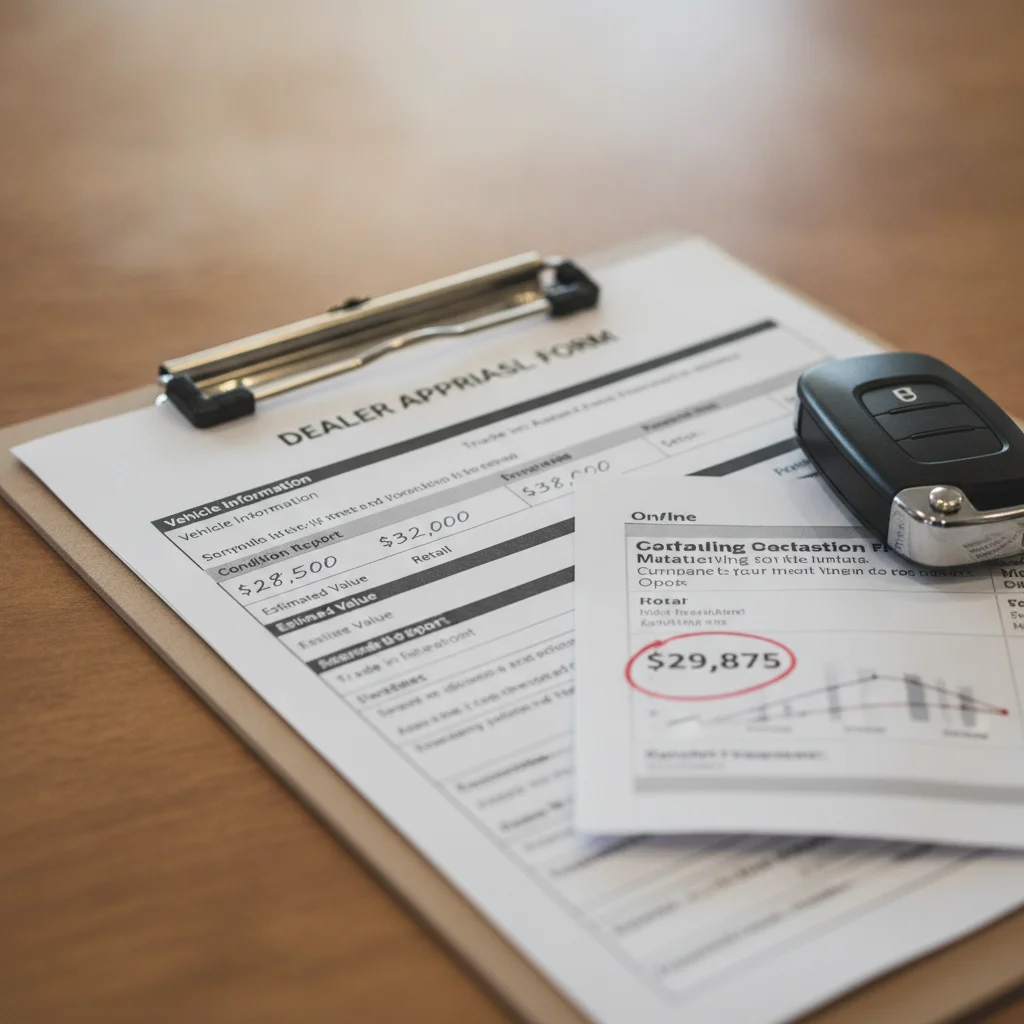
Winning a trade-in negotiation after a lowball final offer requires preparation you should have done before you ever handed over your keys for appraisal. If you skipped that work, you can still recover — but it'll take longer. Either way, here's what you need in hand.
What you will need
Kelley Blue Book (KBB)
Provides a trade-in value range for your vehicle based on condition, mileage, and local market data — use the range, not just the midpoint.
Edmunds True Market Value
Cross-reference tool that provides a second independent trade-in estimate, useful for showing the dealer a consensus range rather than a single source.
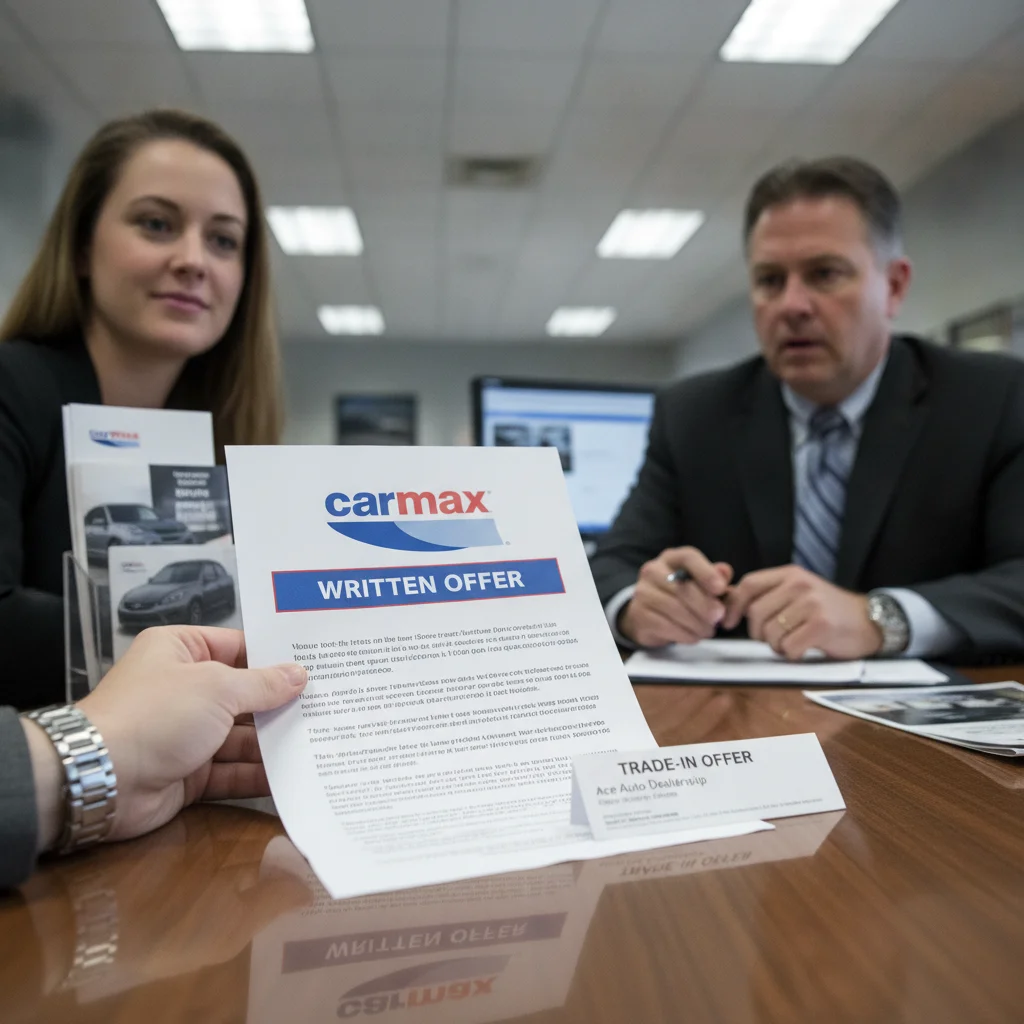
CarMax Written Offer
A binding, no-obligation purchase offer valid for 7 days that serves as hard competitive leverage in any dealer trade-in conversation.
Carvana or Vroom Instant Offer
A second online buyer quote that establishes a range of competing offers, reinforcing that your valuation has market support.
Vehicle Service Records
Documentation of maintenance history that supports a higher condition rating and counters dealer reconditioning cost inflation.
Notepad and Pen
Write down every number the dealer quotes — trade-in offer, reconditioning line items, new car price — to prevent backtracking and keep the negotiation concrete.
NADA Guides
An additional valuation reference often used by dealers themselves, giving you insight into the numbers they're working from internally.
If you haven't already collected competing written offers, do it before your next dealer visit. Services like CarMax, Carvana, and Vroom all provide binding written quotes — typically valid for 7 days — that translate directly into negotiating leverage. Our guide on using competing offers to negotiate a better trade-in walks through the exact process for getting and deploying those quotes strategically.
Step-by-Step: Reopening the Trade-In After a Final Offer
Follow these steps in order. Each one is designed to escalate your leverage without burning the relationship — because you may still want to buy the new car from this dealer.
Acknowledge the offer without accepting or rejecting it
When the dealer delivers their "final" number, don't react emotionally or immediately counter. Say something like: "I appreciate you getting that together. I'd like to take a few minutes to compare it against what I have here before we move forward."
This does two things: it signals you have reference data, and it keeps the conversation open without conceding anything. Dealers are watching your reaction — a flinch or a sigh tells them you weren't prepared.
Present your independent valuations side by side
Pull out your printed or on-screen evidence — Kelley Blue Book trade-in range, Edmunds True Market Value, and any third-party written appraisals you collected in advance. Lay them alongside the dealer's offer so the gap is visible.
Say: "I have three independent valuations here. They put my car's trade-in value in the $[X]–$[Y] range. Your offer is $[Z]. Can you walk me through what's driving that difference?"
You're not attacking — you're requesting justification. That's a reasonable ask, and it shifts the burden of proof to them.
Ask for an itemized reconditioning breakdown
Dealers subtract reconditioning costs from trade-in value. Those costs are real — detail, mechanical inspection, minor repairs, photos, listing fees — but they're also often inflated. Ask directly: "Can you show me the reconditioning estimate your used car manager used to arrive at this number?"
Most dealers won't have a printed breakdown. If they do, review each line. Common inflated items include:
- Paint correction listed at shop retail instead of their in-house cost
- Tire replacement for tires that still have 30–40% tread
- Vague "detail and prep" fees of $300–$600
Pushing back on even one or two line items can recover $300–$800 in offer price.
Present your best competing written offer
This is your highest-leverage move. A written offer from CarMax, Carvana, or another dealer is a binding alternative — and it forces the dealer to compete with a real number, not a hypothetical.
Hand it over and say: "I have a written offer here for $[amount], valid through [date]. I'd rather trade in with you today and apply it toward this purchase — can you match or beat it?"
Most dealers will either match it, come within $200–$300, or ask for a short recess to re-appraise. Any of those responses means their "final offer" wasn't final.
Separate the trade-in from the new car deal
If the dealer starts offering to adjust monthly payments or change the new car price to "make up for" the trade-in, stop them. Say: "I'd like to nail down the trade-in value as a standalone number first, then we can talk about the new vehicle separately."
This prevents the four-square shuffle — where the dealer gives you a little on the trade and takes it back on the purchase price, leaving you thinking you won when the total deal is the same or worse.
Make a specific counter and anchor it to evidence
Don't say "I want more." Name a number. Pick a counter that's grounded in your data — roughly the midpoint between the dealer's offer and your highest independent appraisal or competing offer.
Example: "Based on the KBB trade-in range and the CarMax offer I have in hand, I'm looking for $[X]. That's reasonable given the condition and what the market is showing. Can you get there?"
A specific, evidence-backed counter is much harder to dismiss than a vague "I was hoping for more."
Be prepared to walk — and say so calmly
If the dealer won't close the gap, say clearly: "I appreciate your time. If this is truly the best you can do, I'll take the CarMax offer and apply that cash toward the purchase. I'd still like to buy the car from you — we'd just need to handle the trade separately."
Then stand up slowly and start gathering your paperwork. Don't storm off — stay calm and deliberate. A significant number of dealers will produce a revised offer before you reach the door. If they don't, you've lost nothing and gained the freedom to sell your car to the highest bidder.
Once you've worked through these steps, you'll have either secured a materially better offer or you'll have the clarity to walk and sell your car through a better channel. Either outcome is a win. For a complete checklist of everything to verify before you finalize any deal, run through the trade-in negotiation checklist.
Reading the Dealer's Position: How Much Room Is Really Left?
Not every "final offer" has the same amount of room behind it. Knowing how to read the situation helps you decide whether to push harder or cut your losses.
Signs the dealer still has significant room:
- Your competing offers are 10%+ higher than their appraisal — that gap is hard to justify on reconditioning alone.
- Your car is a fast-moving segment (trucks, SUVs, low-mileage certified pre-owned candidates) — dealers need inventory and the carrying cost argument falls apart.
- They appraised in under 10 minutes — a quick appraisal is almost always a low-ball anchor, not a careful assessment.
- No detailed reconditioning breakdown was offered — if they can't itemize why your car is worth less, they're guessing.
Signs the offer may genuinely be near the floor:
- Your car has structural damage, major mechanical issues, or very high mileage that third-party tools also reflect.
- Multiple independent appraisals (CarMax, Carvana, auction tools) land within $300–$400 of each other and close to the dealer offer.
- The dealer walks you through an itemized reconditioning estimate that accounts for the gap.
Don't Mistake a Confident Tone for an Accurate Number
Dealers are trained to deliver low appraisals with complete certainty — as if market data, condition, and auction trends all point to exactly the number on that slip. They don't. A confident delivery is a sales technique, not evidence. Always verify the offer against your independent research before reacting to it.
Understanding the dealer's cost structure is part of the broader strategy covered in The Trade-In Playbook, which covers every phase from initial valuation research to walking out with a fair offer.
When the Trade-In Is Tied to a New Car Purchase
If you're trading in while simultaneously buying a new vehicle from the same dealer, the negotiation gets more complex — but it doesn't get harder, it just requires discipline.
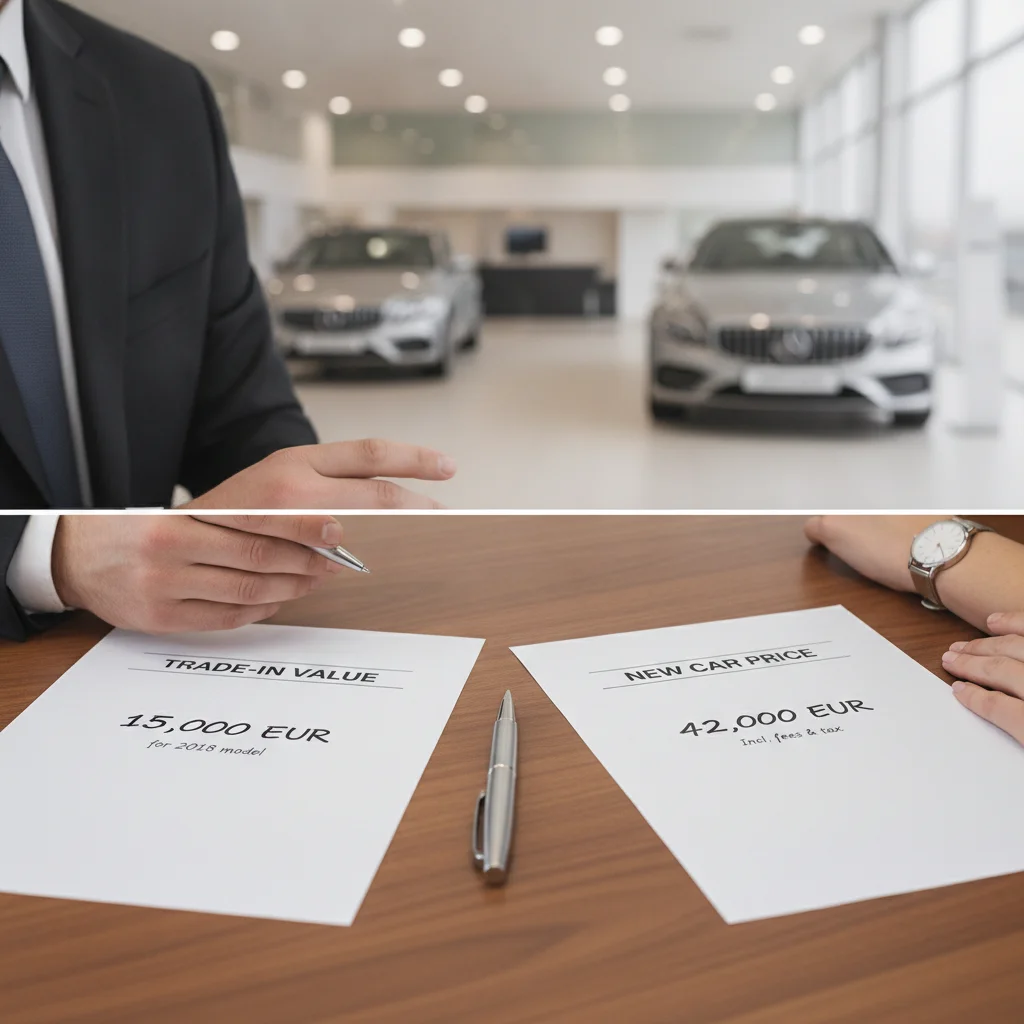
The most important rule: negotiate the new car price and the trade-in value as two separate transactions. Dealers love to blur them together using monthly payments or a single "net difference" number. That's the four-square method at work — it obscures what you're actually getting for your trade and what you're actually paying for the new car.
Never Negotiate Both Numbers at Once
The single most expensive mistake you can make is allowing the dealer to blend your trade-in value and the new car price into one monthly payment figure. When numbers are combined, you lose visibility into what you're actually getting for your trade. Always negotiate them as separate, independent transactions. Insist on a written breakdown that shows both figures explicitly before you sign anything.
Here's what that discipline looks like in practice:
- Get the out-the-door price on the new vehicle agreed upon first, in writing, before you introduce your trade-in.
- Then present your trade-in as a separate line item with your competing written offers as backing.
- If the dealer tries to "make up" for a low trade offer by adjusting the new car price, call it out explicitly: "I'd like to see both numbers individually, not blended."
For a detailed walkthrough of this sequencing, see Negotiating Trade-In Value on a New Car Purchase.
Time Your Visit Strategically
Dealers are more motivated to move inventory — and more flexible on trade-in values — at the end of the month when they're chasing volume targets. Visiting on the last two or three days of the month, particularly on a slow weekday afternoon, puts time pressure on them rather than on you.
A Clean Car Is Worth Real Money
A professional detail costing $150–$250 can legitimately change a dealer's condition assessment from 'fair' to 'good' or 'very good,' which can shift the trade-in range by $300–$800 on many vehicles. Minor repairs — a cracked windshield, a dead battery, scuffed trim — are often worth fixing before appraisal if the repair cost is less than half of what the dealer would deduct.
Your Fallback Options If the Dealer Won't Move
Sometimes a dealer genuinely can't — or won't — improve their offer. That's useful information, not a defeat. Here's what to do with it.
Option 1: Sell to a direct buyer (CarMax, Carvana, Vroom)
If their written offers exceed what the dealer will pay, take one. You'll close the same day at CarMax or within a few days with an online buyer. Use the cash as a down payment on the new vehicle — many dealers will accept it without issue.
Option 2: Private party sale
Private party prices run 10–20% above trade-in values in most markets. The tradeoff is time (typically 2–6 weeks), effort, and the loss of the sales tax offset you get in most states when you trade in. Run the math: if your state offers a trade-in tax credit on the purchase price difference, a private sale may net less after taxes than it appears.
Option 3: Try a different dealer
The same make and model may be worth more to a dealer who currently has low inventory of your vehicle type or who operates a robust used car department. Franchise dealers for your car's brand will often pay more than off-brand dealers because they can certify the vehicle and sell it at a premium.
Option 4: Hold the car longer
If none of these options meet your needs right now, waiting for seasonal demand shifts (trucks in spring, convertibles in late summer) can change your trade-in value by several hundred to a few thousand dollars.

Whatever you decide, you're operating from a position of real information now — not guesswork. That's what separates sellers who get fair deals from those who don't. For everything from initial research to closing, the Trade-In Strategies hub and the Dealer Negotiation hub have the full context you need.

All claims are backed by peer-reviewed research. Sources on request.