Key Takeaways
Summary
24 items · 30–60 minutes
Why Most Buyers Lose Money on Their Trade-In
I spent years on the finance side of a dealership. I watched buyers walk in thrilled about a new car and walk out having handed us $2,000 to $4,000 they didn't need to. It wasn't because they were uninformed — it was because they didn't run a disciplined process. They let the deal flow on the dealer's terms, in the dealer's sequence, with the dealer's numbers.
The trade-in is one of the highest-margin opportunities a dealer has on any single transaction. The average spread between what a dealer pays you and what they resell your car for is significant — and every dollar they save on your trade-in goes straight to their gross profit. That's not cynical, it's just the business model. Your job is to know it going in.
This checklist is designed to run you through every stage of a trade-in negotiation — from research you should complete at home to contract verification at the closing table. Think of it as a pre-flight checklist: skip a step and you may still land safely, but you're flying with avoidable risk.
Before you start, make sure you're solid on the vocabulary. Terms like ACV, reconditioning cost, and equity gap will come up, and if you're unsure on any of them, the Trade-In Terminology glossary gives you a fast-reference breakdown before you walk in.

What You'll Need Before You Start
Running this checklist effectively requires a few tools and pieces of information. Gather everything below before you begin — having these in hand means you'll never be caught flat-footed when the dealer asks a question or presents a number.
Kelley Blue Book (KBB.com)
Generate a baseline trade-in value range segmented by condition, which gives you a credible number to anchor your opening counter.
Edmunds True Market Value
Cross-reference your KBB figure against Edmunds' independently calculated trade-in estimate to validate or challenge the dealer's appraisal.
CarMax or Carvana Instant Offer
Obtain a written, time-limited cash offer that serves as hard leverage — a competing bid the dealer must beat or match to earn your business.
Lender Payoff Statement
Document your exact 10-day payoff balance directly from your lienholder so you can verify the dealer's contract figures are accurate.
Vehicle History Report (Carfax or AutoCheck)
Pull your own report in advance so you know every accident, title issue, or service gap the dealer will use to justify a lower appraisal.
Negotiation Worksheet or Spreadsheet
Track every number in writing — trade offer, new car price, payoff, net equity — so you can spot discrepancies when the finance office produces the contract.
Local Competitor Dealer Quotes
Collect trade appraisals from two or three competing dealers beforehand to create an auction dynamic and prevent any single dealer from lowballing without consequence.
Once you have these tools ready, move through the checklist groups in order. The sequence matters: research first, negotiation second, paperwork last.
The Complete Trade-In Negotiation Checklist
Work through each group before and during your dealership visit. Check off items as you complete them. If you skip any must items, expect to pay for it — either in a lower trade-in offer, a padded new car price, or both.
Pre-Visit Valuation Research
Loan Payoff and Equity Verification
Vehicle Preparation
At the Dealership: Controlling the Sequence
Evaluating and Responding to the Offer
Contract and Documentation Verification
Never Reveal Your Payoff Balance First
Once a dealer knows you owe more than your car is worth, they can structure the deal to absorb your negative equity in ways that inflate your new loan without changing your monthly payment visibly. Get a trade-in offer on its own merits before the payoff enters the conversation. Then disclose the payoff only when the trade-in value is already agreed upon in writing.
Monthly Payment Focus Is a Negotiation Trap
When a salesperson steers the conversation to "what payment works for you," they're moving you away from the numbers that actually matter — price, trade value, and interest rate. A dealer can make almost any payment work by stretching the loan term. Always negotiate total price and trade value, then calculate what the payment should be yourself.
Verbal Agreements Mean Nothing at Signing
If a manager promises you a specific trade-in value verbally, it doesn't exist until it appears on a signed written offer or purchase order. Get every agreed number in writing before you hand over your keys for the appraisal drive. Verbal commitments have a way of changing by the time the paperwork is ready.
For a deeper dive into the strategic sequencing — specifically how to keep the trade-in conversation clean when you're simultaneously buying a new vehicle — see the step-by-step approach to negotiating trade-in value on a new car purchase.
The Bundling Trap and How to Avoid It
The single most effective manipulation a dealership runs on trade-in buyers is bundling. A salesperson or finance manager combines the trade-in value, the new car price, your financing rate, and any add-ons into a single monthly payment conversation. This is intentional. Once everything is folded into one number, it becomes nearly impossible for you to tell where you're winning and where you're getting crushed.

The fix is simple but requires discipline: negotiate each variable in isolation, in writing, before moving to the next. Get the new car price agreed upon first. Get the trade-in value agreed upon second. Then — and only then — let them put together a payment. If a salesperson tries to jump ahead, say: "I appreciate it, but let's nail down the trade value before we talk payments." Then stop talking and wait.
The Bundling Tactic Costs Buyers Thousands
Dealers who insist on presenting your trade-in, new car price, and financing as a single blended monthly payment are using a proven technique to obscure where your money is going. Insist on a line-by-line breakdown of every variable before agreeing to any payment. If they refuse to show you the numbers separately, treat that refusal as a warning sign and be prepared to walk.
Walking Away Is Always a Valid Move
No deal at any single dealership is irreplaceable. The most expensive mistake a buyer can make is believing they must close the deal today. Dealers are trained to manufacture urgency — inventory claims, expiring incentives, other interested buyers. If the numbers don't work, the most valuable thing you can do is leave. Your written competing offers remain valid, your research stays current, and the next store will know you're serious.
If a dealer tells you they can only give you a trade value once they know what you're buying, walk away from that desk and try a different sales rep or a different store. That framing exists to protect their margin, not to help you get a fair deal.
For a comprehensive look at every phase of the dealer trade-in process — from appraisal room tactics to final offer negotiation — the Trade-In Playbook gives you the full picture. And if you're heading into the dealership for the first time, the dealership preparation checklist is worth running through first.
Reading the Contract: Where Trade-In Deals Fall Apart
You negotiated hard. You walked out of the appraisal with a number you're happy with. Now the finance manager hands you a stack of papers to sign. This is not the time to relax — it's the time to pay the closest attention you will all day.
Dealers occasionally make "errors" on the purchase order that reduce the agreed trade-in value by a few hundred dollars, roll in fees you didn't approve, or adjust the payoff amount in ways that shift equity in their favor. These aren't always accidental. The Trade-In Documentation guide walks through exactly which lines to check and what manipulation can look like in contract language.
Key numbers to verify on the purchase order before signing:
- Trade-in allowance — matches the written offer you agreed to
- Payoff amount — matches the figure your lender provided, not the dealer's estimate
- Net trade equity — the difference between those two numbers, correctly calculated
- New vehicle selling price — unchanged from what you agreed before the trade-in was introduced
- Documentation fee — disclosed and within your state's legal limits
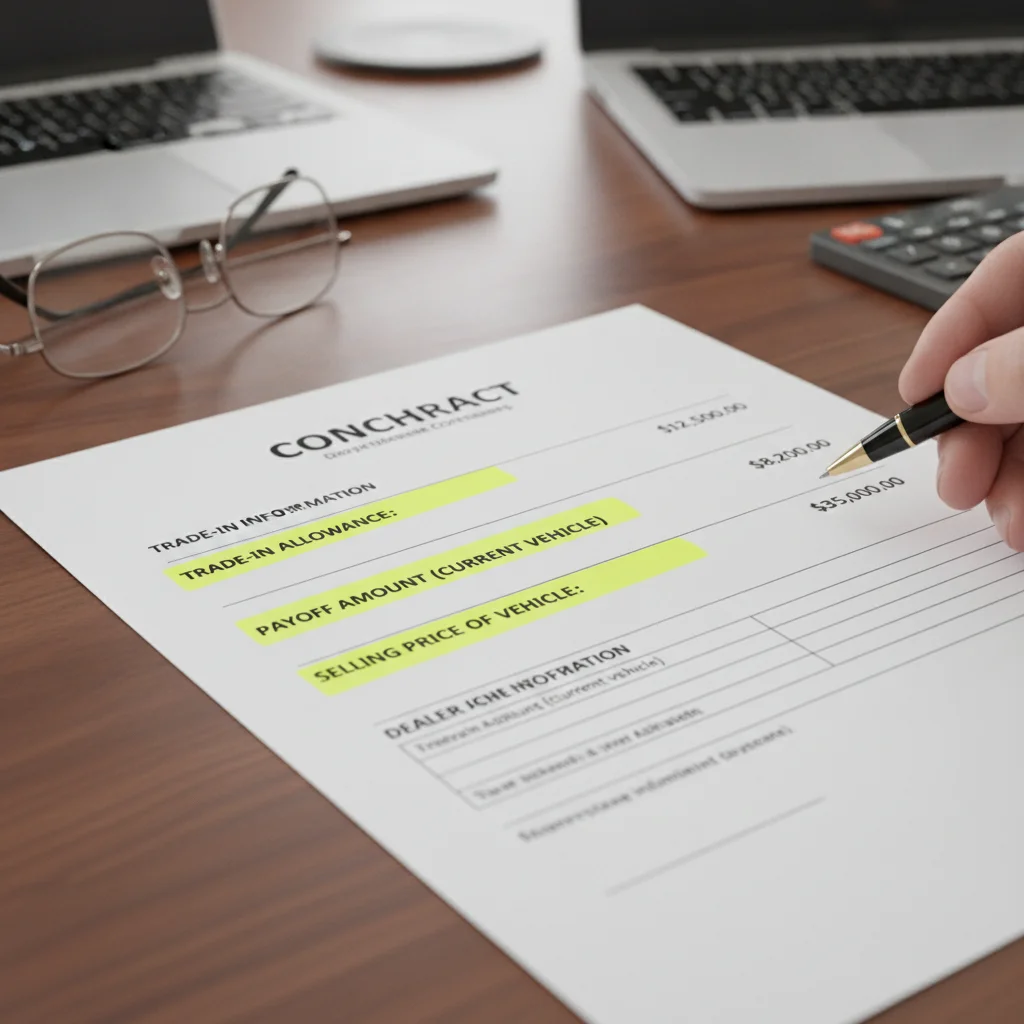
If any number is off, stop signing. Ask for a corrected worksheet before you proceed. A legitimate dealership will make the correction without drama. If they push back or tell you it "doesn't change your payment," that's a signal — not a reason to continue.
For scenarios where a dealer claims the trade offer is final and won't budge, there are still moves available to you. The guide to negotiating after a dealer says the price is final covers tactics that keep the conversation alive.
When to Walk Away — and What to Do Next
Sometimes the right answer is to leave. If the dealer's best trade offer is more than 10–15% below your lowest independent valuation, and they won't budge after you've presented competing written offers, the economics don't work in your favor at that store.
Before walking, consider one alternative: selling your vehicle privately or through a direct-buy service first, then shopping for your new car as a straight purchase. You'll almost always net more money on the vehicle, and you'll negotiate the new car price without the trade-in complexity muddying the water. The Dealer Trade-Ins hub and the Dealer Negotiation hub both have resources that cover this path in more detail.
If you do walk, do it cleanly. Thank them, take any written offer they gave you, and leave. That offer may become useful leverage at the next dealership. And if you later decide to sell privately, the private transaction closing checklist will walk you through the paperwork and handover steps.
The Bundling Tactic Costs Buyers Thousands
Dealers who insist on presenting your trade-in, new car price, and financing as a single blended monthly payment are using a proven technique to obscure where your money is going. Insist on a line-by-line breakdown of every variable before agreeing to any payment. If they refuse to show you the numbers separately, treat that refusal as a warning sign and be prepared to walk.
Walking Away Is Always a Valid Move
No deal at any single dealership is irreplaceable. The most expensive mistake a buyer can make is believing they must close the deal today. Dealers are trained to manufacture urgency — inventory claims, expiring incentives, other interested buyers. If the numbers don't work, the most valuable thing you can do is leave. Your written competing offers remain valid, your research stays current, and the next store will know you're serious.
The goal of this checklist isn't to make you adversarial — it's to make you informed. Dealers are running a business, and a well-prepared buyer who knows their numbers and holds their ground will almost always walk out with a better deal than someone who wings it. Run the checklist, trust the process, and don't let urgency — real or manufactured — push you past a step.

All claims are backed by peer-reviewed research. Sources on request.