

Key Takeaways
Why Trade-In Negotiations Are Designed to Favor the Dealer
Trade-in appraisals are not a neutral process. The dealership's used car manager is trained to buy your vehicle at the lowest defensible price, and the entire structure of a car deal — from the worksheet you're handed to the sequence of questions a salesperson asks — is engineered to reduce what you walk away with. Understanding that structure is the first step to working around it.
The average consumer trades in a vehicle every three to five years. The average used car manager does this dozens of times a week. That experience gap is enormous, and dealers know it. They rely on it. What looks like a straightforward appraisal is actually a multi-variable negotiation where you're the only party who doesn't know all the variables in play.
This article is not about blaming dealers for running a business — it's about giving you the same situational awareness they have at the table. Start by reading how dealers calculate your trade-in offer before you set foot in a showroom. Then come back here to recognize the specific tactics that shrink what you net.

Each mistake below is something I watched play out repeatedly during my time in dealership finance. They are not theories — they are the daily mechanics of how dealers protect their margin on used vehicle acquisitions.
The Mistakes That Cost Buyers the Most
Most trade-in losses don't happen because buyers are uninformed in a general sense. They happen because of specific, repeatable errors that dealers are trained to create the conditions for. Here are the ones that do the most financial damage.
Negotiating the trade-in and new car purchase as a single bundled deal.
Why it happens: Dealers actively encourage this by presenting the four-square worksheet early and steering the conversation toward monthly payments. Buyers focus on the payment number and lose sight of the individual components.
Accepting the first trade-in appraisal without a competing offer in hand.
Why it happens: Most buyers don't realize that dealers expect to negotiate and that the first number is a deliberate anchor point, not a market-rate assessment. Without an external benchmark, buyers have no basis for a counter.
Disclosing your trade-in too early in the conversation.
Why it happens: Salespeople are trained to ask about a trade early — usually within the first few minutes of greeting a buyer — because it gives them more variables to work with when structuring the deal. Buyers share this information freely because it feels like a natural part of the conversation.
Taking dealer reconditioning deductions at face value without questioning the estimates.
Why it happens: Reconditioning estimates are presented as objective cost assessments, but buyers rarely see itemized breakdowns and have no independent benchmark to compare against. The dealer controls the information entirely.
Letting negative equity get rolled into a new loan without fully understanding the impact.
Why it happens: Dealers present negative equity as a minor administrative step — 'we'll just add the difference to the new loan' — and buyers focused on the excitement of a new car don't pause to calculate how much extra interest they'll pay over the life of the loan.
Failing to research your vehicle's real market value before the appraisal.
Why it happens: Buyers trust that the dealer's appraisal reflects current market pricing. In reality, the appraiser is working from a wholesale floor, not retail market value, and is trained to land as far below retail as the buyer will accept.
Focusing on monthly payment instead of total transaction value when evaluating a trade-in outcome.
Why it happens: Monthly payment is the number most buyers relate to their budget, and dealers know this. By keeping the payment conversation front and center, they can obscure whether the trade-in value, new car price, or loan term are actually favorable.
$1,700+
Average gap between trade-in and private-party value
Edmunds data consistently shows dealers offer roughly $1,700 to $2,500 less than private-party value for the same vehicle in similar condition.
31%
Share of trade-ins with negative equity
According to Edmunds, approximately one-third of trade-in vehicles carry negative equity, with the average underwater amount exceeding $6,000.
3–5x
Dealer vs. buyer appraisal experience ratio
A typical franchise dealer's used car manager appraises dozens of vehicles per week versus the average consumer's once every several years.
$500–$2,000
Recoverable value by challenging reconditioning deductions
Industry estimates suggest buyers who present independent repair quotes can recover between $500 and $2,000 in inflated reconditioning deductions.
None of these mistakes are inevitable. Each one has a direct counter — but only if you know it's coming. The trade-in playbook lays out the full sequence for handling each phase of the negotiation.
The Four-Square: How Dealers Bury Your Trade-In Losses
The four-square worksheet is the most widely used deal-structuring tool in franchise dealerships. It divides a car deal into four boxes: selling price, trade-in value, monthly payment, and down payment. In theory, it creates transparency. In practice, it creates confusion — deliberately.
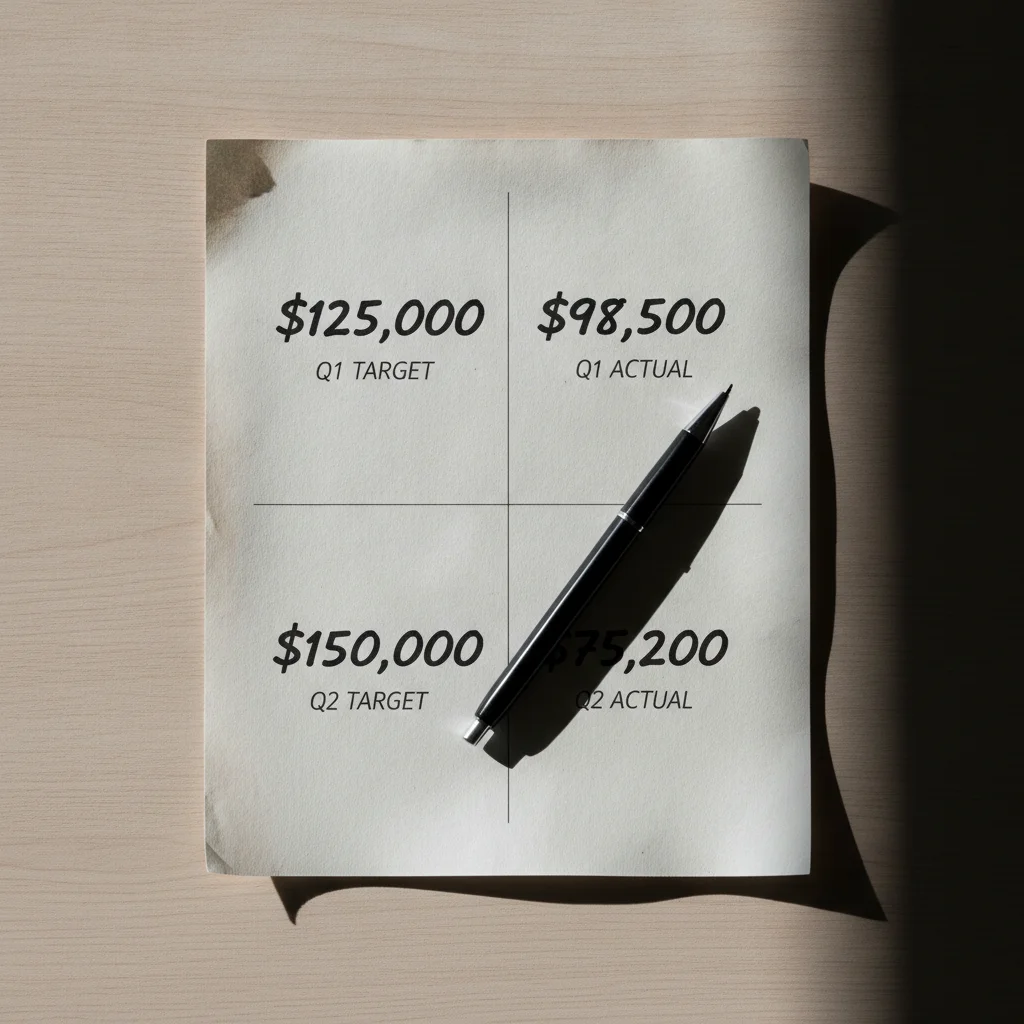
Here is how it works against you: the salesperson can adjust numbers across all four boxes simultaneously. If you push hard on your trade-in value and get an extra $1,500, they can quietly add $1,500 back into the selling price of the new car or stretch the loan term to keep the monthly payment unchanged. You feel like you won on the trade, but the dealer's total gross profit is identical — or higher.
Never Agree to a Bundled Deal in Writing
Once you sign a worksheet that combines trade-in value, new car price, financing, and down payment into a single monthly payment structure, unwinding any one variable becomes extremely difficult. Dealers count on this. Refuse to sign anything until each component is itemized separately and you've verified the trade-in credit as a standalone line. If the salesperson says that's not how they do it, walk to a dealer who will.
Negative Equity Is Debt, Not a Deal Feature
When a dealer offers to 'roll in' your negative equity, what they mean is that you'll borrow more money than the new car is worth — and pay interest on that deficit for the life of the loan. On a $30,000 loan with $6,000 in rolled-in negative equity over 72 months at 7%, that underwater amount alone adds more than $1,300 in interest charges. This is a structural risk that deserves a hard pause before you proceed.
The antidote is to refuse to discuss all four variables at once. Tell the salesperson you want to finalize the trade-in value as a standalone number before discussing new car pricing, financing, or down payment. This is not an unreasonable request, and any pushback you receive is itself a signal. See the deeper breakdown in how dealers track all four deal variables.
Once you have a written trade-in offer in hand, treat it as a separate transaction. The goal is to know exactly what your car is worth to the dealer before you ever engage on the purchase side. That's when your leverage is highest.
Reconditioning Estimates: The Deduction You're Not Supposed to Question
After a used car manager appraises your vehicle, they run an internal reconditioning estimate — every scratch, worn tire, check engine light, and ding translates into a dollar amount subtracted from your offer. This is legitimate math. Dealers do incur real costs preparing vehicles for their lots. But the estimates are almost always inflated, and you are almost never shown the itemized breakdown.
Never Accept an Appraisal Without an Itemized Deduction Sheet
If a dealer won't show you exactly what they deducted and why, you have no basis for negotiation. Always ask for the reconditioning breakdown in writing. A dealer who refuses to provide it is signaling that the deductions won't hold up to scrutiny — which is exactly why you need to see them.
Watch for the Payment Pivot
When a dealer shifts the conversation from trade-in value to monthly payment, it's rarely in your favor. Monthly payment math can obscure an unfavorable trade-in, a marked-up interest rate, or an extended loan term — sometimes all three at once. Bring the conversation back to the trade-in as a standalone dollar amount before agreeing to anything.
Time-Limited Offers Are a Pressure Tactic
If a dealer tells you a trade-in offer expires today or is only good for this visit, treat it with skepticism. Direct-buy platform offers typically last 7 days, and the market doesn't change overnight. Artificial urgency is a negotiating tool designed to prevent you from getting competing bids — exactly what you should be doing.
A dealer might deduct $2,800 for a set of tires that would cost you $600 at a discount retailer. They might flag a minor paint scuff as a $900 paint correction when a detail shop would charge $150. These inflated estimates are not random — they're a margin-building tool.
The counter is straightforward: get an independent repair quote for anything the dealer flags before you go in. If your check engine light is on, spend $40 at an auto parts store or $100 at an independent shop to diagnose and potentially fix it. Understanding what reconditioning actually costs dealers gives you a realistic benchmark to push back against inflated deductions.

You don't need to repair everything before trading in. But you should know the real cost of every flagged item so you can dispute deductions that don't hold up. That knowledge alone can recover $500 to $2,000 in situations where the dealer has padded the estimate.
Competing Offers and Negative Equity: Your Two Most Important Weapons and Risks
The single most effective move in a trade-in negotiation is walking in with a written competing offer. Direct-buy platforms — CarMax, Carvana, CarGurus Instant Max Cash Offer — will give you a real, binding number that the dealership must beat or match. This transforms the conversation from a subjective appraisal into a competitive bid situation.
Dealers know these offers exist and they price accordingly when buyers present them. Without a competing offer, the dealer anchors the conversation. With one, you anchor it. The first number a dealer gives you is rarely their best — but with a competing offer in your hand, the negotiation starts at a much higher floor.

Negative equity is the risk side of this equation. If you owe more on your current vehicle than it's worth, that difference doesn't disappear when you trade in — it gets rolled into your new loan. Dealers sometimes present this as a seamless transition, folding the shortfall into a longer loan term or masking it inside a seemingly small monthly payment increase. The result is that you're paying interest on old debt for the life of the new loan.
Never Agree to a Bundled Deal in Writing
Once you sign a worksheet that combines trade-in value, new car price, financing, and down payment into a single monthly payment structure, unwinding any one variable becomes extremely difficult. Dealers count on this. Refuse to sign anything until each component is itemized separately and you've verified the trade-in credit as a standalone line. If the salesperson says that's not how they do it, walk to a dealer who will.
Negative Equity Is Debt, Not a Deal Feature
When a dealer offers to 'roll in' your negative equity, what they mean is that you'll borrow more money than the new car is worth — and pay interest on that deficit for the life of the loan. On a $30,000 loan with $6,000 in rolled-in negative equity over 72 months at 7%, that underwater amount alone adds more than $1,300 in interest charges. This is a structural risk that deserves a hard pause before you proceed.
Before you trade in any vehicle where you suspect negative equity, get an independent payoff quote from your lender and compare it to your competing trade-in offers. Know the exact gap. Then decide whether trading now makes financial sense or whether holding the vehicle longer — until equity flips — is the smarter move.
For buyers navigating these decisions across multiple deal variables, using competing dealer quotes as a negotiation tool covers how to deploy this leverage systematically without tipping your hand too early. And if you want to understand the right sequence for keeping your trade-in separate from the new car purchase, separating the trade-in from the new car deal walks through exactly how to do it.
What to Do Before You Walk Into the Dealership
Preparation is where trade-in money is actually made or lost. By the time you're sitting across from a salesperson, most of your negotiating leverage is already set. Here's what to do in the days before you go in:
- Pull values from multiple sources. Run your vehicle through Kelley Blue Book, Edmunds True Market Value, and at least one direct-buy platform. The spread across those numbers tells you a lot about your car's position in the current market.
- Get a written competing offer. Visit a CarMax or submit through Carvana or CarGurus. A written, time-stamped offer is a concrete negotiating asset — not just a number you mention in conversation.
- Know your payoff amount. Call your lender and get an exact 10-day payoff quote. This is the number you'll use to calculate whether you have equity or negative equity going in.
- Document your vehicle's condition honestly. Walk around the car and photograph every scratch, ding, and interior issue. When a dealer inflates a deduction, you can reference the actual condition and counter with an independent repair estimate.
- Decide your walk-away number in advance. Set a minimum trade-in value you'll accept before emotions enter the room. If the dealer won't meet it, you have the competing offer as an alternative exit.
Going in prepared doesn't just protect your money — it changes how the dealer treats the conversation. When a buyer demonstrates knowledge of their vehicle's market value and has competing bids in hand, the low-ball first offer rarely appears. Dealers read the room quickly, and an informed buyer signals that the usual tactics won't land.
For a comprehensive view of how dealer trade-in appraisals work and what to expect at every stage, including how to spot when an offer doesn't reflect your car's true market position, see our full hub on dealer trade-ins. And if you want to know the specific red flags that indicate a dealer is undervaluing your trade-in in real time, these signs are worth reviewing before your appointment.
The goal isn't to make the dealer your adversary — it's to make sure both sides of the table are working from the same set of facts. When you show up informed, you change the negotiation by default.

All claims are backed by peer-reviewed research. Sources on request.