
Key Takeaways
Why Most Sellers Leave Money on the Table
The average dealer trade-in offer runs 10–15% below what the same car would fetch on the private market or through a direct-buying platform. That gap isn't accidental — it's baked into the dealership's business model. The used car manager appraises your vehicle knowing most sellers are either in a hurry, don't know its real market value, or are too emotionally invested in the new car they're about to buy to walk away over a few hundred dollars.
Competing offers change that math completely. When you place a written, time-stamped bid from CarMax, Carvana, or a competing dealer on the table, the conversation shifts from "what will this seller accept?" to "what do we need to pay to keep this transaction in house?" That's a fundamentally different negotiation.
This guide walks through exactly how to build a stack of competing offers and deploy them at the right moment — not just to nudge a dealer's number up a little, but to capture every dollar of legitimate market value your car is worth. If you want a broader view of the entire dealer trade-in process, see the Trade-In Playbook for full context on each phase.
What You Need Before You Start
Before you collect a single quote, make sure you have the vehicle information and documentation needed to get accurate bids. Incomplete information leads to conditional offers that dealers can discount later.
What you will need
CarMax Instant Offer
Provides a printed, 7-day written offer you can physically hand a dealer — one of the most recognized and respected competing bids in the industry.
Carvana Instant Cash Offer
Generates a firm written offer online in minutes; printable and typically valid for 7 days, useful as a second independent data point.
KBB Instant Cash Offer
Kelly Blue Book's buying program connects you with local dealers offering cash; adds a third credible data point from a brand dealers recognize.
Edmunds or KBB Trade-In Value Tool
Free reference tool to establish realistic market value before collecting offers so you can evaluate whether incoming bids are reasonable.
Competing Dealer Appraisal
A written appraisal from a second or third dealership creates legitimate head-to-head competition — especially effective if one dealer is the brand you're buying from.
Smartphone camera or photo documentation
Photos of your vehicle's condition prevent disputes later if a buyer claims condition-based deductions that weren't agreed upfront.
How to Build Your Offer Stack
The goal is at least three independent written offers before you step into any dealership. Here's the logic: one offer is a data point, two is a comparison, three is a market. With three offers, you can show a dealer exactly where the floor is — and that floor is now the starting point for negotiation, not the ceiling.
Establish your baseline value from reference tools
Before you collect a single live offer, run your car through both Edmunds and Kelley Blue Book's trade-in estimator using honest condition ratings. Input the same condition for both. The two estimates will differ slightly — that range is your realistic expectation. Write down the midpoint. This number keeps you grounded when evaluating whether the real offers you collect are strong or weak.
Don't use the "excellent" condition rating unless your car genuinely has no mechanical issues, no accidents, under-average miles, and near-perfect cosmetics. Most vehicles rate "good" or "fair." Inflating condition now only leads to disappointment later.
Get a CarMax offer first
CarMax's written offer carries the most weight at dealerships because dealers know it's real and immediately redeemable. You can get an offer online or in person — in-person appraisals are more accurate and harder for a dealer to dispute. Bring the written offer document, not just a screenshot.
The process takes about 30–45 minutes in store. You don't have to sell to CarMax to use this offer — you're simply getting a documented bid that you can reference anywhere within its 7-day validity window.
Collect a second independent offer from Carvana or a similar platform
Complete Carvana's online offer process independently of CarMax. Having two offers from non-dealer, nationally recognized buyers establishes a credible floor. When both offers cluster around the same number, that's your market price — and that's what you tell the dealer.
Other platforms worth checking depending on your region: Vroom, AutoNation's online offer tool, or a local independent used car superstore that issues written appraisals.
Get a written appraisal from a competing dealership
Visit a dealership — ideally one selling the same brand as your current vehicle, since they're likely to want it for certified pre-owned inventory — and ask for a written trade-in appraisal. You don't need to be buying a car there. Tell them you're shopping your trade to find the best offer before you decide where to purchase your next vehicle.
This creates direct dealer-to-dealer competition. When you present this offer at your buying dealer, they know their competitor is in the picture. That dynamic is uniquely motivating.
Compile and organize your offers before the target dealership visit
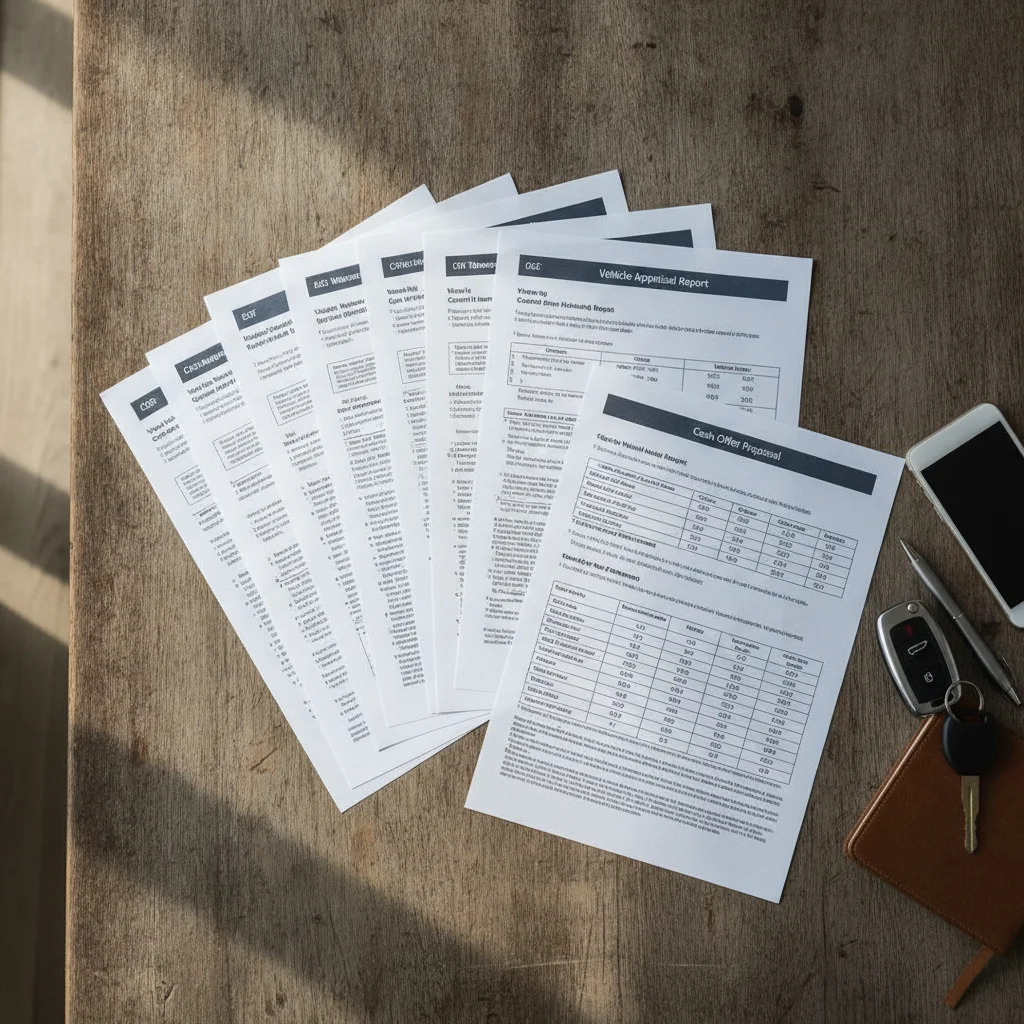
Print every offer. Organize them with the highest offer on top. Note the expiration date of each document in large, clear writing at the top of the page. You want the dealer to be able to see these are real, time-limited, competing bids at a glance — not printouts of online estimates.
Create a simple one-line summary: "Best current offer: $[X] from [Source], expires [Date]." Having this on a clean piece of paper alongside the source documents makes you look organized and serious, which itself changes the negotiating dynamic.
Time Your Collection for the Same Week
Try to get all your competing offers within a 3–5 day window so they're all still valid when you visit your target dealership. Staggered offers where one has already expired significantly weaken your position — the dealer knows you're working with stale data.
More Offers Isn't Always Better
Three to four strong, documented offers from recognized buyers is the sweet spot. Showing up with seven printouts from obscure platforms can actually dilute your credibility — stick to sources the dealer's used car manager will immediately recognize and respect.
Instant Offers Don't Survive Undisclosed Problems
Online offers from Carvana, CarMax, and similar platforms include a condition-verification step at pickup or in-person inspection. If your car has undisclosed mechanical issues, prior accidents not showing on Carfax, or misrepresented mileage, the offer will be revised — sometimes dramatically. Disclose everything accurately upfront so your offers hold at the point of trade.
Don't Mention Competing Offers During the Test Drive
Keep the competing offer conversation entirely separate from the early stages of the car-buying process. If you mention other offers while test-driving or before the dealer appraises your vehicle, you risk anchoring their number or triggering a defensive posture before the actual negotiation begins. Timing is everything.
Once you have your offers in hand, the next phase is deploying them correctly. How and when you present them is just as important as having them in the first place. For context on how separating negotiations protects you on the purchase side, read tactics dealers prefer you don't know.
Using Offers at the Dealership: Timing and Tactics
Arriving at the dealership with competing offers in your pocket is only half the battle. The other half is deploying them at exactly the right moment — too early and you hand the dealer a ceiling to reverse-engineer against; too late and you may have already agreed to terms that are harder to unwind.
Separate the trade-in from the purchase — completely
This is the single most important tactical rule. Dealers profit when negotiations are bundled because they can adjust one number to offset a concession in another. Tell the salesperson upfront: "I'd like to agree on the price of the vehicle I'm buying first, and then we'll handle the trade-in separately." Most will push back. Hold the line. If they won't separate the transactions, that's a signal — walk.
Need more detail on keeping these negotiations clean? The dealer negotiation hub covers the mechanics of controlling the conversation.
Let them appraise first — then pull out the offers
Allow the dealer's used car manager to inspect your vehicle and give you their number without any mention of outside offers. Once that number is on paper, then place your competing bids on the desk. This prevents them from reverse-engineering a slightly higher number that still beats your competitors while leaving money on the table. When their appraisal comes in lower than your best offer — and it usually will — the conversation becomes straightforward: "CarMax will give me $X in writing. What can you do?"
Use expiration dates as real leverage
Instant cash offers from platforms like CarMax and Carvana typically expire in 7 days. That expiration date is your friend. It signals to the dealer that you have a real, time-limited alternative and aren't bluffing. If the dealer knows your Carvana offer expires Thursday and it's Tuesday, they understand the decision window is real.
Never Bundle Trade-In and Purchase Price
Dealers are trained to blend these two negotiations into a single monthly payment conversation. Once blended, it's nearly impossible to know whether a concession on the trade is offset by a markup elsewhere. Insist on agreeing to the out-the-door purchase price first — in writing — before the trade-in number enters the conversation. If the salesperson refuses to separate the two, treat that as a red flag about how the rest of the deal will be handled.
Written Offers Are Non-Negotiable — Verbal Claims Are Not
If you can't produce it in print, the dealer has no reason to believe it. A verbal claim that "the other place offered me more" is ignored dozens of times a day in every dealership in the country. A printed, signed, dated offer from a competing buyer is a document with legal weight that demands a documented counter. Never walk into this conversation without paper.
Know your walk-away number before you walk in
Decide ahead of time: what's the minimum trade-in value that makes it worth trading here versus selling privately or to a direct buyer? If the dealer can't meet that number, your competing offer isn't just a negotiating chip — it's the transaction. Have a plan for that outcome. The trade-in strategies hub has useful frameworks for setting that floor number based on your situation.
When the Dealer Pushes Back
Expect resistance. Used car managers have heard every version of "I have a better offer somewhere else" — most of the time those claims are unverifiable. Written, printed, dated offers are different. Still, there are predictable pushback patterns and how you respond determines whether you win this round.
"Our appraisal accounts for reconditioning costs"
This is the most common deflection. The dealer will point to minor repairs, detail work, or certification costs to justify a lower number. Counter by acknowledging reconditioning is real — then ask them to itemize it. Most won't, because the actual reconditioning estimate is far lower than the gap between their offer and yours. If they do itemize it, you now have something concrete to negotiate against line by line.
"We can't match that offer on this vehicle"
Sometimes true, sometimes a test. Ask them to explain specifically why. If it's a genuine inventory reason (they're overstocked on your vehicle's segment), it may be worth redirecting your trade to the competing buyer. If it's vague, stay patient. A calm, matter-of-fact "I understand — let me think about whether the convenience of doing it here is worth the difference" often produces a revised number within minutes.
"What number would make you happy?"
Don't answer this question with a number. Flip it: "My best offer is $X — I'd like to do business here, so I'm giving you the chance to match it." Naming your target first concedes negotiating room you don't need to give up. Let the competing offer do the talking. For more on staying composed when a dealer claims finality, see what to do when the dealer says the price is final.

The role of the new car price in this conversation
If you've already locked in the purchase price of the car you're buying, the dealer has less room to manipulate. They can't "give" you on the trade and "take" on the new car if the new car price is already agreed and documented. This is why sequence matters. Nail the new car price first, then turn to the trade-in.
After the Deal: Confirming and Closing
Once the dealer meets or exceeds your best competing offer, the work isn't done. How the trade-in value gets applied to the deal matters — and there are a few common ways dealers soften a strong trade-in number at the back end of the transaction.
Verify how the trade-in value is applied
The agreed trade-in amount should reduce your out-of-pocket cost (or financed amount) dollar for dollar. Ask to see the deal sheet and confirm the trade-in allowance is listed as a direct offset against the vehicle price — not buried in a monthly payment calculation. If you're financing, run the numbers: trade-in value minus any payoff on your current loan equals net trade equity. That equity figure should be clearly visible on the buyer's order.
Watch for trade-in value shuffled into incentives
Some dealers will apply manufacturer rebates or financing incentives to make the total look favorable while quietly lowballing the trade line. A $1,500 rebate doesn't make a $1,500 trade-in shortfall disappear — it just obscures it. Look at each line independently. If you've done your work right and the numbers hold up, you've done what most sellers never do: you turned the dealer's home-field advantage into a competitive auction, and you won it.
For guidance on handling situations where you have multiple interested parties simultaneously — relevant if you're weighing a private sale alongside dealer offers — managing multiple buyers simultaneously covers the logistics without burning relationships.


All claims are backed by peer-reviewed research. Sources on request.