
Key Takeaways
Pull live market listings for your car on your phone before the appraisal conversation starts. When a dealer cites "market conditions," you can respond with actual current retail prices from their own market.
Real-time data closes the information gap dealers depend on. Seeing a seller reference live listings on a phone signals preparation and tends to shift the appraisal conversation toward honesty.
Get your CarMax appraisal on a weekday morning — appraisers tend to be less rushed, which means a more thorough evaluation that may credit your vehicle's positive features rather than just flagging negatives.
Appraisal quality varies with appraiser time and attention. A rushed Friday-afternoon appraisal at a busy location is more likely to default to conservative numbers.
Don't reveal that you have a trade-in until after you've agreed on the new car's out-the-door price. Mention it by saying, 'By the way, I do have a car to trade — let's talk about that once we're aligned on this one.'
Premature disclosure of a trade-in gives the dealer an additional variable to manipulate during new car price negotiation, often absorbing your trade equity into their margin on the purchase.
Why Most People Lose Money on Trade-Ins
The average consumer walks into a dealership knowing roughly what they paid for their car years ago and almost nothing about what it's worth today. Dealers know this, and they count on it. The gap between what a dealer pays you and what they sell your car for — called the front-end gross on the used vehicle — is one of the most profitable line items in the dealership's business. In a competitive market, that spread can run anywhere from $1,500 to $4,000 on a typical used car. On a desirable late-model vehicle, it can go higher.
This isn't a moral failing on the dealer's part. They're running a business. But the equation only works against you if you show up unprepared. The good news: preparation is completely within your control, and it doesn't take more than two or three hours before your visit.
The trade-in negotiation process has a specific structure — appraisal, offer, counter, close — and each stage has predictable pressure points where value leaks out. This guide walks you through each phase with concrete tactics to plug those leaks.

The single most expensive mistake people make isn't accepting a low first offer — it's not knowing what a fair offer looks like in the first place. Everything in this playbook flows from that foundation: know your number before you know theirs.
Know Your Car's Real Market Value Before You Go
Your trade-in value research starts at home, not at the dealership. Pull valuations from at least three independent sources and triangulate:
- Kelley Blue Book (KBB.com): Use the "Trade-In Value" figure, not the private party value. KBB's trade-in range gives you a low-to-high window based on condition.
- Edmunds True Market Value (TMV): Edmunds often runs slightly differently from KBB and can reveal which is more favorable for your make and model.
- NADA Guides: Dealers frequently use NADA internally. Knowing the NADA trade-in figure tells you what their own reference point looks like.
- Live market comps: Search CarGurus, Cars.com, or AutoTrader for similar vehicles — same year, make, model, trim, mileage, and color — listed for sale in your ZIP code. What are dealers retailing those cars for? Subtract $1,500–$2,500 for reconditioning and their expected margin, and you have a rough floor for what a dealer should be willing to pay you at wholesale.
$1,500–$4,000
Typical dealer front-end gross on used trade-ins
Industry estimates based on average dealer reconditioning and resale margin on traded vehicles in the U.S.
7 Days
CarMax written offer validity window
CarMax's instant offer is valid for seven days and serves as a firm, portable benchmark for dealer trade-in negotiations.
3–4 Sources
Valuation sources buyers should consult before negotiating
KBB, Edmunds, NADA, and live market comps together give a reliable range for what a dealer should reasonably offer.
$500–$1,500
Dealer deduction for a check-engine light on trade-in
Dealerships routinely discount trade-ins with active warning lights, often well above the actual cost of diagnosis and repair.
$150–$400
Typical deduction for missing second set of keys
Key cutting and programming at retail rates is charged against your trade-in value when only one key is provided.
Be honest about condition. KBB has four condition tiers: Excellent, Very Good, Good, and Fair. Most cars that owners rate "Excellent" actually grade out as "Good" in a professional appraisal. Use "Good" as your baseline unless the car is genuinely under 30,000 miles with zero blemishes. This keeps your expectations realistic and prevents the appraiser from using condition as a negotiating wedge against you.
Pull live market listings for your car on your phone before the appraisal conversation starts. When a dealer cites "market conditions," you can respond with actual current retail prices from their own market.
Real-time data closes the information gap dealers depend on. Seeing a seller reference live listings on a phone signals preparation and tends to shift the appraisal conversation toward honesty.
Get your CarMax appraisal on a weekday morning — appraisers tend to be less rushed, which means a more thorough evaluation that may credit your vehicle's positive features rather than just flagging negatives.
Appraisal quality varies with appraiser time and attention. A rushed Friday-afternoon appraisal at a busy location is more likely to default to conservative numbers.
Don't reveal that you have a trade-in until after you've agreed on the new car's out-the-door price. Mention it by saying, 'By the way, I do have a car to trade — let's talk about that once we're aligned on this one.'
Premature disclosure of a trade-in gives the dealer an additional variable to manipulate during new car price negotiation, often absorbing your trade equity into their margin on the purchase.
Document everything: print your KBB and Edmunds ranges and bring them with you. A physical printout with today's date signals that you did your homework — and that you're not going to be swayed by vague claims about market softness or "what we can move right now."
Prep Your Vehicle to Maximize the Appraisal
A dealer's appraiser walks around your car for roughly five to ten minutes and mentally docks money for every visible flaw. Your job is to reduce the number of legitimate docking opportunities before that walk-around happens.
What's Worth Doing
- Thorough wash and interior detail: A $30 detail job at a coin-op car wash or a $150 professional interior detail can recover $200–$500 in perceived value. Appraisers are human. A clean car feels better-maintained, even if mechanically it's identical to a dirty one.
- Fix cheap cosmetic issues: Touch up rock chips on the hood and bumper with a color-matched touch-up pen. Replace burned-out interior lights. Pop out small door dings if they're in accessible panels — a paintless dent repair shop can often do this for $75–$150 per dent.
- Top off all fluids: An appraiser who pops the hood and sees low coolant or dark, burnt oil mentally adds risk to the vehicle. Fresh oil (even a week before you sell) costs $40–$80 and removes that signal.
- Address dashboard warning lights: A check-engine light is a negotiating gift to the dealer. Even if the underlying issue is minor, they'll use it to deduct $500–$1,500 and then clear it themselves for $200. Get a cheap OBD-II reader at an auto parts store to read the code first — sometimes a loose gas cap or minor sensor issue is an easy self-fix.
What's Not Worth Doing
Don't spend money on mechanical repairs that exceed their return. A transmission job that costs $2,000 rarely adds $2,000 to a trade-in offer — dealers buy mechanical repairs at wholesale cost, not retail. Unless you're planning to sell privately (where buyers care more about drivability), large mechanical investments before a dealer trade-in are almost always money-losing.
Bring Every Set of Keys You Have
Both key fobs, valet keys, and any spare keys should come with you to the appraisal. Dealers price missing keys at retail replacement cost and deduct it from your offer. Bringing everything you have eliminates that easy deduction.
Ask for the Appraisal in Writing Before Negotiating
Request that the appraiser write down their offer before any negotiation happens. A written number is harder to walk back than a verbal one, and it signals that you intend to treat this as a formal transaction with a paper trail.
Verify the Final Trade Credit on the Buyer's Order
Before you sign the purchase contract, locate the trade-in credit line on the buyer's order and confirm it matches what was verbally agreed. Discrepancies between verbal agreements and written contracts are more common than buyers realize and are easy to catch if you know to look.
Gather your paperwork: original window sticker if you have it, service records, clean title, and both sets of keys. Missing keys alone can cost you $150–$400 in deductions because the dealer charges retail for key cutting and programming.
How to Structure the Negotiation
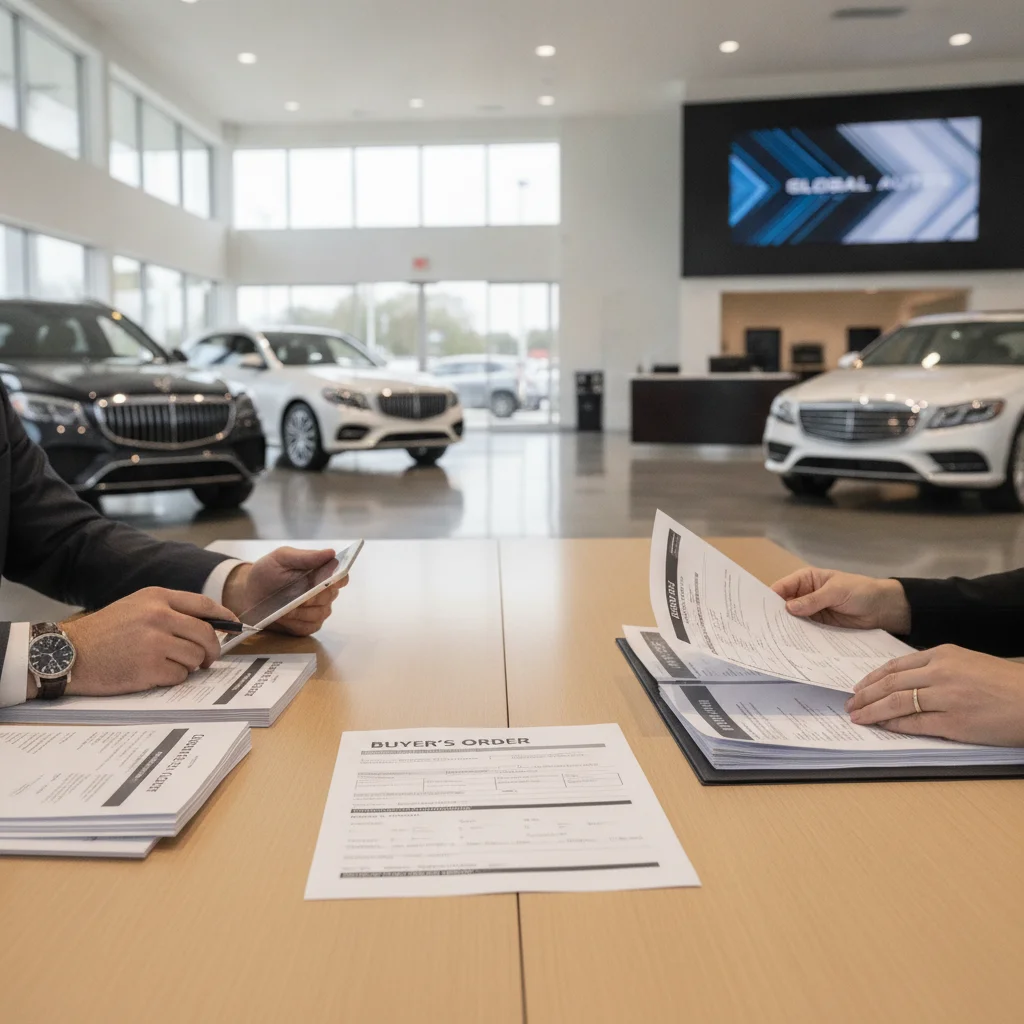
This is where most people make their biggest structural mistake: they let the dealer combine the trade-in, the new car price, and the financing into a single negotiation. The moment you're talking about "monthly payment" instead of individual line items, you've lost control of the math.
The Cardinal Rule: Negotiate Each Variable Separately
- Agree on the new car's out-the-door price first. Get the best possible number on the vehicle you're buying before your trade-in ever enters the conversation. Salespeople will push to mix them — "Let's just figure out what works for your budget" — but hold the line. Say: "I want to make sure we're aligned on the car price first, then we can talk about my trade."
- Then negotiate the trade-in as a standalone transaction. Once the purchase price is locked, introduce the trade-in. Present your research. Let the appraiser do their walk-around. Get their number.
- Evaluate financing separately. If you're financing, compare the dealer's rate against your own bank or credit union before the visit. Treat dealer financing as a separate negotiation — it often is a meaningful profit center for the dealer, and conflating it with the trade-in clouds both.
“Dealers don't lose sleep over a buyer who negotiates hard on the car price. They make their money when that same buyer accepts the first trade-in offer without question.”
— Marty Antonetti, Former franchise dealer general manager and automotive retail consultant
See our complete walkthrough of the dealership negotiation process for tactics that apply at every stage, from first inquiry through signing.
What to Say When They Push Back
If the salesperson insists on discussing everything together, a simple deflection works: "I get that — let's just nail down the car price so I know what we're working with, and then I'll share what I have on my trade." Say it once. If they won't move, that tells you something important about how this dealership operates.
Reading and Countering the Dealer's Offer
When the dealer comes back with their appraisal number, your first move is silence, not reaction. Don't say "Is that the best you can do?" and don't accept. Just look at the number and let a few seconds pass. Then ask: "How did you arrive at that number?"
A professional appraiser should be able to walk you through their reasoning: market comparables, condition deductions, mileage adjustments, any reconditioning they anticipate. If they can't explain it, that's useful information — the number may be a starting offer rather than a researched valuation.
Making Your Counter
Counter with your documented floor, not the top of your KBB range. If KBB trade-in shows $14,000–$16,500, and the dealer offers $12,800, come back at $15,500 — not $16,500. The gap you're asking them to close should feel reasonable. Anchoring too high just makes you look uninformed; anchoring at a credible, documented figure puts the burden on them to justify why they're below it.
Say something like: "Based on KBB's trade-in range and what I'm seeing similar cars listed for in this market, I was expecting something in the $15,000–$15,500 range. Here's what I'm looking at — can you help me understand the difference?"
Don't Accept Monthly-Payment Framing
If the dealer shifts the conversation to "what monthly payment works for you," redirect immediately. Monthly payment math obscures trade-in value, purchase price, and loan terms simultaneously. Agree on gross price and trade-in credit first, then calculate what the payment looks like — not the other way around.
Large Mechanical Repairs Rarely Pencil Out on Trade-Ins
Spending $2,500 on a transmission repair before trading in almost never recovers $2,500 in trade value. Dealers buy mechanical repairs at wholesale cost and apply conservative credit. Disclose major mechanical issues honestly, but don't invest in repairs specifically to improve your trade-in offer.
Watch for Last-Minute Trade-In Number Changes
A small number of dealers will reduce the trade-in credit between the verbal agreement and the final contract, counting on buyer fatigue at the end of a long negotiation. Always re-verify the trade-in line on the buyer's order before signing, regardless of how long the process has taken.
What Dealers Use to Justify Low Offers
- "The market has softened" — sometimes true, but verify. Pull market comps on your phone right there in the showroom.
- "We're going to put X into reconditioning" — a legitimate factor, but often inflated. Ask for the specific line items they anticipate.
- "Our lots are full right now" — may be real inventory pressure; it also may be a negotiating tactic. If they're not interested in your car, a competing offer forces the conversation.
- Condition downgrades — every appraiser will find something. Don't be defensive, but do note which deductions are legitimate versus pretextual.
Using Competing Offers as Leverage
Nothing changes a trade-in negotiation faster than a written competing offer. When you walk in with a CarMax instant cash offer, a Carvana quote, or an offer from another franchise dealer, you've converted the conversation from abstract to concrete. The dealer either meets or beats a real number, or they explain why they can't — and that explanation is usually illuminating.
Here's the practical sequence:
- Get your CarMax appraisal first — it takes about 30 minutes, it's free, it's valid for 7 days, and it's a firm written offer you can actually sell against.
- Get an online quote from Carvana and/or Vroom — these are instant and based on the info you provide, but they're still written offers you can show.
- If you have time, get appraised at a second franchised dealer for the same brand as the one you're buying from — competing dealerships within the same brand often bid aggressively for desirable trade inventory.
The strategy of using competing offers strategically is covered in detail in its own guide, but the headline rule is this: don't reveal the competing offers until after you have the dealer's initial appraisal in hand. If you lead with "CarMax offered me $14,500," you've told them their floor — and some dealers will simply match it to the dollar rather than improving on it.
Pull live market listings for your car on your phone before the appraisal conversation starts. When a dealer cites "market conditions," you can respond with actual current retail prices from their own market.
Real-time data closes the information gap dealers depend on. Seeing a seller reference live listings on a phone signals preparation and tends to shift the appraisal conversation toward honesty.
Get your CarMax appraisal on a weekday morning — appraisers tend to be less rushed, which means a more thorough evaluation that may credit your vehicle's positive features rather than just flagging negatives.
Appraisal quality varies with appraiser time and attention. A rushed Friday-afternoon appraisal at a busy location is more likely to default to conservative numbers.
Don't reveal that you have a trade-in until after you've agreed on the new car's out-the-door price. Mention it by saying, 'By the way, I do have a car to trade — let's talk about that once we're aligned on this one.'
Premature disclosure of a trade-in gives the dealer an additional variable to manipulate during new car price negotiation, often absorbing your trade equity into their margin on the purchase.
Also know that CarMax and Carvana offers are not always the ceiling. In hot used-car markets, franchise dealers often need specific inventory and will beat standalone car-buying services to get a desirable vehicle. Your job is to run the competition and let the market tell you what your car is actually worth.
Dealer Tactics That Erode Your Trade-In Value
Even well-prepared buyers lose value to tactics they don't recognize in the moment. The full rundown of dealer tactics that eat into your trade-in value is worth reading before your visit, but here are the most damaging ones in practice:
The Four-Square Method
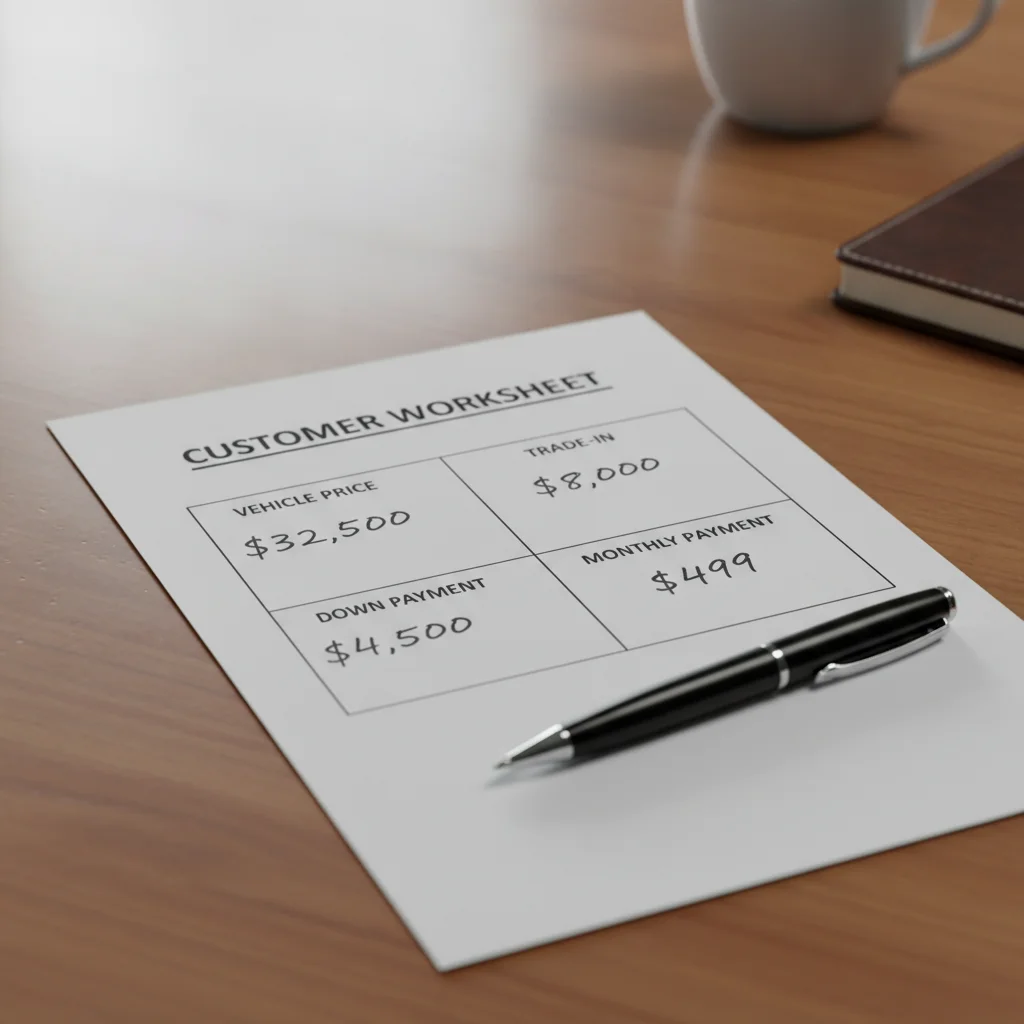
Many traditional dealers use a four-square worksheet that simultaneously tracks trade-in value, vehicle selling price, down payment, and monthly payment. The goal is to keep you focused on the monthly number while manipulating the other three. If your monthly payment goes up by $30 because they lowered your trade-in by $1,500, it's easy to miss — especially if you're also excited about the new car. Refuse to discuss monthly payments until trade-in and purchase price are settled.
"We'll Pay Off Your Loan"
If you're trading in a vehicle with an outstanding loan balance, dealers will sometimes emphasize "we'll handle your payoff" without being explicit about how it affects your trade equity. If you owe $10,000 and they're crediting $11,000, you have $1,000 equity. If they're crediting $9,500, you have negative equity that quietly rolls into your new loan — adding to your total cost.
Appraisal Timing Games
Some dealers hold your keys during the appraisal process — sometimes for 30–45 minutes — to increase your time investment and make walking away feel harder. Others will "lose" your trade in the system until late in the negotiation, then present the trade-in number alongside a signed purchase agreement, betting that you won't start over. Anticipate these moves, and don't let time pressure change your threshold.
Never Sign a Buyer's Order Before Trade-In Is Settled
Some F&I managers will ask you to sign the purchase agreement on the new vehicle while the trade-in is still "being appraised." Do not do this. Once you've signed the purchase contract, your leverage on the trade evaporates. Insist that both the purchase price and trade-in credit are confirmed and documented before any contract is signed.
Negative Equity Rolled into New Loans Is Extremely Costly
If you owe more on your trade-in than the dealer credits you for it, that negative equity doesn't disappear — it gets added to your new loan balance. On a five-year loan at 7% APR, an extra $2,000 in rolled-in negative equity costs you roughly $2,370 by payoff. Always know your exact payoff amount before any trade-in negotiation begins.
When to Walk Away — and What Happens Next
Walking away is not a bluff. It's a legitimate strategy, and it works more often than buyers expect. The full guide to walking away from a dealership covers the psychology and tactics in depth, but here's the trade-in-specific version:
If you've presented your documentation, made a credible counter, and the dealer won't move to within $500–$800 of your researched floor, it's time to leave. Not dramatically — just matter-of-factly. Something like: "I appreciate your time — I think I'm going to explore a few other options before I commit. Can I get your card?"
What Typically Happens
- Nothing: Sometimes the dealer genuinely can't or won't move. This happens — not every car is a fit for every dealership's inventory needs. If you've exhausted your competing offers and all dealers are within the same range, the market has spoken.
- A callback: In a significant number of cases, the sales manager calls or texts within 24–48 hours with an improved offer. Dealers have monthly and weekly volume targets, and a deal that almost happened is often worth another look with a fresh eye.
- A counter as you leave: Sometimes the best offer comes while you're walking to your car. This is the classic closer move — the manager appears at the door with a revised number. Listen to it, evaluate it against your floor, and make your decision without pressure.
The key is that walking away only works if you're genuinely willing to do it. If the car you're buying is only available at that dealership, your leverage decreases. If you can buy the same vehicle elsewhere, your leverage is real — and the dealer knows it.
Wholesale vs. Retail Value: Know the Difference
A dealer trade-in offer is a wholesale transaction — you're selling to a business that needs to profit on the resale. Wholesale prices are legitimately lower than private-party retail. The goal isn't to get retail value from a dealer; it's to get a fair wholesale price that reflects actual market demand for your vehicle.
State Tax Laws Can Affect Trade-In Math
In most U.S. states, trading in a vehicle at the dealership reduces your taxable purchase price — you pay sales tax only on the difference between the new car price and your trade-in credit. In some states, this "trade-in tax credit" can be worth several hundred dollars and changes the true net value comparison between a dealer trade-in and a private-party sale.
Online Instant Offers Are Estimates Until Inspection
Carvana, Vroom, and similar platforms generate offers based on self-reported vehicle information. The final price can change after physical inspection if condition differs from what was reported. CarMax appraisals, done in person, are firm offers — a meaningful distinction when you're using them as leverage in a dealer negotiation.
Closing the Deal: What to Verify Before You Sign
Once you've agreed on a trade-in number that meets your floor and a vehicle price that's in line with the market, the deal moves to finance and insurance (F&I). This is where many buyers let money slip away on the trade-in side by not verifying the final figures.
Check the Buyer's Order Line by Line
Before you sign anything, pull out the buyer's order — the itemized contract — and verify three specific things:
- The trade-in credit matches what was agreed. If you negotiated $14,200 for your trade, that exact number should appear on the contract as a credit. If it's $13,950 with a vague note about "adjusted condition," that's a problem you need to address before signing.
- The payoff figure is accurate. If you have a loan on the trade-in, the dealer should have obtained a 10-day payoff from your lender. Compare that number to your own payoff statement. Discrepancies of even a few hundred dollars matter.
- No surprise fees are tied to the trade. Some dealers add documentation or processing fees that weren't mentioned during negotiation. These are sometimes negotiable — at minimum, they should be disclosed before closing, not buried in the contract.
Bring Every Set of Keys You Have
Both key fobs, valet keys, and any spare keys should come with you to the appraisal. Dealers price missing keys at retail replacement cost and deduct it from your offer. Bringing everything you have eliminates that easy deduction.
Ask for the Appraisal in Writing Before Negotiating
Request that the appraiser write down their offer before any negotiation happens. A written number is harder to walk back than a verbal one, and it signals that you intend to treat this as a formal transaction with a paper trail.
Verify the Final Trade Credit on the Buyer's Order
Before you sign the purchase contract, locate the trade-in credit line on the buyer's order and confirm it matches what was verbally agreed. Discrepancies between verbal agreements and written contracts are more common than buyers realize and are easy to catch if you know to look.
Use the trade-in negotiation checklist to run a final verification pass before you finalize any deal. It takes ten minutes and can catch discrepancies that would otherwise cost you hundreds of dollars.
After you've verified the buyer's order, the F&I manager will present a menu of add-on products: extended warranties, paint protection, gap insurance, and so on. These are separate decisions from your trade-in deal — evaluate them on their own merits, not as a package. If you've successfully held your trade-in floor, don't give it back by buying products you don't need or understand.
Kelley Blue Book Trade-In Value Tool
KBB's trade-in range calculator gives you a low-to-high valuation window based on your vehicle's year, make, model, trim, mileage, and condition. Use it as your primary benchmark before any dealer visit.
CarMax Instant Offer
A free, in-person appraisal that produces a firm written offer valid for seven days. The most useful competing offer to bring into a dealer trade-in negotiation.
Edmunds True Market Value (TMV)
Edmunds TMV provides trade-in and private-party estimates that often differ from KBB — using both together gives you a tighter range and stronger documentation.
Trade-In Negotiation Checklist
A step-by-step verification checklist covering every phase of the trade-in process — from appraisal to buyer's order review — so you don't miss a detail at closing.
NADA Guides
NADA is the valuation source many dealers use internally. Knowing the NADA trade-in figure gives you visibility into the dealer's own reference point before negotiation starts.
OBD-II Code Reader
A basic plug-in OBD-II scanner (available at any auto parts store for $20–$40) lets you read check-engine codes before the appraisal — giving you a chance to address minor issues that would otherwise trigger dealer deductions.
The complete playbook for maximizing your car's trade-in value goes deeper on prep and pricing strategy if you want to extend your preparation beyond what's covered here. And if the dealer negotiation itself still feels uncertain, the dealer negotiation hub has targeted guides for every specific phase of that process.
The trade-in table is one of the most negotiable parts of any car deal — dealers expect pushback, and they price their initial offers accordingly. Show up with documented numbers, a clear floor, competing offers in hand, and the willingness to walk if the deal isn't there. That combination neutralizes the information asymmetry that dealers rely on, and it consistently produces better outcomes for prepared buyers.

All claims are backed by peer-reviewed research. Sources on request.