Key Takeaways
Why Timing Your Car Sale Is More Consequential Than Most Sellers Realize
Most sellers focus almost entirely on what to ask for their car. They research comparable listings, check Kelley Blue Book, maybe read a forum thread or two. What they underestimate is when to list — and that oversight can be worth thousands of dollars by the time all is said and done.
I've watched this play out in my own network more times than I can count. Someone decides they want to sell, spends two weeks detailing the car and fixing small stuff, then waits another month for a better market or a higher payoff balance — and by then, a competing model has flooded the listings in their zip code, the season has turned, or the new model year has hit dealer lots. Their ceiling just dropped $1,500 without them doing anything wrong.
The frustrating truth is that cars are depreciating assets in a market that moves in predictable cycles. Both of those facts work against a seller who treats timing as an afterthought. This article breaks down the specific mistakes that cost sellers real money — not hypothetically, but routinely — and gives you the practical guidance to avoid them.

If you're on the buying side and wondering how timing plays into your decisions, the timing your purchase hub covers the other half of this equation. For sellers, read on.
The Mistakes That Erode Your Sale Price While You Wait
These aren't obscure, edge-case errors. They're the exact patterns I see sellers fall into repeatedly, often while convincing themselves they're being strategic. Recognize any of these in your own plan, and adjust before it costs you.
Waiting until the car has a problem to sell it, instead of selling while it's still in peak condition.
Why it happens: Sellers often think "I'll get one more winter out of it" or defer the sale while dealing with other priorities. By the time a mechanical issue forces the decision, the car's condition story has changed.
Holding out for a price that the market stopped supporting months ago.
Why it happens: Sellers anchor to what a comparable car sold for six months or a year ago, or to what they paid originally. Markets shift, and private sellers often don't update their expectations to match current comparable listings.
Listing during the slowest seasonal demand window without adjusting price or expectations accordingly.
Why it happens: Sellers often list when they're personally ready — after the holidays, or when their new car arrives — without considering whether buyers are active in that period. Urgency on the seller's side doesn't create urgency on the buyer's side.
Ignoring the approaching new model year release and losing pricing power practically overnight.
Why it happens: Most private sellers don't track manufacturer release schedules. When the new model year arrives at dealerships, used versions of the previous year suddenly have a direct, financed competitor — and buyers notice immediately.
Letting the car accumulate unnecessary miles during the decision period.
Why it happens: Once someone decides to sell "soon," they sometimes still use the car for road trips or extended commutes that add thousands of miles before it ever gets listed. Every mile costs you money you didn't have to spend.
Waiting for local market inventory to thin, while your car continues to depreciate in the meantime.
Why it happens: Sellers spot a saturated local market and rationally decide to wait it out. But the holding period itself has a real cost — depreciation, potential mechanical issues, and additional miles — that often exceeds what they would have recovered from a thinner inventory environment.

Before you list, it's worth reviewing steps you can take before listing to slow perceived depreciation — small presentation choices that soften depreciation's impact on what buyers are willing to pay.
How Depreciation Compounds the Longer You Hold
Depreciation isn't a one-time event at purchase — it's a continuous bleed. And it doesn't move at a steady rate. The first one to three years are the sharpest, but there are secondary drop-off points that sellers often don't account for: crossing 60,000 miles, hitting the five-year mark, and — critically — the arrival of a new model year from the manufacturer.
~20%
Average first-year depreciation for new vehicles
According to Carfax and industry data, most new cars lose roughly 15–20% of their value in the first year alone, making early private sale timing critical.
$1,500–$3,000
Estimated value lost by crossing a new model year
Industry analysts at iSeeCars have documented that used car prices for outgoing model years typically drop $1,500 to $3,000 within weeks of new model year inventory reaching full availability.
11.4%
Average price premium for spring vs. winter listings
Data from CarGurus and similar platforms has consistently shown that used vehicle prices peak in spring months, with sellers fetching roughly 8–12% more than comparable winter listings.
$0.08–$0.12
Value lost per additional mile on private listings
Based on typical depreciation curves, most mid-range used vehicles lose between eight and twelve cents per mile in private sale negotiations once a car exceeds 40,000 miles.
That last one catches sellers off guard more than any other. You might have a 2023 model in excellent condition, but the moment 2025 inventory starts appearing at dealerships, your private listing is effectively competing against a brand-new version of the same car with financing incentives. That changes the conversation fast.
Understanding the ownership windows where depreciation slows can help you identify whether you're currently in a favorable holding position or approaching a cliff. For most vehicles, the sweet spot is somewhere between 36,000 and 55,000 miles — before powertrain warranties expire and before that next mileage psychological barrier kicks in with buyers.
Mileage Thresholds Are Real Buyer Psychology
Buyers think in round numbers. A car at 59,800 miles sits in a very different mental category than one at 61,200 — even if the mechanical difference is negligible. If your car is approaching 60,000, 75,000, or 100,000 miles, that's a hard deadline to list before you cross it. Once you're over, expect offers to reflect the buyer's perception of increased risk, whether or not that risk is real.
Don't Let a Loan Payoff Create a False Deadline
Some sellers wait until the loan is fully paid off before listing — assuming they need clean title in hand first. In most states, you can sell a car with an existing loan using lien release procedures at closing. Holding the car an extra 6–12 months to reach payoff could cost more in depreciation than you'd gain in flexibility. Verify your state's process with a title company or DMV before assuming you have to wait.
The model year timing piece deserves its own attention. Listing before a new model year drop is one of the highest-leverage moves a private seller can make — and most people simply don't think about it until it's too late.
Seasonal Demand: The Hidden Cycle Most Sellers Ignore
Used car demand is genuinely seasonal, and sellers who list in January without understanding that are fighting uphill. Here's the general pattern in most U.S. markets:
- February through April: Demand climbs as tax refund season puts cash in buyers' pockets. Strong seller market for most segments.
- May through July: Continued strength, especially for trucks, SUVs, and convertibles. Buyers are active and motivated.
- August through September: Mixed picture — back-to-school spending competes with car budgets. New model year deliveries begin hitting dealers, which softens used prices.
- October through January: Demand typically softens, especially in colder climates. Buyers become scarcer, listings sit longer, and price cuts follow.
This doesn't mean you can't sell in winter — plenty of people do. But it means your asking price and your timeline need to account for slower absorption. If you're sitting on a car in November hoping to get a spring price, the math doesn't add up.
The Cost of Waiting Is Guaranteed; the Benefit Isn't
Every month you hold a vehicle you intend to sell, you absorb measurable, guaranteed depreciation. The market upside you're hoping to capture — higher seasonal prices, thinner inventory, a better moment — is speculative. Make sure the potential gain you're waiting for is actually larger than the certain monthly cost of holding before you decide to delay. In most cases sellers run this math honestly, acting sooner wins.
There are exceptions to the seasonal pattern worth knowing. Four-wheel-drive trucks and SUVs often hold demand well into late fall in northern states. Convertibles are the inverse — you want to list those by August at the latest. Fuel-efficient sedans and hybrids get a bump any time gas prices spike, which can override seasonal trends entirely.
If you're weighing whether to act now or hold for a better seasonal window, short-term vs. long-term timing strategies lays out a clear framework for that decision.
Market Saturation and the Competing Listings Problem
Here's something most sellers don't monitor until they're already in the middle of a slow listing: the local inventory of cars just like theirs. When you're one of three F-150s listed in your metro area, you have leverage. When you're one of forty, you're in a race to the bottom on price.
Inventory conditions shift. Sometimes a major fleet auction dumps a category of vehicles into the private market. Sometimes a manufacturer runs aggressive lease deals that flood the used market with off-lease returns two or three years later. These are things you can track — and react to — if you're paying attention.
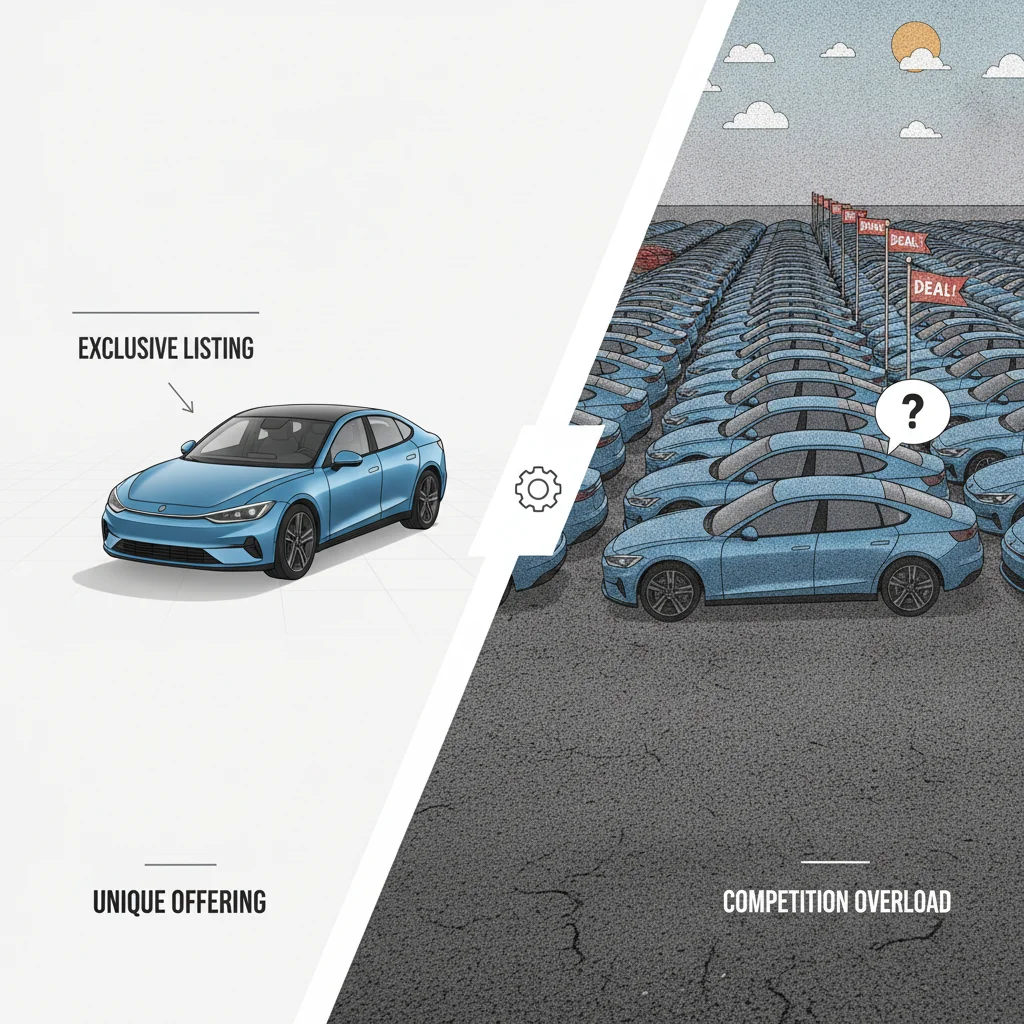
Before listing, spend 20 minutes on the major platforms searching your exact year, make, model, trim, and mileage range in your metro area. Count how many results come up. Then look at how long they've been listed and whether prices have been reduced. That tells you more about your real ceiling than any pricing guide alone.
If you find a saturated market, you have two choices: adjust your price to compete aggressively, or wait for inventory to thin out. But waiting has a carrying cost — every week you hold, the car ages, accumulates more miles, and depreciates further. Understanding how age, mileage, and condition compound that carrying cost is essential context for that decision.
Making the Call: When Good Enough Timing Beats Perfect Timing
Waiting for the ideal confluence of high seasonal demand, low local inventory, pre-new-model-year timing, and peak personal readiness is a real strategy — and it almost never fully materializes. Markets don't hold still. The longer you wait for perfect conditions, the more you give up in steady depreciation.
The practical approach is targeting good enough timing: a window where at least two or three favorable conditions align. Early spring with low local inventory. Late summer before new model year drops. A tax refund period when your specific vehicle type is in demand. That's the target.

Once you've identified that window, the preparation work matters just as much as the timing. Presenting your car well before listing can recover perceived value that otherwise gets negotiated away. And if you've recently paid off your loan, understanding how payoff timing aligns with market windows will help you avoid leaving flexibility on the table.
The bottom line: the sellers who consistently get strong prices aren't the ones who waited longest — they're the ones who acted decisively when conditions were reasonably favorable. Sitting on a depreciating asset while waiting for the stars to align is a strategy that quietly pays the buyer, not you.

All claims are backed by peer-reviewed research. Sources on request.