Key Takeaways
Odometer Fraud
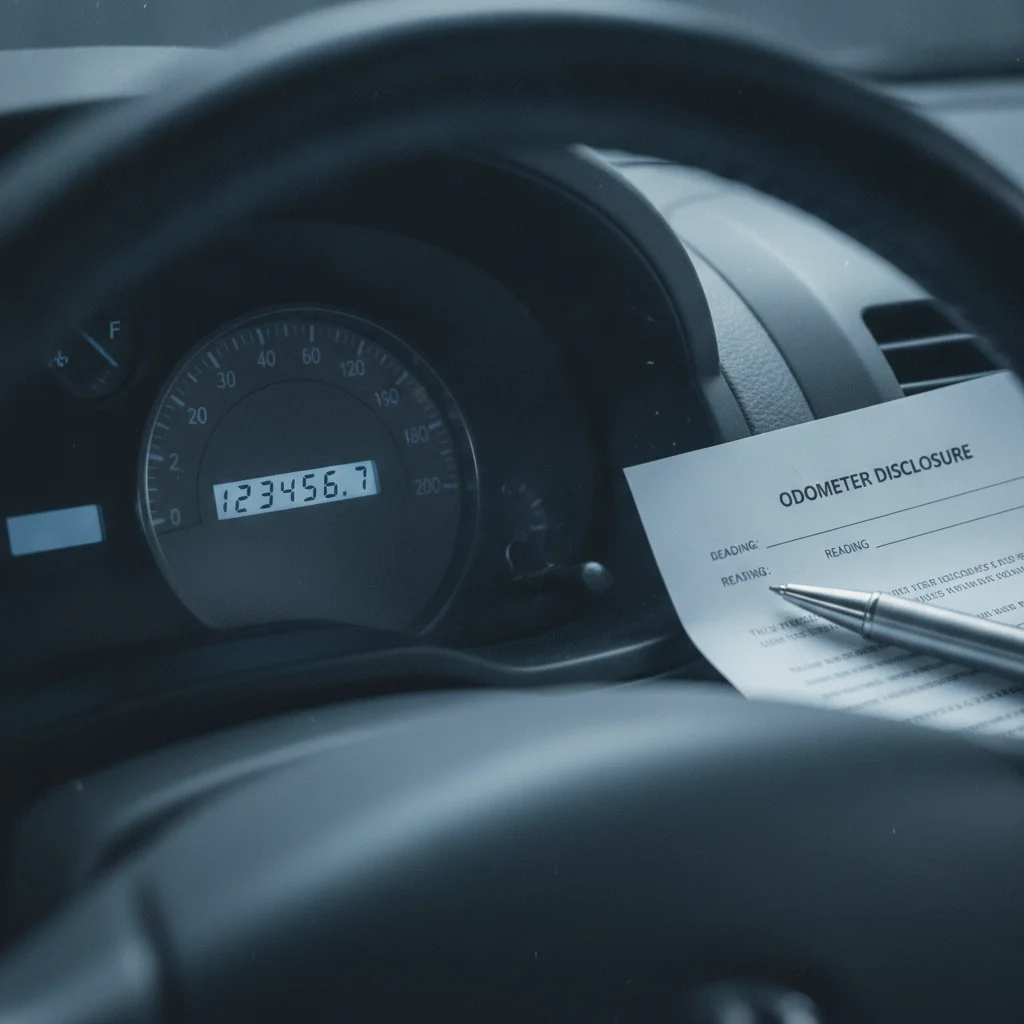
Odometer fraud occurs when someone knowingly falsifies a vehicle's recorded mileage — either by rolling back the odometer, misrepresenting it on paperwork, or tampering with disclosure forms. It is a federal crime under the Truth in Mileage Act (49 U.S.C. § 32701 et seq.) and can expose both sellers and private individuals to civil lawsuits and criminal penalties. The law applies to most motor vehicle transfers, not just dealer sales.
The statute covers 'transferors' broadly — meaning private sellers, dealers, fleet operators, and anyone else transferring title. Vehicles exempt from the disclosure requirement include those over 20 model years old, vehicles with a gross vehicle weight rating over 16,000 lbs, and new vehicles transferred to a dealer for resale.
The Federal Law Behind Odometer Disclosure
Most sellers know they're supposed to write the mileage somewhere on the title. Far fewer understand that this requirement comes from a federal statute with real teeth — the Truth in Mileage Act, codified at 49 U.S.C. §§ 32701–32711. Congress passed the law in 1986 specifically because odometer rollback had become a multi-billion-dollar consumer fraud problem. Rolling back a mechanical odometer took less than an hour with the right tool, and buyers had almost no way to detect it.
Today's digital odometers are harder to manipulate physically, but fraud persists through paperwork. Sellers misrepresent mileage on title forms, on bills of sale, and on verbal representations that contradict the car's documented history. The federal law addresses all of it by requiring a written, signed disclosure at the point of transfer.
The key provision, § 32705, says that before transferring ownership of a motor vehicle, the transferor — that's you as the seller — must disclose the odometer reading to the transferee in writing. This isn't a courtesy. It's a legal obligation backed by both civil and criminal penalties. See our breakdown of what the disclosure form is actually certifying for a closer look at what you're signing when you fill out that section of the title.
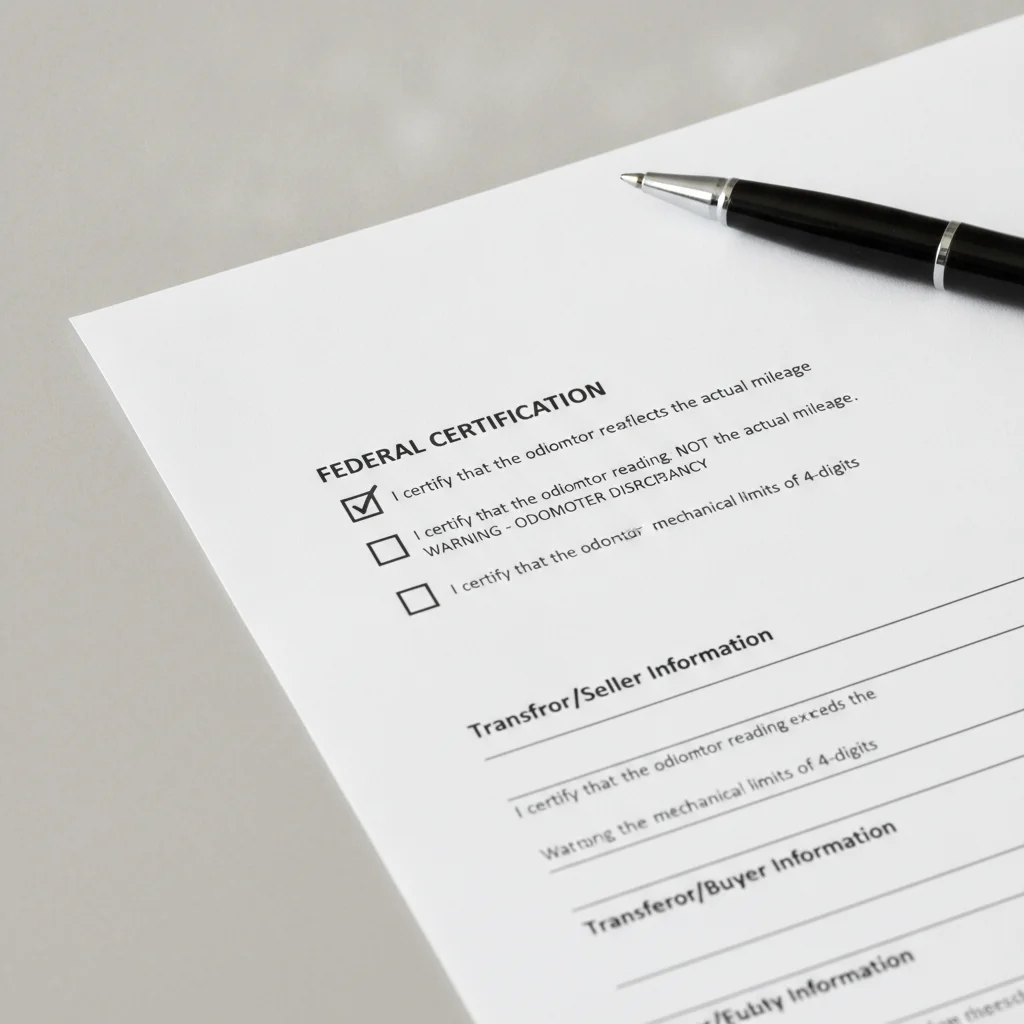
The three certification options on every disclosure form reflect the statute's structure:
- Actual mileage — the reading reflects the true accumulated mileage of the vehicle.
- Exceeds mechanical limits — the odometer has rolled over (typically past 99,999 or 999,999 miles), so the displayed number is lower than actual mileage.
- Not actual mileage — the reading is known or suspected to be inaccurate due to tampering or malfunction.
Choosing the wrong option — or leaving the box unchecked — is itself a violation. If you're unsure which box applies, you need to resolve that uncertainty before you sign, not after.
What Counts as Odometer Fraud — and Who It Traps
Most people picture odometer fraud as a crooked dealer spinning back a clunker's mileage before listing it. That version exists, but federal enforcement patterns show that a large share of odometer fraud cases involve ordinary private sellers — people who inherited a vehicle, bought and re-sold quickly, or simply didn't pay attention to what they were certifying.
~450,000
Vehicles sold with rolled-back odometers annually (U.S. estimate)
According to NHTSA estimates, odometer fraud costs American consumers approximately $1 billion per year in inflated vehicle prices.
$10,000
Minimum statutory damages per violation under federal law
Under 49 U.S.C. § 32710, a defrauded buyer is entitled to the greater of $10,000 or three times actual damages, plus attorney's fees.
3x
Treble damages multiplier on actual losses
Federal law allows buyers to recover three times their actual financial loss from odometer fraud — a powerful incentive for litigation.
20 years
Vehicle age threshold for federal disclosure exemption
Vehicles that are 20 or more model years old are exempt from the federal odometer disclosure requirement under NHTSA regulations.
The statute defines fraud broadly. Under § 32703, it's illegal for any person to:
- Disconnect, reset, alter, or replace a vehicle's odometer with intent to change the mileage reading.
- Operate a vehicle on a public street with knowledge that the odometer is nonfunctional.
- Conspire with any person to do either of the above.
Under § 32705, the written disclosure obligation adds a fourth category that's easier to trigger accidentally: certifying a mileage you know or should have known was incorrect. The phrase "should have known" is the one that catches sellers off guard. If your own service records, your prior registration documents, or a vehicle history report show a higher mileage than what you wrote on the title — and you had access to those records — a court may find that you knew or should have known the discrepancy existed.
When You Inherit a Title with a Mileage Discrepancy
If you purchased a vehicle and the title you received shows a mileage lower than what you know the car had at purchase, you're holding a compromised title. Before reselling, consider filing a title correction request with your state DMV and documenting the discrepancy in writing. Disclosing the problem proactively is both legally and ethically the right move — and it protects you from being held responsible for a prior owner's fraud.
Digital Odometers Are Not Fraud-Proof
Modern digital odometers can be reset using specialized scan tools available online for under $100. Vehicle history reports help detect rollbacks by comparing mileage readings across multiple title events and inspection records — but they only catch discrepancies when prior records exist. A vehicle that has been odometer-rolled between registration periods may not appear on a standard history report.
Private sellers sometimes inherit this problem from a prior owner. You buy a car at 120,000 miles, drive it for two years to 145,000, and then discover the title you received from the previous owner listed only 98,000 miles. When you go to sell the car, you're now in a chain of title that contains a prior mileage misrepresentation. That doesn't automatically make you a fraudster, but it does mean you need to disclose the discrepancy carefully and accurately. Check the "not actual mileage" box, note the discrepancy in writing, and consider adding a separate signed statement explaining what you know about the vehicle's history.
For a fuller picture of what you're legally and ethically required to share beyond mileage, see what to disclose to a private buyer even when it hurts your sale.
How the Disclosure Form Works in Practice
The mechanics of completing the odometer disclosure correctly are straightforward — but the details matter.
Where the disclosure goes
For most vehicles, the odometer disclosure lives directly on the face of the certificate of title. Your state DMV prints a dedicated section that includes space for the mileage reading, the three certification checkboxes, and signature lines for both transferor and transferee. You fill it out at the time of sale, not before and not after. Both parties sign.
If the title doesn't have space — for example, on an older title format or when a lien release creates complications — federal regulations allow a separate NHTSA-compliant odometer disclosure statement. This form must meet specific formatting requirements: it has to be signed by the seller, signed by the buyer to acknowledge receipt, and retained by the buyer. A handwritten note on a napkin doesn't qualify.
The timing requirement
Disclosure must happen before or at the moment of transfer. You can't hand over the keys, collect the money, and then mail a disclosure form later. The transaction and the disclosure are legally a single event. If you're selling remotely and mailing the title, the disclosure must be completed before the title leaves your hands.

What to write in the mileage field
Write the exact reading shown on the odometer at the time of sale — not an estimate, not a round number, and not what you think it should be. If your odometer reads 87,413, write 87,413. If it reads 87,413.7 on a tenths display, most states want only the whole-number portion, but verify your state's instructions. Round numbers like "87,000" invite scrutiny because they look estimated.
Record the Reading with a Timestamp
On the day of sale, photograph the odometer display with your phone. The photo embeds a timestamp and GPS location that can prove the mileage reading at the exact moment of transfer. This takes 10 seconds and gives you irrefutable documentation if a buyer later disputes what you disclosed.
Keep Copies of All Signed Disclosure Forms
Even if your state doesn't legally require you to retain a copy, keep one for at least three years after the sale. Scan it and store it digitally. If a buyer ever files a complaint, your signed copy of the completed disclosure is your first line of defense.
Correcting a mistake
If you catch an error before the buyer leaves, draw a single line through the mistake, write the correct information, and have both parties initial the correction. Do not use white-out or correction fluid — altered forms with obliterated text raise immediate fraud flags. If the title has already been transferred and you discover the error later, contact your state DMV and consult with an attorney before doing anything else.
State Law Requirements on Top of Federal Rules
Federal law sets the floor. States can — and do — build on top of it. Understanding your state's specific requirements matters because a form that satisfies federal law may still be insufficient under state rules.
Common state additions include:
- Notarization
- Some states require the seller's signature on the odometer disclosure to be notarized, particularly when the disclosure appears on a separate form rather than on the title itself.
- Duplicate form requirements
- Certain states require the seller to retain a copy of the completed disclosure form for a specified period — often one to three years — after the sale.
- Electronic titles (eTitles)
- If your state uses electronic titles held by the DMV rather than paper certificates, the odometer disclosure may be completed through a state web portal rather than on a physical document. The process differs, but the legal obligation is identical.
- Separate state forms
- A handful of states require their own state-specific odometer disclosure form in addition to the federal requirement, particularly for vehicles that change hands at auction or through dealer transactions.
For a state-by-state breakdown of private sale paperwork requirements including odometer disclosures, see private sale paperwork: a state-by-state overview. And because disclosure obligations extend beyond mileage, also review seller disclosure laws by state.
“The odometer is one of the most important factors consumers use to assess a vehicle's value. Ensuring that the information is accurate and disclosed in writing isn't a bureaucratic formality — it's the foundation of an honest transaction.”
— Carol Marchitto, Former NHTSA Odometer Fraud Program Coordinator
Your Civil and Criminal Liability as a Seller
This is the section most sellers skim past — and the one that costs them the most if something goes wrong.
Civil liability
Under 49 U.S.C. § 32710, any person who violates the odometer disclosure requirements with intent to defraud is liable to the buyer for the greater of:
- Three times the actual damages sustained, or
- $10,000
Plus reasonable attorney's fees and court costs. The phrase "with intent to defraud" sounds like it requires deliberate malice, but courts have found intent based on reckless disregard for the accuracy of the disclosed mileage. If you had service records showing higher mileage and didn't check them before signing, that can be enough.
On a vehicle sold for $12,000 where the undisclosed high mileage would have reduced the value by $4,000, three times actual damages is $12,000 — and the buyer may also recover their attorney's fees. The economics of fighting these claims often favor settlement even when sellers believe they did nothing wrong.
Criminal penalties
Intentional odometer tampering or knowing falsification of disclosure paperwork can be prosecuted as a federal crime under 49 U.S.C. § 32709. Penalties can reach up to three years imprisonment and fines up to $100,000 per violation for individuals. Organized rollback schemes involving multiple vehicles have resulted in multi-year federal sentences.
State fraud statutes add another layer. Many states have their own odometer fraud statutes that run parallel to federal law and carry independent criminal penalties. A single fraudulent transaction can trigger both federal and state prosecutions.
One practical protection: keep documentation. Hold onto your service records, your own purchase paperwork showing the mileage when you bought the car, and any inspection reports. If a buyer later claims you misrepresented mileage, contemporaneous documentation of the actual reading is your primary defense. The traffic laws hub has additional context on how federal vehicle regulations interact with state enforcement.
It's also worth understanding what "as-is" clauses do and don't protect you from. See the truth about as-is sales and seller liability — the short answer is that odometer fraud claims survive any as-is disclaimer.
A Practical Checklist Before You Sign the Title
Before you hand over a signed title, run through these steps. They take less than 15 minutes and can prevent claims that take years to resolve.
- Read the odometer on the day of sale — not the day before, not from memory. Walk out to the car and read it. Write down the exact number.
- Compare it to your most recent service record. The mileage on the disclosure form should be equal to or higher than the last documented service entry. If it's lower, stop and figure out why before proceeding.
- Pull a vehicle history report if you don't have complete service records. Reports from NMVTIS-participating providers reflect mileage readings from prior title transfers and inspections. A reading on the disclosure form that's lower than a prior DMV record is a red flag you need to address, not ignore.
- Check the correct box. Actual mileage, exceeds mechanical limits, or not actual mileage. If you're unsure, the "not actual mileage" box is the safest choice — it signals to the buyer that something is uncertain rather than certifying accuracy you can't confirm.
- Have the buyer sign the acknowledgment. The disclosure is a two-party transaction. Both seller and buyer must sign. Keep a copy for your records.
- Retain all paperwork for at least three years. Federal regulations require dealers to keep odometer disclosure records for five years. Private sellers have no mandated retention period under federal law, but keeping records until any dispute period has clearly passed is sound practice.

The disclosure form is one page. The federal statute behind it is nine pages. Taking five extra minutes at the point of sale to get this right is significantly cheaper than finding out what § 32710 costs in practice.

All claims are backed by peer-reviewed research. Sources on request.