

Key Takeaways
Odometer Disclosure Statement
An odometer disclosure statement is a federally required document in which the seller of a motor vehicle certifies the vehicle's current mileage at the time of sale. It confirms — under penalty of law — that the number on the odometer is accurate and has not been altered or tampered with. Both the buyer and seller must sign it for the transfer to be legally complete.
Required under the Truth in Mileage Act (49 U.S.C. § 32705), the disclosure is typically embedded in the vehicle title itself for transactions in most states, rather than existing as a separate form.
Why This Form Exists and What Law Backs It
Before the federal government stepped in, odometer fraud was rampant. Turning back a car's odometer — called "clocking" in some parts of the world — was a common enough scam that Congress passed the Motor Vehicle Information and Cost Savings Act in 1972, later consolidated into the Truth in Mileage Act. The goal was simple: give buyers a paper trail they could rely on, and give prosecutors a legal hook when sellers lied about mileage.
Today, the requirement lives in Title 49 of the U.S. Code, and the federal rules are enforced by the National Highway Traffic Safety Administration (NHTSA). The rules are clear: anyone transferring ownership of a motor vehicle must disclose the odometer reading in writing at the time of transfer. This means dealerships, private sellers, banks selling repossessed vehicles, estate executors selling inherited cars — essentially any entity handing off a title.
Federal Law Sets the Floor, Not the Ceiling
The Truth in Mileage Act establishes minimum odometer disclosure requirements that apply nationally. Individual states can — and some do — impose stricter requirements, such as mandating disclosure on older vehicles or requiring additional forms alongside the title. Always verify your specific state's DMV requirements before completing a sale, particularly in private party transactions.
Electronic Titles Follow the Same Rules
States using electronic lien and title (ELT) systems handle odometer disclosure digitally, but the legal obligations are identical. Sellers must still attest to a specific mileage reading and select the appropriate certification status. The format is paperless, but the federal requirements remain fully in force.
Buyer's Signature Is Not an Agreement of Accuracy
When you countersign an odometer disclosure as a buyer, you are acknowledging that you received the disclosure — not confirming that the mileage is correct. Your signature doesn't forfeit your right to pursue legal action if you later discover the reading was falsified. Keep your copy of the signed disclosure so you have documentation if a dispute arises.
The disclosure requirement applies to the transaction, not the vehicle type per se. If a transaction meets the criteria — a covered vehicle, a covered seller, and a buyer — the form is mandatory. Skipping it isn't a technicality you can fix after the fact; it's a legal deficiency in the sale itself.
Exactly What the Seller Is Certifying
The odometer disclosure statement asks the seller to certify three possible things, and only one can be true for any given vehicle:
- The mileage shown is the actual mileage of the vehicle. This is the standard certification — the odometer is functioning correctly and the reading is genuine.
- The mileage shown exceeds the odometer's mechanical limits. Older mechanical odometers often max out at 99,999 miles and then roll over to zero. If the vehicle has driven, say, 120,000 miles but the odometer reads 20,000, the seller must check this box and explain the discrepancy in writing.
- The odometer reading is not the actual mileage — WARNING: odometer discrepancy. This is for situations where the seller knows or has reason to believe the odometer has been tampered with, replaced without proper documentation, or is otherwise unreliable.
Notice what sellers are not certifying: they're not warranting the vehicle's condition, they're not guaranteeing the engine, and they're not promising anything about maintenance history. The disclosure is specifically and exclusively about the mileage number — nothing more, nothing less.
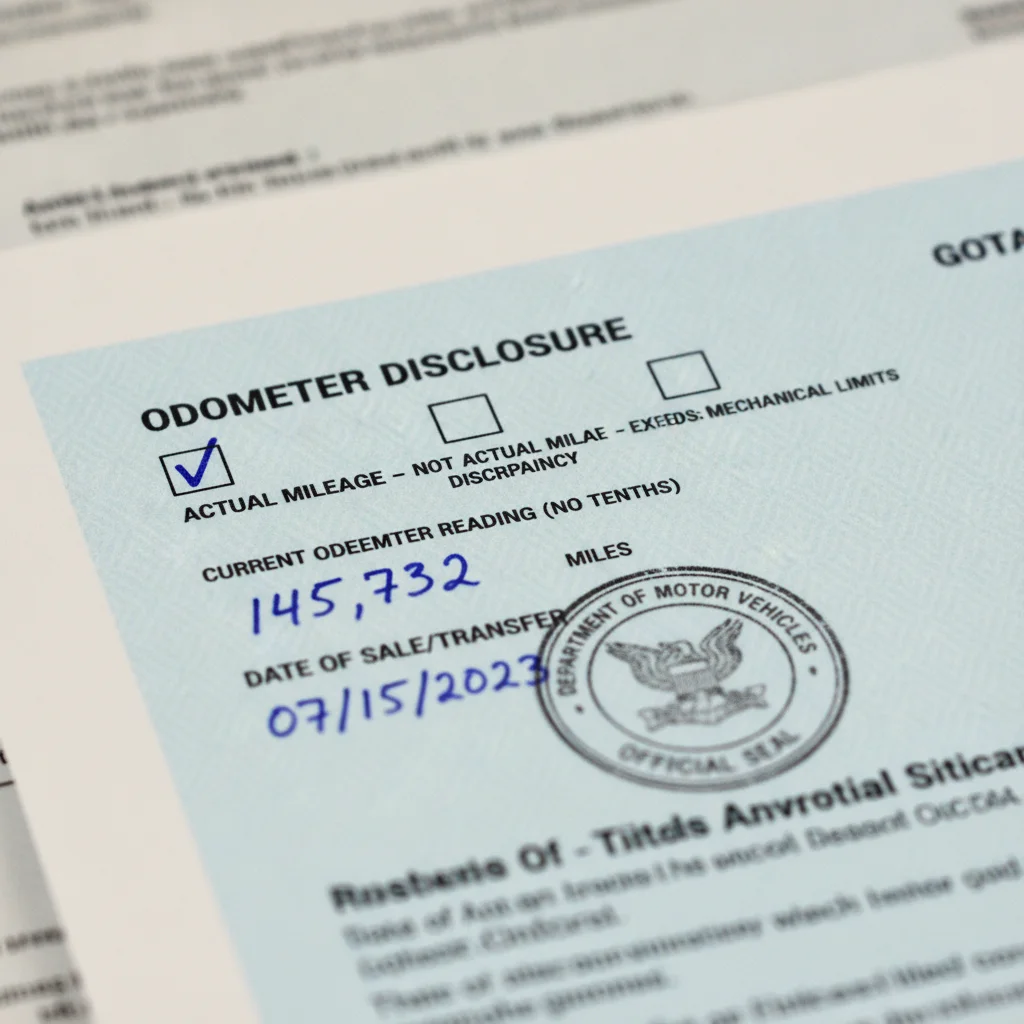
This distinction matters because buyers sometimes conflate the odometer disclosure with broader vehicle history transparency. It's a narrow document. For a fuller picture of what disclosures sellers are legally obligated to make, see what sellers are legally required to disclose beyond just the mileage reading.
~452,000
Vehicles with rolled-back odometers sold annually in the U.S.
According to NHTSA estimates, nearly half a million cars per year are sold with fraudulent odometer readings, costing buyers over $1 billion.
$10,000
Minimum statutory damages for odometer fraud
Under 49 U.S.C. § 32710, defrauded buyers are entitled to the greater of three times actual damages or $10,000, whichever is higher.
10 years
Vehicle age threshold for federal exemption
Federal regulations exempt vehicles that are 10 or more model years old from the mandatory odometer disclosure requirement.
3 years
Maximum federal prison term per count
Under the federal odometer fraud statute, each knowing violation can result in up to three years of imprisonment in addition to civil penalties.
Who Signs It and When
Both parties have a role, and both signatures are required for the disclosure to be legally complete.
The Seller's Role
The seller fills in the odometer reading, selects the appropriate certification box, signs, prints their name, and dates the document. If the seller is a business — a dealership, fleet company, or lending institution — an authorized representative signs on behalf of the entity. Importantly, the seller must record the mileage at the time of transfer, not the mileage from a recent service visit or a prior inspection. The number needs to reflect the odometer at the moment ownership changes hands.
The Buyer's Role
The buyer signs to acknowledge receipt of the disclosure — not to agree that the mileage is accurate, but to confirm they've seen and received the information. This is a meaningful distinction. Signing as a buyer doesn't waive your right to dispute the mileage later if evidence emerges that it was falsified.
Timing Matters
The disclosure must happen at the time of transfer. A seller cannot hand over a car on Friday and mail the disclosure on Monday. Courts have interpreted this strictly, and after-the-fact paperwork can create legal exposure for sellers. Every document you'll sign at a dealership should be completed before keys change hands — the odometer disclosure is no exception.
Complete the Disclosure Before Handing Over Keys
The federal rule says disclosure must happen 'at the time of transfer.' In practice, this means completing and signing the odometer section before the buyer takes possession of the vehicle. Don't treat it as an afterthought to be mailed or texted later — doing so can invalidate the transfer documentation and create legal headaches for both parties.
Cross-Check with a Vehicle History Report Before Signing
Run a Carfax or AutoCheck report before you sign the odometer disclosure as a buyer. If the reported mileage from prior service records or title transfers doesn't align with what the seller is disclosing, ask for an explanation in writing before proceeding. An inconsistency caught before signing is far easier to resolve than one discovered afterward.
Where to Find It: Title Integration vs. Separate Forms
This is where buyers often get confused: the odometer disclosure statement doesn't always look like a standalone form. In most states, it's built directly into the vehicle title certificate. Look on the back of the title for a section that says something like "Odometer Disclosure" — you'll see spaces for the mileage reading, the certification checkboxes, and signature lines for both seller and buyer.
In states that use electronic lien and title (ELT) systems, the process may be handled digitally, but the same fields and certifications apply. The seller still attests to mileage; the buyer still acknowledges receipt.
Some scenarios — particularly older titles, out-of-state transfers, or situations where the original title doesn't have adequate space — require a separate physical disclosure form. NHTSA's regulations specify the required language and format for these standalone forms. A dealership's finance office will typically have them on hand; private sellers may need to download one from their state DMV website.
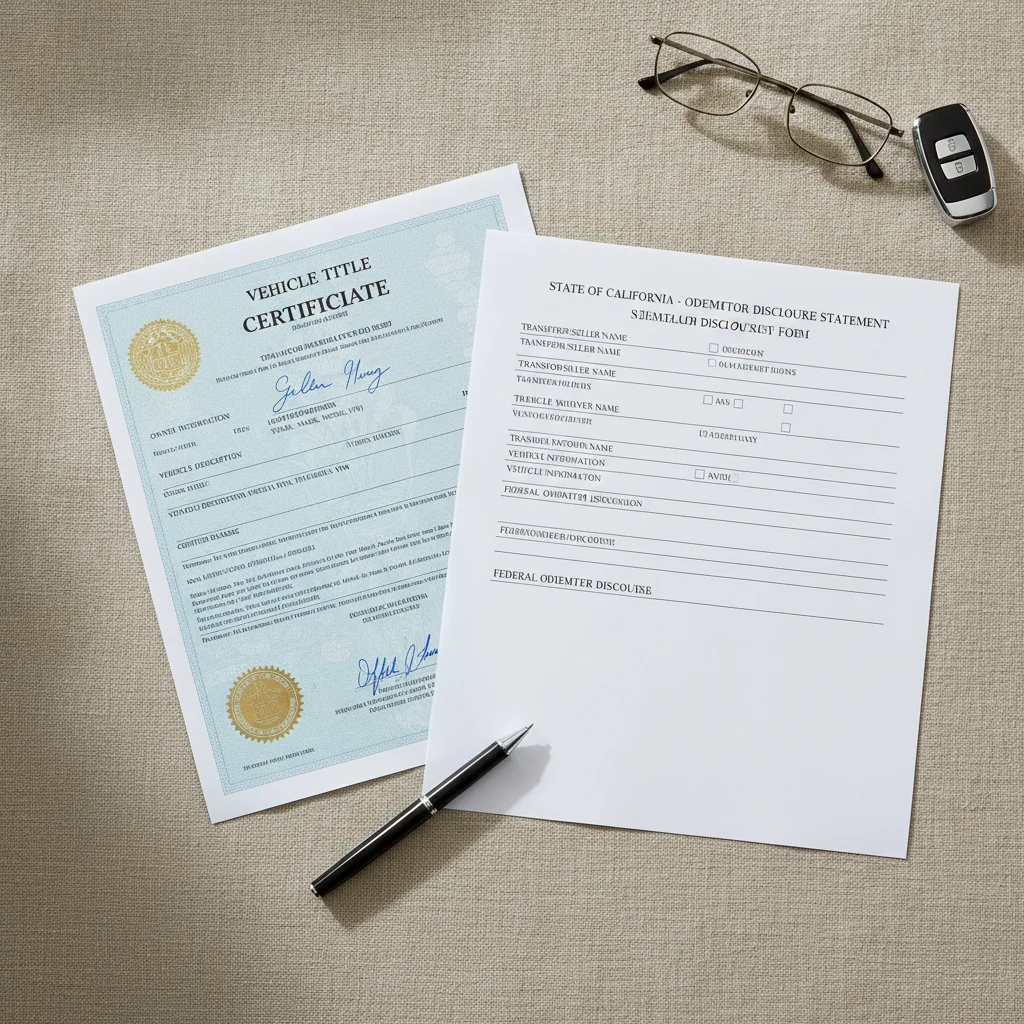
For private party transactions specifically, private sale paperwork requirements vary by state, and some states impose additional mileage disclosure rules beyond the federal baseline. Always check your state's DMV requirements before completing a private sale.
Federal Law Sets the Floor, Not the Ceiling
The Truth in Mileage Act establishes minimum odometer disclosure requirements that apply nationally. Individual states can — and some do — impose stricter requirements, such as mandating disclosure on older vehicles or requiring additional forms alongside the title. Always verify your specific state's DMV requirements before completing a sale, particularly in private party transactions.
Electronic Titles Follow the Same Rules
States using electronic lien and title (ELT) systems handle odometer disclosure digitally, but the legal obligations are identical. Sellers must still attest to a specific mileage reading and select the appropriate certification status. The format is paperless, but the federal requirements remain fully in force.
Buyer's Signature Is Not an Agreement of Accuracy
When you countersign an odometer disclosure as a buyer, you are acknowledging that you received the disclosure — not confirming that the mileage is correct. Your signature doesn't forfeit your right to pursue legal action if you later discover the reading was falsified. Keep your copy of the signed disclosure so you have documentation if a dispute arises.
Exemptions: When the Requirement Doesn't Apply
The federal odometer disclosure requirement doesn't cover every vehicle sale. The main exemptions are:
- Vehicles 10 or more model years old. The federal threshold is based on model year, not calendar year. As of 2025, vehicles from model year 2015 and earlier are exempt. The rationale is that high mileage is expected on older vehicles and the disclosure adds less informational value.
- Heavy vehicles over 16,000 lbs. gross vehicle weight rating (GVWR). Large commercial trucks, buses, and similar heavy-duty vehicles are excluded from the requirement.
- Vehicles sold directly to dealers for resale. Auction-to-dealer transfers and dealer-to-dealer wholesale transactions may have different documentation standards, though dealers must still disclose when selling to an end consumer.
- Vehicles transferred by court order. Certain legally mandated transfers may be exempt, though specifics depend on jurisdiction.
One important caveat: state law can be stricter than federal law. Some states require odometer disclosure on vehicles older than the federal cutoff, or apply the requirement to heavier vehicles. The federal rule sets a floor, not a ceiling.
What Happens When the Disclosure Is Wrong
This is where the stakes get serious. Under federal law, a person who knowingly gives a false odometer disclosure — or conspires to do so — faces both civil and criminal consequences.
Civil Liability
A defrauded buyer can sue for the greater of:
- Three times the actual damages suffered, or
- $10,000
Plus attorney's fees. This means a seller who rolled back an odometer by 40,000 miles to inflate a car's value by $4,000 could be looking at a $12,000 judgment — plus paying the buyer's lawyer. The federal statute of limitations for civil odometer fraud claims is two years from the date the buyer discovered or should have discovered the fraud.
Criminal Penalties
Odometer fraud is a federal crime. Convictions can carry up to three years in prison per count, plus substantial fines. State laws may stack additional penalties on top. Law enforcement takes these cases seriously because odometer fraud harms not just individual buyers but the broader used car market's integrity.
For sellers wanting to understand their full legal exposure, federal odometer disclosure law and seller liability covers the specific risk landscape in detail.
“Odometer fraud is not a victimless crime. It directly harms consumers by stripping them of accurate information they need to make a fair purchase — and it undermines confidence in the used-car market as a whole.”
— NHTSA Office of Odometer Fraud Investigation, Federal agency responsible for odometer fraud enforcement
How Buyers Can Verify the Disclosed Mileage
Signing an odometer disclosure statement gives you a legal baseline — but it doesn't mean the number is automatically trustworthy. Here's how to cross-check what the form says before you commit:
Pull a Vehicle History Report
Services like Carfax and AutoCheck aggregate odometer readings from state title transfers, insurance claims, service records, and inspection reports. If a disclosure says 62,000 miles but a report shows the car had 78,000 miles at a smog check two years ago, you have a serious discrepancy on your hands.
Check for Consistent Records
Ask the seller for maintenance records. Oil change stickers on the door jamb, dated service invoices, and inspection reports all capture mileage at a specific point in time. A coherent mileage timeline — where numbers go up consistently over time — is a good sign. Gaps or sudden drops are red flags.
Inspect the Odometer Physically
Have a mechanic check that the odometer cluster shows no signs of tampering — misaligned numbers, replaced components, or broken seals around the instrument cluster. These are physical evidence that the reading may have been manipulated.
Understanding the disclosure is one piece of the puzzle. what odometer readings actually tell you about a car's condition explains what those numbers mean for wear, value, and how to interpret high versus low mileage in context.
Complete the Disclosure Before Handing Over Keys
The federal rule says disclosure must happen 'at the time of transfer.' In practice, this means completing and signing the odometer section before the buyer takes possession of the vehicle. Don't treat it as an afterthought to be mailed or texted later — doing so can invalidate the transfer documentation and create legal headaches for both parties.
Cross-Check with a Vehicle History Report Before Signing
Run a Carfax or AutoCheck report before you sign the odometer disclosure as a buyer. If the reported mileage from prior service records or title transfers doesn't align with what the seller is disclosing, ask for an explanation in writing before proceeding. An inconsistency caught before signing is far easier to resolve than one discovered afterward.

Practical Steps: Making Sure the Disclosure Is Done Right
Whether you're buying or selling, here's how to handle the odometer disclosure correctly every time:
If You're the Seller
- Record the odometer reading on the day of transfer — not days before or after.
- Select the correct certification box honestly. If you have any doubt about the odometer's accuracy, disclose the discrepancy rather than certifying accuracy you can't guarantee.
- Sign and date legibly. Illegible signatures have caused title rejection at DMV offices.
- Keep a copy of the completed disclosure for your records. If a dispute arises later, your copy is evidence.
If You're the Buyer
- Don't sign a blank or incomplete disclosure form. The mileage field must be filled in before you sign.
- Compare the disclosed mileage against the vehicle history report you've already pulled.
- Keep your signed copy of the disclosure. It's your evidence in any future dispute.
- If the seller seems reluctant to provide the disclosure, treat that hesitation as a serious warning sign.
Federal Law Sets the Floor, Not the Ceiling
The Truth in Mileage Act establishes minimum odometer disclosure requirements that apply nationally. Individual states can — and some do — impose stricter requirements, such as mandating disclosure on older vehicles or requiring additional forms alongside the title. Always verify your specific state's DMV requirements before completing a sale, particularly in private party transactions.
Electronic Titles Follow the Same Rules
States using electronic lien and title (ELT) systems handle odometer disclosure digitally, but the legal obligations are identical. Sellers must still attest to a specific mileage reading and select the appropriate certification status. The format is paperless, but the federal requirements remain fully in force.
Buyer's Signature Is Not an Agreement of Accuracy
When you countersign an odometer disclosure as a buyer, you are acknowledging that you received the disclosure — not confirming that the mileage is correct. Your signature doesn't forfeit your right to pursue legal action if you later discover the reading was falsified. Keep your copy of the signed disclosure so you have documentation if a dispute arises.
The odometer disclosure statement is a small box on a larger form, but the legal weight behind it is substantial. Treat it with the same attention you'd give to any financial contract — because that's exactly what it is.

All claims are backed by peer-reviewed research. Sources on request.